Recently, I wrote a novel about the Buddha’s wife disguising herself as a man to join his religious community. When I showed the manuscript to a Buddhist friend, whose knowledge and practice I respect greatly, he expressed apprehension that it violated the basic myth of Buddhism. I assumed he meant that my storyline of gender deception strays too far from the versions of the Buddha’s life as recorded in the traditional canon, which adherents regard as the Buddha’s inviolable teachings. The last thing I wanted to do was to misrepresent these teachings.
What does it mean “to violate a myth”? If I had portrayed the Buddha as a psycho-killer or wife-beater, I could appreciate this charge, but I had presented an enlightened Buddha whose values were in alignment with standard scripture and the mores of his day. The change I made was to tell the story from a woman’s point of view, and to do so, I modified some of the traditional legends and created new material to make my choices plausible. Predictably, my modifications came up against many of the stories’ misogynistic elements.
For instance, in the canon, the Buddha initially refuses to admit women to the monastic order. Eventually his attendant Ananda persuades him, but then the Buddha adds 104 extra rules for nuns, eight of which (the Garudammas) clearly put women in an inferior position. One rule states: “A nun who has been ordained even for a hundred years must greet respectfully, rise up from her seat, salute with joined palms, do proper homage to a monk ordained but that day.” The Buddha also told Ananda that thanks to the admission of women, the Dharma (the teachings and practices of Buddhism) would die out after only 500 years.
Your ex-boyfriend gave you a solid brass Buddha, one foot high. You hate to think what he had to pay for it. Not knowing what else to do with it, you place it on your bookcase. You must admit that it’s a beautiful object, that it inspires a certain peace. But it leaves you cold, just like the crucifix hanging in your parents’ bedroom always left you cold.
Your ex-boyfriend gave you a solid brass Buddha, one foot high. You hate to think what he had to pay for it. Not knowing what else to do with it, you place it on your bookcase. You must admit that it’s a beautiful object, that it inspires a certain peace. But it leaves you cold, just like the crucifix hanging in your parents’ bedroom always left you cold. Only when you sit in your dead grandmother’s chair and rock yourself into a trance can you reach your world of wonder, that green and gold place where May sunshine washes through newly unfurled birch leaves, where shadow and light dance on the white bark you peel off like onionskin. Long ago, you think, people worshipped their ancestors.
You wake up to cold and gray, to a day so drab that it hurts like a permanent migraine. On the bus ride to the office, the commuters in their career clothes are scrying into their phones. No free seats so you grab the handrail and gaze out the window. Instead of city buildings and dirty snow, you see an old farmhouse at the edge of an apple orchard. A gaggle of geese guards that house. They rush towards you, flapping their wings and hissing. But you walk resolutely on until you reach the veranda, and then the front door, propped open by a pair of gardening shoes. Stepping into the hall, you breathe in the mixture of baking bread and boiled coffee. A woman comes to you, a woman like your grandmother, but older. Her thin silver hair reaches her knees. Her face is so wrinkled, you can hardly see where her glittering eyes end and her crow’s feet begin.
Cocking her head, she says, “What took you so long?” And taking your hand, she marches you into her kitchen where a cat sleeps on the windowsill. She sits you down and serves you elderflower wine in an old jam jar. You take one sip and the kitchen reels around you.
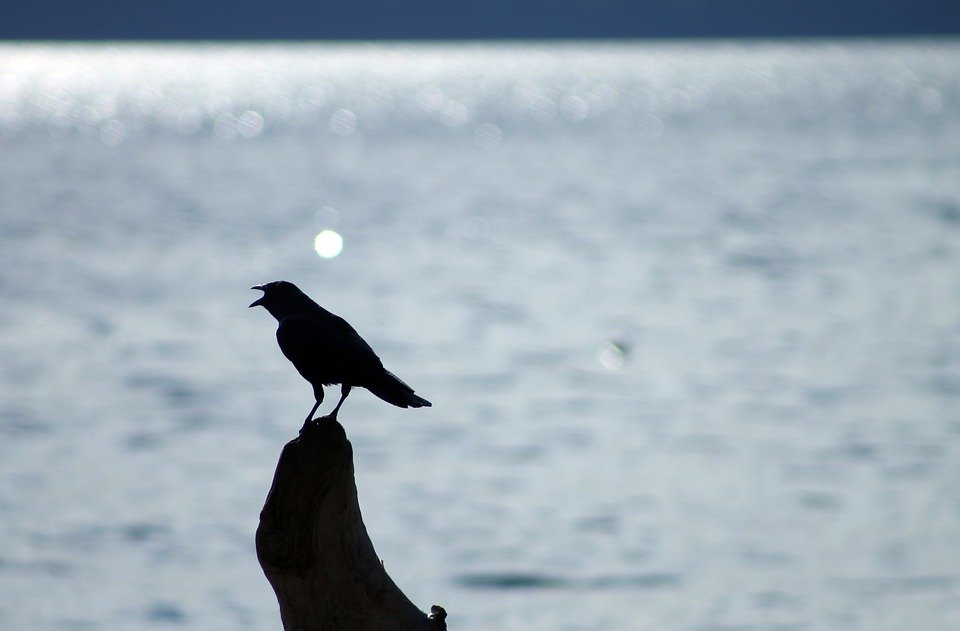
You hear a rushing sound, a pounding, and then you are alone on a beach holding a piece of driftwood shaped like a goose in flight. A strange new weight pulls at your shoulder blades. Craning your neck to investigate, you see the wings sprouting there, blue-black crow wings. Of their own volition, they stretch and flap until you are airborne. Heading out over the waves, the tips of your bare toes graze the water.
“You dream too much,” your ex informs you. “You live on another planet. When’s the last time you watched the news? When’s the last time you voted? You can’t just spend your whole life with your head in the sand.”
Your ex is an activist. He majored in queer theory. He worked on Bernie Sander’s election campaign. He buys everything organic and volunteers one day a month at the soup kitchen. You are humbled by his social engagement, but when he sends you links to articles and videos overflowing with the world’s misery, the weight is too heavy for you to bear. You find yourself wondering how many homeless people he could have fed for the price of that solid brass Buddha.
Your grandmother lived until she was ninety-nine. She quarreled bitterly with everyone who came to visit and expressed concern about the farm falling into disrepair around her. She told them she just wanted to be left in peace. Then one day she died of a stroke while chopping wood on that old farm where she had lived alone for fifty-six years. She died instantly—no lingering pain, hospital gowns, or stench of bedpans or disinfectant. That’s how it is on your mother’s side of the family—the women are widowed early and seem to live forever until the day they suddenly drop dead.
After her death, her children sold her farm to a developer, who tore down her Victorian house to build rows and rows of condos. They left only three of her apple trees standing. Those trees are as old and gnarled as she was when she died. Like old women, they no longer bear fruit but stand and bear witness to what once was, but is no longer.
You pack the brass Buddha away in old newspapers, stick it in a cardboard box. You’ve decided to donate it to a drug rehabilitation center. Maybe it will bring the people there peace and clarity. Then you brew a pot of tea and sit in the rocking chair, huddled in an afghan your grandmother crocheted before you were born. You close your eyes and you are far out over the ocean, sometimes floating, sometimes flying. A blast of salt wind fills your shiny black wings, lifting you even higher. Opening your beak wide, you cackle and caw.
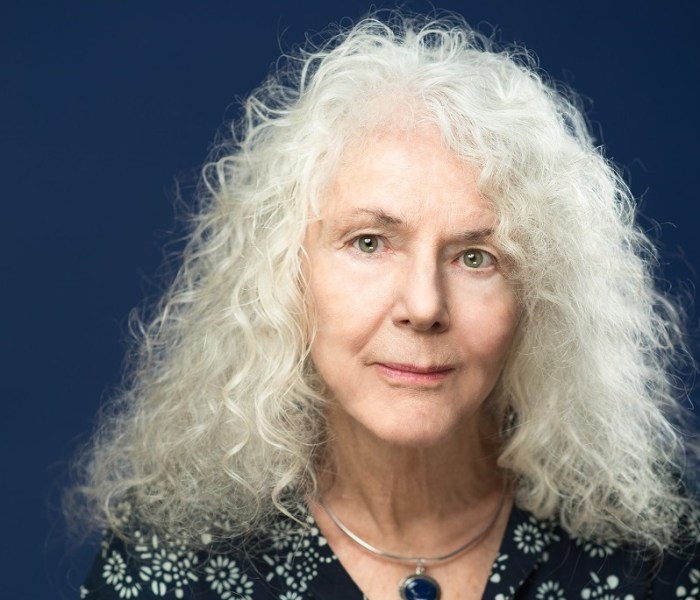
Mary Sharratt is committed to telling women’s stories. If you enjoyed this short piece, please check out her acclaimed novel Illuminations, drawn from the dramatic life of Hildegard von Bingen, and her new novelRevelations, about the mystical pilgrim Margery Kempe and her friendship with Julian of Norwich. Visit her website.
Moderator’s note: This marvelous FAR site has been running for 10 years and has had more than 3,600 posts in that time. There are so many treasures that have been posted in this decade. They tend to get lost in the archives. We are beginning this column so that we can all revisit some of these gems. Today’s blogpost was originally posted October 1, 2017. You can visit it here to see the original comments.This post is the 3rd and final of a series which has been posted for the past 2 days. They were curated by Barbara Ardinger to stand together for their relevancy, now, 5 years later.
Members of this community (and others) have been feeling that the world is out of balance since the 2016 election. There’s a feeling that people are becoming less kind and that some men (following the model that lives and tweets in the White House when he’s not at one of his golf resorts) are more misogynistic. I’ve heard that Orwell’s novel Nineteen Eight-Four is more popular than ever before. We seem to be living in a new dystopia. It’s very sad and very scary.
I’ve recently reread three novels written by women that I think may be both prophetic and inspiring. I’m hoping that if you read them, too, you’ll inspired by their brave heras to keep on resisting. The novels are Gibbon’s Decline and Fall (1996) by Sheri S. Tepper, Woman on the Edge of Time (1976) by Marge Piercy, and The Fifth Sacred Thing (1993) by Starhawk.
Starhawk (Miriam Simos) was probably the most famous “out” witch in the last quarter of the 20th century. Her book The Spiral Dance (1979) introduced uncountable numbers of people to the Goddess, Paganism, and Witchcraft. Nowadays, she’s teaching “Regenerative Culture, Earth-based spirituality, and Permaculture.” She is no doubt working up to the Uprising described in The Fifth Sacred Thing that separated northern and southern California—a generally bucolic San Francisco filled with Pagans and an eclectic mix of every other religion with free healthcare for all and a City of Angels (Los Angeles) filled with Stewards, ruins, and sex slaves.
The Fifth Sacred Thing opens in 2048 with Maya, a 98-year-old Orthodox (sic.!) Pagan climbing a mountain. At the Lammas (August 1) ritual, she tells how the Uprising began. Global warming has happened, and during the drought of 2028, four old women (remember Tepper’s bag ladies?) went with pickaxes to a major thoroughfare in San Francisco, dug up the pavement, and planted seeds in the earth. The Uprising was led by people who had participated in the Summer of Love (1967) and demonstrated against the Vietnam War.
In the next chapter we begin to meet the Stewards, who in 2028 canceled the elections and took control. Now “the Corporation,” which banished women from every profession but the oldest one, owns the Southlands and apparently most of the U.S. Although Starhawk wrote this novel in 1993, the Stewards look like Trump’s cabinet and true believers exponentially multiplied. The Steward are allied with the Millennialists, who have suppressed every religion but their own and whose Creed reads in part, “…we abhor the earth, the Devil’s playground, and the flesh, Satan’s instrument. We abhor the false…gods…who tempt us to wallow in the worship of demons, whether they be called Goddesses, Saints, Lucifer, or the so-called Virgin Mary. For we know that Our Lord never lowered Himself to take on loathly flesh….” Maya’s grandson, Bird, has been their prisoner for ten years. He’s been drugged (like Connie), but now he’s beginning to feel his magical powers returning.
Another protagonist is Madrone, a healer and midwife. As we read through a long Council meeting (they’ve got Councils for everything), we see the similarities between San Francisco is 2048 and Piercy’s free future of 2137. The values are much the same, although Starhawk’s future is determinedly Pagan and Witchy (and very PC). Madrone has lost a patient to a mysterious fever that morning. In the council meeting, one character says they’re still living in the “toxic stew” of pollution in the Bay. Is this fever becoming an epidemic? Is it biological warfare?
Bird summons the best magic he can and escapes with two other prisoners. As he travels up the California coast, sometimes along what was once the Pacific Coast Highway, sometimes along what was Interstate 5, he learns what happened to him ten years ago. When he and some other Witches destroyed an atomic reactor (probably in Santa Barbara County), his friends were killed by the Stewards and he was captured. Now he’s regaining his memory and his powers as he’s meeting other outlaws.
When Bird arrives in San Francisco, not much has changed: there’s still a lot of free love and arguing and they all still work collectively. Madrone recently went into “the ch’i worlds” to search for the virus, caught it, and almost died, but now she’s mostly recovered. They hold a meeting in which they discuss nonviolent resistance. After much argument about how best to resist, Madrone finally decides to travel south to find out if the Stewards are really planning an invasion. As she retraces Bird’s trail and meets the people who helped him, she gives them free healings and teaches them Witchy powers. The book thus turns into what is essentially a handbook of resistance and Witchy powers. When Madrone goes to Hollywood to take part in raid on a drug warehouse, we learn that in the Southlands only the rich have water, medicine, fresh vegetables, cars, access to education, healthcare, and any kind of technology (which is mostly built by prisoners).
Yes, there is a war in this novel. Just think of any superhero-action-adventure movie and add Nazis, and you’re seeing it. The Stewards’ army invades San Francisco, and nonviolent resistance seems to wither under bullets. Although she finds pockets of rebellion and resistance, Madrone nearly dies in Los Angeles. She finally gets home and learns that Bird has been captured again. But the Witches are also learning how to get soldiers to desert.
The novel has a sort of happy ending. Is it prophetic? I hope not! I live in the Southlands. But anyone who is paying attention to the daily news sees that we’re already on the path to a world run by the Stewards and the Millennialists. Starhawk has written a sequel, City of Refuge (2015), around the three major characters to tell what happens next in the North and the Southlands. I have not read the new novel.
But I know that Witches can prophesy. And so can writers, and so we have in these three novels four protagonists—Carolyn Crespin, Consuelo Ramos, and Maya and Madrona—who can teach us a great deal about resistance. The four sacred things are earth, air, fire, and water. The fifth is spirit. Blessed be.
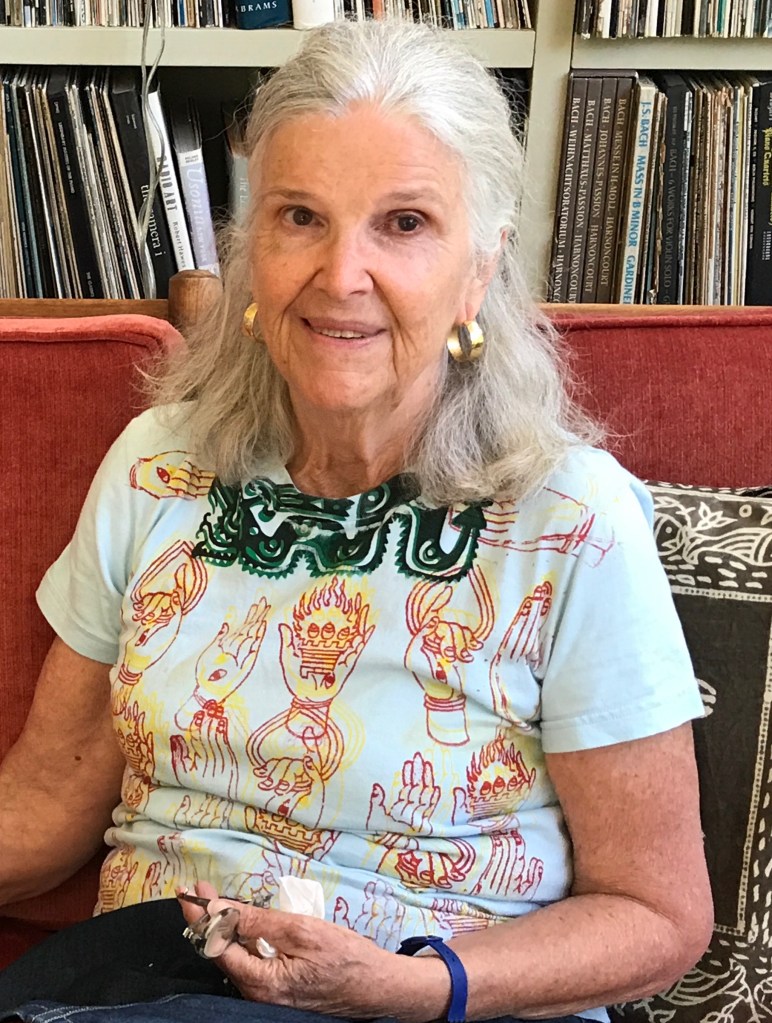
BIO:Barbara Ardinger, Ph.D. (barbaraardinger.com), is the author of Secret Lives, a novel about crones and other magical folks, Pagan Every Day, a unique daybook of daily meditations, and other books. She really enjoys writing her monthly blogs for FAR. Her work has also been published in devotionals to Isis, Athena, and Brigid. Barbara’s day job is freelance editing for people who have good ideas but don’t want to embarrass themselves in print. To date, she has edited more than 400 books, both fiction and nonfiction, on a wide range of topics. She lives in Long Beach, California, with her rescued calico cat, Schroedinger.
Moderator’s note: This marvelous FAR site has been running for 10 years and has had more than 3,600 posts in that time. There are so many treasures that have been posted in this decade. They tend to get lost in the archives. We are beginning this column so that we can all revisit some of these gems. Today’s blogpost was originally posted August 6, 2017. You can visit it here to see the original comments.This post along with those which will be posted in next two days were curated by Barbara Ardinger to stand together for their relevancy now, 5 years later.
Members of this community (and others) have been feeling that the world is out of balance since the 2016 election. There’s a feeling that people are becoming less kind and that some men (following the model that lives and tweets in the White House when he’s not at one of his golf resorts) are more misogynistic. I’ve heard that Orwell’s novel Nineteen Eight-Four is more popular than ever before. We seem to be living in a new, dystopic society. It’s very sad and very scary.
I’ve recently reread three novels written by women that I think may be both prophetic and inspiring. I’m hoping that if you read them, too, you’ll inspired by their brave heras to keep on resisting. The novels are Gibbon’s Decline and Fall (1996) by Sheri S. Tepper, Woman on the Edge of Time (1976) by Marge Piercy, and The Fifth Sacred Thing (1993) by Starhawk.
Long a fan of Surrealist artist Leonora Carrington, I was initially hesitant when the New York Review of Books reissued her 1974 novel, The Hearing Trumpet. I didn’t know what to expect when this extraordinary painter picked up a pen.
To my delight and surprise, Carrington shows the same artistry and whimsy in her writing that she does in her painting. She also reveals herself to be an astute feminist and aficionado of the Goddess, well-versed in arcane lore, with which she accents her fantastical world. The Hearing Trumpet is full of British humor and eccentricity, set in a finely spun, other-worldly landscape.
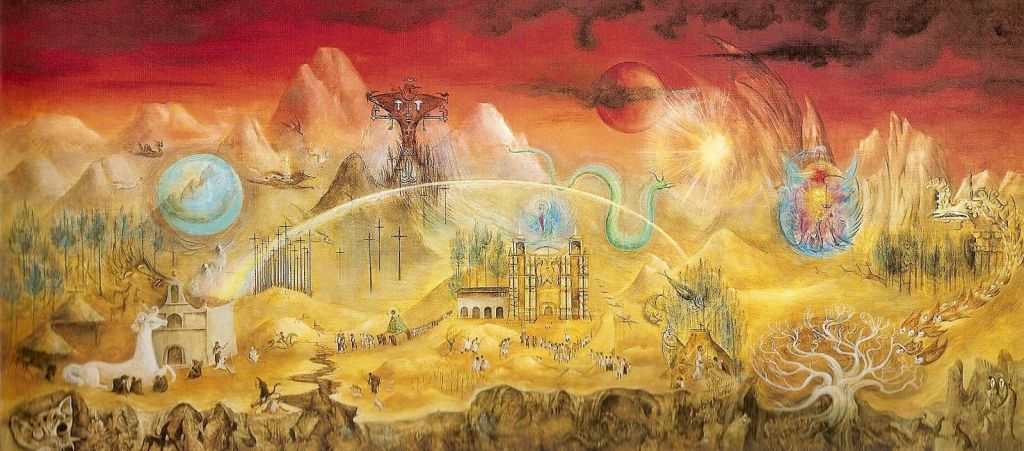
The World of the Maya
Her heroine Marian Leatherby is a 92-year-old, who lacks teeth, is hard of hearing, and sports a beard–a whimsical, endearing character who loves cats. She has been given a hearing trumpet by her great friend Carmella, and thereby learns that her son and his wife plan to send her away to an old folks’ home run by a Dr. Gambit and the Well of Light Brotherhood.
(With apologies to Jean de La Fontaine for significant changes to his fable)
Note: We watch TV or read posts on the social media, and what do see? People attacking other people. People with guns shooting other people. Racist and fascist groups trying to stomp our democracy into the mud. I first wrote this story several years ago for a Llewellyn annual. A few years later, I secured permission from them to post it on this site. I’m reposting it today because—especially on Independence Day—we need a few chuckles and some practical lessons in kindness. My friends, I hope you enjoy this story.
“Curses on that grasshopper!” exclaimed the ever-busy Madame Fourmi. “All he ever does is play. He’ll be sorry when winter comes.”
Rest awhile, Dear Reader, and dream along with me. We’re standing on a corner, call it Main Street, Any City, USA. We’re chatting, passing the time of day, being happy we can stand among other people without the fear of a giant virus jumping out of someone’s breath and attacking us. It’s a nice day here on the street. Not much traffic.
Oh, look—there’s a huge box in the middle of the intersection. It’s shabby, looks to be made of old, thin wood loosely clamped together. The box starts shaking, rocking back and forth. What’s in there? Something is obviously trying to get out. As we watch, an orange mist starts seeping out through the cracks in the box. More shaking. Now the box seems to be jumping. More orange mist. And the box shatters. An orange form—is it human? It’s fat. It’s shaking an iPhone. Or is that a golf club? The orange one speaks. “Do you miss me yet?” “Stand back and stand by.” “I’ll be baa-ack.”
Fairy tales are intwined in our imagination and our spirituality. As Jane Yolan writes, one of the subtlest and yet most important functions of myth and fantasy is to “provide a framework or model for an individual’s belief system.” (1)
In the Reclaiming spiritual tradition, we often use fairy tales in healing and self development work. These stories act as warp and weft as we weave and spin complex ritual arcs and other events that take place at extended Witch Camp sessions. In Twelve Wild Swans, Starhawk points out that fairy stories are “more than just encouraging and inspiring. They are also templates for soul healing from Europe’s ancestral wise women and healers. When the ancient Earth-based cultures of Europe were destroyed, these stories remained.” (2)
Those of us in the Northern Hemisphere are coming out of a long pandemic winter and entering a new season of waxing light, hope, and growth. Yet these continue to be turbulent times. Even with the progress of the Covid vaccine, none of us truly knows when life will ever return to “normal.”
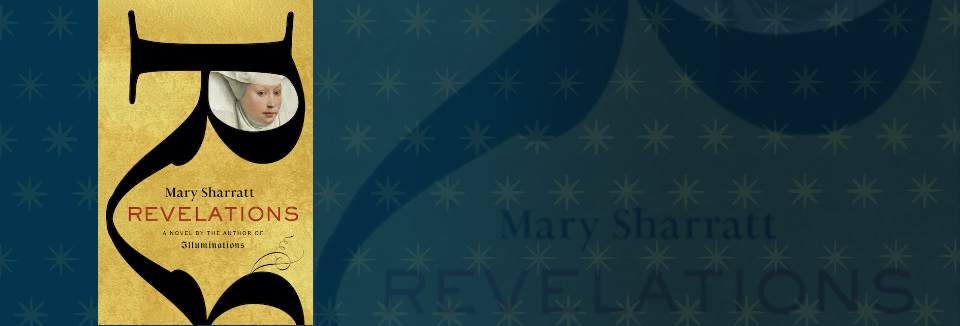
Like us today, the medieval mystics Julian of Norwich and Margery Kempe, the heroines of my new novel REVELATIONS, which will be published on April 27, lived in a time of pandemic and social upheaval, yet both women bore witness to the divine promise that ultimately all shall be well.
During a near-death experience, Julian received a series of divine visions and spent the next forty years unpacking them in her luminous theology of an unconditionally loving God who is both Mother and Father. Julian offered radical counsel to Margery Kempe, a failed businesswoman and mother of fourteen, who was haunted by her own visceral mystic experience. With Julian’s blessing, Margery walked away from a soul-destroying marriage and became a globe-trotting pilgrim-preacher and rabble rouser. Though these two women might seem like polar opposites—Julian, the enclosed anchoress, and free-roving Margery experiencing her visions in the full stream of worldly life—they complement each other. Together their lives and work form a Via Feminina, a distinctly female path to the divine.
The women mystics have always fascinated me. I identify very powerfully with Hildegard of Bingen, the heroine of my previous novel ILLUMINATIONS, as well as with Margery and Julian as spiritual women facing the roadblock of an institutional, male-dominated religion that side-lined them precisely because they were women. But instead of letting this beat them down, they found within their own hearts a vision of the divine that mirrored their female experience. I believe it’s no mere coincidence that both Hildegard and Julian dared to create a theology of the Feminine Divine, of God the Mother. All three women seized their power and their voice to write about their encounters with the sacred, preserving their revelations to inspire us today.
In our modern world, when many traditional religious institutions are crumbling, we can follow in these women’s footsteps and seek the divine—however we perceive the divine—within the sanctuary of our own hearts. This is the birthright no one can take from us, our eternal refuge. This is the Way of the Mystic.
Learn more about Margery and Julian as I discuss these mystics in a series of free virtual events.
My virtual tour kicks off with a very special Literature Lover’s event, sponsored by Valley Bookseller and Excelsior Bay Books in Minnesota. You can watch the video above. I am in conversation with acclaimed author, Elissa Elliot .
For a deep dive into Julian of Norwich’s spirituality, I am teaming up with Christine Valters Paintner of Abbey of the Arts to offer a Virtual Mini-Retreat on May 13, Julian’s Feast Day. You can learn more and register here.
Mary Sharratt is on a mission to write women back into history. Her acclaimed novel Illuminations, drawn from the dramatic life of Hildegard von Bingen, is published by Mariner.Her new novelRevelations, about the globe-trotting mystic and rabble-rouser, Margery Kempe, will be published on April 27. Visit her website.
For the past two months, I have been exploring the religious elements of Star Trek: Discovery. Both seasons one and two have considerable religious elements. Of course that depends on how one exactly defines religion as well as how one interprets the actions of the characters. Season three is no different as the principle of connection becomes associated with religious rituals, behaviours, beliefs, and discussions.
By far, the most recognisably religious element of the season is the ritual bath that Adira participates in episode 4 in order to be able to commune (connect) with the symbiote. The ritual bath occurs in the sacred caves of Mak’ala. Adira, robed in white, enters the pool and spends considerable time learning to commune with the symbiote and its past hosts. After emerging from the pool of water, Adira is wrapped in a cloth that very much resembles a tallit.









 Feminism and Religion