Son of Man: An Updated Gospel Story of Jesus Set in South Africa by Michele Stopera Freyhauf

January 12, 2012

Son of Man is an updated story of the life of Jesus set in the fictional State of Judea that is modern day South Africa – complete with warlords and child soldiers.    It could easily be mistaken for modern day Rwanda or Darfur with its modern issues and political overtonesRoger Ebert stated, “The secret of the movie is that it doesn’t strain to draw parallels with current world events – because it doesn’t have to.”  The director draws parallels between the gospels and 21st century Africa.  According to Dartford-May, “we wanted to look at the Gospels as if they were written by spin doctors and to strip that away and look at the truth.”  The director “captures the rhythms of African life in both rural settings and sprawling townships.”  “Feather-clad young angels offer an eerie echo and reminder of Africa’s lost generations.”

The movie also sticks with what Eric Snider calls “Traditional African trial music, dance, and costumes” as a type of worship or or allusion to Jesus’ godhood.  Judea is in flux; warlords and corruption take center stage.  Poverty, violence, and oppression affect the all of the people.  The key idea is that Jesus is a freedom fighter – one that fights injustice and oppression.  The director does not emphasize “Jesus’ divinity so much as his leadership, good sense and compassion.”  Jesus is not violent and his followers, most of whom were former child soldiers, are encouraged to respond non-violently, which goes against their upbringing and training. Continue reading “Son of Man: An Updated Gospel Story of Jesus Set in South Africa by Michele Stopera Freyhauf”

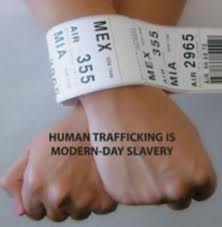
January 11th is National Human Trafficking Awareness Day

This information was originally distributed by WATER:

January 11th is National Human Trafficking Awareness Day. Human trafficking, referred to as modern-day slavery, is the fastest growing and second most profitable criminal industry in the world. More than 27 million women, men, and children have become victims of human trafficking for labor and sexual exploitation. Trafficking can and does occur in all parts of the world, including the U.S. Large sporting events like the Super Bowl attract human trafficking, especially for sexual exploitation of women. Read Mary E. Hunt’s new article on human trafficking entitled “Women and Children First.”

Stories of Trafficking
Excerpted from www.polarisproject.org

Amanda learned that her cousin was with a pimp who was advertising her for commercial sex on various websites.

A teacher became concerned about one of her students, a 14 year-old girl, and spoke with classmates who directed the teacher to multiple postings advertising the young girl for commercial sex on backpage.com. Continue reading “January 11th is National Human Trafficking Awareness Day”

It is the Best of Times. It is the Worst of Times: An Athlete Looks at Her Life and Title IX By Paula McGee

I expect 2012 to be a great year. Not only do I plan on graduating in May with a Ph.D., but I will also receive one of highest honors in sports. On Sunday, February 19, 2012 in the USC Galen Center during halftime of the USC and UCLA women’s basketball game, USC will retire the jerseys of my twin sister and I.  Most people in my women’s studies and theology world do not really know that I have a twin sister, nor do they fully appreciate that about twenty-five years ago, my sister and I played on one of the most prominent teams in women’s basketball and in women’s sports. We won two back-to-back national championships in 1983 and 1984. We were also the first NCAA national champions (previous women’s teams were American Intercollegiate Association for Women (AIAW) championships). My sister and I played with Cynthia Cooper and Cheryl Miller. Our team was one the first women’s teams to get mainstream acceptance in the larger sports world. We were not just “girls” that happened to play a sport; we were “real” athletes. We received the same media attention and acceptance of any sports team during that period.

Most of my feminist friends—the preachers, scholars, and theologians—have no idea of what it means for a university to retire a jersey. In the sports world, retiring an athlete’s jersey means that no other person in that sport will ever wear that number at that university. The retired athletic jersey hangs in the rafters of the sports facility forever. This honor for an athlete is synonymous to a scholar receiving a named endowed chair in the academy. What is exciting for me is that my jersey will not only be hanging with my sister’s—that alone would be enough to celebrate. USC is one of the few institutions in the country in which the majority of the retired jerseys are the jerseys of women: Cheryl Miller, Lisa Leslie, Cynthia Cooper, and now Pam and Paula McGee. Cheryl and Cynthia are also members of the Naismith Hall of Fame, and Lisa is sure to join them  with that honor very soon. Continue reading “It is the Best of Times. It is the Worst of Times: An Athlete Looks at Her Life and Title IX By Paula McGee”

(Non-Human) Animals on the Agenda by Grace Yia-Hei Kao

“[E]thical interest in nonhuman animals is flourishing.”

To my delight, the New York Times recently chronicled the growing scholarly interest in human/non-human animal interactions in a story entitled “Animal Studies Cross Campus to Lecture Hall.” There are now more than 100 courses in colleges and universities in the burgeoning field of animal studies. At least 40 U.S. law schools now routinely offer courses in animal law. A growing number of formal academic programs, book series, journals, conferences, institutes, and fellowships are also dedicated to (re)examining human-animal relations from a variety of disciplinary perspectives—“art, literature, sociology, anthropology, film, theater, philosophy, [and] religion,” to name a few.

Continue reading “(Non-Human) Animals on the Agenda by Grace Yia-Hei Kao”

Well-Behaved Women Seldom Make History, But Obedient Ones are Rewarded in Heaven: An Examination of the Re-Invention of the Bengali Tradition of Sati By Michele Stopera Freyhauf

Well-Behaved Women Seldom Make History is a book authored by Laurel Thatcher Ulrich.  This has become a well-known phrase used by most feminists to imply a meaning of disobedience or stance against the patriarchal structure of society.  Often in error, the credit of the invention of this phrase is attributed Eleanor Roosevelt and Marilyn Monroe.  Their image, and especially the image of Monroe, will often appear with the slogan on merchandise as a means of marketing and raising revenue.  Ironically, reinvention or reuse is prevalent in history when it comes to tradition or ritual for the same reason – monetary gain.  This practice is common and the benefit of reinventing or reinterpreting an old tradition is an automatic connection to the past giving continuity, which, according to Eric Hobsbaum, instills strong “binding social practice,” (p. 10) including loyalty and duty in the members of the group.  This is especially effective in manipulating the poor and uneducated who usually display strict obedience and blind acceptance of tradition. The Bengali reinvented tradition of satî is an example of this. Continue reading “Well-Behaved Women Seldom Make History, But Obedient Ones are Rewarded in Heaven: An Examination of the Re-Invention of the Bengali Tradition of Sati By Michele Stopera Freyhauf”

Feminist Music By Gina Messina-Dysert

Last week Caroline Kline shared the article “Feminist Films” and discussed the Bechdel Test as a way to identify whether or not a film is feminist.  It left me wondering – can we identify music as feminist in the same way?  Music generally does not offer dialogue between two women.  But there are instances where we find two women singing together about feminist issues like the 80’s classic “Sisters are Doin’ it for Themselves.”   There are also women singing about or to women, like Juliana Hatfield’s “My Sister.” And there is music that acknowledges women’s struggles as women like Ani Difranco’s “I’m No Heroine,” No Doubt’s “I’m Just a Girl,” and Pink’s “Stupid Girls”.    But is this the only way to identify feminist music?   Continue reading “Feminist Music By Gina Messina-Dysert”

The Paradoxical Perception of Midwifery in American Culture By Stacia Guzzo

This past Sunday night, midwife Robin Lim was named CNN Hero of the Year at a formal award ceremony in Los Angeles, California. The award, which was given after eleven weeks of public voting on CNN.com, came with $250,000 to support Lim’s quest to provide quality prenatal, labor, birth, and postpartum care for the poor and underserved in Indonesia.  She accepted the award amidst a standing ovation, and closed her words of acceptance by simply saying: “Every mother counts. And health care is a human right.”

The recognition of Lim—or Ibu (“Mother”) Robin, as she is called by those whom she serves— is well-deserved.  An American woman, Lim provides midwifery care at the Bumi Sehat clinics which she helped to establish. Each year, she helps thousands of Indonesian women get care and attention during their pregnancies and the births of their children.  She began her work in 1994, seeing pregnant women and children under five for free out of her home. As her reputation spread, supporters of Lim, along with local business and community leaders, helped to advance her cause. Today, the village-based Bumi Sehat clinics are located in both Bali and Aceh. They provide free prenatal and birthing care as well as breastfeeding support to any woman who needs it, regardless of her ability to afford it.  Ibu Robin’s words to CNN reflect that her commitment to her cause is an altruistic one: “”Every baby’s first breath on Earth could be one of peace and love. Every mother should be healthy and strong. Every birth could be safe and loving.” Continue reading “The Paradoxical Perception of Midwifery in American Culture By Stacia Guzzo”

Can the Students at Penn State Read? Did They Read What I Read? By Paula McGee

The following is a guest post written by Paula McGee, dynamic preacher, writer, and inspirational speaker.  She earned a Master of Divinity from the Interdenominational Theological Center and a Master of Arts in Religion from Vanderbilt University. She is currently a Ph.D. candidate in Women’s Studies in Religion at Claremont Graduate University.  Her personal mission is “to inspire others to recognize, accept, and fulfill their call to greatness.”

“As the graduate assistant put the sneakers in his locker, he looked into the shower. He saw a naked boy, Victim 2, whose age he estimated to be ten years old, with his hands against the wall, being subjected to anal intercourse by a naked Sandusky.”

Can the students at Penn State read? I saw thousands of students rioting in the streets after the Board of Trustees announced the termination of football coaching legend Joe Paterno and President Graham Spanier. I wondered if the students had read page 6 of the 23 page Grand Jury report. The report provides detailed information on 8 victims. So I can’t imagine any student that would question the university’s decision to fire Joe Paterno, if they had read any portion of the report from the Grand Jury’s investigation. The details on page six have caused the most controversy. In 2002, a 28 year old graduate assistant walks in on Jerry Sandusky raping a ten year old boy. Sandusky is now telling people that he only showered with boys.  Continue reading “Can the Students at Penn State Read? Did They Read What I Read? By Paula McGee”

Should Our Children and Grandchildren Live Better Than Us? And Whatever Happened to Our Dreams? By Carol P. Christ

Carol P. Christ is a founding mother in the study of women and religion, feminist theology, women’s spirituality, and the Goddess movement.  She teaches in the Women’s Spirituality program at CIIS and through Ariadne Institute offers Goddess Pilgrimages to Crete. Her books include She Who Changes and Rebirth of the Goddess and the widely used anthologies Womanspirit Rising and Weaving the Visions.

Last Sunday on Meet the Press Tom Brokaw spoke about the breakdown of what he felt had been a common consensus about American life. He said that Americans are questioning the American dream which tells us that “our children and grandchildren will live better than us.”  He found it disturbing that people now feel their children will not be better off than they were.  The poor no longer see a way out of poverty and the middle class fear that their children will be unemployed for long periods in their lives, burdened with college debt, and unable to afford mortgages and college educations for their children.  I have heard this idea expressed many times in the recent economic crisis, including by progressive journalist Adrianna Huffington.

What Brokaw and others do not mention is that a few generations ago, this American dream was the hope that one’s children would not live in poverty.  Now, for the middle class if this dream means anything, it means having a bigger house, more cars, $2000 suits, botox and plastic surgery, expensive vacations, weddings costing tens of thousands of dollars, store-bought Halloween costumes, and so many Christmas presents that children step on their new toys to get to the tree for more packages.  What Brokaw and others did not address is whether the desire for your children to have “more” than you had, once your family is out of poverty is a valid, good, or sustainable desire to have.  Of course we should all hope that our children and children’s children will find employment and not live in poverty, but an endless upward spiral cannot be sustained and there is no evidence that it makes anyone any happier. Continue reading “Should Our Children and Grandchildren Live Better Than Us? And Whatever Happened to Our Dreams? By Carol P. Christ”

The Egyptian Revolution: Women, Islam And Social Change By Karen Torjesen

The following is a guest post written by Karen Torjesen, Ph.D., Margo L. Goldsmith Professor of Women’s Studies in Religion at Claremont Graduate University where she has helped establish graduate programs in Women’s Studies in Religion and Applied Women’s Studies. For ten years she served as Dean of the School of Religion, partnering with religious communities to create programs in comparative religion. She has published extensively on women, gender and sexuality within Christianity.

Originally posted at Huffington Post: http://www.huffingtonpost.com/karen-torjesen/the-egyptian-revolution-women-islam-social-change_b_978190.html

Traffic inches through the narrow streets. Sidewalks are peppered with chairs, men in gallabiyas (tunic-like garment reaching the ankles) chatting, drinking tea or smoking the hookah. Women in hijabs threading the traffic, children in tow. Shops bustle; vendors call. Normal life — but there is something in the air. What is it I wondered. What is going on in Egypt?

It is profound and it is complex, but a conversation at the Cheops pyramid with a young student worked as a single snapshot. His first question after, “Where are you from?” was, “What do Americans think of us now, after the revolution?” How can I describe his effect — it was something new. A tone? A manner? He asked with eagerness; he asked with pride, there was a confidence in his voice. He explained, straining for the English vocabulary that the regime had controlled how Egyptians thought about themselves. “When we woke up in the morning, we thought only of taking care of food and family. Now we think about ourselves differently.” Johnny West named this difference in his Journey through the Arab Spring. It became the title of his book, “Karama,” dignity. Continue reading “The Egyptian Revolution: Women, Islam And Social Change By Karen Torjesen”