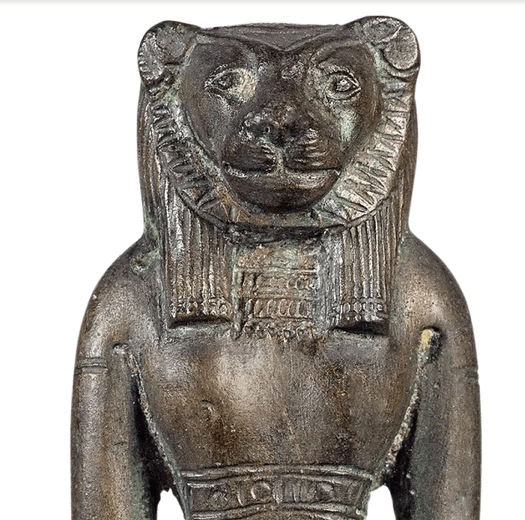
One of the over 700 granodiorite statues made of the Goddess Sekhmet almost 3500 years ago, “the Lady of the Place of the Beginning of Time.”
Molly Remer of Brigid’s Grove, a fellow contributor here at Feminism and Religion recently wrote on the Mother Well section of the divine feminine app: “I feel like Inanna & Enheduanna are all around in recent months!”
Yes. I do as well.
A year or two ago, I read a book by Lauren Sleeman entitled ‘Behold’. The premise of the book has remained with me: a telling of the Goddesses, in particular Lilith, the Great Mother and Crone of the Cosmos, and Hekate, Goddess of the Dark Moon and the Mysteries of Life, who have been silently watching and waiting these past few thousand years to return to our human consciousness.
A warm summer sun smiles down upon the British coastline, the low tide reflecting jewels which are wash up and dispersed upon fine sand. A welcome breeze dances around a gathering of Goddess devotees encircling a small bonfire. Amongst them stands a banner and statue depicting and imitating Botticelli’s Venus and bouquets of roses. Just before the sun sets, those gathered lovingly collect these assembled artifacts, holding them aloft, and begin to process barefoot towards the sea.
Aphrodite-Venus’s banner and sculpted face shines in the low afternoon sunlight. As the procession slowly steps, weaves, and dances, towards the sea to the beat of a drum, the sun reaches further behind the hills, casting a long shadow upon the beach. The Goddess’s image dances with them, banner swaying and statue bobbing with the dance of its carrier. By the time the procession reaches the sea, the sun has dipped behind the now black silhouette of the hills bathing the beach ahead in dusky oranges and brilliant blues. At the shoreline, a priestess steps forward and turns the Goddess’s statue to face the procession, which has now fanning out into a semi-circle.
The data came as somewhat of a shock to me. I stumbled across it one day in The Civilization of the Goddess, a mammoth book by the late Lithuanian-American archaeologist Marija Gimbutas about what Gimbutas dubbed “Old Europe” – a culture area in southeastern Neolithic Europe that she maintains was centered around female deity.
Until she had the temerity to suggest that people at some point in the past might have worshipped goddesses rather than gods, Gimbutas had a sterling reputation among academics, even being hired to teach at two of the most prestigious of all American archaeology departments, Harvard’s and UCLA’s. After presenting her goddess theory of Old Europe, however, Gimbutas came under attack by a few powerful male archaeologists, after which her reputation among academics began to plummet (see Spretnak 2011 for a good accounting of Gimbutas’ fall from grace).
Marija Gimbutas
Before I get to the data that so startled me, I need to tell you a bit about archaeologists. Like the members of many academic disciplines, they disagree with each other – sometimes vehemently (and perhaps even somewhat more vehemently than scholars in other disciplines). One thing however they all agree on is this: the higher the quality and quantity of grave goods buried with an individual, the higher that individual’s status in her or his society. Continue reading “When Baby Girls and Old Crones Ruled by Jeri Studebaker”




 Feminism and Religion