Nine Goddesses Every Woman Should Know by Annie Finch

Are you a woman (or man) who has lost touch with yourself spiritually — or

has never gotten in touch with yourself spiritually — or who just wants more joy in each day? If so, you may want to try entwining more goddess energy into your life. Many anthropologists believe that human societies were originally goddess-centered, and goddesses are still worshipped on every continent. Whatever your desire — strength, wisdom, compassion, fertility, creativity, sexuality — there is a goddess who can help you. Connecting with the goddesses who call to you — in the form of jewelry or art, words and music, or simply your thoughts — can sweeten and enhance your days with bright threads of unity, wonder, and female power.

But how to begin? The number and diversity of goddesses loved, worshipped, and celebrated throughout time and into the present, in every corner of the earth, is so breathtakingly large that trying to keep track of them can feel like counting the stars. To start you off, here are nine of my own favorite goddesses, chosen from among the most popular female divinities celebrated today (please note that many of them may also be known by different names or spellings).

Durga. The great Hindu mother goddess Durga is really nine goddesses in one. Durga’s nine manifestations — embodying qualities from courage to piety to blissful joy — are celebrated in India during a huge nine-day festival called Navarati. Durga is often pictured as a fierce goddess with many arms riding a lion. I have revered her ever since I found an ancient and powerful stone carving of her in the Asian wing of the Museum of Fine Arts in Boston. You can call on Durga’s invincible spirit when you need to be strong to your core!

Me (5th from right) with friends at a Durga Puja Celebration in Kolkata, India, many-armed Sculpture of Durga in background
Continue reading “Nine Goddesses Every Woman Should Know by Annie Finch”

How to Talk to a War Goddess: A Poetic Lesson From Sekhmet by Annie Finch

Consensus decision making, according to the mother of matriarchal studies Heidi Goettner-Abendroth, is woven into the definition of matriarchal societies. In these cultures, the respect, empathy, kindness, maturity, and belief in sustainable relationships that consensus implies are foundational.  War, as the inimitable Yael Deckelberg sings to us, is “not a woman’s game”; any society that truly hears women will not play it.  Overseen through the caring wisdom of circles of elder women in what Genevieve Vaughan calls the Maternal Gift Economy, matriarchal societies have less than no use for such a cruel, stupid, wasteful custom.  As my great-aunt Jessie Wallace Hughan, founder of the War Resisters League, used to say, someday humanity will consider war as absurd as we now consider the custom of dueling. But we won’t see the end of this integral outrage in our lifetimes; that day will likely arrive only after we’ve all come to our matriarchal senses.

Meanwhile, here we are again.

Continue reading “How to Talk to a War Goddess: A Poetic Lesson From Sekhmet by Annie Finch”

Bloody Waters by Ivy Helman

(Author’s note: I live in Prague, Czech Republic and teach at Charles University.Try as I might, I could not express in prose my thoughts about the violence in the world and particularly the violence here, in Prague, on the 21st of December, especially given the fact that I was a block away from what took place. So, I have written a poem instead.)

I swim through
the slimy waters of patriarchal violence
Difficult to express in words
the anxieties, the fear, the sadness
I feel as I take another stroke

towards

the parshah Bo (Exodus 10:1-13:6),
a divinely wrought plague of locusts
devouring all in their path.

Breathe,
stroke.

Darkness lasting three long days
blood smeared on doorposts and lintels
the deaths of first-borns, humans and animals alike,
the proclamation of a New Year and its festivities
to remind us of such nonsensical violence.

Breathe.
There is blood in the water.
Stroke.

Continue reading “Bloody Waters by Ivy Helman”

The Return of the Goddess to Our Human Consciousness by Caryn MacGrandle

One of the over 700 granodiorite statues made of the Goddess Sekhmet almost 3500 years ago, “the Lady of the Place of the Beginning of Time.” 

Molly Remer of Brigid’s Grove, a fellow contributor here at Feminism and Religion recently wrote on the Mother Well section of the divine feminine app: “I feel like Inanna & Enheduanna are all around in recent months!”

Yes. I do as well.

A year or two ago, I read a book by Lauren Sleeman entitled ‘Behold’.  The premise of the book has remained with me:  a telling of the Goddesses, in particular Lilith, the Great Mother and Crone of the Cosmos, and Hekate, Goddess of the Dark Moon and the Mysteries of Life, who have been silently watching and waiting these past few thousand years to return to our human consciousness. 

Continue reading “The Return of the Goddess to Our Human Consciousness by Caryn MacGrandle”

Strolling with Sekhmet and Bast into the New Year by Jan Peppler

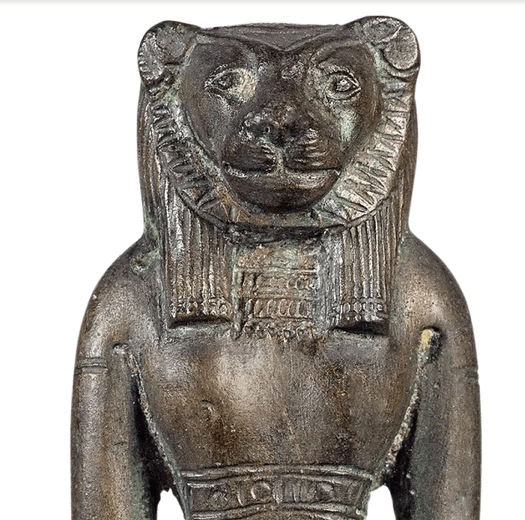
In my dream, two large cats are walking towards me on a sidewalk. They are large cats, not house cats, rather, lions or tigers and they are walking on two legs, standing up, like humans. Wait, their bodies are human, only their heads are feline.  As they come closer, they appear to have top hats on their heads. They look like twins. I step aside and they stroll past me.

Clearly Sekhmet and Bast have come to me in my dream. These goddesses are not part of my faith tradition. Yet depth psychology is my tool for understanding and dreams are the realm of life: animating the forces bubbling beneath the surface. I must turn my face to these feline goddesses, bow and listen, to hear what they may want to share.

Sekhmet and Bast derive from Net or Neith, the oldest Egyptian female deity. Both were considered daughters and consorts of Ra (or Re), the sun god. Bast was designated the mild eye of Ra, while Sekhmet was the sun’s scorching eye. As such, the two goddesses are both opposites and complements of each other. Continue reading “Strolling with Sekhmet and Bast into the New Year by Jan Peppler”