
Painting Breast Cancer Goddess by Rev. Dr. Angela Yarber

October is Breast Cancer Awareness Month, though I imagine most of us are already relatively aware. One in eight women will have breast cancer. Pink is everywhere. It’s difficult to find a person who hasn’t been impacted by breast cancer on a personal level. In 2003, my mom was diagnosed. Radiation, a lumpectomy, and ten years later she was dubbed cancer free. When I finished my Ph.D. in 2009, I did a stint as a Research Assistant for a fabulous liturgical studies scholar working on a book that examined and created rituals for women with breast cancer. My task was researching everything written on breast cancer that intersected with feminism, womanism, religion, spirituality, and ritual.


Audre Lorde’s Cancer Journals struck me profoundly. The critiques weighed heavy as a movement that began with destigmatizing breast cancer and offering solidarity to patients has transformed into a pinkified commodity. Whether it’s the lack of transparency in major breast cancer foundations, pinkification, the essentializing conversations that equate breasts with womanhood, lack of access to comprehensive health coverage, the role of the meat and dairy industry in increased risks of breast cancer, the talk of “surviving” and “fighting” as though those who don’t survive aren’t fighters, or the complete lack of representation of women of color in any pink marketing (seriously, do a google image search of “breast cancer headwraps” and feast your eyes upon an endless array of young, white women), breast cancer awareness has been commodified so that helping cancer patients is second to profit. Amidst these pink teddy bears delicately embroidered with the word “fighter,” one can only wonder what we can actually do and offer and create to be supportive of those with breast cancer. What rituals might we offer? What sacred spaces might we create? What is a feminist response? A spiritual response?

Continue reading “Painting Breast Cancer Goddess by Rev. Dr. Angela Yarber”
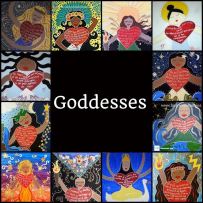
Bridging Beyond Binaries: Painting Gloria Anzaldúa by Angela Yarber

One of the great joys of being an artist and writer is working on commissions, enlivening in paint, canvas, and word the stories of revolutionary holy women who have emboldened and inspired the one commissioning the Holy Woman Icon. Gloria Anzaldúa was on my list of holy women for a while when Dr. Robyn Henderson-Espinoza finally gave me the nudge to paint her by commissioning an icon. Anzaldúa gave Robyn—and so many others—the framework, the bridgework, for dismantling the binaries of difference, for finding the beauty that resides at the borderlands of race, gender, and sexuality. As a scholar-activist, Robyn speaks of Anzaldúa as a patron saint, saying:

“Anzaldúa has always been for me the bridge between theory and action, and her work, both in writing and teaching, compels me to live into my vocation as a public theologian, which at root is bridging across lines of radical difference. Without Anzaldúa and without her bridging frame, I am unable to do the work that I now do. This icon offers me a visual reminder of the ways in which I’m called to be a bridge in curating communities of radical difference.”

Queer borderlands. Chicana borderlands. Feminist borderlands. Gloria Anzaldúa (September 26, 1942 – May 15, 2004) was an American scholar who focused on the intersections among queer theory, feminist theory, and Chicana cultural theory. Born in the Rio Grande Valley of south Texas, Anzaldúa also bridged the borders of personal and academic writing, weaving together theory with lived experience, English with Spanish, and inviting readers into a new world—Mundo Zurdo—that transcended these seeming binaries. Continue reading “Bridging Beyond Binaries: Painting Gloria Anzaldúa by Angela Yarber”

Holy Women Icons Online Retreats by Angela Yarber

I’ve shared before that the non-profit my wife and I created, the Holy Women Icons Project, is in the process of creating a small intersectionally ecofeminist retreat center on Hawai’i Island. The Holy Women Icons Project seeks to empower marginalized women by telling the stories of revolutionary holy women through art, writing, and special events.

Both the art and writing side of the project have been a monthly part of Feminism and Religion since 2012 as I feature the story of one of my holy women icons, along with the icon I’ve painted depicting them. As I paint revolutionary holy women from history, scripture, and myth, I also write about their lives; in addition to painting and writing, the bold witness of these women has inspired and grounded many of the retreats I lead in churches, seminaries, women’s and LGBTQ centers. Now the time has come for us to try and fulfill our dream of creating a home for this work, a little off-grid retreat center where people can come on retreat to create, sustain, and empower (by paying to attend or receiving scholarships from grants, but more on that later).

We were thrilled to film the first step of this process—building our family’s “tiny house”—with the television show Tiny House Nation. Since then, we’ve been working tirelessly to get our acre of land ready to build more housing for those on retreat, and to find funding sources to make it possible. Anyone who runs a non-profit or works in sustainable construction knows this is no easy (or affordable) task. We’re realizing that this far-flung dream may take longer than we’d envisioned due to lack of funding. We have some fabulous monthly patrons through Patreon, and we’d surely welcome more tax-deductible patronage or donations! Other than this, though, it’s the scrappy work of my wife and I to try and make this whole intersectionally-ecofeminist-off-grid-Hawai’i-retreat-thing a reality. Continue reading “Holy Women Icons Online Retreats by Angela Yarber”

Painting, Privilege, and “Going Tiny” in Hawai’i by Angela Yarber

Pelé by A. Yarber

It started with Pelé, the Hawai’ian Volcano Goddess who governs fire, lightning, volcanoes, and the flow of lava. When my little family set off on a big adventure in June 2015, I knew I’d research and paint her as a Holy Woman Icon, but I wanted to get to Hawai’i first so that I could experience her power firsthand. After three months volunteering without running water in Vermont, a month in southern Virginia’s finest fall foliage, and a holiday season traversing the country from east to west in a camper named Freya, we crossed the Pacific in search of Pelé.

The long-term goal of nearly two years of full-time travel was to discern next steps for our queer little family, and to find land to open an intersectionally ecofeminist retreat center. We always imagined returning to the southeast, likely buying land and creating the retreat center in the North Carolina mountains. Pelé had something else in store.

After three wild months volunteering on the Big Island, we fell in love, enlivened by this place we now call home: its beauty, the diversity of people, access to living off-grid, access to growing your own food, its rich culture and history, access to a vegan lifestyle, and the ability to live the majority of our life outside. In short, all of our plans were upended and recreated in the most beautiful and challenging ways because we knew Hawai’i must become our home. Continue reading “Painting, Privilege, and “Going Tiny” in Hawai’i by Angela Yarber”

Painting Our Lady of Sorrows: Mother’s Day and Resurrection by Angela Yarber

The month of May finds those within the Christian tradition solidly within Easter season, reveling in the promise of resurrection, while simultaneously celebrating Mother’s Day. To be honest, I’d never seen much of a correlation between these two events in the past. But since my brother’s death in March, I’m viewing everything through the lens of grief, likely a new perspective that will color the way I see the world forever. Namely, until this year, I’d never really given much thought to what Jesus’ mother, Mary, was feeling in a post-resurrection world. Of course, the suffering, sorrow, and sadness of a mother who watched her child die is something that most Christian churches highlight during Holy Week, on Good Friday, or even on Easter Sunday. But then our liturgy shifts, as though Mary transitioned from weeping at the gruesome death of her child one day and then suddenly celebrates the reality of resurrection the next. At the risk of extreme blasphemy—a place where I consistently reside—when I place myself in Mary’s shoes as a mother, resurrection kinda sucks. Continue reading “Painting Our Lady of Sorrows: Mother’s Day and Resurrection by Angela Yarber”

Painting a Goddess of Grief by Angela Yarber

In many ways, I’ve thought of the myriad Holy Women Icons I’ve painted as mediators, guides who accompany us, women who have shown us the way. Whether they enliven us to create, inspire us to sustain, or embolden us to empower, these holy women have taught me to rage, praise, hope, endure, persist, love, and laugh. Recently, though, I discovered that none of the Holy Women Icons I’ve researched, written about, or painted have helped me to grieve. Surely, many have experienced grief, or give us tools for coping with the grieving process, but no Goddesses of Grief filled my heart when I needed it most.

Last month, amidst my worries about walls and bans and words that exclude, grief came along and sucker punched me in such a way that I continue to grasp for mediators, guides, and ways to cope amidst tremendous sadness. On March 6, 2017 my little brother, Carl, died. An addict for much of his adulthood, his recent addiction began spiraling out of control over a year ago and he refused to go to rehab. My family worked hard to try and reach out to him, to open him up, to offer him support, but he refused to let anyone in, drowning his anguish in blackouts and overdoses. Though we filled his life with tremendous love, he also experienced pain—externally and internally—that he never shared with anyone. The drug of choice for the past year—duster—runs the risk of cutting off the oxygen to the brain every time it is used; in fact, there are instances of people dying the first time using duster. And this is precisely what happened when my mother found my brother. My beloved single-mom, Mary, became Our Lady of Sorrows, as she held the lifeless body of her 33 year-old son. Our lives will never be the same and the grief is overwhelming. Continue reading “Painting a Goddess of Grief by Angela Yarber”

Painting the Mother of Exiles by Angela Yarber

angelaLast month, my column focused on the importance of intersectionality within the feminist movement by highlighting the revolutionary work of Sojourner Truth, an escaped slave, abolitionist, and women’s rights activist. I’d like to continue to press the importance of intersectionality, particularly given our current political state. Of late, I’ve received a little criticism that some of my recent Holy Women Icons are too political, particularly with reference to Mothers of Black Lives Matter, Dolores Huerta, and the Midwives of Standing Rock. As a woman artist, and particularly a queer woman artist, the personal is always political. Feminists taught us this decades ago. Since the lives, loves, and bodies of LGBTQs, women, refugees, immigrants, people of color, Muslims, Jews, those who are differently abled, and the poor continue to be legislated, violated, excluded, and oppressed, I’d contend that writing about, painting about, and working for liberation for all of these intersectional identities is paramount, especially for those who profess faith in a homeless refugee liberator from the Middle East (that would be Jesus, of course). Needless to say, I believe these recent works in the Holy Women Icons Project fit in quite nicely with the over seventy revolutionaries—political and otherwise—that I’ve painted and written about in the past.

These critiques combined with the current climate of the United States, new legislation passed, proposed, and promised that attacks the lives of the aforementioned marginalized groups. So, I took to canvas and, for the first time, I did not pen the poetry scrawled across the holy woman’s heart. Instead, I relied on the words of Jewish American poet, Emma Lazarus (1849-1877). Most famous for the portion of her sonnet, “The New Colossus,” that graces the pedestal of the Statue of Liberty, I wanted Lady Liberty and Lazarus’ timely words to become my newest Holy Woman Icon. In its entirety, “The New Colossus” reads: Continue reading “Painting the Mother of Exiles by Angela Yarber”

The Need for Intersectionality: Repainting Sojourner Truth by AngelaYarber

angelaI’ve long held that feminism, in order to be true and engaged and practical, must be intersectional. Such is also the case, I believe, for LGBTQ rights. The work of justice for women and LGBTQs people must also include justice for other marginalized groups. Because many LGBTQ people are also women, people of color, people with disabilities, Muslims, immigrants, and others marginalized for identities other than their sexuality. Paying attention to these intersections—of sexuality, gender, race, class, ability, religion—and acknowledging that many people have multiple intersecting identities for which they are oppressed is vital to the work of justice.

These thoughts remained at the forefront of my mind as I recently marched in one of the sister marches of the Women’s March in my home of Hilo, Hawaii. I heard many straight, white, cisgender women claim that women are not oppressed while mocking the march as irrelevant. I heard some gay men purport that such a march was unnecessary. And I wondered. Are not women of color also women? Muslim women? Immigrant women? Women with disabilities? Queer women? Further, are not women also part of LGBTQs? Are not there LGBTQ people of color? LGBTQs who are Muslim? LGBTQs who are immigrants? LGBTQs with disabilities? Of course there are. And even if there are not, are not our quests for liberation and rights and legal validity interrelated, mutually dependent, might I even say intersectional? Continue reading “The Need for Intersectionality: Repainting Sojourner Truth by AngelaYarber”

Painting Lilith, Queering Lilith by Angela Yarber

angelaLilith has been a misunderstood, appropriated, and redeemed woman throughout the ages. Many feminists claim her as an empowering figure in Jewish mythology, her story reclaimed by contemporary artists such as Sarah McLachlan, who created the all-women music tour, “Lilith Fair.” Some queer scholars have surmised that Lilith had a romantic relationship with Eve. Others have claimed that Lilith was a demon who seduced men and strangled children in the night. Quite a disparity, isn’t it?
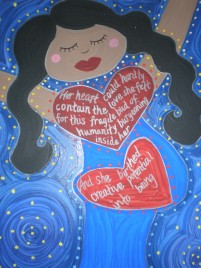
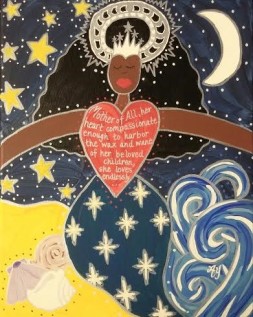
The first time I painted her, I wrote about my subsequent leaving of the church here on Feminism and Religion. Based almost entirely on Judith Plaskow’s beautiful midrash, “The Coming of Lilith,” I’ve painted a second Holy Woman Icon rendition of Lilith. In the Jewish tradition, midrash is akin to climbing inside the story—inside the Torah—and imagining what happened in the places where the text offers no description; it is the space between the letters, the creative imagination within the narrative that makes the story come alive.

According to Plaskow’s midrash, God created Adam and Lilith from the same earth. Tired of Adam demanding that she be subservient to him, Lilith left the Garden of Eden. She was later befriended by Eve and her legacy of empowering women continues today. Adding a queer twist to this feminist midrash, some claim that Lilith and Eve became lovers, as well. Continue reading “Painting Lilith, Queering Lilith by Angela Yarber”

Painting Mary(s), Queering Mary(s) by Angela Yarber

Mary 1
Mary

It’s no secret that the holidays are often a difficult time for queer people. Disproportionately estranged from family, we often must create our own family. While these chosen families can be tremendously life-giving, it’s tough not to long for our families of origin during Christmas time. Many still in relationship with family are forced to retreat to the closet for fear of safety or exclusion this season.

Queer folk who have affirming families of origin still experience the twang of heteronormativity in holiday commercials, family events, and church services throughout December. There’s a reason why many refer to it as “Blue Christmas,” because, well, the holidays can leave us feeling pretty blue when our identities are invalidated, excluded, questioned, or marginalized.

In every nativity scene, we see images of a so-called “holy family” that likely doesn’t look very much like the family’s most queer folk create: a straight, cisgender couple, and a baby. This family is lauded by the Church as the quintessential iteration of what family should look like. When our families don’t look anything like this, it’s easy to see how celebrating the birth of Jesus is fraught with emotional and spiritual hardship.

Mary 5
Virgin de la Regla

There is good news, though. We can subvert this narrative of traditional family by queering the story. So, I’d like to talk a bit about the revolutionary power of queering Mary. Abolitionist and Women’s Rights Activist, Sojourner Truth, said it best at the 1851 Ohio Women’s Convention. Once a slave, Truth questioned the whitewashing done to women of color by white women working only for white women’s right to vote by asking the famed question, “Ain’t I a woman?” In that same speech, she notes that male clergy claim that women “can’t have as much rights as men ‘cause Christ was a man.”

This adage is familiar, not only to women, but also to LGBTQs who have been told that our iterations of family aren’t real or true or right because they don’t reflect the so-called holy family of Joseph, Mary, and Jesus. In an act of theological brilliance and subversion, Sojourner Truth poses this question to the male clergy gathered at the convention: “Where did your Christ come from? Where did your Christ come from? From God and a woman. Man had nothing to do with him!” Continue reading “Painting Mary(s), Queering Mary(s) by Angela Yarber”