The Wisdom of the Beguines: The Forgotten Story of a Medieval Women’s Movement by Laura Swan, part 2 by Theresa C. Dintino 

Part 1 was posted yesterday

Praying people out of purgatory

Beguines excelled at this. By the Middle Ages, the belief in many Christian circles was that one did not go directly to heaven but to a sort of “holding place” after death to be cleansed of their sins before being allowed into heaven. Eventually “the medieval church also taught that people could pray for the souls in purgatory and that their prayers would effectively aid those souls in their transition from purgatory to heaven”(108).
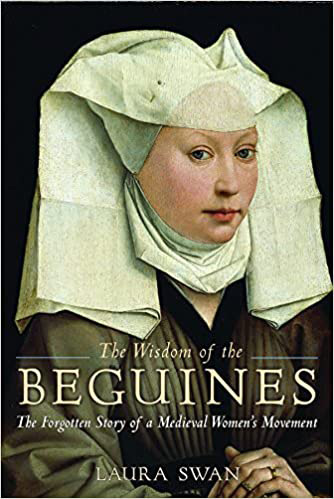
It’s important to note that these women were esteemed by the communities they lived in as spiritually gifted, able to intercede with God on their own without permission from the church, clergy or men. This is radical for the time.

“Beguines, as we have seen, were understood to have extraordinary spiritual powers. People believed that having a beguine intercede before God on their behalf was an assurance that their petition was heard by God—and perhaps in no instance more than for “those poor souls in purgatory.” And beguines believed that they did indeed exercise the authority to release countless souls from purgatory. Many of the stories included in the vitae of beguines grapple with the fate of the deceased in purgatory (or hell)”(109).

Continue reading “The Wisdom of the Beguines: The Forgotten Story of a Medieval Women’s Movement by Laura Swan, part 2 by Theresa C. Dintino “
The Wisdom of the Beguines: The Forgotten Story of a Medieval Women’s Movement by Laura Swan, part 1 by Theresa C. Dintino 

Moderator’s Note: This piece is in co-operation with The Nasty Women Writers Project, a site dedicated to highlighting and amplifying the voices and visions of powerful women. The site was founded by sisters Theresa and Maria Dintino. To quote Theresa, “by doing this work we are expanding our own writer’s web for nourishment and support.” This was originally posted on their site on July 5, 2022. You can see more of their posts here. 

Around 1200 AD in Europe, communities of women often called beguines began to form. These women were not nuns, they were devout and devoted to the tenets of Christianity but did not belong to any church. They were independent communities of women who often created their own industry, trade or other means to produce income. They were self-sufficient and generally concerned with helping the poor, especially women. They lived in convents. This was the origin of that word.

“These women were essentially self-defined, in opposition to the many attempts to control and define them. They lived by themselves or together in so-called beguinages, which could be single houses for as few as a handful of beguines or, as in Brugge, walled-in rows of houses enclosing a central court with a chapel where over a thousand beguines might live—a village of women within a medieval town or city”(2).

Continue reading “The Wisdom of the Beguines: The Forgotten Story of a Medieval Women’s Movement by Laura Swan, part 1 by Theresa C. Dintino “

Mysticism as a Female Path by Mary Sharratt


Women have been sidelined and marginalized in every established institutional religion in the world. Even in alternative spiritual movements, male teachers and leaders abuse their authority toward their female students and followers. This is why women’s circles and spiritual groups are as relevant and necessary in 2020 as they ever were. Those women who can’t find spiritual community often chose to go it alone on a solitary path. But they are not entirely alone–they follow in the footsteps of a long ancestral line of female seekers and mystics, who rejected a life of slavish obedience to male authority figures in order to contemplate the deep mysteries of the soul on a path of inner revelation.

The Cambridge Dictionary defines mysticism as the belief that there is hidden meaning in our existence, that every human being can unite with the divine. The American Dictionary states that mysticism is the belief that it is possible to directly receive truth or achieve communication with the divine through prayer and contemplation. Continue reading “Mysticism as a Female Path by Mary Sharratt”

How Can Change Happen If We Can’t Imagine It First? by Darla Graves Palmer

More than one hundred years ago, a small group of women joined together and decided to create their own village, one rooted in relationship and guided by spirit. They weren’t the first such women-led town in the country – there was a web of sister villages throughout America, some formed as early as the seventeenth century – but Chantilly Lace was unique. Rising out of the dust of an abandoned Gold Rush era in the Rocky Mountains of Colorado, a time when many women were abandoned by men seeking further adventures or widowed when husbands lost their lives in the mines, this mostly female community determined its own fate. Now the modern women (and a minority of men) faced new challenges in the twenty-first century: how would they adapt and thrive?

If this had been true, how might things be different now for all of us?

The above sets the stage for a fictional series of books I’ve been writing (the first book is complete). The locale was always going to be a small town in the Rockies (because I’ve lived there), but the broader ideas about the town’s development have been evolving steadily, especially since the last presidential election. I keep asking myself how a culture based upon principles of peace and values of belonging, established firmly upon a spiritual core, might function in our capitalist patriarchy.

How can change happen in real life if we can’t imagine it in fiction? I’m challenging myself to make it happen.

Continue reading “How Can Change Happen If We Can’t Imagine It First? by Darla Graves Palmer”

The Medieval Beguines: Models for Spiritual Agency Today by Cynthia Garrity Bond

In a recent article from U.S. Catholic, Common Law lawyer Karen Gargamelli and her newly founded lay community Benincasa are profiled.  Established in New York’s Upper West Side, Benincasa, is named and patterned after 14th century mystic and theologian, Catherine of Siena. It was established as house/retreat center, the emphasis of which is placed on prayer and the pursuit of social justice.

While Gargamelli practiced housing law she found it difficult to incorporate an ethos of Christian justice and spirituality into a secular matrix of thought.  At the same time, living alone in a studio apartment, Gargamelli also felt an alienation and lack of spiritual support from her local parish.  “I have a sense that before my time parishes were places where people felt supported,” laments Gargamelli, “I don’t know that the parish is really a home base anymore.”  Gargamelli  cites the Church’s focus on sacraments, along with less emphasis on theological reflection/adult education, as perpetrators of her spiritual malaise.  Continue reading “The Medieval Beguines: Models for Spiritual Agency Today by Cynthia Garrity Bond”