Heather Pringle: Celebrating Viking Women— Warriors, Weavers and Wise Women, part 1 by Theresa Dintino

Moderator’s Note: This piece is in co-operation with The Nasty Women Writers Project, a site dedicated to highlighting and amplifying the voices and visions of powerful women. The site was founded by sisters Theresa and Maria Dintino. To quote Theresa, “by doing this work we are expanding our own writer’s web for nourishment and support.” This was originally posted on their site on April 22th, 2025. You can see more of their posts here. 

Most people have heard of the Vikings, the seafaring warriors of Northern Europe. Their  travels to Iceland, Greenland and the American continent long before most believed contact was accomplished proved their prowess in navigation and traveling the turbulent waters of the north. Others are familiar with Norse Mythology: the flying Valkyries, god Odin and goddess Freya. But little has been known of the lives of ordinary or extraordinary Viking women until recently.

In The Northwomen: Untold Stories From the Other Half of the Viking World, Heather Pringle does an incredible job of gathering and telling the stories of these erased, ignored and unacknowledged women.

The chapter “Sorceresses and Demigoddesses” detailing the famous Oseberg burial of two high-status women in a Viking ship, is a powerful transmission. Then there is the chapter on recent revelations of the burials of Viking warrior women, which intrigue and astound.

But what is most remarkable about The Northwomen is that Pringle takes the time and care to include the story of the variety of ways women lived their lives in the Viking world. She does not only write about the “exceptional” women of the Vikings—the warriors and the sorceresses and Demigoddesses. She includes stories of women traders, ancestors, protectors, weavers, voyagers, and even the women the Vikings enslaved.

By looking into the myriad ways women lived their lives in Viking society, Pringle sheds light on all the ways women participated, contributed to, and created the culture of the  Vikings. This is, of course, true of all cultures of the world. Women have always participated in, contributed to and helped create culture, but often what is seen as women’s work gets left out as unimportant and nonessential. Pringle’s model in this book is a great one for us to follow to be sure that when we talk about women who have been erased, forgotten, and unacknowledged, we include all women, not only the ones we call exceptional —meaning the ones who excelled at what are often considered male accomplishments.

In the case of the women weavers of the Viking age, it becomes clear that without the weavers, there would be no Vikings. And yet, women’s accomplishments in textile arts is are often overlooked and left out of stories of culture and history.

Read Nasty Women Writers post: NastyWomenWeavers: Elizabeth Wayland Barber’s Women’s Work: The First 20,000 years

The people called the Vikings made their presence known to the monasteries of England beginning in 750 CE with the first documented raid. The origin of the term Viking is unknown.

“But whatever its origins, the name stuck. Today, English-language speakers use the term to include anyone, male or female, who lived in Scandinavia during the time now called the Viking Age, which began in the mid-eighth century and wound down after the mid 11th century or so”(NW 17).

The Oseberg ship burial

Many Viking burial mounds have been found and uncovered. In them are graves of high-ranking people, sometimes even buried in a whole ship. Because of the elaborateness of the burial and the wealth of grave goods, these burials were assumed to be that of men. However, the Oseberg ship burial revealed the graves of two high-status Viking women.

I doubt we can fully imagine who these two women were. Pringle does a good job creating a picture from what was found in the burial and what is known from myth and history, but also acknowledges there is much more to this story and we must keep listening. The degree to which these and other powerful female leaders were erased leaves us with a vacuum within which we find ourselves at a loss to even understand or begin to describe.

An interesting feature of the book is fictionalized vignettes at the beginning of each chapter written by Pringle about the women we are to encounter in the following pages. These introductions are compelling and give an intimate framework for the facts to follow. I hope she is planning to write a fictional version of this book and these women.

Within a mound on a farm in Norway called Lille Oseberg, was exposed the burial of a complete Viking longship with an ornate pattern of repeating dragon-like beings carved along its prow and stern. Inside the ship were also carriages, three wooden sleighs, a high wooden throne, an ornate chest and a pouch full of cannabis seeds.

“But the inventory of treasures didn’t end there. Tucked away in the burial chamber, Gustafson and his colleagues found five intricately carved animal heads, each the work of a master artisan. In addition, the team collected hundreds of fragments of delicate cloth. Some were remnants of rich robes trimmed with silk that probably came from Central Asia and the eastern Mediterranean; others were segments of tapestries that had hung in the great hall of someone rich and powerful. Woven by Scandinavian women, those artworks portrayed warriors, shield walls, shape-shifters, sorceresses, ceremonial processions, and human sacrifices”(NW 35).

The Oseberg ship from 820 in the Viking Ship Hall in Oslo, Norway. Photo Museum of Cultural History

The fact that this burial housed two women has been known since 1907. This ship is now on display in the Viking Ship Museum in Oslo. Encountering this ship and learning about this burial twenty years prior to writing this book is what whetted Pringle’s  appetite to know more about Viking women.

Oseberg Animal Head. Photo by Mike Fay, published on 06 February 2018

The bones of the Oseberg ship burial indicated that one of the women was a crone, almost 80 years old, which, for Viking women is beyond old. Most died at 40. The other woman was between 50-55 and may have been from Persia. Both seem to be women of privilege and high rank. Norwegian archaeologist Anne Stine Ingstad states:

“That the grave was so rich, so packed with ceremonial regalia and so unlike any other known Viking Burial that it may have contained a woman of extraordinary power—a woman who was at once a queen and a royal broker between the realm of humans and the world of gods and goddesses”(NW 44).

It is well known that some Viking women were sorceresses of magnificent prowess. They could raise a warrior from the dead on the battlefield, see into the future, and create smokescreens and other protections on the high seas. These women were most likely sought out and utilized by warriors as well as highly valued in the general culture.

They were identified by the possession of their magical staffs and box-like thrones that they sat upon to speak their incantations, spells and prophecy. They traveled with a retinue of women who performed chants that induced trance to open portals into the otherworldly realms. They were also herbalists and cast spells by throwing seeds upon a high-burning fire. These women passed the craft on to one another in a continuous lineage. Most likely groups of them travelled together and supported one another in the work.

Oseberg sleigh. Viking Ship Museum, Norway. photo by Helen Simonsson, published on 07 July 2018

These women are called Volva (sing) or Volur (pl) which translates to “wand wed.”

“The poetic language surrounding these tools suggested the varied ways in which a sorcery staff could be used. Metaphors often linked magic to spinning, suggesting that a sorceress placed the staff between her legs and spun it, as if spinning an invisible thread onto the rod. In the ancient Nordic world, people believed that a sorceress’s soul left her body as she entered a trance state. Tethered to her by only a slender thread, her soul was then free to roam the spirit world in search of knowledge. Later, to retrieve it, a volva had to reel it back in with her staff”(NW 50).

Though some believe burying people in ships was a metaphor for sailing to the otherworld, Pringle reminds us that many cultures, including the Vikings, believed that a seer could still offer oracle after her death at the site of her burial. This burial mound in Oseberg may well have remained a place of oracular power long after these women were buried.

The women of the Oseberg burial were perhaps leaders of this spiritual lineage and it could be that many made pilgrimage to visit the grave to continue to seek oracle and  protection and to honor them.

And perhaps these women were also leaders of the Vikings at a certain point in time. In the ancient world, leaders were also usually spiritual leaders. Whoever they were, they were certainly important to the people who honored them with such a burial.

Part 2 tomorrow . . .

We Will Be Jaguars: A Memoir of My People by Nemonte Nenquimo, part 2 by Theresa Dintino

Part 1 was posted yesterday.

Eventually, Nemonte is fully taken in and away from her village by the missionaries to the city where she is indoctrinated further into White world with sexual abuse and rape. After years of this she is raging and lost, separated from her people and living in the city. She finds her brother and they decide to return to their people and try to find a way to change the trajectory.

“I couldn’t go home anymore. It was too late for that. I had left the forest many years ago because I believed in the white people. I had trusted them, thought they were better than us. Their skin, their teeth, their clothes, their planes, their promises. But now I knew they had no limits, that they wanted everything. They wanted to save our souls and change our stories and steal our lands. Those distant oil wells rumbling in the depths of the village night—those wells were creeping closer and closer. I still didn’t know what to do about it”(198).

Now she can speak, read, and write Spanish. Now she is educated in the White people ways. Now she can be a bridge. And what a bridge she will become.

Continue reading “We Will Be Jaguars: A Memoir of My People by Nemonte Nenquimo, part 2 by Theresa Dintino”

We Will Be Jaguars: A Memoir of My People by Nemonte Nenquimo, part 1 by Theresa Dintino

Moderator’s Note: This piece is in co-operation with The Nasty Women Writers Project, a site dedicated to highlighting and amplifying the voices and visions of powerful women. The site was founded by sisters Theresa and Maria Dintino. To quote Theresa, “by doing this work we are expanding our own writer’s web for nourishment and support.” This was originally posted on their site on May 20th, 2025. You can see more of their posts here. 

She didn’t know what the United States was. She didn’t know where it was, she called it “the land of Rachel” after the missionary in her village. She didn’t know what God was. She only knew if she went to church, she may get a pretty dress. And she wanted one.

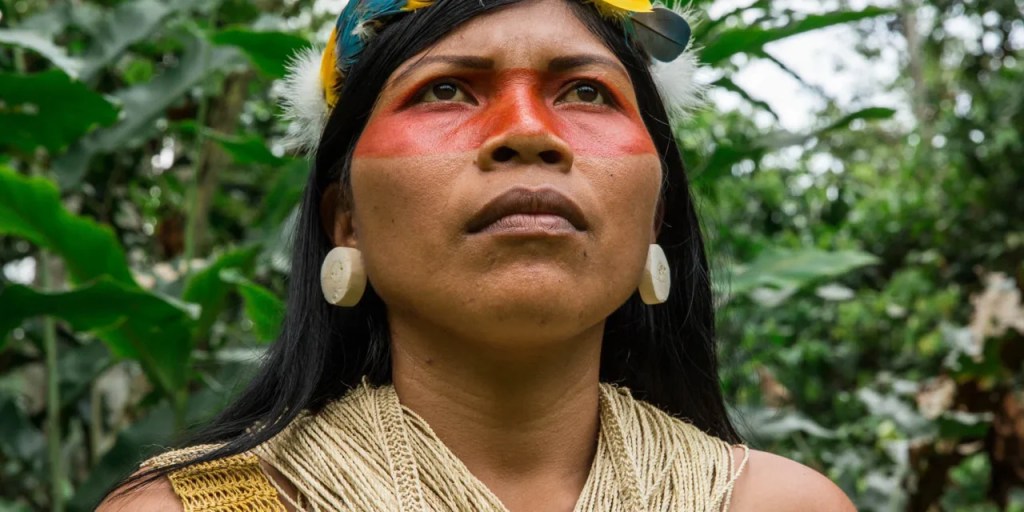
More important than an activist tome, more important than a cry for the Amazon Rainforest and acknowledgement of indigenous peoples’ right to their own land, more important than a scathing exposé on colonialist pillage, and predatory preachers, this book is the story of a woman growing up, a woman coming of age, a woman allowing us into her personal story and her unique worldview in her own voice. This book is a treasure primarily because of that. Because we finally get to hear the story from the point of view of a Waorani woman as she experienced it.

Continue reading “We Will Be Jaguars: A Memoir of My People by Nemonte Nenquimo, part 1 by Theresa Dintino”

All That She Carried by Tiya Miles: Recovering the Untold Stories of Black Women in America, part 2 by Theresa Dintino

Part 1, appeared yesterday.

There are many women named Rose in the ledgers of unfree people in Charleston around 1850. The defining feature to find the Rose mentioned on this sack is that her daughter is named Ashley, not a common name for Black female children of the time. Miles finally locates a Rose and an Ashley in the inventory of Milberry Place Plantation, a country estate of a man named Robert Martin. When Martin died, his estate was liquidated and thus the mention of the sale of Ashley. 

“Ashley is listed among one hundred unfree people in the inventory of Martin’s enslaved property taken in the year 1853. Her attributed value of $300, in comparison to that of other women listed at $500 and $600 in the cotton boom decade of the 1850’s, suggests that she may have been a younger or relatively unskilled worker”(69).

Things were bad enough for unfree people but the disruption that came like a tsunami through their lives when an enslaver died and his property was sold was a fear most carried and trembled at the thought of. Unfree families were always being torn apart in the time that slavery was legal and allowed in this country, but when estates were being divided up, it became particularly excruciating and this is what came to pass for Rose and Ashley. 

Continue reading “All That She Carried by Tiya Miles: Recovering the Untold Stories of Black Women in America, part 2 by Theresa Dintino”

All That She Carried by Tiya Miles: Recovering the Untold Stories of Black Women in America, part 1 by Theresa Dintino

Moderator’s Note: This piece is in co-operation with The Nasty Women Writers Project, a site dedicated to highlighting and amplifying the voices and visions of powerful women. The site was founded by sisters Theresa and Maria Dintino. To quote Theresa, “by doing this work we are expanding our own writer’s web for nourishment and support.” This was originally posted on their site on November 30, 2021. You can see more of their posts here. 

First she was told about a grain sack dating from around 1851 that had these words  embroidered on it:

My great grandmother Rose
mother of Ashley gave her this sack when
she was sold at age 9 in South Carolina
it held a tattered dress 3 handfulls of
pecans a braid of Roses hair. Told her
It be filled with my LOVE always
she never saw her again
Ashley is my grandmother
Ruth Middleton
1921

Continue reading “All That She Carried by Tiya Miles: Recovering the Untold Stories of Black Women in America, part 1 by Theresa Dintino”

Diana Beresford-Kroeger: Integrating Celtic Wisdom and Science, part 2 by Theresa Dintino

Part 1 was posted yesterday

Combining ancient wisdom and western science

At age sixteen Beresford-Kroeger was graduated from her mentorship of the Lisheens and went on to become a scientist, learning medical biochemistry and botany. Eventually she saw that many of the things she learned from the Lisheens elders could be scientifically proven. This offered her delight and reassurance.

One of the first of these was the plant Chrondrus crispus or seaweed named Irish moss. Her Great-Aunt Nellie taught her that it cured tuberculosis and how to prepare and use the gel-like mucilage it released upon being boiled.

In the lab Beresford-Kroeger later discovered that this mucilage has antibiotic properties.

“The feeling this confirmation of Nellie’s teaching gave me is hard to describe. I loved my teachers in Lisheens, but I hadn’t completely ruled out the idea that the things I’d been taught there were just old superstitions. I needed to confirm them for myself. There was always the chance that there would turn out to be nothing of import in the plants they’d emphasized to me, and nothing more to the ancient knowledge than beautiful clouds of vapor”(96).

She began to understand that what she had been taught was an oral tradition and that it existed in no other format and that she was meant to be a bridge between “the ancient and the scientific”(97).

“My teachers in the valley might have indicated that a particular plant was good for poor circulation, which I’d taken to mean heart trouble. I would then know to keep a particular eye out for the presence of any chemical known to benefit the heart. “Well, Diana,” they might have begun, while cradling a small, five-pointed yellow flower in the crook of two fingers. “St. John’s Wort, as you see here, has a strong medicine for nervousness and mental problems.” I would later find out that St. John’s Wort contains phytochemicals such as hyperforin, which increase the effectiveness of dopamine and serotonin in the brain. The plant is as effective as many prescription anti-depressants, and may in some cases be more effective”(98).

Continue reading “Diana Beresford-Kroeger: Integrating Celtic Wisdom and Science, part 2 by Theresa Dintino”

Diana Beresford-Kroeger: Integrating Celtic Wisdom and Science, part 1 by Theresa Dintino

Moderator’s Note: This post is brought to you by a collaboration by FAR and Nasty Women Writers written and hosted by Maria and Theresa Dintino. This post originally appeared on their website on Sep 12, 2023

In her book To Speak for the Trees: My Life’s Journey from Ancient Celtic Wisdom to a Healing Vision of the Forest, Diana Beresford-Kroeger  shares her origin story, the humble beginnings of the famous scientist, the activist and crusader for the planet she became. We learn on what forge that will, strength, brain and consciousness were smelted. And it is one of beauty, strength and love, one that takes the breath away.

I loved this book. I loved going deeper and deeper into Beresford-Kroeger’s life story, into the rich depths of her Celtic heritage and medicine lineage. To learn the secrets and the wisdom. Beresford-Kroeger offers sacred transmission in this book, revealing another part of herself. It is a vulnerable telling and an irreplaceable gift.

Continue reading “Diana Beresford-Kroeger: Integrating Celtic Wisdom and Science, part 1 by Theresa Dintino”

The Wisdom of the Beguines: The Forgotten Story of a Medieval Women’s Movement by Laura Swan, part 2 by Theresa C. Dintino 

Part 1 was posted yesterday

Praying people out of purgatory

Beguines excelled at this. By the Middle Ages, the belief in many Christian circles was that one did not go directly to heaven but to a sort of “holding place” after death to be cleansed of their sins before being allowed into heaven. Eventually “the medieval church also taught that people could pray for the souls in purgatory and that their prayers would effectively aid those souls in their transition from purgatory to heaven”(108).

It’s important to note that these women were esteemed by the communities they lived in as spiritually gifted, able to intercede with God on their own without permission from the church, clergy or men. This is radical for the time.

“Beguines, as we have seen, were understood to have extraordinary spiritual powers. People believed that having a beguine intercede before God on their behalf was an assurance that their petition was heard by God—and perhaps in no instance more than for “those poor souls in purgatory.” And beguines believed that they did indeed exercise the authority to release countless souls from purgatory. Many of the stories included in the vitae of beguines grapple with the fate of the deceased in purgatory (or hell)”(109).

Continue reading “The Wisdom of the Beguines: The Forgotten Story of a Medieval Women’s Movement by Laura Swan, part 2 by Theresa C. Dintino “

The Wisdom of the Beguines: The Forgotten Story of a Medieval Women’s Movement by Laura Swan, part 1 by Theresa C. Dintino 

Moderator’s Note: This piece is in co-operation with The Nasty Women Writers Project, a site dedicated to highlighting and amplifying the voices and visions of powerful women. The site was founded by sisters Theresa and Maria Dintino. To quote Theresa, “by doing this work we are expanding our own writer’s web for nourishment and support.” This was originally posted on their site on July 5, 2022. You can see more of their posts here. 

Around 1200 AD in Europe, communities of women often called beguines began to form. These women were not nuns, they were devout and devoted to the tenets of Christianity but did not belong to any church. They were independent communities of women who often created their own industry, trade or other means to produce income. They were self-sufficient and generally concerned with helping the poor, especially women. They lived in convents. This was the origin of that word.

“These women were essentially self-defined, in opposition to the many attempts to control and define them. They lived by themselves or together in so-called beguinages, which could be single houses for as few as a handful of beguines or, as in Brugge, walled-in rows of houses enclosing a central court with a chapel where over a thousand beguines might live—a village of women within a medieval town or city”(2).

Continue reading “The Wisdom of the Beguines: The Forgotten Story of a Medieval Women’s Movement by Laura Swan, part 1 by Theresa C. Dintino “

How the Nineteenth-Century Spiritualist Movement Gave Voice to American Women -Part 2 by Theresa Dintino

Moderator’s Note: This post is presented as part of FAR’s co-operation with The Nasty Women Writers Project, a site dedicated to highlighting and amplifying the voices and visions of powerful women. The site was founded by sisters Theresa and Maria Dintino. Part 1 was posted yesterday

Spiritualism began with two young girls, the Fox sisters, hearing knocking sounds in their home near Rochester, N.Y . They determined the knocking to be coming from a man who was murdered and buried under their home. The knocking was soon categorized into an alphabet out of which seances began. In seances groups of people gathered and put their hands on a table while asking questions of ancestors who made themselves known by rapping and knocking in response. Next, mediums in the form of young women speaking the answers of the dead as the bereaved asked them questions, emerged. Instructions were disseminated on how to be a medium and how to run a seance. The movement took off.

The movement was largely white, northern Protestants but other ethnicities were  involved. The Black population may have influenced the arising of these practices with traditions brought with them from West Africa.

Continue reading “How the Nineteenth-Century Spiritualist Movement Gave Voice to American Women -Part 2 by Theresa Dintino”