
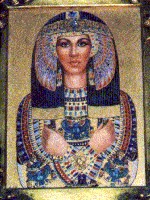
Happy Birthday Isis: Isis Isis…Ra! Ra! Ra! by Karen Tate

I wanted to pull myself away from the ugliness out there and take time to honor the Egyptian Goddess, Isis, as Her birthday is recognized to be in the latter part of July.  My husband, Roy, and I formed the Isis Ancient Cultures Society and the Iseum of Isis Navigatum, in Los Angeles, sometime ago and for more than a decade, in Her name, we sponsored Moon Circles to promote diversity, Salons to teach, and we put out a quarterly newsletter when you still had to fold and mail them – remember that?  But the premier events every  year were the Isis Birthday Tea and the Isis Navigatum or Festival of Isis, every March.    Our aim was to reconstruct Isis rituals in a modern context and make them relevant  for today.

We put on the Isis Tea in prestigious locations like aboard the Queen Mary and the Isis Navigatum in various public locations including The Japanese Gardens, in the San Fernando Valley, and on the beach on Point Dume, in Malibu, California.  So detailed were our events, sometimes the public joined us thinking we were a movie crew and our organization was written about by a anthropologist/folklorist citing the detail and depth of the material culture of contemporary Isian devotees.

Continue reading “Happy Birthday Isis: Isis Isis…Ra! Ra! Ra! by Karen Tate”

Hagar – Demoted Servant or Egyptian Princess? By Michele Stopera Freyhauf

A socio-political examination of Genesis 16 explores how ancient myth can influence the story of Hagar and Sarai. Socio-political events could have occurred between the Egyptians and King Solomon that influenced the writing of this text.  According to John Currid in Ancient Egypt and the Old Testament, the Egyptians and Hebrews borrowed many things from each other and because of that, an inter-relatedness exists between the languages as well as cultural and religious practices of both kingdoms (26).  It is this inter-relatedness that I wish to explore and ask the question -was Hagar an Egyptian Princess demoted to a lower position of servitude in order to make a political statement of superiority of the Israelites over the Egyptians?  Or is this a story of conflict between two of Solomon’s wives?  Finally, could this story tell us about events that occurred after Solomon’s death since the Biblical texts from the pre-exilic period began to take shape during the reign of David and Solomon?  This is a very brief exploration of these theories.

In Genesis 16, Hagar and Sarai connect Egypt and Israel in a familial relationship, one rooted in strife.  These two women, an Israelite and an Egyptian, are brought together because of Sarai’s barrenness and need to fulfill the covenantal promise. Because of this, Hagar becomes Abram’s secondary wife.  This is not the only time that marriage between an Israelite and Egyptian occurs in the Old Testament.  Joseph marries and an Egyptian, the daughter of a priest of On (Genesis 41:45).  Solomon also has an Egyptian wife who seems to have some importance because she is mentioned six times in the Old Testament (1 Kings 3:1; 7:8, 9:24; 11:1-2; 2 Chronicles 8:11).

Important is the fact that this passage could be rooted in the writings that emerged in that period that portray family strife.  Savina J. Teubal in Ancient Sisterhood: The Lost Traditions of Hagar and Sarah, states these “andocentric writing and editing” of the biblical narratives portray conflicts between women who “vie for the attention of their husbands or sons” (19).  In this case the story really could be a tale of family strife inspired by two of the wives of Solomon, one of which was Egyptian.

Continue reading “Hagar – Demoted Servant or Egyptian Princess? By Michele Stopera Freyhauf”