Bird Watching and Geology in the Body of Goddess by Carol P. Christ

carol p. christ 2002 color

The notion of the earth as the body of Goddess has taken on deeper meaning for me in recent years.  I have felt connected to nature all of my life.  Yet often, though not always, I have related to nature in general rather than in specific ways. Some years ago, after reading Hartshorne’s essay “Do Birds Love Singing?” I stopped for the first time in the wetlands of Kalloni, Lesbos, to see the flamingoes that live in the salt pans there.

Flamingo's-Kalloni3-Saltpan

One thing led to another, and I met someone with whom I spent the next six weeks visiting every pool and puddle where birds were stopping in Lesbos that spring.  Continue reading “Bird Watching and Geology in the Body of Goddess by Carol P. Christ”

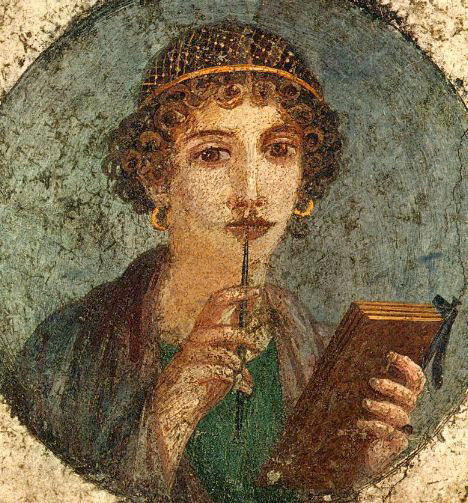
Sappho Chose Love Not War, What Will You Choose? by Carol P. Christ

*

We have been taught to speak of war and the heroes of war in hushed tones. We have been told that evil Helen’s choice was the cause of the Trojan war.  2600 years ago Sappho, known as the greatest lyric poet of ancient Greece, spoke truth to power and unmasked the lies told at the beginning of western tradition.

*

In a poem addressed to Anactoria, Sappho writes:

            Some say a cavalry corps

            some say infantry, some, again,

            will maintain that the swift oars

            of our fleet are the finest

            sight on dark earth …

Here, Sappho invokes the heroic tradition celebrated in the epic poems of Homer that shaped the values of ancient Greek culture and all the cultures that followed it, including our own.  This tradition tells us that to serve in a war and to be remembered as a hero is the highest goal to which a man can aspire.  Sappho does not agree:

             …but I say

             that whatever one loves, is.

Continue reading “Sappho Chose Love Not War, What Will You Choose? by Carol P. Christ”

Cry The Beloved Country by Carol P. Christ

With the final day of voting in the US election less than 24 hours away, I feel a deep sadness descending on my soul. 

This election will have far-reaching consequences in relation to a number of issues I care deeply about. Among them are health care, social services, a social safety net, a graduated tax structure that taxes the rich and to a lesser extent the middle classes in order to provide services for the poor, equal pay for equal work, a woman’s right to choose, and gay rights.  On these issues there is a clear choice between the two candidates for President and the two parties. 

Democrats believe that health care is a human right, that social services should be provided for those who need them, that taxes should be paid by those who can afford to do so, that women have a right to equal pay and control of our own bodies, and that gays and lesbians should have all the rights of other citizens. Republicans believe that government does not need to provide or control health care, that social services are largely unnecessary, that it is unfair to tax the rich, that equal pay is not important if women have husbands, that the church and state should be making decisions about women’s bodies, and that homosexuality is a unnatural.  There is a clear choice on these issues. 

For this reason, I urge all of you who have not voted yet—and those of you who are considering not voting–to vote, no matter how long the lines are, no matter what intimidation you may face, and no matter what discouragement and disappointment you may be feeling.*

Nevertheless I feel like crying.

I feel sad that just about half of all Americans who intend to vote will be voting for the rich, against the poor, and against women’s—my–independence.  Continue reading “Cry The Beloved Country by Carol P. Christ”

THE CARELESS SPIRIT OF ANNIE CORLISS: TRUMPING DESPAIR IN THE NEW WORLD by Carol P. Christ

Annie Corliss was my great-great-grandmother. The Corliss name, also spelled Corlis, Corless, Corlies, Corlers, and Carlis, is derived from “careless” meaning someone who is “carefree” or “happy-go-lucky.”

Annie Corliss was the daughter of James and Mary Corliss, both born in Ireland. Her parents may have been tenant farmers, but given that their surname could refer to someone who doesn’t settle or own property, they may have been Irish Travellers– itinerant craft persons and traders, sometimes called tinkers because they mended cooking pots and farm implements.  “Irish Travellers are a traditionally nomadic people of ethnic Irish origin, who maintain a separate language and set of traditions. … Irish Travellers have their roots in a Celtic (and possibly pre Celtic) nomadic population in Ireland.” Continue reading “THE CARELESS SPIRIT OF ANNIE CORLISS: TRUMPING DESPAIR IN THE NEW WORLD by Carol P. Christ”