A Family Conceived, Lost, and Resurrected by Gina Messina-Dysert

As I had written about in a previous post, my husband and I had a very long struggle with infertility.  After nine years, multiple failed rounds of infertility treatments, and much heartache, we decided to look at alternative options to grow our family.  Once we had made the decision to adopt, I felt new hope.  There was a light at the end of the tunnel and I knew a child would be coming home to us before long.  I had a dream that Mary, the mother of Jesus, had come to me and told me that I would be a mother.  She promised that a child was waiting that needed our love and would arrive soon.  I began praying to a shrine of Mary at a local parish near my home; she became my source of strength and solace.

Not long after we had been approved for the adoption waiting list, we took a family trip to Italy to visit my father’s hometown and meet our relatives.  It was quite an adventure and during our excursion I stopped in every church we passed to say a prayer to Mary.  Half way through the trip we received a call that a child had been matched with us.  To say we were overjoyed would be a complete understatement.  We tried to catch an earlier flight home but were unable.  A once in a lifetime trip to Italy was suddenly of no interest to us as we sat around our hotel room looking at baby items, reading parenting info, and preparing for the homecoming of our first child.   Continue reading “A Family Conceived, Lost, and Resurrected by Gina Messina-Dysert”
Peace Begins at Home by Gina Messina-Dysert

I began my career in the field of social services as a woman’s advocate for rape and domestic violence survivors.  The motto for an organization I was employed with early on was “peace begins at home,” a significant point that must be acknowledged. While much attention around women’s involvement in peacebuilding efforts have been focused at the macro level, there has been little consideration of women’s efforts towards peace at the micro level.  Certainly, women’s involvement in formal peacebuilding processes at the larger public level is crucial.  This being said, we must not undermine the leadership roles that women play in their homes, their families, and their religious and immediate communities, and how those roles can have an incredible impact on greater society.

I would like to start off by defining “peace.”  It is a word that we all use quite frequently and often with different meanings.  Some would claim that peace equates the cessation of conflict.  However, within our world conflict is inevitable; daily life is riddled with internal, interpersonal, intergroup, and international conflict. Thus, when defining peace, we must understand it as being able to deal creatively with inevitable conflict.  According to Jean Zaru, “It is the process of working to resolve conflicts in such a way that both sides win, with increased harmony as the outcome of the conflict and its resolution.  Peace is based on respect, cooperation, and well being.  Peace is the presence of social justice” (Occupied with Non-Violence, p. 81-2).

Zaru’s comments here are important in that she acknowledges a clear relationship between peace and justice.  In the words of Pope Paul VI, “if you want peace, work for justice.”  Because peace is not only the absence of war, but also the absence of poverty and disease, the access to clean water, the freedom from slavery; peace is the affirmation of the full humanity of every person. Peace is salaam, peace is shalom, peace is the well being of all.  Thus, there are many elements that come together in the word peace.  It is not simply government initiatives, it is not a patchwork solution to the conflicts of the world, nor is it submission or silent acceptance, rather we must understand peace as justice. Continue reading “Peace Begins at Home by Gina Messina-Dysert”

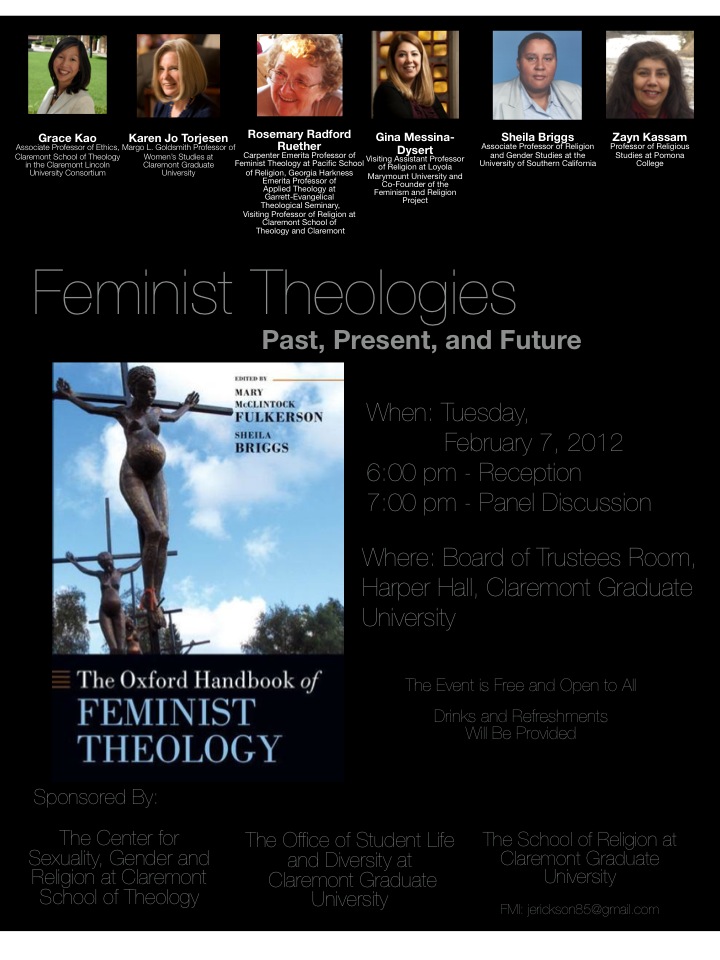
Feminist Theologies: Past, Present, and Future

On February 7, 2012, a panel discussion focused on the past, present, and future of feminist theologies took place at Claremont Graduate University to celebrate the release of TheOxford Handbook on Feminist Theology.  The panel was organized by John Erickson, moderated by Grace Kao, and featured Karen Torjesen, Rosemary Radford Ruether, Gina Messina-Dysert, Zayne Kassam, and Sheila Briggs as presenters.  What resulted was a terrific discussion about women, religion, and feminist theologies.  Many were in attendance and participated in the panel; for those who were unable to attend, here is a video of the presentations from that evening.  We look forward to you sharing your thoughts and comments about the past, present, and future of feminist theologies.

Women being “Raped too much?”: Fox News, Liz Trotta, and Rape Culture by Gina Messina-Dysert

I may be a bit late to the conversation, but it is impossible for me not to comment on the infuriating statements made by Liz Trotta on Fox News about the staggering 64% increase in sexual assaults against women in the military since 2006.  Responding to reports from the Pentagon about women serving in combat, Trotta complained that money is being wasted on women in the military who are “raped too much.”  The statements by the Fox News pundit well demonstrate the existence of rape culture within our society and the continued problem of victim blaming and double victimization experienced by women who have been raped.

In her rant, Trotta claimed that women want to be “warriors and victims at the same time.”  She argued that women who want to serve in the military should expect to be raped and not raise such a fuss about it. She also alleged that “feminists” have demanded too much money to fund programs for sexual abuse victims.

“I think they have actually discovered that there is a difference between men and women. And the sexual abuse report says that there has been, since 2006, a 64% increase in violent sexual assaults. Now, what did they expect? These people are in close contact, the whole airing of this issue has never been done by Congress, it’s strictly been a question of pressure from the feminists… You have this whole bureaucracy upon bureaucracy being built up with all kinds of levels of people to support women in the military who are now being raped too much.”

First, I must ask, is there an acceptable amount of rape?  Trotta’s tone is outrageous as she implies that we should expect rape to occur if women and men are going to be in such “close contact” with each other.  Rape is not about sex; it is about violence.  Thus, the disturbing notion that men in the military rape because they cannot control their sexual urges is one that is ill-informed (not to mention a major insult to all men!). Continue reading “Women being “Raped too much?”: Fox News, Liz Trotta, and Rape Culture by Gina Messina-Dysert”

Hildegard of Bingen to be Canonized and Named Doctor of the Church By Gina Messina-Dysert

Known as the “Sybil of the Rhine,” Hildegard of Bingen was a remarkable woman who produced multiple visionary writings and major theological works throughout her life (1098-1179).  During a time period when women received little respect, Hildegard was consulted by religious and political leaders and advised popes and kings.  Her contributions are many and include founding a convent, composing music, and writing about the medicinal uses of natural objects such as plants, trees, animals, and stones.

It was recently announced that Hildegard of Bingen will be canonized and declared a doctor of the church.  Hearing this I was among the many who were surprised by the news since I had assumed that Hildegard was already canonized, particularly since she has been called St. Hildegard and has had a feast day on September 17th since 1940 (although only within the Benedictine order in Germany).  Nonetheless, I have recognized Hildegard as a crucial woman in Christian history – as crucial as St. Catherine of Siena, St. Teresa of Avila, and St. Therese of Lisieux who have already been canonized.  So why the delay in granting this honor to Hildegard of Bingen? Continue reading “Hildegard of Bingen to be Canonized and Named Doctor of the Church By Gina Messina-Dysert”

Feminist Music By Gina Messina-Dysert

Last week Caroline Kline shared the article “Feminist Films” and discussed the Bechdel Test as a way to identify whether or not a film is feminist.  It left me wondering – can we identify music as feminist in the same way?  Music generally does not offer dialogue between two women.  But there are instances where we find two women singing together about feminist issues like the 80’s classic “Sisters are Doin’ it for Themselves.”   There are also women singing about or to women, like Juliana Hatfield’s “My Sister.” And there is music that acknowledges women’s struggles as women like Ani Difranco’s “I’m No Heroine,” No Doubt’s “I’m Just a Girl,” and Pink’s “Stupid Girls”.    But is this the only way to identify feminist music?   Continue reading “Feminist Music By Gina Messina-Dysert”

Women Blogging Thealogy By Gina Messina-Dysert

In Rebirth of the Goddess: Finding Meaning in Feminist Spirituality, Carol Christ offers a thealogy that is grounded in embodied thinking and begins with personal experience. She explains that experience is “embodied, relational, communal, social, and historical” (p. 37),  and that experiences of the Goddess are shaped and inspired by the experiences of others. Consequently her thealogy, in addition to being personal, is also communal.

According to Christ, the “voices of women are a lifeline” (Rebirth of the Goddess, p. 41), a sentiment that has been loudly echoed by women in blogging communities. Although some may claim that a blog is nothing more than an online diary, it is a powerful tool that offers individuals the opportunity to express their thoughts and experiences in a public forum; blogging gives a voice to anyone who wants it. Recent statistics have Continue reading “Women Blogging Thealogy By Gina Messina-Dysert”

Dr. Mercy Oduyoye and the Ninth Annual Patricia Reif Lecture By Gina Messina-Dysert

Dr. Mercy Oduyoye is the Ninth Annual Patricia Reif Lecture speaker and will present “Women and Violence in Africa: the Plight of Widows and the Churches Response” on Monday, November 14, 2011 at 7pm at the Mudd Theater on the Claremont School of Theology campus.  Oduyoye is Africa’s foremost feminist theologian whose contributions have greatly impacted worldviews on gender and religion.  I am familiar with Oduyoye’s work and today had the honor to meet her in person and have a one on one conversation about violence against women, feminism, and religion.

Oduyoye was incredibly gracious and entertained all my questions about her work, her insights in regards to violence against women, and her thoughts about feminism and religion and where the field is going.  She explained that although some believe feminism is dead, the marginalization of women continues to be a serious issue.  Although the issues women face change over time, women continue to be oppressed.  According to Oduyoye, we must recognize that the issues women faced 50 years ago are different from the issues women face today; however this does not mean that gender-based inequalities have seized to exist.  Rather, it means that the culture has manifested itself in a new way.  We must come to recognize this and continue to work towards the eradication of gender-based violence.    Continue reading “Dr. Mercy Oduyoye and the Ninth Annual Patricia Reif Lecture By Gina Messina-Dysert”

Confronting Sexual Harassment Ten Years Later: Speaking Out, Empowerment, and Refusing to Accept Defeat By Gina Messina-Dysert

Much of my research and activism thus far has centered on rape culture*, sexual violence, and spiritual wounding.  This being said, I have given little consideration, and have shared even less, of my own experience of sexual harassment perpetrated by a professor at the end of my undergraduate career.  Although I had called myself an advocate for women who had been victimized by various forms of violence, sexual included, I was unable to advocate for myself when confronted with my experience.  What’s more, although I have called for a speaking out of one’s experience of sexual violence in order to challenge the rape culture and begin the healing process, I have not been able to do this myself.

My professor sexually harassed me during my final semester of college in the very last course I needed to graduate.  The first time he approached me he asked me to stay after class.  Initially I was nervous thinking I had done something wrong; however I was surprised when he began to ask me personal questions.  I was engaged at the time and Dr. X commented how lucky my now husband was.  He then reached out, hugged me, and stroked my hair.   I didn’t move, I was scared and wondered what was happening. After a few moments, I forced myself out of his arms and with my head down, unable to look him in the eye, I said I had to leave and darted out the door. My initial reaction was to downplay his inappropriate behavior and I convinced myself that I must have misinterpreted the situation.  Continue reading “Confronting Sexual Harassment Ten Years Later: Speaking Out, Empowerment, and Refusing to Accept Defeat By Gina Messina-Dysert”

Rosemary Radford Ruether’s Women and Redemption: A Theological History By Gina Messina-Dysert


Women and Redemption : A Theological History. 2nd ed. By Rosemary Radford Ruether.Minneapolis: Fortress Press. 2011.

Women and Redemption: A Theological History

Having been critically impacted by the work of Rosemary Radford Ruether, I was anxious for the release of the second edition of her crucial book, Women and Redemption: A Theological HistoryRedesigned with illustrative material, research questions, and suggested reading for further research, as well as the addition of a new chapter exploring recent developments in feminist theology, this text does not disappoint.

With this newest edition, Ruether acknowledges the ongoing journey in the field of feminist theology and emerging issues faced by women in religion and society. Examining the Christian claim of an inclusive and universal redemption in Christ, she traces paradigm shifts in understandings of gender over the last two millennia.  Ruether offers an historical exploration of women and redemption in the first five chapters followed by a global survey of contemporary feminist theologies in the final four chapters, which includes a concluding section that gives attention to “Fourth World” feminisms and post-colonialism in an effort to “bring this volume up to date” (xvii). Continue reading “Rosemary Radford Ruether’s Women and Redemption: A Theological History By Gina Messina-Dysert”