
Making Room for Reverence by Kelly Applegate-Nichols

While the Goddess spirituality movement runs alongside the women’s and feminist spirituality movements, I am certain the Goddess herself looks on with wonder and pride at Her creations. I am sure that it pleases Her to see women so devoted to self-sovereignty, and the fierce determination to get out from under the lash of patriarchy, to stand as women together, united in our passion for a better world.

While I know in my heart that we are continually held in the mind of the Goddess, I am called to wonder, how often is She in ours?

Though we make great strides together in our common goal of freedom and peace, some of us seem to be less at peace than ever before; there seems to be an undercurrent of loneliness, of disconnection. Lately, I’ve been thinking, it is at least possible that the thing that keeps us up at night is less about the state of the world, and more about the sometimes tenuous connection with our Mother. We may be so focused on self-empowerment that we have forgotten that there is another power, a “higher power” if you will. And She wants to commune with us.

Continue reading “Making Room for Reverence by Kelly Applegate-Nichols”
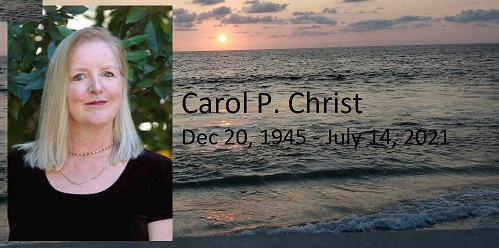
Legacy of Carol P. Christ: THE “G” WORD

This was originally posted on December 10, 2011

Recently, I saw the following line in a promotion for a book to which I contributed: “This volume includes voices from Christianity, Judaism, goddess religion, the Black church, and indigenous religions.” The editors of this book are to be strongly commended for expanding the dialogue in feminism and religion beyond the confines of the Christian hegemony in which it is still all too often framed.  Nonetheless, I felt hurt and offended.  I immediately wrote to the editors asking how they would feel if a book were promoted using the words:  “This volume includes voices from Goddess religion and god traditions such as judaism and christianity.”

Continue reading “Legacy of Carol P. Christ: THE “G” WORD”

My Church Won’t Let Me Call the Divine “Father” by Trelawney Grenfell-Muir

I had a startling experience in church recently. It was Father’s Day, and the pastor was talking about how “God is our heavenly Father.” For the first time in 17 years, that idea held some appeal to me. But no sooner did the thought enter my mind, then it was ripped away by the realization that my church will never allow me to symbolize the divine as a “father.”

I grew up with “God the Father” language saturating my churches. I also grew up with a rageful, unsafe, sometimes abusive father, who was also wonderful, empowering, and feminist in many ways. Seventeen years ago, I attended my first seminary lecture on the topic of Feminist Theology. That day changed my life, as did my exposure to feminist theology throughout seminary and at a queer Methodist congregation. My journey took me through more scholarship and liturgy, jobs as chaplain or as assistant pastor struggling to convince my communities that sexism matters, parenting young daughters who lament their own subconscious male divine programming, and finding a prophetic call to speak, write, and sing the Female Divine. Continue reading “My Church Won’t Let Me Call the Divine “Father” by Trelawney Grenfell-Muir”

Dying For the Triune God by Esther Nelson

esther-nelsonLast week, the Catholic Studies Chair in the public university where I teach sponsored an event that brought Monsignor Kevin Irwin from The Catholic University of America; School of Theology and Religious Studies, Washington DC, into our midst.  His hour-long talk was titled, “Pope Francis’ Teaching on the Environment.”
The monsignor couched his talk in the Latin American proverb, “We drink water from our own wells.”  In other words, our life experiences (to a large extent) give us a prism through which we see the world.  We construct a “reality” from that view–a view that in turn shapes us.  Pope Francis, according to the monsignor, was shaped by the huge unemployment rate and resultant poverty that happened (and is still ongoing) in his native country–Argentina.  In addition, he saw first hand how large corporations had taken over the country, laying claim to resources not belonging to them.  Furthermore, environmental destruction has taken a heavy toll on the Amazon in Brazil–an area “beloved” to the current Pope.  These are some of the waters from the well which Pope Francis has drunk, shaping his worldview. Continue reading “Dying For the Triune God by Esther Nelson”

Does God have Cleavage? The Avengers and Why the Sheroe We Need is Goddess by Trista Hendren

trista_bkgr_greenMost days I am not certain that anyone really cares about what happens to girls. As a mother of a soon-9-year-old daughter, this burns me.

Because I also have a 12-year-old son, I often end up watching movies I wouldn’t chose on my own. Last Friday, we went to see The Avengers sequel, and I left feeling angry. There were two sheroes shadowed by testosterone; both were highly sexualized. After all the hype over Joss Whedon and his “strong female characters” I began to wonder if the Sheroe we really need is Goddess.

Saturday night we had a lively discussion after dinner with my son’s best friend. I shared my observations on the movie and asked for feedback. They told me the only girl heroes they could think of had “huge boobs.” I asked them why they thought there was not equal amounts of sheroes in movies like this and whether they could think of any movies that were comparable in budget to the Superman, Batman, and Spiderman movies that continue to come out year after year. Continue reading “Does God have Cleavage? The Avengers and Why the Sheroe We Need is Goddess by Trista Hendren”

THE “G” WORD By Carol P. Christ

Recently, I saw the following line in a promotion for a book to which I contributed: “This volume includes voices from Christianity, Judaism, goddess religion, the Black church, and indigenous religions.” The editors of this book are to be strongly commended for expanding the dialogue in feminism and religion beyond the confines of the Christian hegemony in which it is still all too often framed.  Nonetheless, I felt hurt and offended.  I immediately wrote to the editors asking how they would feel if a book were promoted using the words:  “This volume includes voices from Goddess religion and god traditions such as judaism and christianity.”

I am well aware that the conventions of English grammar dictate that the word “God” is to be capitalized when referring to the deity of the Bible and the Koran and in some other cases where a monotheistic deity is intended.  I have been fighting this battle with editors of my work for years.  Usually they automatically change “Goddess” to “goddess.” When I gained the courage to question this, an exception would usually be made for me, but the grammatical convention remained in force for other works by the publisher.   Continue reading “THE “G” WORD By Carol P. Christ”

Female Language and Imagery of the Divine By Gina Messina-Dysert

According to Rita Gross, “If we do not mean that God is male when we use masculine pronouns and imagery, then why should there be any objections to using female imagery and pronouns as well?” What an important question. I was raised using only male language when talking about God and while I am embarrassed to admit it, spent my childhood through my early college years believing that God was a man. As studying religion and theology has shaped my life, I decided that gender neutral language when talking about God was the most appropriate way to approach the problem of God-talk and sexism, and thus utilized the term“divine” to talk about God. It made sense to me. But then I began reading Gross, as well as Carol Christ and Elizabeth Johnson, and other feminist scholars who argued that we must use female language to talk about God in order to have positive female imagery of the divine. Right now we are inundated with male language, we must balance that out.

And so, I decided that I must use female language to refer to God. To be honest, I feel comforted by talking about the divine as woman, as mother. In order to further develop my own imagery of God as woman, I wrote a prayer that I wanted to share. It was a great spiritual exercise for me to describe the qualities I feel the divine possesses and it allowed me to experience a closer connection to Divine Mother.

Prayer to Divine Mother

Great Divine Mother

Who is Immanent in All Things

Spiraling Life into Being

And Communicating through Nature

She Who is Compassionate and Merciful

Nurturing our Spirit

Her Benevolence felt Strongly

And Encountered through Humanity

She Who is Guardian

Cradling us with Affection

Her Protection Sensed

And Her Love a Source of Haven

She Who is Sustainer

Nourishing our Lives

She Who is Vivifier

Cultivating our Hearts

Great Divine Mother

Guide Me to Have Faith in Your Wisdom

To Share Your Gentle Compassion

And to be Sincere in Spirit and Heart