

A Tribute to Carol P. Christ’s Legacy of Peace
Carol P. Christ was a feminist scholar and thealogian I deeply admired from afar for many years. That changed when I read her post in Feminism and Religion describing “washing wet clothes cast off by refugees who crossed the Sea of Death.”[1]
In that moment, she became a woman I connected with on a soul level. What could be more profound than washing and folding the clothing of tiny dead children? What other metaphor could be more vivid for how desperately we need to change the world?
“A tiny pink long-sleeved shirt with a boat neck, for a girl, size 3 months.
A pair of leggings with feet, grey with pink, orange, brown, white, and blue polka-dots, to be worn over diapers.”
The week before, she asserted that “the only ‘solution’ to the problem of people leaving their homes in fear for their lives is TO END WAR.” She continued, “No one takes this suggestion seriously enough to engage it.”[2]
I remember sitting inside the Idean cave with our Goddess Pilgrimage group when Carol read, “We Need a God Who Bleeds Now” by Ntozake Shange. I knew the poem well, but hearing Carolina read it so forcefully shook something deep inside me.
While I have had the privilege of having several wonderful female pastors, they were never particularly affirming of my womanhood—or my divinity. They certainly never celebrated my period.
Continue reading “We Don’t Have to Live Like This by Trista Hendren”
 On a cold and rainy morning in Lesbos, I ponder the advice of my intuitive friend Cristina to reflect on the spiritual dimensions of my decision to move to Crete. When asked why I am moving from Lesbos to Crete, I tend focus on the negative: I am lonely in my small village; and I am disheartened by my neighbors’ lack of compassion for the refugees who come to our island from Syria, Iraq, Iran, and Afghanistan.
 A pilgrim leaves home and sets off on a journey, seeking healing, revelation, and direction in her life. She finds companions along the way whose stories reflect her own, validating her quest and shedding light on her journey. According to anthropologists Victor Turner and Edith Turner, pilgrimages have common structural elements. A pilgrim separates from family and friends, work and obligations. She steps across a threshold into “liminal space” in which daily routines are suspended, opening herself to discovering new ways of being and living.
 This “Mountain Mother” painting is an ode to women’s earth wisdom and is my prayer for reclaiming of that wisdom to heal the earth and all her beings.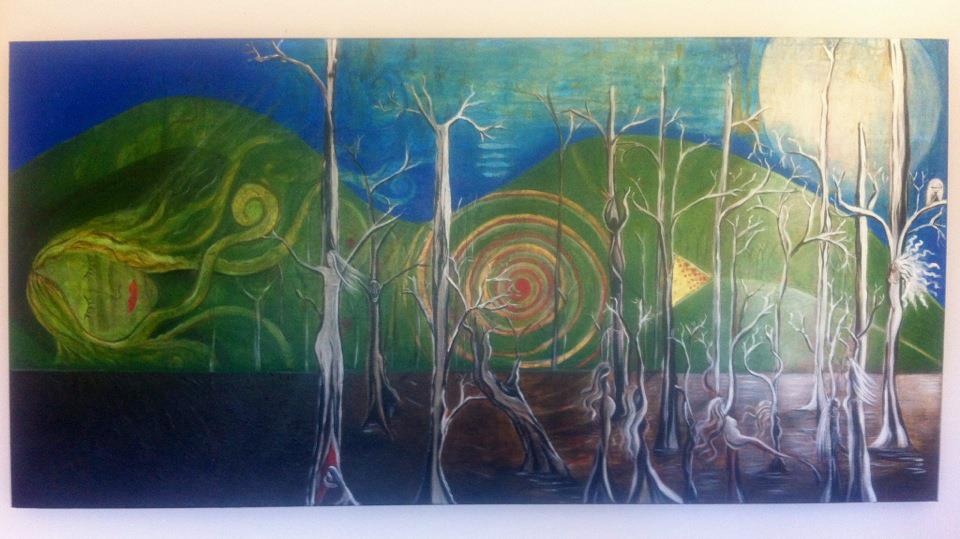

 Feminism and Religion