Carol P. Christ’s Legacy: Why Don’t Feminists Express Anger At God? by Carol P. Christ

Moderator’s Note: We here at FAR have been so fortunate to work along side Carol Christ for many years. She died from cancer in July, 2021. Her work continues through her non-profit foundation, the Ariadne Institute for the Study of Myth and Ritual and the Goddess Pilgrimage to Crete. To honor her legacy, as well as allow as many people as possible to read her thought-provoking and important blogs, we are pleased to offer this new column to highlight her work. We will be picking out special blogs for reposting. This blog was originally posted July 9, 2012. You can read it long with its original comments here.

My relationship to God changed when I accused “Him” of everything I thought “He” had done or let be done to women—from allowing us to be beaten and raped and sold into slavery, to not sending us female prophets and saviors, to allowing “Himself” to be portrayed as a “man of war.”

In the silence that followed my outpouring of anger, I heard a still small voice within me say: In God is a woman like yourself. She too has been silenced and had her history stolen from her. Until that moment God had been an “Other” to me. “He” sometimes appeared as a dominating and judgmental Other, and at other times as a loving and supportive Other, but “He” was always an “Other.” I as a woman in my female mind-body definitely was not in “His” image. 

Continue reading “Carol P. Christ’s Legacy: Why Don’t Feminists Express Anger At God? by Carol P. Christ”

WHY DON’T FEMINISTS EXPRESS ANGER AT GOD? by Carol P. Christ

 My relationship to God changed when I accused “Him” of everything I thought “He” had done or let be done to women—from allowing us to be beaten and raped and sold into slavery, to not sending us female prophets and saviors, to allowing “Himself” to be portrayed as a “man of war.”

In the silence that followed my outpouring of anger, I heard a still small voice within me say: In God is a woman like yourself. She too has been silenced and had her history stolen from her. Until that moment God had been an “Other” to me. “He” sometimes appeared as a dominating and judgmental Other, and at other times as a loving and supportive Other, but “He” was always an “Other.” I as a woman in my female mind-body definitely was not in “His” image. 

After I expressed my anger to God, God transformed from an Other into what Whitehead once described as “a fellow [or should I say female] sufferer who understands.”  Although I had already been searching for a “God in my image” or “in whose image I could be,” I had yet to find Her. In the quiet after the storm, I came to believe that I would.   Continue reading “WHY DON’T FEMINISTS EXPRESS ANGER AT GOD? by Carol P. Christ”

God As Seductress: The Call of Nature By Stacia Guzzo

When my husband and I decided to move out of the city, we knew what we wanted as an alternative.

We wanted land. Land to grow things, to raise animals, to build upon, to tend. We wanted blisters on our hands and calluses on our feet. We wanted to taste our sweat, feel our muscles burn, and then relax with some homemade beer in front of a roaring fire at the end of a long day. We wanted to harvest honey, gather eggs, spin fiber, and split wood. We wanted to raise sons and daughters to appreciate the sound of silence and the clarity of a night sky so clear that you can see the Milky Way in cold of winter. We wanted to be in community with other fellow homesteaders, sharing ideas and breaking freshly baked bread together. These were all things that had only been dreams when living in a cramped, rented apartment with little sun and neighbors who ducked into their houses before anyone could mumble a friendly hello.

And thus was the way that Mother Nature courted us. Her sensual beckoning drove us mad with desire and frustrated with impatience. She danced slightly out of our reach, ducking behind obstacles like home loan approvals and darting in and out of practicalities like job security and worries over distance from loved ones. Ah, she was a sly one, that Mother Nature. Her siren song was irresistible, and eventually, we bent beneath the strain. Continue reading “God As Seductress: The Call of Nature By Stacia Guzzo”

In my defense against an abusive God… what I forget and what I am learning By Sara Frykenberg

I spent a great deal of my life believing that the smaller and smaller I made myself, the bigger God would be in my life and the more power He (sic) would have to do the good things He had planned.  If I could just get out of the way… If I could resist my humanness… If I could be “alive to Him and dead to me,” as one of the songs we sang in my college church group reminded me.  I stopped believing this when I felt I had become so small and lost so much of myself that I couldn’t bear it anymore.

I don’t know how to explain it otherwise, but I had a physically violent reaction to any more of myself disappearing.  I yelled and snapped at people like a wounded animal; and when I reached out to members of my Bible study for help, I remember one woman suggesting that maybe demons were involved in some way.  I’m not sure if she thought I was being possessed or attacked, but I remember feeling like she hadn’t heard me at all.

I didn’t understand… excuse me, couldn’t understand why the God I was always taught to believe in, the God who was in control of everything and the God who purposefully made things the way they were, would plan for all the suffering and loss I saw around me—for the loss I was experiencing.  A man who is my ally and my spirit friend listened to me explain this feeling.  He then looked up at me and asked, “You think that God is abusive, don’t you?”  And I replied, “I guess I do.” Continue reading “In my defense against an abusive God… what I forget and what I am learning By Sara Frykenberg”

Feminism in Disguise By Cynthia Garrity-Bond

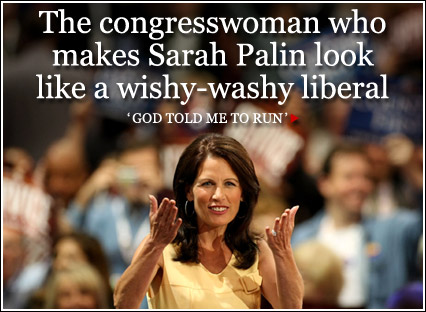
Recently CNN ran a feature article on GOP presidential runner Michele Bachmann, an extreme conservative congresswoman from Minnesota, whose political ideologies are shaped and endorsed by the Tea Party [http://politicalticker.blogs.cnn.com/2011/06/27/michele-bachmann-evangelical-feminist/.]  The article raised the question if Bachmann, like Hilary Clinton, could be considered a feminist icon, with the distinction of Bachmann as an “evangelical feminist.”  While the article gives a brief history of evangelical feminism, starting with the appointment of Christian conservative Elizabeth Dole during the reign of Ronald Reagan, a huge assumption is made by not clarifying what, exactly, is a feminist and what makes one a feminist?  This sin of omission thus renders the term “evangelical feminist” as a binary coupling that locates feminism to a 1970’s reformist notion of women’s equality with men, but men in their shared social status. While Bachmann may object to being identified as a feminist, I find it interesting that the writer for CNN has no difficulty (or sense of clarity) with the consideration of her as a feminist.  What, I wonder, in Bachmann’s political trajectory is considered “feminist”?

In Feminism is for Everybody, author bell hooks takes to task what she identifies as “lifestyle-based feminism” which hooks argues, “suggest[s] any woman could be a feminist no matter what her political beliefs.” Enter Michele Bachmann and her beloved Tea Party. Admittedly the Tea Party is all over the map in their ideology, yet a few constants can be teased out.  For example, they overwhelmingly disapprove of President Obama’s policy of engaging with Muslim countries.  They support Arizona’s immigration laws, feel gay and lesbian couples should not be able to marry, global warming is simply made-up, the repeal of the Health Care legislation, repeal of minimum wage, and reduction or elimination of reproductive rights for women and men.  All of which begs the question, can an individual who invest in a political ideology of extreme nationalism while further excluding those on the margins through racist immigration laws, homophobic fears, classist response to the poor and sick while promoting a misdirected Biblical position of dominance of the earth and its limited resources be consider a feminist?

Recall in the last post Rosemary Radford Ruether’s understanding of feminism as “a critique of patriarchy as a system that distorts the humanity of both women and men.” One form of distortion arises when patriarchy co-opts feminism as power gained through the exploitation and oppression of others.  In what hooks identifies as “power feminism” of the 90’s, wealthy white heterosexual women became the icons of feminist success by appropriating feminist jargon while sustaining their commitment to Western imperialism and transnational capitalism. Which goes back to my initial point, we must clarify what we mean when we use the word feminist or feminism.  Is it a chameleon-like identity or a political movement that seeks to end sexism, exploitation and oppression of women and men? Continue reading “Feminism in Disguise By Cynthia Garrity-Bond”