Letter from a Palestinian Political Prisoner in Louisiana Dictated over the phone from ICE Detention March 18, 2025

Moderator’s Note: Below is a letter from Mahmoud Khalil in its entirety, dictated over the phone from Immigrations and Customs (ICE) detention in Louisiana. A permanent resident taken by the government for his political speech. The phrase “who has the right to have rights?” was coined by Hannah Arendt who escaped Nazi Germany and wrote poignantly and pointedly about the rise of fascism. While on the surface, this letter doesn’t have an obvious link to FAR’s mission, we feel it is deeply intertwined. Who has the right the have rights? Women once had no rights and it appears we are losing them again at breakneck speed. Immigrant’s rights in this country are being stripped also at breakneck speed. And that is just the tip of the iceberg. If we can’t answer “EVERYONE” to Arendt and Khalil’s question, then human rights mean nothing for any of us.
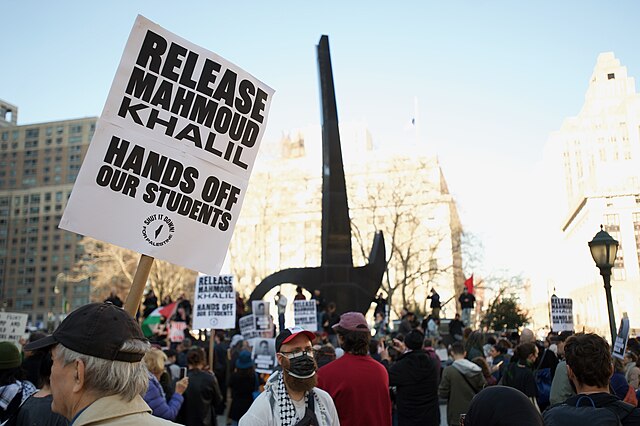
Wikimedia Commons: Protests in Thomas Paine Park against the detention of Palestinian activist and Columbia student Mahmoud Khalil. [SWinxy]

My name is Mahmoud Khalil and I am a political prisoner. I am writing to you from a detention facility in Louisiana where I wake to cold mornings and spend long days bearing witness to the quiet injustices underway against a great many people precluded from the protections of the law.

Who has the right to have rights? It is certainly not the humans crowded into the cells here. It isn’t the Senegalese man I met who has been deprived of his liberty for a year, his legal situation in limbo and his family an ocean away. It isn’t the 21-year-old detainee I met, who stepped foot in this country at age nine, only to be deported without so much as a hearing.

Justice escapes the contours of this nation’s immigration facilities.

On March 8, I was taken by DHS agents who refused to provide a warrant, and accosted my wife and me as we returned from dinner. By now, the footage of that night has been made public. Before I knew what was happening, agents handcuffed and forced me into an unmarked car. At that moment, my only concern was for Noor’s safety. I had no idea if she would be taken too, since the agents had threatened to arrest her for not leaving my side. DHS would not tell me anything for hours — I did not know the cause of my arrest or if I was facing immediate deportation. At 26 Federal Plaza, I slept on the cold floor. In the early morning hours, agents transported me to another facility in Elizabeth, New Jersey. There, I slept on the ground and was refused a blanket despite my request.

Continue reading “Letter from a Palestinian Political Prisoner in Louisiana Dictated over the phone from ICE Detention March 18, 2025”

On the ‘Naturalness’ of Inequality by Ivy Helman

29662350_10155723099993089_8391051315166448776_oIn some regards, life on Earth seems to depend on some basic inequalities.  For example, differences in size, height, strength, speed and endurance advantages some and disadvantages others.  Depending on another for survival is another type of inequality. Being able to adapt to change increases one’s likelihood of survival as well.  

In this regard, inequality is natural, a normal part of existence.  In fact, the exploitation of such inequalities supports and perpetuates life on this planet.   Darwin said as much. Evolutionary theory does as well. At one point, we, homo sapiens, replaced our Neanderthal cousins.  Lions kill and eat gazelles. Some iguanas in the Galapagos Islands were able to become great underwater swimmers in order to reach edibles; those who couldn’t died. Continue reading “On the ‘Naturalness’ of Inequality by Ivy Helman”

Responding to Human Suffering by Elise M. Edwards

Elise EdwardsIn the past few weeks, there have been renewed debates throughout the US about death with dignity laws and the role of government is providing or securing access to health care. The tragic story of Brittany Maynard and the incessant election-year politicking about the Affordable Care Act (Obamacare) have made issues about human suffering more visible and volatile than usual. These are topics I deal with in two courses I am teaching this semester–one about Christian ethics and the other about bioethics.

I truly admire those who work in the presence of suffering daily by caring for others.   It’s difficult to even talk about suffering in the classroom day after day. My intention behind doing so is for my students to resist simplistic responses by either valorizing human pain and suffering or retreating to escapism. I caution them about using religion to legitimize suffering when it accompanies from evil, yet encourage them to see the meaning in suffering as well. We try to maintain the fine line of affirming the experiences of those who claim to gain strength or some other good from their pain without crossing into discourse that names the pain itself as something good. We debate whether there can be any way of discussing suffering as redemptive. We discuss disparities in medical treatment and health care along economic, racial, gendered, cultural, and international divides and what the responses of clergy, medical providers, and everyday people to remedy them.

Through these heavy debates, I’ve gained more clarity about the ways that suffering is often a result of human injustice and I’m deeply saddened by it. Continue reading “Responding to Human Suffering by Elise M. Edwards”

An Ethics of Anger by Ivy Helman

me bio-suitSometimes I feel angry.  I would say that more often I’m upset, disappointed, annoyed or just plain frustrated.  These are easier emotions for me to handle because I tend to shy away from confrontation and conflict.  Of course, when they come up I can deal with them but I’d rather put time and energy into fruitful communication before difficult conflicts erupt.  Nevertheless, this doesn’t always work and other people handle situations and communication differently than I do.  So how does one approach anger?  The anger inside one’s self?  Another’s  anger?  What about when two individuals are angry with each other?  I would like to spend a little bit of time treating each one of these scenarios separately and then conclude with a few general remarks about the importance of empathic feelings of anger over the situations of others.

First of all, everyone handles anger differently.  I’m not sure that there is only one correct way to approach it.  Personally, I use anger as a reflective tool.  Why am I angry?  What happened or didn’t happen to provoke my anger?  Is my anger an appropriate response to the situation in which I find myself?  Are there some concrete actions I can do to right the situation?  These questions allow space for me to not only explore my feelings and ground myself, but more importantly they give me some space between what made me angry and whatever action or inaction I take toward that feeling of anger. Continue reading “An Ethics of Anger by Ivy Helman”

Review of “The Book of Mormon” by Ivy Helman

IMG_5998My friend and I won two tickets to “The Book of Mormon” showing as part of Broadway in Boston.  Having known nothing about the musical, we were curious and excited to be going.  Nearly two weeks later, we are still discussing how we feel about the production.  We agree that overall we like it and there are some very funny parts, but we are also troubled and disgusted by it on a number of levels.  Moreover, the fact that we like it makes us quite uncomfortable.

As a Broadway production, the cast was amazing!  The songs were creative.  Characters were dynamic and showed marked growth.  “Spooky Mormon Hell Dream” was outright brilliant with its use of humor, satire and fear to explain the Mormon preoccupation with hell as punishment for immorality and/or disbelief. Continue reading “Review of “The Book of Mormon” by Ivy Helman”