“Immanent Inclusive Monotheism” with a Multiplicity of Symbols Affirming All the Diversity and Difference in the World by Carol P. Christ

carol-christIn recent years monotheism has been attacked as a “totalizing discourse” that justifies the domination of others in the name of a universal truth. In addition, from the Bible to the present day some have used their own definitions of “exclusive monotheism” to disparage the religions of others. Moreover, feminists have come to recognize that monotheism as we know it has been a “male monotheism” that for the most part excludes female symbols and metaphors for God.  With all of this going against monotheism, who would want to affirm it?

In response to some or all of the above critiques, many modern pagans define themselves as polytheists, affirming at minimum, the Goddess and the God, and at maximum a vast pantheon of individual deities, both female and male, from a single culture or from many, including divinities with animal characteristics.  Other pagans define themselves as animists, affirming a plurality of spirits in the natural world. A group of Christian feminists have argued that the Christian Trinity, the notion of God Three-in-One, provides a multiple and relational understanding of divinity.

While also rejecting exclusive monotheism and male monotheism, Jewish poet, ritualist, and theologian Marcia Falk provided a definition of inclusive monotheism that I find compelling.

Monotheism means that, with all our differences, I am more like you than unlike you. It means that we all share the same source, and that one principle of justice must govern us equally.  . . Continue reading ““Immanent Inclusive Monotheism” with a Multiplicity of Symbols Affirming All the Diversity and Difference in the World by Carol P. Christ”

Painting Lilith, Leaving Church by Angela Yarber

 Lilith has been a misunderstood, appropriated, and redeemed woman throughout the ages.  Many feminists claim her as an empowering figure in Jewish mythology, her story reclaimed by contemporary artists such as Sarah McLachlan, who created the all-women music tour, “Lilith Fair.”  Others have claimed that Lilith was a demon who seduced men and strangled children in the night.

Based almost entirely on Judith Plaskow’s beautiful Midrash, “The Coming of Lilith,” this new Holy Woman Icon with a folk feminist twist has empowered me to reject the sexism and heterosexism that was rendering me broken.  So, she joins Virginia Woolf , the Shulamite, Mary Daly, Baby Suggs, Pachamama and Gaia, Frida Kahlo, Salome, Guadalupe and Mary, Fatima, Sojourner Truth, Saraswati, Jarena Lee, Isadora Duncan, and Miriam as powerful women who have done holy and remarkable things.  First, her story.  Then—if I may—my own.

Continue reading “Painting Lilith, Leaving Church by Angela Yarber”

Deciding to Leave or Remain in the Religion of Your Birth – Part II by Judith Plaskow

Photo by Manhattan College

This is a response to Carol P. Christ’s blog of April 29, 2013 on why she decided to leave the Christian tradition. Carol and I discuss these questions further in our forthcoming book Goddess and God in the World: Conversations in Embodied Theology.

You raise the important question of what factors lead feminists to leave or remain within the religion of their birth. Your central challenge to me is how I can commit myself to a tradition in which God is imagined as a violent warrior when these images have harmed and continue to harm women and the world. How can I not recoil from using such images in worship? Why is the power of symbols less important to me than to you?

The first thing I would say is that, like you, I find these images profoundly problematic. One of the projects I have taken on in my retirement is reading the Bible from cover to cover, and I was appalled in going through all the prophets together at the amount of violence in their teachings. When I have spoken on the topic of dealing with difficult texts in the Jewish and Christian traditions—a subject that is dear to my heart—I always talk about God’s violence in addition to texts that demean women. And, yes, I have sometimes asked myself how I can remain part of a tradition in which God is depicted in this way. So I do not disagree with your critique of this imagery, but obviously for me, it is not decisive. Why not? Continue reading “Deciding to Leave or Remain in the Religion of Your Birth – Part II by Judith Plaskow”

Deciding To Leave the Religion of Your Birth–Or Not by Carol P. Christ

carol p. christ 2002 colorWhat factors are most important in the decisions of spiritual feminists to leave or to stay affiliated with traditional religions? My friend Jewish feminist theologian Judith Plaskow and I discuss these questions in our forthcoming book, Goddess and God in the World. In this excerpt I speak to Judith about our different choices.

For me no longer identifying with Christian tradition had a great deal to do with belief. At some point I came to the conclusion that I did not believe in Christianity’s “core doctrines” of Trinity, incarnation, and salvation through Christ. Yet these doctrines are expressed in the Nicene Creed, which is accepted by all Christians. In an interview at a Christian seminary early on in my career, I was asked to define and defend my Christology or theory of salvation through Jesus Christ. My answer that feminism had put a question mark over all doctrines for me was not considered acceptable.

Judaism, on the other hand, is not a religion that stresses belief. Indeed your husband Robert used to love to shock me and other Christians by saying that for a Jew belief in God was not required as long as he or she followed the law. Understanding this difference between Judaism and Christianity helped me to understand that the question of belief in “core doctrines” simply was not as central for you as a Jewish theologian as it would necessarily be for me as a Christian theologian.

However, my reasons for leaving Christianity did not only have to do with my lack of belief in its core doctrines. For me the issue I call the power of “core symbols” was equally if not more important. Once I began to understand the way in which the “core symbols” of the Bible had influenced people and cultures, “I” simply could not ally “myself” with traditions that continued to promote them in liturgies. Continue reading “Deciding To Leave the Religion of Your Birth–Or Not by Carol P. Christ”

Gratitude and Sharing: Two Fundamental Principles of Goddess Spirituality by Carol P. Christ

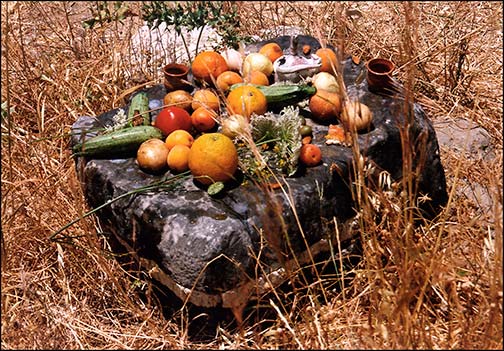
carol p. christThe more I practice the spirituality of the Goddess, the more I understand that earth-based spiritualities are rooted in two fundamental principles:  gratitude and sharing.  We give thanks to the earth for the gift of life. As we recognize our interdependence and interconnection in the web of life, we are moved to share what has been given to us with others. *

When I first began to lead Goddess Pilgrimages in Crete, I was inspired by a line in Homer to begin a pilgrimage tradition of pouring libations of milk, honey, water, and wine on ancient stones. At first I knew the form, but not its deeper meaning.  It gradually dawned on me as I thought about the large number of pouring vessels in the museums, the altar stones, and the Procession Fresco from Knossos, that an important part of Minoan rituals involved processions in which people offered first fruits back to the Mother whose body had produced them, and poured libations on altars.

kernos stone kay keys

Over twenty years of performing the ritual of pouring libations has convinced me that this was not “a” but “the” central Minoan ritual.  Its purpose is to thank Mother Earth for the bounty She has bestowed on us. Continue reading “Gratitude and Sharing: Two Fundamental Principles of Goddess Spirituality by Carol P. Christ”

Occupying Feminism/Religion: Letting Community Consciousness Roam Free By Amy Levin

Becoming involved in the women’s movement means moving from isolation as a woman to community. Through telling my story, I reach out to other women. Through their hearing, which both affirms my story and makes it possible, they reach out to me. I am able to move, gradually, from defensiveness to openness, from fear of questioning to a deep and radical questioning of the premises from which I have lived my life. I experience relief; my anger has been heard, and I am not alone. But I am also frightened; I am undermining my own foundations. The walls come tumbling down. – Judith Plaskow, The Coming of Lilith

Lately, I’ve been thinking about this blog – what it does – in relation to my life, as it promotes the intersection between scholarship, activism, and community. I notice these three elements in most, if not all of the FAR posts, but I’ve been wondering what exactly it means to really embody a life that allows scholarship, activism, and community to mutually mix and inform each other.

Becoming involved in the women’s movement means moving from isolation as a woman to community. Through telling my story, I reach out to other women. Through their hearing, which both affirms my story and makes it possible, they reach out to me. I am able to move, gradually, from defensiveness to openness, from fear of questioning to a deep and radical questioning of the premises from which I have lived my life. I experience relief; my anger has been heard, and I am not alone. But I am also frightened; I am undermining my own foundations. The walls come tumbling down. – Judith Plaskow, The Coming of Lilith

Lately, I’ve been thinking about this blog – what it does – in relation to my life, as it promotes the intersection between scholarship, activism, and community. I notice these three elements in most, if not all of the FAR posts, but I’ve been wondering what exactly it means to really embody a life that allows scholarship, activism, and community to mutually mix and inform each other. Continue reading “Occupying Feminism/Religion: Letting Community Consciousness Roam Free By Amy Levin”