One of the most famous Catholic icons is the model for a Haitian Vodou goddess who protects lesbians.
Traditional images of Erzulie Dantor, the Vodou defender of lesbians, are based on the Black Madonna of Czestochowa. They even share the same two scars on the dark skin of the right cheek.
Every year more than 100,000 people view the original Black Madonna of Czestochowa icon in Poland at one of the most popular Catholic shrines on the planet. John Paul II, the Polish pope, was devoted to her. Few suspect that the revered icon of the Blessed Virgin Mary has a lesbian connection. Continue reading “Black Madonna Transforms into Vodou’s Lesbian Defender by Kittredge Cherry”
I light a memorial candle for lesbian feminist poet and essayist Adrienne Rich, who died March 27, 2012 at age 82.
Rich was one of the most influential poets of the 20th century. Her writing was a guiding light to me and countless others, both people of faith and secular readers. The following lines from her poem “Natural Resources” (from The Dream of a Common Language: Poems 1974-1977) became like a creed for many of us:
The following is a guest post written by Rev. Kittredge Cherry, lesbian Christian author and art historian who blogs about LGBT spirituality and the arts at the Jesus in Love Blog. Her books include “Equal Rites” and “Art That Dares: Gay Jesus, Woman Christ, and More“.
Feminists have criticized saints as top-down tools of the dominant morality, but as a lesbian Christian I find that sometimes the opposite is true. The desire for saints rises from the grassroots, and LGBT saints can shake up the status quo. Feminist theology is helping me in a quest for new models of sainthood that lead to LGBT and queer saints. The LGBT saints attract people with the quality of their love. They show us not only THEIR place in history, but also OUR place — because we are all saints who are meant to embody love. Continue reading “LGBT Saints: Feminism Leads to a Queer Theology of Sainthood By Kittredge Cherry”
The following is a guest post written by Rev. Kittredge Cherry, lesbian Christian author and art historian who blogs about LGBT spirituality and the arts at the Jesus in Love Blog. Her books include “Equal Rites” and “Art That Dares: Gay Jesus, Woman Christ, and More“.
August 15 was once the festival of the lesbian goddess Diana (Artemis), but it has been adapted into a feast day for the Virgin Mary.
Midsummer feasts have celebrated the divine feminine on this date since before the time of Christ. Now devoted to Mary, August 15 carries the torch of lesbian spiritual power to a new generation.
Saint Mary, mother of Jesus, is honored by churches today in a major feast day marking her death and entrance into heaven. Catholic and Orthodox churches call it the Feast of the Assumption or Dormition, when Mary was assumed into heaven, body and soul.
The Virgin Mary’s holiday was adapted — some would say appropriated — from an ancient Roman festival for Diana, the virgin goddess of the moon and the hunt. Diana, or Artemis in Greek, is sometimes called a lesbian goddess because of her love for woman and her vow never to marry a man. The ancient Roman Festival of Torches (Nemoralia) was held from Aug. 13-15 as Diana’s chief festival. Continue reading “Mary’s Feast Rooted in Lesbian Goddesses Diana and Artemis By Kittredge Cherry”
The following is a guest post written by Rev. Kittredge Cherry, lesbian Christian author and art historian who blogs about LGBT spirituality and the arts at the Jesus in Love Blog. Her books include “Equal Rites” and “Art That Dares: Gay Jesus, Woman Christ, and More“.
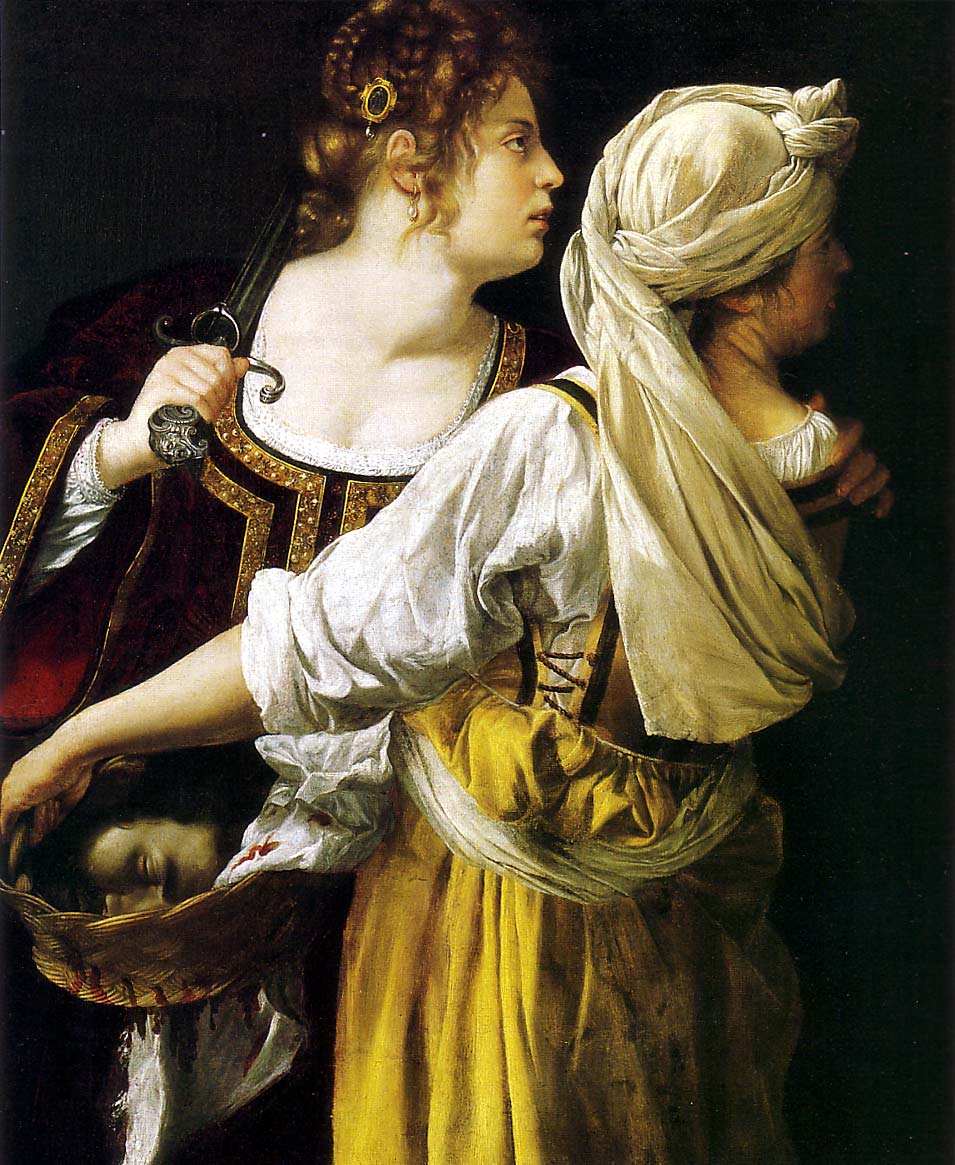
Baroque artist Artemisia Gentileschi inspires many with her paintings of strong Biblical women — created despite the discrimination and sexual violence that she faced as a woman in 17th-century Italy.
Gentileschi (1593–1652) was successful in her own day, but was mostly written out of art history until the 1970s, when feminist scholars rediscovered her work. Now she is celebrated in many books, films and plays, and her work is widely reproduced. Her greatest paintings include “Judith Beheading Holofernes” and “Susanna and the Elders.”
Many women and queer people can relate to her battles against prejudice and sexual violence, documented in her rape trial in 1612. She could be considered the patron saint of women artists.
"Judith and Her Maidservant" by Artemisia Gentileschi
Although Gentileschi was apparently heterosexual, lesbians have drawn energy from her life and art.
Lesbians who have created tributes to Gentileschi include painter Becki Jayne Harrelson and playwright Carolyn Gage. In the play “Artemisia and Hildegard,” Gage has two of history’s great women artists debate their contrasting survival strategies: Gentileschi battled to achieve in the male-dominated art world while Hildegard of Bingen found support for her art in the women-only community of a medieval German nunnery.
The daughter of a painter, Gentileschi was born in Rome and trained as a painter in her father’s workshop there. She was refused admission to the art academy because she was a woman, so her father arranged for her to have a private painting teacher — who raped her when she was about 19. Gentileschi herself was tortured by thumbscrews during the seven-month rape trial, but she stuck to her testimony. The teacher was convicted, but received a suspended sentence. Continue reading “Artemisia Gentileschi: Baroque artist and rape survivor painted strong Biblical women, By Kittredge Cherry”




 ) became like a creed for many of us:
 Feminism and Religion