Hildegard’s vision of Christ, surrounded by concentric circles of light.
When I was forty-two years and seven months old, Heaven was opened and a fiery light of exceeding brilliance came and permeated my whole brain, and inflamed my whole heart and my whole breast, not like a burning but like a warming flame, as the sun warms anything its rays touch.
–Hildegard von Bingen, Scivias, translated by Mother Columba Hart, O.S.B., and Jane Bishop
Neurologist Oliver Sacks believed that the dazzling visions of Hildegard von Bingen (1098-1179), the great Benedictine abbess and polymath, were caused by migraines. Hildegard struggled with chronic health problems. In Scivias, her first book of visionary theology, she described being bedridden when she received the divine command to write and speak about her visions that she had kept secret since childhood. According to Sacks, the symptoms she described are identical to those of migraine sufferers. He also stated that the concentric circles in the illuminations illustrating her visions are reminiscent of a migraine aura.
Saint Hildegard von Bingen (1098–1179) was not only a visionary Benedictine abbess, composer, and Powerfrau extraordinaire. She was also a physician and healer who developed her own highly original system of medical treatment and holistic dietary philosophy.
Saint Benedict of Nursia (480-543), the founder of her order, expressly forbade the study of medicine, which in his era derived solely from texts written by Pagans such as Hippocrates and Galen. Benedict believed that prayer alone must suffice in healing Christians.
But by Hildegard’s time, monasteries had become centers of healing that embraced the medical knowledge of both the Classical Pagan world and the pioneering work of Arab and Persian physicians. Nearly every monastic house had its own infirmary, hospice, apothecary, and medicinal garden. Hildegard would have had ample opportunity to train as a physician and apothecarer at Disibodenberg Monastery, a double monastery housing both monks and nuns, where she lived for most of the first half of her life.
Illumination based on Hildegard’s vision of the human body as the microcosm within the sacred macrocosm.
Here in Northern England, I find myself plunged into the depths of midwinter darkness. It is in this dark womb of stillness that the Light is reborn. Through the ages and across cultures, world faith traditions have marked this sacred passage through the darkness.
In Christian tradition, Advent is a period of expectant waiting, of anticipating the birth of Christ. The word Advent comes from the Latin adventus, which means “coming.” This First Sunday of Advent marks the beginning of the Western Christian liturgical year.
Image: “Hildegard’s House of Light,” painting by Elizabeth Erickson
The Advent wreath and Advent calendar are relatively recent innovations. Christmas and Advent celebrations have gone through many permutations throughout history. Continue reading “Journey into Light by Mary Sharratt”
The visionary abbess Hildegard von Bingen (1098-1179) has long been regarded as a saint, with her feast day of September 17, yet she was only officially canonized in May 2012. Why did it take the Vatican over eight centuries to canonize this great polymath, composer, and theologian?
The first attempt to canonize Hildegard began in 1233, but failed as over fifty years had passed since her death and most of the witnesses and beneficiaries of her reported miracles were deceased. Her theological writings were deemed too dense and difficult for subsequent generations to understand and soon fell into obscurity, as did her music. According to Barbara Newman, Hildegard was remembered mainly as an apocalyptic prophet. But in the age of Enlightenment, prophets and mystics went out of fashion. Hildegard was dismissed as a hysteric. Even the authorship of her own work was disputed as pundits began to suggest her books had been written by a man.
Newman states that Hildegard’s contemporary rehabilitation and resurgence was due mainly to the tireless efforts of the nuns at Saint Hildegard Abbey in Eibingen, Germany. In 1956 Marianna Schrader and Adelgundis Führkötter, OSB, published a carefully documented study that proved the authenticity of Hildegard’s authorship. Their research provides the foundation of all subsequent Hildegard scholarship.
In the 1980s, in the wake of a wider women’s spirituality movement, Hildegard’s star rose as seekers from diverse faith backgrounds embraced her as a foremother and role model. The artist Judy Chicago showcased Hildegard at her iconic feminist Dinner Party installation.
Medievalists and theologians rediscovered Hildegard’s writings. New recordings of her sacred music hit the popular charts. The radical theologian Matthew Fox adopted Hildegard as the figurehead of his creation-centered spirituality. Fox’s book Illuminations of Hildegard of Bingen remains one of the most accessible and popular books on the 12th-century visionary. In 2009, German director Margarethe von Trotta made Hildegard the subject of her luminous film, Vision. And all the while, the sisters at Saint Hildegard Abbey were exerting their quiet pressure on Rome to get Hildegard the official endorsement they believed she deserved.
Pope John Paul II, who had canonized more saints than any previous pontiff, steadfastly ignored Hildegard’s burgeoning cult, possibly because he was repelled by her status as a feminist icon. Ironically it was his successor, Benedict XVI, one of the most conservative popes in recent history—who, as Cardinal Ratzinger, expelled Matthew Fox from the Dominican Order where Fox had served for thirty-four years—finally gave Hildegard her due. Reportedly Joseph Ratzinger, a German, had long admired Hildegard. He not only canonized her but elevated her to Doctor of the Church, a rare and solemn title given to only the most distinguished theologians.
But I believe the true credit for Hildegard’s triumph is due to the Benedictine Sisters at Saint Hildegard Abbey for keeping Hildegard’s flame burning.
Read Hildegard’s poem slowly as a prayer, contemplating how the Sacred Flame, however you envision it in your own spiritual tradition, relates to your life.
Hildegard von Bingen (1098–1179) was a visionary abbess and polymath. She composed an entire corpus of sacred music and wrote nine books on subjects as diverse as theology, cosmology, botany, medicine, linguistics, and human sexuality, a prodigious intellectual outpouring that was unprecedented for a 12th-century woman. Her prophecies earned her the title Sybil of the Rhine.
Pope Benedict XVI canonized Hildegard on May 10, 2012—over eight centuries after her death. In October 2012, she was elevated to Doctor of the Church, a rare and solemn title reserved for theologians who have significantly impacted Church doctrine. Hildegard is the fourth woman in the entire history of the Church to receive this distinction.
The Great Goddess and Divine Mother of Us All manifests where and to whom She chooses, no matter what faith we hold. In the 12th century, She manifested to a German nun named Hildegard. Hildegard’s story has been told in many places, including a highly detailed entry in the Catholic Encyclopedia, which is a wonderful resource for stories about saints. I’ve just finished reading Illuminations (Houghton Mifflin Harcourt, 2012), a splendid new novel about Hildegard by Mary Sharratt, who is the author of other excellent novels, including Daughters of the Witching Hill.
Hildegard, who lived from 1092 to 1179, was the tenth child of a family of minor nobility in the Holy Roman Empire. She’s a sturdy child who loves the outdoors and enjoys running through the forest with her brother. But early in the novel, she learns that she is to be her family’s tithe to the church. Her mother has already arranged for this bright and curious eight-year-old child to be the companion to Jutta von Sponheim, a “holy virgin” who yearns to be bricked up as an anchorite in the Abby of Disibodenberg. Being an anchorite means that, like Julian of Norwich (about 250 years later), this girl and her magistra are bricked in. There is a screened opening in the wall through which their meager meals are passed and through which they can witness mass and speak to Abbott Cuno, the other monks, and visiting pilgrims, but they can never go out. Never. In the Afterword, Sharratt writes that “Disibodenberg Abbey is now in ruins and it’s impossible to precisely pinpoint where the anchorage was, but the suggested location is two suffocatingly narrow rooms and a narrow courtyard built on to the back of the church” (p. 272). As Sharratt vividly shows us, Hildegard survived in that awful place for thirty years. Continue reading “Illuminations: A Novel of Hildegard von Bingen By Barbara Ardinger”



 Saint Hildegard von Bingen (1098–1179) was not only a visionary Benedictine abbess, composer, and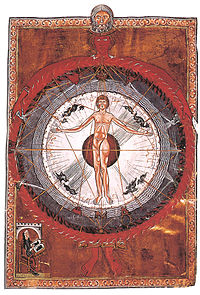

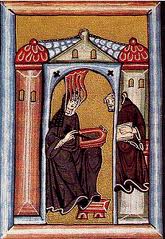



 Hildegard, who lived from 1092 to 1179, was the tenth child of a family of minor nobility in the Holy Roman Empire. She’s a sturdy child who loves the outdoors and enjoys running through the forest with her brother. But early in the novel, she learns that she is to be her family’s tithe to the church. Her mother has already arranged for this bright and curious eight-year-old child to be the companion to Jutta von Sponheim, a “holy virgin” who yearns to be bricked up as an anchorite in the Abby of Disibodenberg. Being an anchorite means that, like Julian of Norwich (about 250 years later), this girl and her magistra are bricked in. There is a screened opening in the wall through which their meager meals are passed and through which they can witness mass and speak to Abbott Cuno, the other monks, and visiting pilgrims, but they can never go out. Never. In the Afterword, Sharratt writes that “Disibodenberg Abbey is now in ruins and it’s impossible to precisely pinpoint where the anchorage was, but the suggested location is two suffocatingly narrow rooms and a narrow courtyard built on to the back of the church” (p. 272). As Sharratt vividly shows us, Hildegard survived in that awful place for thirty years.
  Feminism and Religion