Anne Brontë’s Agnes Grey: Lifting the Veil on Cruelty, part 2 by Maria Dintino

Part 1 was posted yesterday.

Here the reader further witnesses how young Tom treats his little sisters which is consistently cruel-hearted. Tom continues to describe how he will harm the helpless birds while Agnes desperately works to persuade him otherwise:

“But you shall see me fettle ’em off. My word, but I will wallop ’em? See if I don’t now. By gum! but there’s rare sport for me in that nest.”

“But, Tom,” said I, “I shall not allow you to torture those birds. They must either be killed at once or carried back to the place you took them from, that the old birds may continue to feed them.”

“But you don’t know where that is, Madam: it’s only me and uncle Robson that knows that.”

“But if you don’t tell me, I shall kill them myself—much as I hate it.”

“You daren’t. You daren’t touch them for your life! because you know papa and mamma, and uncle Robson, would be angry. Ha, ha! I’ve caught you there, Miss!”

“I shall do what I think right in a case of this sort without consulting any one. If your papa and mamma don’t happen to approve of it, I shall be sorry to offend them; but your uncle Robson’s opinions, of course, are nothing to me.”

This young charge of Agnes’s is threatening and manipulating her as he and the other children do often. Tom doesn’t realize he has hit a nerve with Agnes, where the brutal treatment of the most vulnerable is unbearable. This situation is indicative of the overall treatment she receives as a governess, as one less-worthy-than and stripped of power, yet blamed for the misbehavior of her charges.

“So saying—urged by a sense of duty—at the risk of both making myself sick and incurring the wrath of my employers—I got a large flat stone, that had been reared up for a mouse-trap by the gardener; then, having once more vainly endeavoured to persuade the little tyrant to let the birds be carried back, I asked what he intended to do with them. With fiendish glee he commenced a list of torments; and while he was busied in the relation, I dropped the stone upon his intended victims and crushed them flat beneath it. Loud were the outcries, terrible the execrations, consequent upon this daring outrage; uncle Robson had been coming up the walk with his gun, and was just then pausing to kick his dog.

“Tom flew towards him, vowing he would make him kick me instead of Juno. Mr. Robson leant upon his gun, and laughed excessively at the violence of his nephew’s passion, and the bitter maledictions and opprobrious epithets he heaped upon me. “Well, you are a good ’un!” exclaimed he, at length, taking up his weapon and proceeding towards the house. “Damme, but the lad has some spunk in him, too. Curse me, if ever I saw a nobler little scoundrel than that. He’s beyond petticoat government already: by God! he defies mother, granny, governess, and all! Ha, ha, ha! Never mind, Tom, I’ll get you another brood to-morrow.”

Uncle Robson’s appalling show of support and praise for Tom’s egregious behavior toward his governess underscores a deeply engrained and condoned misogyny. But here our usual grin-and-bear-it Agnes will not back down or be silenced.

“If you do, Mr. Robson, I shall kill them too,” said I.

“Humph!” replied he, and having honoured me with a broad stare—which, contrary to his expectations, I sustained without flinching—he turned away with an air of supreme contempt, and stalked into the house. Tom next went to tell his mamma.”

Agnes has risked her position in defense of her values, but Uncle Robson, who it is noted never pays his nieces any heed, has instilled and upholds his nephew’s cruel ways, no doubt leading him to become a person who will kick his dogs and treat all creatures deemed lesser, including girls and women, with disdain. Little Tom is “beyond petticoat government already,” encouraged and rewarded for not listening to any of the women in his life. Following the example of his father, uncle, and many of the other men in his life, Tom has already learned to disregard what women have to say.

And Tom’s mother, Mrs. Bloomfield, buys into the dysfunction wholeheartedly. The passage continues with an interaction between Agnes and lady of the house, with her defending the violent behavior of her son and blaming Agnes for interfering with his fun and games.

“It was not her [Mrs. Bloomfield’s] way to say much on any subject; but, when she next saw me, her aspect and demeanour were doubly dark and chilled. After some casual remark about the weather, she observed—“I am sorry, Miss Grey, you should think it necessary to interfere with Master Bloomfield’s amusements; he was very much distressed about your destroying the birds.”

“When Master Bloomfield’s amusements consist in injuring sentient creatures,” I answered, “I think it my duty to interfere.”

“You seemed to have forgotten,” said she, calmly, “that the creatures were all created for our convenience.”

I thought that doctrine admitted some doubt, but merely replied—“If they were, we have no right to torment them for our amusement.”

“I think,” said she, “a child’s amusement is scarcely to be weighed against the welfare of a soulless brute.”

“But, for the child’s own sake, it ought not to be encouraged to have such amusements,” answered I, as meekly as I could, to make up for such unusual pertinacity. “‘Blessed are the merciful, for they shall obtain mercy.’”

“Oh! of course; but that refers to our conduct towards each other.”

“‘The merciful man shows mercy to his beast,’” I ventured to add.

“I think you have not shown much mercy,” replied she, with a short, bitter laugh; “killing the poor birds by wholesale in that shocking manner, and putting the dear boy to such misery for a mere whim.”

“I judged it prudent to say no more. This was the nearest approach to a quarrel I ever had with Mrs. Bloomfield; as well as the greatest number of words I ever exchanged with her at one time, since the day of my first arrival.”

Agnes knows her place and if she wants to maintain her position to both assist her family and to prove she can handle the role, she must monitor herself and bite her tongue around her employers and their children. In both Agnes’s positions, the parents are portrayed as overly indulgent and uninvolved, allowing the children to misbehave and manipulate at every turn. The parents consistently take their children’s side and refuse to see any fault in them, lest it cast blame on their parenting. This creates an especially impossible arrangement for the governess to have any influence on the children, let alone get them to care about and complete their lessons.

Anne’s resting place at St. Mary’s Church in the seaside town of Scarborough, North Yorkshire.

At a certain point in the story it becomes quite clear how all will unfold, yet one cannot stop reading!

In the end, Agnes is rewarded with the love of one she has admired for some time. The icing on this happy-ending cake is that she is also reunited with the neglected dog, Snap, that one of the young women in her charge had given away, breaking Agnes’s heart. This delightful reunion takes place on the beach, a setting Anne Brontë herself cherished.

If one cannot bear the truth, don’t read Anne Brontë’s novels. Yet, it’s worth keeping in mind that if the ugly truth is kept undercover, it’s less likely to be addressed.

Anne Brontë is a Nasty Woman Writer.

© Maria Dintino 2024

Works Cited & Resources

Brontë, Anne. Agnes Grey. The Project Gutenberg eBook of Agnes Grey, 4 December 2020. https://www.gutenberg.org/files/767/767-h/767-h.htm

Ellis, Samantha. “Anne Brontë: the sister who got there first.” The Guardian. 6 January 2017.  https://www.theguardian.com/books/2017/jan/06/anne-bronte-agnes-grey-jane-eyre-charlotte

Holland, Nick. “Agnes Grey: Nothing short of genius.” Anne Brontë Blog, 9 April 2017.  https://www.annebronte.org/2017/04/09/agnes-grey-nothing-short-of-genius/

Anne Brontë’s Agnes Grey: Lifting the Veil on Cruelty, part 1 by Maria Dintino

Moderator’s Note: This piece is in co-operation with The Nasty Women Writers Project, a site dedicated to highlighting and amplifying the voices and visions of powerful women. The site was founded by sisters Theresa and Maria Dintino. To quote Theresa, “by doing this work we are expanding our own writer’s web for nourishment and support.” This was originally posted on their site on November 19, 2024. You can see more of their posts here. 

Anne, the youngest of the Brontë sisters, penned two novels in her short life. The first was Agnes Grey (1847), then The Tenant of Wildfell Hall (1848).

A sketch of Anne by her sister Charlotte.

It’s probably safe to say that Agnes Grey is the least read and appreciated of all the Brontë novels, of which there are seven. Emily’s Wuthering Heights and Charlotte’s Jane Eyre garner the most praise and attention. But Anne’s The Tenant of Wildfell Hall is not far behind, and by some accounts leads the pack.

Interestingly, all the sisters’ first novels were released in the same year, under their pen names Currer, Ellis, and Acton Bell. First was Jane Eyre in October 1847 and then Wuthering Heights and Agnes Grey together as a ‘triple decker’ in December 1847, with Wuthering Heights making up the first two parts, and Agnes Grey the third.

Continue reading “Anne Brontë’s Agnes Grey: Lifting the Veil on Cruelty, part 1 by Maria Dintino”

Margaret Fuller (1810-1850): A Thanksgiving Revelation by Maria Dintino

Moderator’s Note: This piece is in co-operation with The Nasty Women Writers Project, a site dedicated to highlighting and amplifying the voices and visions of powerful women. The site was founded by sisters Theresa and Maria Dintino. To quote Theresa, “by doing this work we are expanding our own writer’s web for nourishment and support.” This was originally posted on their site on November 19, 2024. You can see more of their posts here. 

As the Thanksgiving holiday rolls around, I am reminded of Margaret Fuller’s Thanksgiving revelation, one she later wrote about in her journal. This revelation resonates annually for its gentle reminder of the value of being willingly and patiently engaged, of releasing resistance in the face of what cannot readily be altered.

Joy Harjo, American poet, musician, playwright, and author. She served as 23rd US Poet Laureate, the first Native American to hold that honor. (Wikipedia) Learn more at joyharjo.com.

As I re-read Fuller’s account, I think about something former US Poet Laureate Joy Harjo said when she joined us a few years back at Flagler College in St Augustine, Florida for a virtual event. I don’t remember the exact question one of the listeners asked, but I’ll never forget Harjo’s response. She answered, “Every job is a service job.”

The truth in this statement struck me. I’d never considered my many jobs over the years, both inside and outside the home, as service jobs, but indeed they were.

Continue reading “Margaret Fuller (1810-1850): A Thanksgiving Revelation by Maria Dintino”

All That She Carried by Tiya Miles: Recovering the Untold Stories of Black Women in America, part 1 by Theresa Dintino

Moderator’s Note: This piece is in co-operation with The Nasty Women Writers Project, a site dedicated to highlighting and amplifying the voices and visions of powerful women. The site was founded by sisters Theresa and Maria Dintino. To quote Theresa, “by doing this work we are expanding our own writer’s web for nourishment and support.” This was originally posted on their site on November 30, 2021. You can see more of their posts here. 

First she was told about a grain sack dating from around 1851 that had these words  embroidered on it:

My great grandmother Rose
mother of Ashley gave her this sack when
she was sold at age 9 in South Carolina
it held a tattered dress 3 handfulls of
pecans a braid of Roses hair. Told her
It be filled with my LOVE always
she never saw her again
Ashley is my grandmother
Ruth Middleton
1921

Continue reading “All That She Carried by Tiya Miles: Recovering the Untold Stories of Black Women in America, part 1 by Theresa Dintino”

May Sarton: Leaping the Waterfalls (1912-1995 American Woman Writer), part 2 by Marie Dintino

Part 1 was posted yesterday.

That richness of self may be what May chased her entire life: for herself to be enough. Eight years later in Journal of a Solitude, May further explores her relationship with solitude:

May’s house in Nelson, NH

“Later on in the night I reached quite a different level of being. I was thinking about solitude, its supreme value. Here in Nelson I have been close to suicide more than once, and more than once have been close to a mystical experience of unity with the universe. The two states resemble each other: one has no wall, one is absolutely naked and diminished to essence. Then death would be the rejection of life because we cannot let go what we wish so hard to keep, but have to let go if we are to continue to grow”(57).

But May knew the drill, and wrote such to a friend, “I came to see that my loneliness (acute and awful) was really a loneliness for myself”(Peters 279).

In Journal of a Solitude, May reveals the challenges surrounding the writing of Mrs. Stevens in 1965, the guts it took, the mission she had in mind:

“On the surface my work has not looked radical, but perhaps it will be seen eventually that in a “nice, quiet, noisy way” I have been trying to say radical things gently so that they may penetrate without shock. The fear of homosexuality is so great that it took courage to write Mrs. Stevens, to write a novel about a woman homosexual who is not a sex maniac, a drunkard, a drug-taker, or in any way repulsive; to portray a homosexual who is neither pitiable nor disgusting, without sentimentality; and to face the truth that such a life is rarely happy, a life where art must become the primary motivation, for love is never going to fulfill in the usual sense.

“But I am well aware that I probably could not have “leveled” as I did in that book had I had any family (my parents were dead when I wrote it), and perhaps not if I had had a regular job. I have a great responsibility because I can afford to be honest. The danger is that if you are placed in a sexual context people will read your work from a distorting angle of vision. I did not write Mrs. Stevens until I had written several novels concerned with marriage and family life”(91).

The need to mask in life and art, the patience to slowly roll out the truth, in a “nice, quiet, noisy way.”

Margot Peters weighs in on Mrs. Stevens in May’s biography:

“While Hilary Stevens might outrage those who believe that women artists are not deviants, her claim that women must find their own language and subjects in the dominant world of men’s literature was a radical concept in 1965. Mrs. Stevens’s idea of “woman’s work” also goes far to explain the puzzle of May Sarton’s own oeuvre: how such an aggressive, volatile, and violent person could produce novels and poems that ultimately transcend conflict. Like Hilary Stevens, May believed that her creative demon was masculine, her sensibility feminine”(254).

Mrs. Stevens Hears the Mermaids Singing was a novel before its time. In coming years, as the gathering momentum of the feminist, gay, and civil rights movements raised America’s consciousness and women’s studies departments sprang up on campuses across the nation, Mrs. Stevens brought its author a fame she had sought all her life”(259).

While living in Nelson, May received letter upon letter from women envying her seemingly ideal situation, but May wanted to set the record straight, that her living alone in a small rural town in New Hampshire was not the panacea so many imagined.

“No partner in a love relationship (whether homosexual or heterosexual) should feel that he has to give up an essential part of himself to make it viable. But the fact is that men still do rather consistently undervalue or devalue women’s powers as serious contributors to civilization except as homemakers. And women, no doubt, equally devalue their own powers. But there is something wrong when solitude such as mine can be “envied” by a happily married woman with children.

“Mine is not, I feel sure, the best human solution. Nor have I ever thought it was. In my case it has perhaps made possible the creation of some works of art, but certainly it has done so at a high price in emotional maturity and in happiness. What I have is space around me and time around me. How they can be achieved in marriage is the real question. It is not an easy one to answer”(Journal 123).

Make no mistake, although May was living alone, she was not alone. She had frequent visitors and was often off lecturing, leading workshops and teaching seminars. Nelson was an attempt to extract, one met with mixed results.

May Sarton grappled with life’s intangibles while living as close as possible to tangible pleasures; she struggled with darkness in the greatest sense and basked in full-on light in the intimate moments, where she found peace. Nothing was meaningless; everything was meaningless. She bared her soul and her heart, revealed her gifts and vulnerabilities in a way not many dare.

“Rage is the deprived infant in me but there is also a compassionate mother in me and she will come back with her healing powers in time”(Peters 339). How accurately May’s sums herself up here; for all her crossness and fire, she was generous to a fault, gifting thousands of dollars to friends every single year.

May became a gardener, as was her mother. In Nelson, she planted, weeded, harvested and displayed vibrant, oh-so-necessary flowers. It became a true labor of love, for even if she wasn’t up to doing such work, she forced herself out of doors to commune with the rocky soil, the scent of dirt and plants, the distinct hope of growth and blossoms. This seemed the antidote to starving for love and light:

“For a long time, for years, I have carried in my mind the excruciating image of plants, bulbs, in a cellar, trying to grow without light, putting out white shoots that will inevitably wither. It is time I examined this image. Until now it has simply made me wince and turn away, bury it, as really too terrible to contemplate.”(Journal 57).

May lamented in a letter to a friend,

“My rage and woe come from great and prolonged suffering that the critics have never never given the poems a break. I see the mediocre winning and I suppose to keep going I have to get mad…better than committing suicide. It is a fight to survive somehow against the current. I am a salmon leaping the waterfalls”(Peters 279).

Thank you for passionately and patiently swimming against the current, May.

May Sarton is a #NastyWomanWriter.

(Here’s the post about May’s resting place in the Nelson cemetery: The Phoenix Takes Its Rest: Visiting May Sarton’s Grave.)

©Maria Dintino 2019

Works Cited:

Peters, Margot. May Sarton: a Biography. New York: Alfred A. Knopf, 1997.

Sarton, May. Journal of a Solitude. New York: W.W. Norton & Company, Inc., 1973.

Sarton, May. Mrs. Stevens Hears the Mermaids Singing. New York: W.W. Norton & Company, Inc., 1965.

May Sarton: Leaping the Waterfalls (1912-1995 American Woman Writer), part 1 by Marie Dintino

Moderator’s Note: This piece is in co-operation with The Nasty Women Writers Project, a site dedicated to highlighting and amplifying the voices and visions of powerful women. The site was founded by sisters Theresa and Maria Dintino. To quote Theresa, “by doing this work we are expanding our own writer’s web for nourishment and support.” This was originally posted on their site on July 13, 2021. You can see more of their posts here. 

Spending summer 2021 in New Hampshire, I drive through Nelson quite often these days. Each time I do, I think of May Sarton, her years here, who she was, her art, and all she accomplished. I always glance down the road at the cemetery where she now rests.*

This post is one I wrote about May two years ago and it feels right to run it again since I feel so close to her these days. Enjoy!

May Sarton: Leaping the Waterfalls

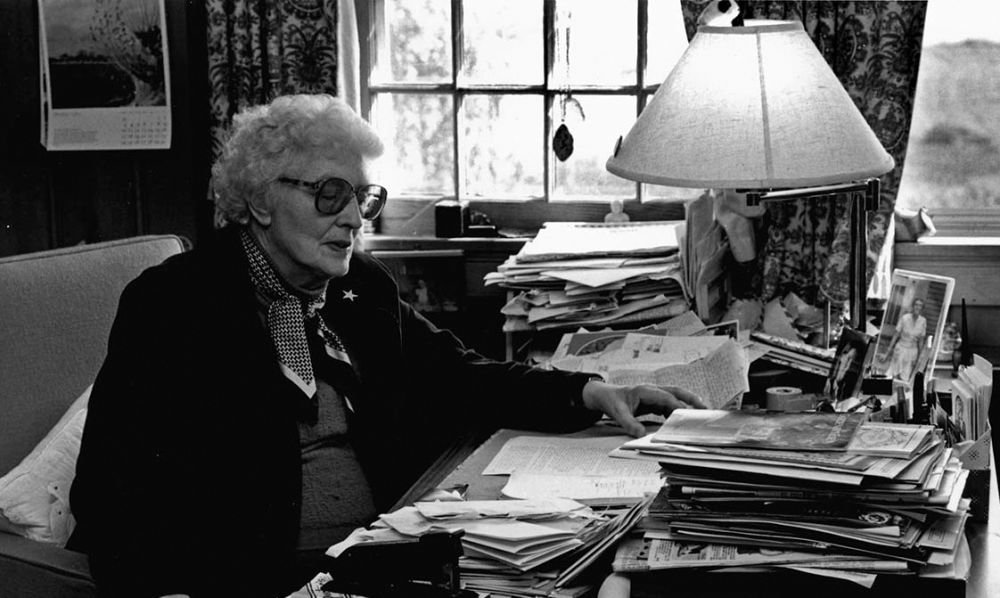
I’d been duped. The gray-haired writer who moved to the small town of Nelson, New Hampshire in 1958 was not who I imagined. I only discovered this when I began work on this post. Far from the tranquil woman in my mind, May Sarton was an enigma, even to herself.

At forty-six, May Sarton purchased her first and only house, attempting to extract herself. In a destructive relationship, struggling to reign herself in, she sought to settle, to live where only those she wanted to see or those who really wanted to see her would visit. Plus, the dramatic move would provide fresh writing material.

May, high school graduation, Cambridge, MA 1929

Continue reading “May Sarton: Leaping the Waterfalls (1912-1995 American Woman Writer), part 1 by Marie Dintino”

Diana Beresford-Kroeger: Integrating Celtic Wisdom and Science, part 2 by Theresa Dintino

Part 1 was posted yesterday

Combining ancient wisdom and western science

At age sixteen Beresford-Kroeger was graduated from her mentorship of the Lisheens and went on to become a scientist, learning medical biochemistry and botany. Eventually she saw that many of the things she learned from the Lisheens elders could be scientifically proven. This offered her delight and reassurance.

One of the first of these was the plant Chrondrus crispus or seaweed named Irish moss. Her Great-Aunt Nellie taught her that it cured tuberculosis and how to prepare and use the gel-like mucilage it released upon being boiled.

In the lab Beresford-Kroeger later discovered that this mucilage has antibiotic properties.

“The feeling this confirmation of Nellie’s teaching gave me is hard to describe. I loved my teachers in Lisheens, but I hadn’t completely ruled out the idea that the things I’d been taught there were just old superstitions. I needed to confirm them for myself. There was always the chance that there would turn out to be nothing of import in the plants they’d emphasized to me, and nothing more to the ancient knowledge than beautiful clouds of vapor”(96).

She began to understand that what she had been taught was an oral tradition and that it existed in no other format and that she was meant to be a bridge between “the ancient and the scientific”(97).

“My teachers in the valley might have indicated that a particular plant was good for poor circulation, which I’d taken to mean heart trouble. I would then know to keep a particular eye out for the presence of any chemical known to benefit the heart. “Well, Diana,” they might have begun, while cradling a small, five-pointed yellow flower in the crook of two fingers. “St. John’s Wort, as you see here, has a strong medicine for nervousness and mental problems.” I would later find out that St. John’s Wort contains phytochemicals such as hyperforin, which increase the effectiveness of dopamine and serotonin in the brain. The plant is as effective as many prescription anti-depressants, and may in some cases be more effective”(98).

Continue reading “Diana Beresford-Kroeger: Integrating Celtic Wisdom and Science, part 2 by Theresa Dintino”

Diana Beresford-Kroeger: Integrating Celtic Wisdom and Science, part 1 by Theresa Dintino

Moderator’s Note: This post is brought to you by a collaboration by FAR and Nasty Women Writers written and hosted by Maria and Theresa Dintino. This post originally appeared on their website on Sep 12, 2023

In her book To Speak for the Trees: My Life’s Journey from Ancient Celtic Wisdom to a Healing Vision of the Forest, Diana Beresford-Kroeger  shares her origin story, the humble beginnings of the famous scientist, the activist and crusader for the planet she became. We learn on what forge that will, strength, brain and consciousness were smelted. And it is one of beauty, strength and love, one that takes the breath away.

I loved this book. I loved going deeper and deeper into Beresford-Kroeger’s life story, into the rich depths of her Celtic heritage and medicine lineage. To learn the secrets and the wisdom. Beresford-Kroeger offers sacred transmission in this book, revealing another part of herself. It is a vulnerable telling and an irreplaceable gift.

Continue reading “Diana Beresford-Kroeger: Integrating Celtic Wisdom and Science, part 1 by Theresa Dintino”

Journey to Freedom: Harriet Tubman Still on the Move, part 2 by Maria Dintino

Part 1 appeared yesterday

Additional Developments

Although there’s a significant dearth of statues depicting real women in our country, Tubman’s image and legacy have done much to address this gap and put a serious dent in the bronze ceiling.

There are said to be at least 9 full-figure sculptures of Tubman with others in the works, along with plaques, busts,  parks and museums named in her honor. Also, three commemorative coins have been released, each depicting a particular phase in Tubman’s life.

Speaking of currency, the plan to replace President Andrew Jackson’s image with that of Harriet Tubman’s on the twenty-dollar bill is still in the works. It’s an important endeavor that’s taking far too long. Annie Linskey with The Philadelphia Tribune explains:

“There has never been a Black person on the U.S. currency, nor has there been a woman on a bill in the modern era, despite repeated attempts to diversify the currency.”

Continue reading “Journey to Freedom: Harriet Tubman Still on the Move, part 2 by Maria Dintino”

Journey to Freedom: Harriet Tubman Still on the Move, part 1 by Maria Dintino

Moderator’s Note: This post is brought to you by a collaboration by FAR and Nasty Women Writers written and hosted by Maria and Theresa Dintino. This post originally appeared on their website on Feb. 20,2024. It has been updated to reflect recent events. the post is subtitled: Nasty Women Writers: Breaking the Bronze Ceiling – Statues of Real Women in Public Spaces

It’s quite fitting that the 9-foot bronze statue of Harriet Tubman, named Journey to Freedom is still on the move, as was Tubman for much of her life.

Since 2020, the statue has traveled around the country. It’s currently on Hilton Head Island, South Carolina, in Historic Mitcheville Freedom Park. The monument will remain on Hilton Head through April 2025 and from there be transported to Vienna, Virginia.

Continue reading “Journey to Freedom: Harriet Tubman Still on the Move, part 1 by Maria Dintino”