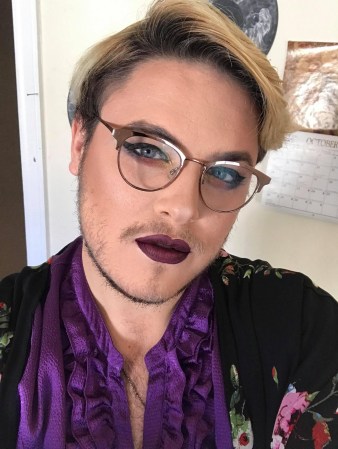
“I’m trying to tell you something about my life.” I joke with my friends that if the 1990’s weren’t so transphobic, I would have thrived as a trans lesbian. Citing my knowledge of the L Word, Pacific Northwest flannel sensibilities, and Spotify playlists as my reasoning; I embody a millennial genderqueer take on lesbian stereotypes. The only thing missing is an exclusive attraction to women which― I would argue―is the main factor holding me back from waving the lesbian pride flag high. Though I write with a particular levity, I cannot deny the role that lesbian singer songwriters and folk/rock singers have played in cultivating my sense of self and my sense of the Divine. The Holy, for me, is wrapped up in the the harmonies of the Indigo Girls, the raspy blues of Melissa Etheridge, the heart-breaking riffs of Tracy Chapman, and the tear-jerking truths of Brandi Carlile. These women have gifted me Divine Imaginaries of what justice is, who God is, and how I fit in.
In full trans-parency (pun intended), I hold a small level of fear in writing this piece. As the rhetorics of Transgender Exclusive Radical Feminists (TERF) appear to be touching the mainstream, I am reminded that these rhetorics are deeply tied to lesbian music culture. The Michigan Womyn’s Music Festival holds itself as a historic cultural object created by the amazing and radical work of lesbians and feminists and lasted from 1976 – 2015. MichFest, as it was later known, also uplifted and validated the concept of “womyn-born-womyn” only spaces. A concept with the intention to center the experiences of cis women, and the impact of discriminating against trans people. I reference this not to tear at the scabs of these two communities as we continue healing. Rather, I am naming the irony that my anthems for my survival are also the songs that have historical ties to mindsets and movements that prohibited my community from experiencing them first hand.
But this piece isn’t about trans exclusive feminists. This piece is about the soundtrack of my survival, and the powerful women who’s wise words guide that experience. The following four songs are invitations into my survival.
Closer to Fine – Indigo Girls
“The less I seek my source for some definitive, the closer I am to fine.” Since I was 17, this lyric has echoed in my mind. I would drive around Seattle listening to this song on a mix CD, wondering if I would ever get close to fine. Masked in their flawless harmonies, Amy Ray and Emily Saliers words gave me comfort and language to articulate my experiences. They mixed joy and laughter with the harsh truth of growing older. They gave room for a multiplicity of perspective and called out institutions and dominant epistemologies as inefficient modes of knowledge gaining. I was gifted a queer critical lens, a slightly Gnostic view of God, and an acknowledgement that “[t]here’s more than one answer to these questions/ Pointing me in a crooked line.”
Silent Legacy- Melissa Etheridge
To say that Melissa Etheridge’s 1993 album “Yes I Am” is not one of the best albums―let alone queer albums―ever created is homophobic. I wish I could tell you I’m being facetious. I am not. While her singles “I’m the Only One” and “Come to My Window” remain as her most popular hits; the song “Silent Legacy” is a testimony to queer feminist survival. I encourage you to set aside some time to listen to this song as if it were a prayer. In five minutes, Etheridge manages to describe and enflesh the impact of spiritual trauma on the queered body. Each verse unpacking the silent internalization of misogyny, homophobia, and transphobia. Each chorus echoing a prayer to heaven. Only to finish with Etheridge repeating the phrase “Oh my child,” building her emotions from tenderness to rage as if she, herself, embodies God calling us home to protect us.
Talkin’ Bout a Revolution – Tracy Chapman
I confess, my conversion to the Gospel of Tracy Chapman occurred later than I would prefer. Knowing her for her iconic lesbian anthem “Fast Car,” it wasn’t until I discovered her full discography about two years ago that I felt held in her words. With “Talkin’ Bout a Revolution” as the first track on her first album, “Tracy Chapman.” Chapman sets a specific tone for the album. The album is a protest. She reveals a portrait of her experiences of the United States in 1988, one that does not shy away from harsh realities of racial injustice and domestic violence. And at the same time gives tender insights into how to love someone. Chapman’s wisdom grounds my survival in the hardest truths of our world. That if I am to survive, I must ensure others’ survival as well.
The Joke- Brandi Carlile
Brandi Carlile feels like home. As an out lesbian musician of my home state of Washington, Carlile’s music reaches the depths where few dare to dive. I recognize the majority of this soundtrack dates to the late ‘80’s and early ‘90s, Brandi Carlile’s “The Joke” is from her Grammy Award winning 2018 Album “By the Way I Forgive You.” Carlile is contemporary, current, and continuing the legacy paved before her. Her song―“The Joke”―echos like a ghost of queer future. Carlile’s voice is moving forwards while reaching back. She gives assurance, not that it gets better, rather that it gets different. Carlile invites the listener into the act of survival.
As a queer theologian, I tend to search for scripture in the most secular of places. These women have formed a gospel where the Divine Imaginary provided is an invitation to all people to the radical act of survival. As a trans femme person, I know, and these women testify, that one can survive and thrive simultaneously. Because “there’s more than one answer to these questions/ Pointing me in a crooked line/ And the less I seek my source for some definitive / The closer I am to fine.”
P.S. I believe that my fair, sincere, and soft mention of the “TERF/trans exclusion” conversation can spark strong push back from some of the readership of this blog. I am aware that we (cis and trans) who are in Feminist theological spaces need to continue engaging seriously in conversation around this topic and start working together to construct something from it. I would like for my post to be a part of starting that conversation. The heart of my post is that there is something profound in the liberative music created by these amazing and powerful women. Part of that profundity, is that I, a trans feminine queer person, heard an invitation into a legacy of liberation and justice. So I invite you, whoever you are, reading this to reread my piece. Reread it, knowing this is a small part of a larger conversation, and the heart of the conversation is a painful history of exclusion and transphobia and simultaneously a history of liberation and justice.
Nathan Bakken (they/them), originally from Seattle, WA, has found home in Boston, MA. Raised Roman Catholic, Nathan stands firm in the intersection of Christianity and Esoteric Spirituality. They earned their Master of Divinity, and Master Certificate in Religious Conflict Transformation, from Boston University School of Theology with particular focus in trans and queer theologies, queer spiritual practice, and the intersection of pop culture and theology.



 Feminism and Religion