

One of the great joys of being an artist and writer is working on commissions, enlivening in paint, canvas, and word the stories of revolutionary holy women who have emboldened and inspired the one commissioning the Holy Woman Icon. Gloria Anzaldúa was on my list of holy women for a while when Dr. Robyn Henderson-Espinoza finally gave me the nudge to paint her by commissioning an icon. Anzaldúa gave Robyn—and so many others—the framework, the bridgework, for dismantling the binaries of difference, for finding the beauty that resides at the borderlands of race, gender, and sexuality. As a scholar-activist, Robyn speaks of Anzaldúa as a patron saint, saying:
“Anzaldúa has always been for me the bridge between theory and action, and her work, both in writing and teaching, compels me to live into my vocation as a public theologian, which at root is bridging across lines of radical difference. Without Anzaldúa and without her bridging frame, I am unable to do the work that I now do. This icon offers me a visual reminder of the ways in which I’m called to be a bridge in curating communities of radical difference.”
Queer borderlands. Chicana borderlands. Feminist borderlands. Gloria Anzaldúa (September 26, 1942 – May 15, 2004) was an American scholar who focused on the intersections among queer theory, feminist theory, and Chicana cultural theory. Born in the Rio Grande Valley of south Texas, Anzaldúa also bridged the borders of personal and academic writing, weaving together theory with lived experience, English with Spanish, and inviting readers into a new world—Mundo Zurdo—that transcended these seeming binaries. Continue reading “Bridging Beyond Binaries: Painting Gloria Anzaldúa by Angela Yarber”

 I’ve
I’ve 
 In many ways, I’ve thought of the myriad
  Last month, my column focused on the importance of
  I’ve long held that feminism, in order to be true and engaged and practical, must be intersectional. Such is also the case, I believe, for LGBTQ rights. The work of justice for women and LGBTQs people must also include justice for other marginalized groups. Because many LGBTQ people are also women, people of color, people with disabilities, Muslims, immigrants, and others marginalized for identities other than their sexuality. Paying attention to these intersections—of sexuality, gender, race, class, ability, religion—and acknowledging that many people have multiple intersecting identities for which they are oppressed is vital to the work of justice.
 Lilith has been a misunderstood, appropriated, and redeemed woman throughout the ages. Many feminists claim her as an empowering figure in Jewish mythology, her story reclaimed by contemporary artists such as Sarah McLachlan, who created the all-women music tour, “Lilith Fair.” Some queer scholars have surmised that Lilith had a romantic relationship with Eve. Others have claimed that Lilith was a demon who seduced men and strangled children in the night. Quite a disparity, isn’t it?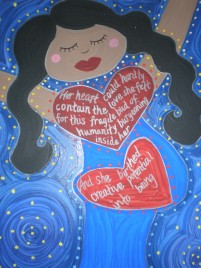
 Feminism and Religion