That Christmas Morning Feeling by Marie Cartier

MarieCartierforKCETa-thumb-300x448-72405What follows is an excerpt from my current project—a novel I have been working on for over ten years. It is finished—sort of— in various journals and I am currently trying to pull them all together. These are the opening pages. Thank you so much for your support of my work. The novel is called- That Christmas Morning Feeling.
Book Number Sixteen

This is how I feel about incest, I mean learning to talk about it…speak Incest, as in capital “I” – Incest, like French, German, – Incest…right? Because you don’t talk about it, you talk it…you, as in you alone, you talk it; you use it in a sentence. “This is what happened to me…” And no one talks back.

And, why compare it to French or German? There are whole countries who will talk back to you if you speak French or German. Learning Incest is like learning Martian – you think to yourself, maybe there’s a planet somewhere where learning Martian would be useful…but it is certainly not here… no one can speak Martian here, correct your grammar, help you write a poem, check your iambic pentameter…whatever. My point is, learning Martian, well, if you learned it…how would you ever know if you were speaking it right? If someone on Mars could actually understand you? Of course, you wouldn’t know. You would just have to really love Martian enough to learn to speak it – even though…And then, of course, assume that you might meet and if you ever did meet a Martian and you had invested all this time in learning Martian just in case you would ever run into a Martian, you’d hope that he would understand you. Or she. Whatever. Continue reading “That Christmas Morning Feeling by Marie Cartier”

I Am A Woman’s Poet by Marie Cartier

MarieCartierforKCETa-thumb-300x448-72405This is the first poem I ever wrote and had published.
I wrote it in the early 80s at the height of the second wave of Women’s Liberation.

Having just returned from the final Michigan Womyn’s Music Festival, I publish it here with FAR today as an homage to that time period, to those women (myself among them), to many “womyn with a ‘y,’” and what we accomplished—battered women’s shelters, rape crisis centers, health clinics, women’s studies programs, bookstores, festivals, music and culture etc. etc.

Much of what we accomplished is because we learned to listen to each other’s repetition until, as Nelle Morton said, we “heard each other into speech.” Continue reading “I Am A Woman’s Poet by Marie Cartier”

Spouses for Life by Marie Cartier

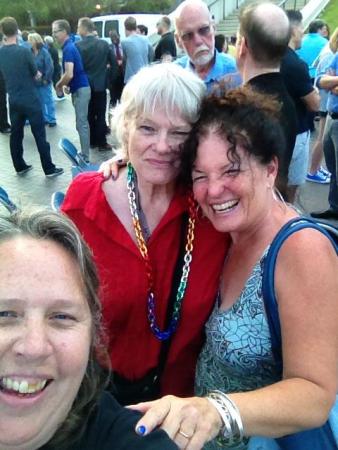
Marie & friends at Long Beach, CA celebrations of the Obergefell decision

This essay is perhaps the last in an occasional series I have written since the New Year, which can be read here and here. Gay marriage as of June 26th is now legal in the United States. What has changed—and what has not?

If public opinion drives public policy, then the motivation for banning same-sex marriage was moral disapproval, religious disapproval—and the belief that God was not “on the side” of the homosexuals and had cast homosexuals as sinners in the faith choice of the person formulating the public policy critique. Public discourse —based on religious formulations such as “sinner” and what “God intended” had been the primary agents erected into state law to ban the LGBTIQ population from civil rights—such as marriage.

Religious sentiment, such as “you are a sinner” should not make the case for legal judgment. In fact, it was unconstitutional.

Love the Sinner. Hate the Sin. Continue reading “Spouses for Life by Marie Cartier”

All Hail a New Priestess! by Marie Cartier

ordination photo
“All hail- the new priestess!” they all shouted at the end.  I was recently ordained near Midsummer Eve (June 20, 2015) as a priestess with the Temple of Isis, Los Angeles and Fellowship of Isis. As befits feminism and religion — I felt it important to share the document read by my scribe – the person who did a lengthy interview and wrote up a summary of why I should be accepted into ordination. I am sharing this with her permission with the Feminism and Religion community. Why do we choose the paths we choose? Why did I choose this Goddess path? The document that explores those reasons follows:

~~~~~~~~~~~~~~~~~~~~~~~~~~~~~~~~~~~~~~~~~~~~~~~~~~~~~~~~~~~~~~~~~~~

June 20th 2015 – 4:00 p.m.
Ordination of Dr. Marie Cartier into the Fellowship of Isis,
Temple of Isis Los Angeles and the Temple of Isis Long Beach.

Our dear sister has reached a point in her life that our ancient mothers of old have been preparing for her and she is ready to be dedicated to and be an emissary of the Goddesses.  She is ready to take on the responsibilities of Priestess and is very honored and proud to be accepted by her Priestess Sisters who she dearly loves and admires. 

Dr. Marie Cartier is a scholar, visual/performance artist, queer activist, writer and theologian. She has been active in many movements for social change. Marie teaches at UC Irvine in the Film & Media Studies Department and CSU Northridge in Gender and Women’s Studies and Queer Studies. She received her Ph.D. in Religion from Claremont Graduate University, 2010, in Women Studies in Religion, with an emphasis on theology, ethics, and culture. She published in 2013 through Routledge the book Baby, You Are My Religion: Women, Gay Bars and Theology Before Stonewall and created the concept of “theelogy” a religion of friendship for people in exile, particularly lesbians prior to 1975. Continue reading “All Hail a New Priestess! by Marie Cartier”

Thoughts on Nuns and Sisters and Perpetual Indulgence by Marie Cartier

helen prejean
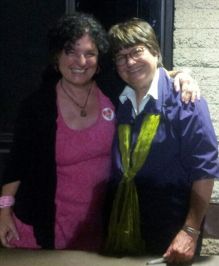
Marie and Sister Helen Prejean

The word “nun” can conjure images from traditional to irreverent in terms of gender. The gender of those who call themselves nuns can range from feminine to masculine, from a woman who looks like a woman dressed as a woman, a contemporary sister or “nun,” who does not wear the traditional black habit, but contemporary female clothing and perhaps a short veil or “wimple” and a cross around her neck; to a man dressed as nun in extremely sexual female garb, a “drag queen” nun; to the traditionally dressed nun, whose habit is a full-length black gown, and full veil covering everything but her face and hands, who means to conceal gender and become something else – a “nun.”

The physical space of “nun” then has opened the realm of gender for women, and recently men, since the creation of the category “nun” was established with the first order of female religious. Cloistered orders of women began in the fifth century, with the more liberated orders of “sisters” forming in the sixteenth century. The Encyclopedia of Catholicism lists approximately twelve Roman Catholic religious orders of sisters, or as they are commonly called, “nuns.” However, this terminology should be amended to allow for the difference between “sisters”- non-cloistered orders, and “nuns”- cloistered orders. Most traditionally the word nun officially refers to Roman Catholic nuns – those who take solemn vows of chastity, poverty and obedience, and live cloistered lives of silence, and prayerful meditation. Choir nuns, such as that of the famous convent headed by Hildegard de Bingen, (1098-1179), German nun, mystic and composer, chant the Liturgy of the Hours daily – consisting of a set order of readings and prayers, including Morning, Evening, Daytime and Night Prayers. Continue reading “Thoughts on Nuns and Sisters and Perpetual Indulgence by Marie Cartier”

Gay Marriage: “Tell me why I shouldn’t hate you…?” asks the straight Christian to the lesbian by Marie Cartier

MarieCartierforKCETa-thumb-300x448-72405This is the third of a series exploring gay marriage as a game changer within religion and politics. I have explored the topic as political animus and earlier as almost fairy tale come to life. Today I am examining it from a very person view.

Consider a gay woman (myself) being asked by a straight attempting to understand the “right” for gay marriage, “What does it matter if I know you’re ‘gay’ if I’m not attracted to you?”[1]

Then consider that another right of “marriage” –or being known as “gay”—is the right to be admitted into the hospital room of a loved one, who is considered one’s primary partner, or “spouse.” Yes, one wants to say to the questioning woman in the above scenario, the rights for marriage include the crucial family relationships which allow one person to be able to take sick leave to care for a partner, or a partner’s child; being able to make critical medical decisions, and the right to be together in crisis situations (such as a hospital emergency room).[2]

Imagine the gay woman speaking to the straight woman and saying, “Because I am more than someone you might or might not be attracted to. I am my own person with my own life. I want to among other things, get into the hospital room of my partner, my loved one, the one I am actually attracted to.” Continue reading “Gay Marriage: “Tell me why I shouldn’t hate you…?” asks the straight Christian to the lesbian by Marie Cartier”

Spouse for Life & the Fight for Gay Marriage by Marie Cartier

marriage
Marie & Kim’s Legal Marriage California 2008

Today, I am exploring the following question set:

What is the shifting conception of religious liberty as religious groups carve out exemptions in complying with laws on LGBTQI rights, particularly as they relate to marriage? As gay marriage becomes “normative” how does it change the structure and study of religion? How did the anti-gay rights movement in California, regarding Proposition 8, funded largely through religious organizations such as the Church of Latter Day Saints and the Catholic Knights of Columbus, have a direct impact on state decisions, and animate new conversations about the juncture of religion and politics?

Let’s start with this information:

Sociologist Brian Powell posed the question of why people were opposed to gay marriage. Do what people say match the legal arguments that justify the opposition to gay marriage? Since legal arguments are based on public policy, what public policy was shaping the legal arguments? The findings, published recently in Social Currents, show that the most common reason for gay marriage opposition was given as: “Because I don’t believe God intended them to be that way.” Running a close second was: “Well, they’re sinners.”

If public opinion drives public policy, then the motivation for banning same-sex marriage is moral disapproval. Or as stated in Powell’s findings—religious disapproval—and the belief that God is not “on the side” of the homosexuals; casting homosexuals as sinners in the faith choice of the person formulating the public policy critique. With these formulations, Powell suggested that public discourse —based on religious formulations such as “sinner” and what “God intended” are the primary agents erecting state laws that ban access to civil rights- such as marriage- for the LGBTQI population. Continue reading “Spouse for Life & the Fight for Gay Marriage by Marie Cartier”

On Not Being A Big Hollywood Film Director, and Other Life Choices by Marie Cartier

MARIE CARTIER- YOUNGAs you read this, dear FAR community, it will be my 59th birthday. I was born February 27, 1956. I have one year to go before I turn 60. For this last year I desperately wanted to dye my hair blue, purple and green and let the roots go gray.

However in a long conversation with my hair stylist she helped me realize that I have spent so many years dying my hair various shades of brown, dark brown and burgundy that if I bleach the hair out to white (so that I can then go blue, purple and green) the hair will fry and fall out—ah, Ok. I willhair live with my brown, black and burgundy hair until I am ready to go completely gray and watch it grow out (my hairdresser tells me it will take three years). Or I will decide to live with the choice I made to dye my hair since I was 35 or so and let it be and keep dying it – and have that be the choice I made. Continue reading “On Not Being A Big Hollywood Film Director, and Other Life Choices by Marie Cartier”

Hail Mary: The Rosary and Why I Keep Praying by Marie Cartier

MarieCartierforKCETa-thumb-300x448-72405My mother-in-law is currently in hospice and expected to cross over any time now. My wife is with her. Those two sentences alone—since I am a woman writing this blog—signify historic/herstoric change. I am a woman and I am writing about my mother in law and I am writing that my wife is with her. We are in a sea change regarding gay marriage. I will be allowed bereavement to go with my wife, when the time comes, for the services.

What has not changed in my life is my dependence on traditional prayer. Although I am a witch/Wiccan, have done all kinds of meditation from Transcendental Meditation, and Buddhist chanting, to visualization, spell work, and New Age affirmation—when push comes to shove as they say, I get out the Rosary.

Why? Continue reading “Hail Mary: The Rosary and Why I Keep Praying by Marie Cartier”

Be Wild this Holiday and Find the Face of God(dess) by Marie Cartier

MarieCartierforKCETa-thumb-300x448-72405I know that you all will be reading this the day after Christmas…so this is my Christmas and/or winter holiday gift to you. I so love the Feminism and Religion (FAR) community—its discourse, intelligence, and its community of like minds. And I appreciate that so many of us offer lessons to each other on how to live—wild. For in some ways the very juxtaposition of the words “feminism” and “religion” posits an out of bounds existence. What does it mean?

I was recently asked how I would teach a class on “women and religion.” Among my first responses was that I would, among other texts, use the book The Feminine Face of God: the Unfolding of the Sacred in Women by Sherry Ruth Anderson and Patricia Hopkins (1992). Although this book was published over two decades ago it still holds, perhaps unfortunately, as true today as then. The text is based on interviews with women regarding the “unfolding of the sacred” in their lives. This book was required as part of my graduate program in the first class I took at Claremont Graduate University (CGU) “Women’s Studies in Religion.” CGU was the first program in the country where you could get your Ph.D. in Religion, with an emphasis in Women’s Studies in Religion, and I believe it is still the only program where you can do so.

My professor for that class, Dr. Karen Torjesen, challenged us to write, if we could, the “theology” in the book—was there one? She challenged us to see if there was a “theo” “logo” word of God in this idea of the “unfolding of the sacred” in women. I took up her challenge—and so one of my first big graduate papers was to unpack this book of interviews and see if I could find a theology in these lives/stories. This is what I found—what is sacred to women—right now (in 1992 and still today)—is the chance to find the sacred. Continue reading “Be Wild this Holiday and Find the Face of God(dess) by Marie Cartier”