Reclaiming Forgotten Voices by Freia Serafina

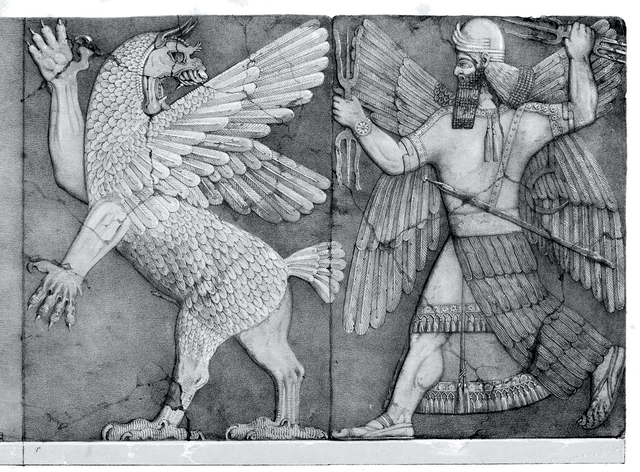
Marduk fighting Tiamat

Last night I found myself crying over Tiamat. Tiamat is one of the most ancient Babylonian Creatress Goddesses. She is known as the Goddess of the Salty Sea and is considered the primordial Creatress in Sumerian religion. Tiamat was slaughtered in the vilest of ways to demonstrate the death of the Goddess and the rise of the God. She was defiled and written about in such a way as to discredit women and provide justification for the slaughtering, defiling, and enslavement of “enemy” women abroad and “bad” women at home.

As I was reading Carol Christ’s Rebirth of the Goddess, I found myself shaken to the core at the ways in which Tiamat was defiled and destroyed in the “epic” called the Enuma Elish. As someone who is well aware of the ways in which the Goddess and women have been usurped throughout time and space, I was still so broken down after reading it that I had an actual ugly cry in my living room. I want to tell you to read the Enuma Elish to understand why I feel this way, but I also want to warn you about the way you might feel afterwards. It is a difficult read.

Continue reading “Reclaiming Forgotten Voices by Freia Serafina”
On the Pertinence of Ritual by Anonymous

Art by Jaysen Waller

This post started as a comment to Annie Finch’s part 1 of Abortion As A Sacrament post.  Realizing it was a story that was getting too long, I’m sharing it here as a reiteration of the practical significance of ritual, and finding our way through the no-longer-charted territories of being a female human — in the sense that if we were a female of any other animal form, we would still know exactly how to navigate all the challenges.

I had a years-long pregnancy-related experience in which ritual was the only thing to finally bringing closure, though the real issue was more the other being’s feelings or intent than mine. About a year after the birth of my only child, still nursing full time and using what should have been sufficient birth control, I became pregnant and aborted at Planned Parenthood. I had been well along, not having suspected anything because my menses hadn’t yet returned. 

At the time, there was no debate in my mind, if I had added another responsibility to my already excessive load, I would have failed at everything, the most important being my daughter.

Continue reading “On the Pertinence of Ritual by Anonymous”

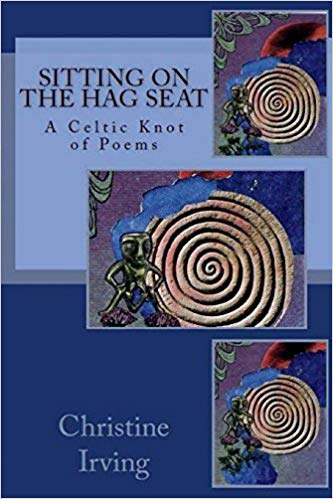
Asking Her Blessing by Christine Irving

… if the carving is in reach of its admirers,

the yoni will often be polished to a shine

by the touching fingers wishing to evoke

 the blessings of the Goddess.

~Adele Getty, Goddess: Mother of Living Nature

My book Sitting on the Hag Seat carries the blue cover I designed. Buried in the blue, riding the spiral Wheel of Return, stands a small Sheela-na-gig. The Sheela’ s origins remain unknown and controversial. It sometimes seem to me that the less explanation exists for a mysterious object or occasion, the more emotional attachment accrues to the opinions of diverging theorists. However, no matter what symbolism is ascribed to Sheela-na gig, her frequent placement above church doors or in the walls of cities, castles and watch towers, does seem to support a protective aspect not necessarily at odds with other attributions.

Continue reading “Asking Her Blessing by Christine Irving”

TRAVELOGUE INTO HISTORY: MY BIG FAT GREEK ODYSSEY (Part 2) by Sally Mansfield Abbott

Part 1 was posted yesterday. You can read it here.

Arriving in Heraklion on Crete, I was enlivened by the sea air and the informal “island” vibration. My sister and I made our way through its labyrinthine streets, following Daedalus, a pedestrian street named after the legendary creator of the labyrinth at Knossos, the prototype of the artist, who Joyce names as his stand-in in Portrait of the Artist as a Young Man and Ulysses. Our hotel was on Theotokopolous Street. (They’d call you El Greco too if your name was Domenikus Theotokopolous.) Nikos Kazantzakis was also from Heraklion, a city noted for its artists.

Knossos was a small, contained place circled by pine trees, unlike the sprawling sun-drenched expanse of a typical archeological site. There were restored ocher columns, four storeys to the palace, open courtyards for bull leaping, and cisterns that had been used for self-purification. Its red clay and turquoise frescoes were so familiar to me, with their vivid colors and playful lines that Matisse could have envied. No wonder it was the prototype of a work of art!

Continue reading “TRAVELOGUE INTO HISTORY: MY BIG FAT GREEK ODYSSEY (Part 2) by Sally Mansfield Abbott”

TRAVELOGUE INTO HISTORY: MY BIG FAT GREEK ODYSSEY (Part 1) by Sally Mansfield Abbott

My sister and I arrived in Athens midafternoon on Lamas, the feast day of the first harvest. A blast of dry heat greeted us as we left the airport and surveyed the barren brown hills. It transported me to my childhood when I’d lived in distant and exotic climates, and I felt the old excitement of being abroad again.

Going to Greece had long been a dream of mine. It was a spiritual pilgrimage, a Hajj to be undertaken at least once in a lifetime. Greece figured prominently in the college classes on the Goddess I had taught for ten years, but I’d only known it through the books and slides I lectured from. I longed to see its sacred sites in person.

Our hotel was at the base of the Acropolis, within a block of the Acropolis Museum, a stunning work of modern architecture that quotes the structure of the Parthenon.  The Parthenon and Erechtheon had been stripped of their bas reliefs and engravings—even the famed Karatydids– were now housed in the museum, either already or soon to be replaced by copies on the temples.

Continue reading “TRAVELOGUE INTO HISTORY: MY BIG FAT GREEK ODYSSEY (Part 1) by Sally Mansfield Abbott”

The Uses of Color On Screen by Freia Serafina

We have to thank a woman named Natalie M. Kalmus for her contributions to the development of color on screen. Being a woman and the executive head of the Technicolor art department in the 1930’s was nothing short of extraordinary, and, in 1935 she released a document titled Color Consciousness in which she explored color theory and the use of color on screen. And, while this was illuminating and groundbreaking at a time, we also have some serious problems with the document that need to be re-examined from an anti-racist and feminist perspective.

Kalmus tells us how and when to use color given that particular color’s moral and psychological associations. She tells us that different colors evoke emotional reactions from the audience because these colors paint a realistic worldview. This presents a problem because, if, as Kalmus suggests, the usage of color and its associations represent a realistic worldview then the worldview Kalmus presents is an inherently racist one. Kalmus writes that black “… has a distinctly negative and destructive aspect. Black instinctively recalls night, fear, darkness, crime. It suggests funerals, mourning. It is impenetrable, comfortless, secretive.” In stark contrast to the color black, Kalmus writes that white “… reflects the greatest amount of light, it emanates a luminosity which symbolizes spirit. White represents purity, cleanliness, peace, marriage… White uplifts and ennobles, while black lowers and renders more base and evil any color.” To put it simply: black is evil and white is good. What does any of this have to do with spirituality? Well, the way we think and feel about color and how characters are depicted on screen taps into our psychological understanding of how “good” or “bad” a color is. This trickles over into our magical and spiritual practices with the notions of “Black Magic” vs. “White Magic.”  We often associate someone who practices black magic as someone who works with dark or evil forces, and white magic with someone who practices magic for the good of others.

Continue reading “The Uses of Color On Screen by Freia Serafina”

Woman of the Isle of Women by Annelinde Metzner

Gratitude to the FAR community for welcoming my poems as of April of this year.   Various earlier poems have been my way of introducing myself.

     My work as a poet and composer has been centered around welcoming the reemergence of the Goddess in all Her forms.  So this time I’ve submitted two poems referring to two of the many Goddesses who have influenced my life so profoundly.

Ix Chel is a Mayan Goddess of childbirth, midwifery, medicine and the moon. She has been especially honored and featured in artwork and sculpture on the Isle of Women (Isla Mujeres) in Mexico. She appeared to me in Her aspect as a young woman, the Jaguar Woman. In my mind’s eye, I associated Ix Chel with my beautiful son Peter who passed away in 2004, imagining them living joyously together in the Otherworld. Thanks to Deb Pollard for showing all aspects of the Moon above our heads as we sleep.

My second poem was born on a trip through the just-blooming peach orchards of South Carolina. A vision came to me of the Peach Maidens reaching out over millennia to the young priestesses of ancient Crete, dancing in celebration of each other’s beauty. And also sharing of their truth-telling and hard-earned wisdom. 

Continue reading “Woman of the Isle of Women by Annelinde Metzner”

9 Ingredients for Building New Narratives by Eline Kieft

There have been a few intriguing posts recently on creating new narratives (by Carolyn Lee Boyd, whose ‘dollops of mud’ inspired the title of this post), and reinterpreting existing ones that are deeply embedded in the fabric of our cultures (such as Moses and Rambo by Janet Rudolph). I distinguish re-creating personal and collective narratives as two aspects of this fascinating task.

The first aspect addresses our capacity to rewrite our personal narrative. What story do we tell about our lives? One of my teachers, Ya’Acov Darling Khan, says ‘we humans are story tellers by nature, so we better tell a good one!’ This doesn’t mean ‘making up’ a story, embellishing the facts, or putting sugar over shit, but exploring our own hero/ine’s journey, overcoming obstacles with courage, seeking help from allies, daring to go into the darkness and emerging with new insights, and most of all, what I call the skill to ‘harvest the wisdom gifts’ of life’s experiences. I look forward to writing more about this another time.

Continue reading “9 Ingredients for Building New Narratives by Eline Kieft”

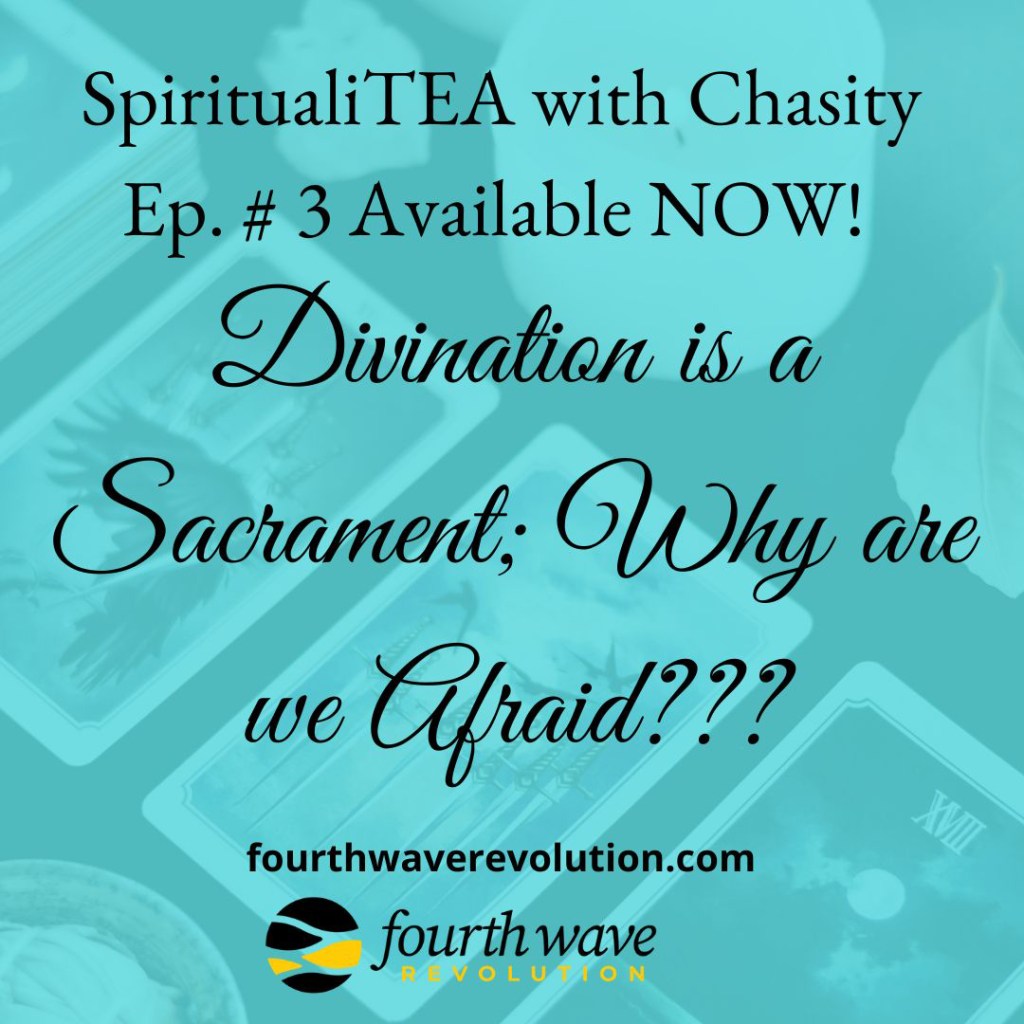
SpiritualiTEA with Chasity Podcast, Episode 3 by Chasity Jones

An excerpt from SpiritualiTEA with Chasity Podcast Episode 3: Why are we afraid of Divination??? What is divination?

Divination is from Latin divinare “to foresee, to be inspired by a god”. (Goleman, David. The Varieties of the Meditative Experience. London: Rider, 1975.)

“DIVINATION IS A SACRAMENT!!” – Chastity S. Jones

This is beautiful to me because it reminds me of how when the prophets would begin to prophesy in the bible or even the explosive forward movement of the spread of the gospel- driven by the Holy Spirit, as well as those who documented the gospel are all described as being inspired by God. 

The most popular form of divination right now is tarot cards but we will discuss how there are many other forms- including forms that are acceptable in the church RIGHT NOW.

There are many bible verses cursing those who divine but I want to reiterate that one bible verse cannot be a comprehensive ethic or set of ethics, especially when there are other verses that contradict that verse.

Continue reading “SpiritualiTEA with Chasity Podcast, Episode 3 by Chasity Jones”

Exploring Dance as Spiritual Practice by Eline Kieft

Image Credit: Ben Cole

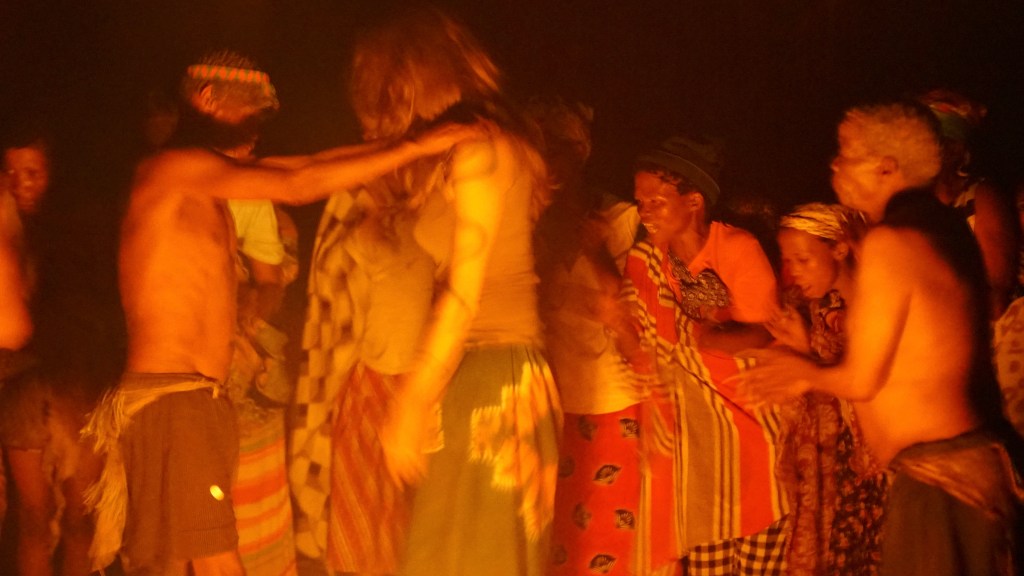
Nature and dance are my gateways to the mystery, where I can bring my worries, exhaustion, prayers, celebrations and gratitude. These gateways open to places deep within and far beyond my perception and imagination. They create an impromptu sacred space that emerges, flexes, stretches, and nurtures, and always ‘meets’ me regardless of my emotional state.

In this post I reflect on the possibilities of danced spirituality in relation to the overarching theme of Feminism and Religion. How does dance relate to our sense of personal expression, freedom and take on life as gender-aware people, and our experience of spiritual intimacy?

Dance is a versatile practice to move through life in an empowered way and to strengthen our connection with the numinous. I truly believe that everyone can dance, and one of my roles as a ceremonial dance facilitator is to help people re-connect with the dancer inside them.

Continue reading “Exploring Dance as Spiritual Practice by Eline Kieft”