 Hmmm…. Time Travel? Maybe, I suppose. I recall a strange video clip in which Steven Hawking throws a Time Travelers’ Party. He sends an invitation for a fancy soiree, holds the event, and sets the scene where future folk will find a welcome reception at specific coordinates in the past, should they find the means to get there.
Then, there’s the Baby and Bird pub in Oxford, England, where the famed Inklings writers convened to share manuscripts. There was a curious tile in the wall of one of the more private rooms, wherein, while drinking my Pimm’s Cup, I was told by some cat playing cards that Tolkien, Lewis, and company made a pact to use that tile as a sort of gathering horcrux, if they discovered they could get meet up again after crossing into the world beyond. I can imagine that conversation among pipe-smoking guys in tweed, very seriously stacking their hands together, imbuing their spirits into a piece of decorative ceramic. I hope it is a true story. I’ve heard enough Brian Greene to appreciate theoretically how perhaps skipping ahead to the future is possible.
My greatest sympathy, though, for the time theorists goes to my old professor, who used to pray for things to be different in his past. He said he believed God could change anything. I thought it was eccentric, and I sort of think he was praying for particular events and things to actually have been different. I admit, his level of specificity is hard for me to brook, but the concept makes a measure of sense when I consider that a person’s past is still actively present in her or his personhood insofar as we are constantly remembering, revaluing, and reintegrating ourselves in one way or another.
From a transcendental personal perspective, things that are decades old condition certain meanings, values, and tolerances in the present self. I have lunch with a friend every couple of months, and there is a never a visit that goes by in which she does not recount and somehow integrate the experience of having a gun pointed at her head. Our stories, especially how we re-member them, great and small, live on in us. It occurs to me even as I write that our conditioning is not even our own exclusively; we carry legacies of the human and cultural past in our embodied presents. And, we presume the future every time we make a promise.
I am reminded of St. Augustine here and largely persuaded to appreciate the value of recognizing something like a perpetual NOW: Continue reading “Time Traveling Letter to Kids of the 70s (especially you, Natalie) by Natalie Weaver”


 Dreaming has always been a huge part of my life. When I was a little girl, I would run to my mom in the morning, before I was even completely awake, and tell her what I had been dreaming, It would seem very important, I mean, desperately, terribly important, to share whatever journey I had been on.
 On June 8, Cleveland watched the Cavaliers lose the NBA championship. Outside of Cleveland, according to the commentators I heard, no one really expected our guys to pull it off. But, here in Cleveland, we felt otherwise. Up until the final four minutes of the fourth quarter, when the Herculean LeBron took the bench, we were still thinking something magical could happen. When he stopped, the game ended. We lost. And, the city, once again, had to recast its disappointment, redirect its energies, and rediscover the eschatological hope that is the core of Cleveland’s athletic grit: “there’s always next year!”
 Dear Mom,
 Human beings tell stories. This may sound like a simple truth. To folklorists, literature professors, and people who work in media and in government, I would sound like a rather simple-minded child to be arriving so late in life at this obvious fact. We tell stories. And, just as the phrase “telling a story” might connote, our stories are not always true to life. Our stories are descriptors and meaning-making efforts, largely rooted in our grappling with self and group identity.
 I have recently read a couple of articles in the Chronicle of Higher Education about the challenge of working in academia. One article lamented the paucity of tenure line positions and the great disappointment some ex-academics feel when they finally give up searching for that elusive job, which is actually non-existent. Another article reported on the sham interview experience, in which a national search is conducted, but the whole thing is a ruse since an internal candidate already has the position. Hopeful candidates put their families and lives on hold as they bide months of time while thinking, completely ignorant of the reality of situation, that they may be in line for a new position. They get letters of reference, prepare for interviews, buy suits, arrange childcare, manage time away from whatever they would otherwise be doing to make an interview, and then endure the emotional trial of waiting.

 I was asked by my sculpture teacher to make a monument. “A monument to what,” I asked? “Anything,” he answered. The only parameter seemed to be that the work was produced in wood. Having seen some interesting stone and marbleizing paints, I had the immediate idea to transform the wood into a marble-like appearance. Marble, for some reason, probably because it is the cemetery standard, seemed like the right medium for a monument to me.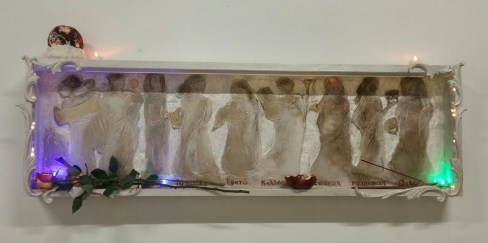
 Feminism and Religion