
Mary as Sister, Trickster, and Mother by Elanur Williams

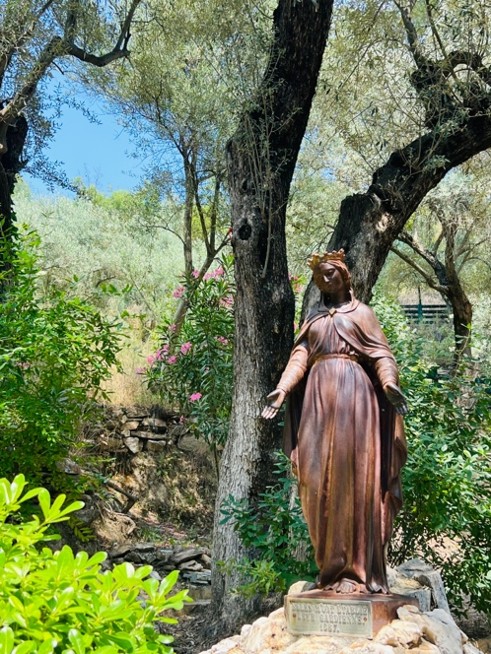
Meryemana Evi, Personal Photo, 2023

The road to the House of the Virgin winds through the hills, a thin ribbon of light. Nestled on Mount Koressos (also known as Bülbüldağı, Turkish for “Mount Nightingale”) near Ephesus, its discovery in the late nineteenth century was inspired by the visions recorded in The Life of the Blessed Virgin Mary by mystic Anne Catherine Emmerich, whose descriptions led priests to identify the small stone dwelling she saw in her revelations. Although the Bible is unclear about Mary’s later life, passages such as John 19:26–27, in which Jesus entrusts his mother to the Apostle John, lend narrative weight to the belief that she followed him; whether to Ephesus or elsewhere, this is a matter of faith and ongoing historical debate. For many, the House is a place of pilgrimage and serves as a symbol of interfaith devotion across centuries. At the wishing wall, candles and paper flutter in the breeze, small, tangled petitions to the divine. I feel my own within my heart as I light a candle among the others, its black wick catching the wind.

Continue reading “Mary as Sister, Trickster, and Mother by Elanur Williams”

Depicting Mary by Natalie Weaver

In October I had the opportunity to travel to the Louvre Museum on a free day I had from a conference I was attending in Leuven, Belgium.  I went predisposed to consider images of the Madonna as I had been thinking about her representations in art for some time.  In my own painting, I have been developing a version of the Annunciation that depicts Mary as a teenage girl reading a pregnancy test.  Her fear and consternation, coupled by the shock of the event of learning of her pregnancy strikes me as a more accessible telling of the true vulnerability and risk of the unwed child Mary than classic depictions of Mary as a reclining queenly figure quietly receiving the angel’s message.  I likewise had been working on a wood burnt figure of a Black Madonna as a study in both icon making and also understanding the tradition of Black Madonnas found throughout Eastern Europe.

I am deeply aware that representing this figure is a culturally laden task because the Madonna speaks both to some of the deepest spiritual needs and inclinations of many faithful Christians world over, just as she is almost shorthand for division among Christian communities.  Her presentation is tremendously political as it is received by fans and critics simultaneously as at once championing women (and the divine within women) and also condemning real women whose maternity and bodies can never be as morally or physically pristine as Mary’s.  Mary’s skin, clothing, age, gesturing, posture, gaze, and more speak volumes about the social location of her patrons and creators as well as the manner in which the viewer is being invited to receive her.

Continue reading “Depicting Mary by Natalie Weaver”

ADVENT: THE ACTIVE-WAIT, PART II, By Cynthia Garrity-Bond

On Nov. 14 I posted Part 1 of Advent: The Active-Wait. What follows (in Part II) is a rereading or exegesis of Mary’s encounter with her cousin Elizabeth as an Advent waiting with hope, anticipation and trust, but also with action.

The second form of waiting, illustrated in verse Luke 1: 39, reads: “In those days, Mary set out and went with haste to a Judean town in the hill country, where she entered the house of Zechariah and greeted Elizabeth.”  The verse before this has Mary in complete surrender,  “Here I am” Mary proclaims, “the servant of the Lord; let it be with me according to your Word.”  Continue reading “ADVENT: THE ACTIVE-WAIT, PART II, By Cynthia Garrity-Bond”