Legacy of Carol P. Christ: On Believing Things That Are Not True

This was originally posted on August 19, 2019 (when the former guy was President. Although former guy isn’t in power now, Carol’s points are still operative in our world.)

Anyone who is following American politics these days knows that the American President and his acolytes have little respect for what the rest of us consider to be the truth—or at least the best approximation of the truth that we can discern. Last week, while discussing the “lie” of white supremacy that approximately 40% of the American public has bought hook, line, and sinker, I had occasion to reflect again on the relation between traditional religious beliefs and rejection of reason and common sense. As is also well-known the President and his supporters have no respect for factual truth.

Continue reading “Legacy of Carol P. Christ: On Believing Things That Are Not True”

The Legacy of Carol P. Christ: Meeting the Windigo

Towards the end of Braiding Sweetgrass, mother, biologist, and member of the Citizen Potawami Nation Robin Wall Kimmerer sets out at the end of winter to visit a forest area near her home that she considers hers not in name but in virtue of her love and care for it. On arriving, she discovers that the forest is no more, having been clear-cut by the owner. The wildflowers and the plants she has harvested over the years have sprouted up, but Kimmerer knows that without the forest cover they will be burned by the sun and their places taken by brambles.

Kimmerer is overcome by anger and despair, her feelings for the land she loves merging with her knowledge that not only her forest, but the earth itself is being treated as nothing more than a product by so many—without second thought for all that is lost.

Continue reading “The Legacy of Carol P. Christ: Meeting the Windigo”

Legacy of Carol P. Christ:“Ursula Niebuhr, Ursula Niebuhr”: Unacknowledged Co-author of Great Works of Theology?

This was originally posted on August 26, 2019. It fits in with our new project of Unsung Heroines.

A few days ago while watching the movie The Wife, I kept hearing the words “Ursula Niebuhr, Ursula Niebuhr,” in my mind. I knew the reason was Ursula’s unacknowledged collaboration on the work of Reinhold Niebuhr, which I discovered while writing an earlier blog on uncredited co-authors.

I had not been particularly interested in seeing The Wife because I assumed it was the familiar story of the woman who gives up her career interests when she marries. Want to become a rabbi? Marry one. Want to become an artist? Live with him and become his muse. This is a very old story, and for me, not a very interesting one.

Continue reading “Legacy of Carol P. Christ:“Ursula Niebuhr, Ursula Niebuhr”: Unacknowledged Co-author of Great Works of Theology?”

Legacy of Carol P. Christ: His Terror

Moderator’s Note: This was originally posted on March 25, 2019. AND the issues are still with us and as vivid as ever.

The first two parts of Susan Griffin’s Woman and Nature, “MATTER” and “SEPARATION,” are written in the authoritative voice of western philosophy and science that declares matter to be dead and the body an impediment to thought, and proceeds to separate the mind from the body. All of this, Griffin suggests, is based in the fear of death.

As Griffin notes, in this equation woman is identified with the body and her voice is silenced. Re-reading these parts of Woman and Nature for the umpteenth time for a class I am teaching felt even more painful than it had before. I was reliving parts of my own story.

I was brought up in the tract home suburbs of post-war Los Angeles in a world of women. Both of my grandmothers played central roles in my upbringing, introducing me to nature and the spirit of life they experienced as we explored trails the Los Angeles County arboretum before it was fenced or when we frolicked in the waves and picked up sand dollars at the seashore south of San Francisco. When I was ten years old my family moved to a new neighborhood that was almost entirely made up of families like ours with small children, fathers who worked, and mothers who stayed home.

Continue reading “Legacy of Carol P. Christ: His Terror”

Legacy of Carol P. Christ: It’s Time to Thank Stacey Abrams Again

This was originally posted on January 18, 2021

The insurrection in the Capitol on January 6 has dominated the news ever since. Coverage of the Democrats’ victories in the two Senate runoffs in Georgia has been virtually nil. Now that it seems that at least as long as the National Guard is deployed to defend the national and state capitols, the insurrectionists have been stopped, it is time to thank Raphael Warnock and Jon Ossoff–and most of all to Stacey Abrams–for returning control of the Senate to the Democrats.

As is well-known to most readers of FAR, Stacey Abrams narrowly lost the election for Governor of Georgia in 2018 due to voter suppression.

Voter suppression of voters of color and young voters is a scourge our country faces in states across the nation.  Georgia’s 2018 elections shone a bright light on the issue with elections that were rife with mismanagement, irregularities, unbelievably long lines and more, exposing both recent and also decades-long actions and inactions by the state to thwart the right to vote. 

Continue reading “Legacy of Carol P. Christ: It’s Time to Thank Stacey Abrams Again”

The Guru Question: Are Spiritual Hierarchies Inherently Oppressive?

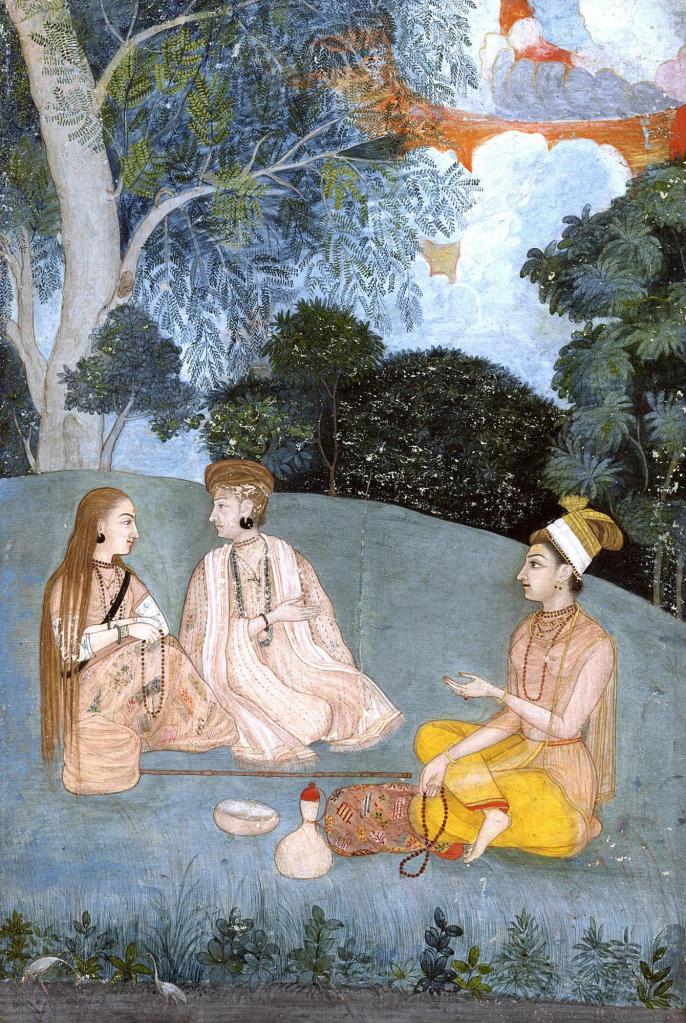
Painting of a noblewoman seeking counsel from two Tantric yoginis, in the Mughal style, about 1750. From the British Museum’s recent exhibition, Tantra: Enlightenment to Revolution. A beautiful starting point to learn about Indian spirituality in its original context. May all our paths be crossed by wise teachers.

I’ve received a tremendous response to my essay on cults, published on Feminism and Religion in December last year. The topic continues to be a burning issue as more and more survivors break their silence on the spiritual abuse they suffered. Cults are a feminist issue because women and girls suffer the worst abuses at the hands of male cult leaders.

To fully understand how this cult dynamic works, I highly recommend watching Dan Shaw’s lecture on the subject, in which he explains how cult leaders are traumatizing narcissists whose goal is to subjugate their followers and “purify” them by utterly destroying their sense of self. Yet for me, the most haunting moment of his presentation came just near the end, during the Q & A session. An audience member and survivor of Siddha Yoga, the same cult that Shaw once belonged to, asked, “Are there gurus that people can trust?” She asked if guru-driven spirituality was “inherently subjugating.”  

Shaw, perhaps understandably not wanting to come across as a white man casting judgement on another culture’s deeply-rooted spiritual traditions, wiggled out of answering by saying that it was up to the individual to discern if a particular guru was safe or not.  

But I think this anonymous woman’s question deserves a more nuanced answer.

In Hinduism, since the age of the Upanishads, gurus have played a crucial role in preserving wisdom teachings in a religion with no centralized authority figure or governing body. The teachings are passed on orally to disciples who worship the guru as a divine being in order to realize their own innate divinity. I would love to hear from Indian feminists on how this guru-disciple relationship plays out in India today, particularly with female practitioners.

However legitimate and honorable these systems might be in their original cultural context, I think it’s fair to say something gets lost in translation when Eastern spirituality moves West. Great abuses have come to light. Katy Butler, in her article, “Encountering the Shadow in Buddhist America,” writes that guru abuse has become so prevalent due to the “unhealthy marriage of Asian hierarchy and American license that distorts the student-teacher relationship.”

It’s pertinent to point out that many of these misbehaving gurus, lamas, and swamis are white men. Spiritual hierarchies can be abusive across cultures—look at the sex abuse scandals in the Catholic Church. Cults are not necessarily “Eastern” or “foreign.” There are plenty of Christian cults, self help cults, and wellness cults.

Another thing that often gets lost in translation is what Eastern spirituality actually intends to offer the student. Many Western students turn to Eastern disciplines like meditation and mindfulness for stress reduction, but that is not their original purpose. These disciplines are intended to liberate the practitioner from the wheel of death and rebirth, to transcend this world of suffering and our worldly attachments, in order to enter an enlightened state—i.e. not to be reincarnated again, a goal some Western people might find world-denying and nihilistic.

Dr Willoughby Britton, professor of psychiatry at Brown University, speaking to Rachel Bernstein on IndoctriNation podcast asks, “How problematic or paradoxical is it if you believe that enlightenment is a destination that someone else can take you to? What dependence does that create?”

The goal is unmeasurable and the endpoint keeps shifting according to the power dynamics. You become much more dependent on the teacher who decides if you have reached this invisible destination. If you’re being charged a lot for the teachings, the teacher may decide that you don’t achieve the end result for a very long time.

Willoughby says practitioners can empower themselves by asking themselves the following questions:

Where do you want to go with this practice?

If you are seeking enlightenment, what does that mean for you?

You get to define your own outcomes and measure your success by what you want to show up in your life, i.e. better sleep, reduced anxiety, improved relationships, and inner peace.

In evaluating teachers and spiritual groups, ask yourself:

What were you initially promised?

Has it been achieved after all your hard work?

Do you feel you are closer to your goal?

Or have your initial reasons been shifted by the teacher into their reasons and their goals that are no longer yours?

Are you under pressure to perform for and please the teacher?

Are you expected to use scripted, stilted language to describe your experience?

If you question the teacher and the teacher retaliates, that’s your tipping point, says Britton. If you say that a practice isn’t working for you and the response you get is, “Well, that’s because you don’t have the right karmas/aren’t dedicated enough/haven’t reached the right level of spiritual maturity”  etc., you need to leave and find a different group.

In order for anyone to have a healthy experience with a teacher, you need the freedom to say, “I think this isn’t working for me, and, in fact, it’s hurting me and I need to move on.” Depending on how people respond to you setting your boundary, you’ll know if you’re in a healthy space or not.

As Dan Lawton says on another episode of IndoctriNation Podcast, a spiritual practice can only be as healthy as the person teaching you that practice. The endgame for a lot of teachers is often building a personal brand around the supremacy of a certain spiritual practice. Once you’re locked into that box, there are a lot of things you’re not going to be able to see and there’s a possibility of doing real harm to your students.

Good, ethical teachers, whether they call themselves gurus or not, are deserving of deep respect. But they need to be vetted and held accountable. And maybe in the West, at least, the obligation to see the teacher as enlightened or divine is indeed too subjugating. Maybe it would much healthier to look up to them as a wise elder or mentor. Surrendering our agency to another human is always going to be subjugating.

Perhaps we can follow the example of the female seeker in the 18th century painting above, who is taking counsel from two yoginis, female practitioners who live in the forest, outside the strictures and hierarchies of patriarchal society. Instead of placing all our hopes in one exalted individual, why not instead seek the deep wisdom of the female collective?

Mary Sharratt is committed to telling women’s stories. Please check out her acclaimed novel Illuminations, drawn from the dramatic life of Hildegard von Bingen, and her new novel Revelationsabout the mystical pilgrim Margery Kempe and her friendship with Julian of Norwich. Visit her website.

Memoirs of a Cult Survivor by Chasity Jones

This blogpost is a reflection on my experience creating a podcast series concerning religious trauma experienced in cults as well as how to heal from traumatic cult experiences.

Firstly, I had to be very intentional about the word survivor as opposed to victim. Survivor was the obvious choice because I used to cringe when thinking of myself as a victim. However, As I heal, I can honor both the survivor and the victim, for they are the same. I cannot forget to acknowledge though that some victims do not survive and this is the same concerning cults. Many people at this very moment are in exile or in hiding from their cults when they escape and for that reason some of the people who engaged in this series were forced to engage anonymously.

Continue reading “Memoirs of a Cult Survivor by Chasity Jones”

Remembering “The Burning Times,” Part 1 by Beth Bartlett

I first saw it when looking at their faces while showing The Burning Times in class — the blank stares, the pained expressions, the tears, the looking away. The scenes and sounds of women tortured and burned alive touched something deep and ancient in them.  Here it was — the historical trauma of women.[i]  The lasting impact of historical trauma is experienced by subsequent generations for hundreds of years, manifesting in such things as depression, PTSD, self-destructive behaviors, anger, violence, suicide, and more. As Native LGBTQ activist and writer Chris Stark so eloquently put it: “The experiences of our grandparents and great-grandparents are written into the library of our bodies . . . . My ancestors’ loss and screams are written in me – their pain and murder and rape merged with my own as a child. . . We carry them through time. We remember.”

Continue reading “Remembering “The Burning Times,” Part 1 by Beth Bartlett”

Legacy of Carol P. Christ: The Devil’s Bargain: “If You Can Convince a White Woman”

This was originally posted on August 12, 2019

This week’s news from America. Where to begin? When will it end?

The President of the United States is a racist who incites racist violence. Republicans have been slow to condemn the President and are not likely to pass a complete ban on assault weapons and to make those currently in circulation illegal.

After reading a speech condemning hate speech and gun violence that he obviously didn’t write, the President scheduled a round-up of brown people working in chicken-packing factories in Mississippi to coincide with his unsympathetic visits to the cities of Dayton and El Paso, where two recent mass killings by assault weapons occurred. The next morning, we were greeted by images of little children coming home from school in small towns in Mississippi to find their parents missing. We were told that none of the surviving victims of the El Paso shooting wanted to meet the President.

This is not the America I want. But it is the America that many Americans seem to want. I would like to think that women as a group reject the President and his agenda. Sadly, this is not true.

Continue reading “Legacy of Carol P. Christ: The Devil’s Bargain: “If You Can Convince a White Woman””

The Fall of Patriarchy: I Got Scammed by Caryn MacGrandle

I am a few months out of my second marriage. There will be no third. I know my task right now is to become self-sufficient.

Thanks to my second husband, I have valuable Project Management skills. He set up an S-Corporation when he was out of work in Illinois and handed it over to me when he found a salaried job. I gained needed self-confidence over the past eight years and figured out that I am good at Project Management.

Now I need to convince another company of that. Because I am not good at sales and no longer have my main client in my company and with my divorce, I need a steady income.

I thought I had found one.

I was reached out to by a supposedly Swiss company called HAND-Lease that leases and sells extremely large equipment from $25,000 up to $55 million. They had just established a Pennsylvania office and were now opening a Birmingham office. I was phone screened by a customer service employee who said if they were interested, the Human Resource department would reach out to me for a longer interview. 

Continue reading “The Fall of Patriarchy: I Got Scammed by Caryn MacGrandle”