
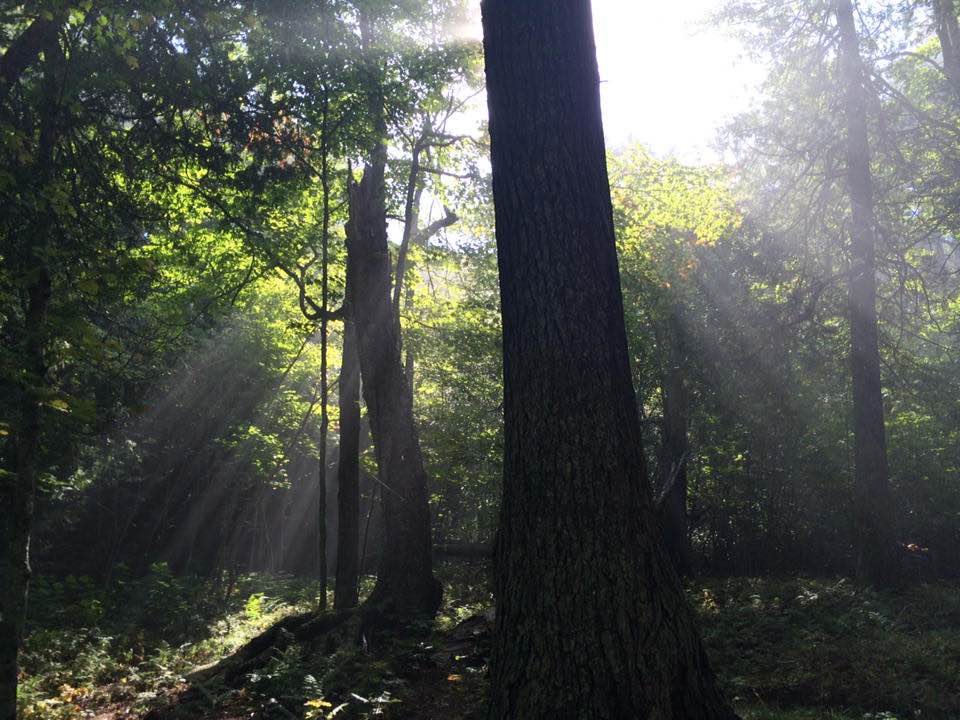
AI: The New Windigo by Beth Bartlett

photo by Beth Bartlett

It was a post about an old growth forest being cut down to build a data center that brought me to my knees in grief. The anguish I’ve been experiencing over the destruction of the planet has been building in me for years, decades even, as I’ve slowly watched the land and water that I love be destroyed bit by bit and at an ever-increasing rate.  So, reading about another forest being devastated and for yet another data center was nothing new, but it was the last in an accumulation of sorrow and rage that left me feeling that I could no longer bear the weight of it. The loss of centuries of growth of arboreal ancestors was shattering in itself, but it was the purpose of this annihilation that ultimately undid me – the new idol that has taken the world by storm – artificial intelligence – the latest iteration of the Windigo[i], destroying the earth and waters in its greed.

Years ago, long before the introduction of AI, one of my students, a computer science major, did his ecofeminism final project on the environmental impact of the internet.  The other students and I were all a bit surprised.  Wasn’t the internet revolution supposed to be better for the environment, reducing the destruction of forests and the need for fossil fuels since we no longer needed so much paper and transportation for books,  newspapers, letters, and other ways to communicate with one another?  No, he warned, because of the vast amounts of electricity and water needed to run data centers. It’s been on my mind ever since.

Continue reading “AI: The New Windigo by Beth Bartlett”

Windigo Winter Rolls On by Sara Wright

  Preface: Yesterday someone asked me to contribute an academic article that had to be cited to be included in a book. I said no because my academic years are over. My life experience has taught me that education is simply not enough to shift perception, and that Story may be equally/ or more important because story taps into the creative side of us, moving us through our childhood senses which include our feelings. Although not specifically feminist in content, I believe the underlying messages belong to feminism. The first highlights the destructive greedy ‘head’ without a body. The second addresses the complicated situation we find ourselves in – offering us a way through. The second story also highlights the primary difference between an exchange economy and a gift giving one.

Continue reading “Windigo Winter Rolls On by Sara Wright”

The Legacy of Carol P. Christ: Meeting the Windigo

Towards the end of Braiding Sweetgrass, mother, biologist, and member of the Citizen Potawami Nation Robin Wall Kimmerer sets out at the end of winter to visit a forest area near her home that she considers hers not in name but in virtue of her love and care for it. On arriving, she discovers that the forest is no more, having been clear-cut by the owner. The wildflowers and the plants she has harvested over the years have sprouted up, but Kimmerer knows that without the forest cover they will be burned by the sun and their places taken by brambles.

Kimmerer is overcome by anger and despair, her feelings for the land she loves merging with her knowledge that not only her forest, but the earth itself is being treated as nothing more than a product by so many—without second thought for all that is lost.

Continue reading “The Legacy of Carol P. Christ: Meeting the Windigo”

Windigo by Sara Wright

Windigo,

the Potawami Nations call him.

Malignant,

this spirit thrives

in the Northern Woods,

within the human soul.

Hatred for self or other

hidden

under Lies.


Windigo, the

Potawami Nations call him

He thrives

on greed.

Empty

He can never

Be filled.

Continue reading “Windigo by Sara Wright”

Meeting the Windigo by Carol P. Christ

Towards the end of Braiding Sweetgrass, mother, biologist, and member of the Citizen Potawami Nation Robin Wall Kimmerer sets out at the end of winter to visit a forest area near her home that she considers hers not in name but in virtue of her love and care for it. On arriving, she discovers that the forest is no more, having been clear-cut by the owner. The wildflowers and the plants she has harvested over the years have sprouted up, but Kimmerer knows that without the forest cover they will be burned by the sun and their places taken by brambles. Continue reading “Meeting the Windigo by Carol P. Christ”