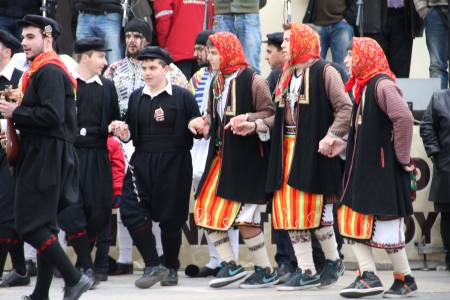
When I Dance I Am I Greek by Carol P. Christ

Carol Molivos by Andrea Sarris 2When I first moved to Greece I spoke of being attracted to a culture in which people express their emotions easily and do not hold on to anger. In the part of American culture I know, the opposite is often the case: people do not express their emotions easily and hold onto their anger. When I joined a therapy group in Greece, my therapist said that I made the right decision to move to Greece. “You needed to learn to live from here,” she said touching her belly, “and this is where Greeks live.”

During the first years I lived in Greece, I often said that I wanted to become Greek. Like others had done before me, I romanticized Greece and the Greeks. Then one winter I learned that family violence is as prevalent in Greece as it is in every other country. The cultural ability to express emotion does not stop Greek men from beating their wives or Greek women from hitting children. Indeed the more expressive nature of the Greek culture may make it easier for Greeks to resort to physical violence. On the other hand, violence stemming from withheld feelings can be cruel and unpredictable. Continue reading “When I Dance I Am I Greek by Carol P. Christ”

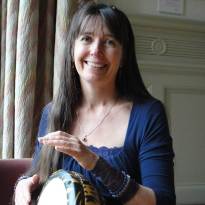
Lighting Our Candles, We Dance into the Dark by Laura Shannon

Laura ShannonHere in the northern hemisphere, these weeks between Samhain and the winter solstice bring us into the darkest time of the year.  In my dance circles, this is my favourite time for candle dances, whose gentle light guides us when we cannot clearly see, while the support of the circle gives us courage to step into the unknown.

Dancing with candles is like travelling through time. For thousands of years, dancing in the dark – at night, or deep in caves – took place by the light of the moon or the flame. The beauty of candle dancing is that the darkness is still present; we do not need to disparage it, dispel it, flee it or fight it. This marriage of light and dark comes across in this lovely photo from a recent candle dance at Findhorn. Continue reading “Lighting Our Candles, We Dance into the Dark by Laura Shannon”

The Dance of Memory, Part 2: The Wishing Tree Laura Shannon

Laura Shannon square crop

Now is the time of Beltane, the great festival celebrating life and fertility.

Last week, on April 24th, in my post The Dance of Memory I wrote about the centennial of the Armenian Genocide, and invited everyone to join in this worldwide day of remembrance through prayer, meditation, music and dance. Subsequently I received testimony from students and colleagues all over the world about dance events they had organised in response to my call.

Dancing friends from Europe, North America, South America, and Australia told how moved they felt to be part of a larger whole, connected through the wordless beauty of music and dance, and by our compassion and caring for all those affected by genocide. Many, including my sister Leslie, thanked me for my ‘call to include Turkish and other dances in the Armenian commemoration activities’. She wrote from New Zealand, ‘The world needs more of this kind of inclusiveness!’

In Germany, Sybille Kolaric danced Armenian dances and a Turkish dance with her group, saying, “I really liked the idea to combine in the dance circle what is so separated in reality.”

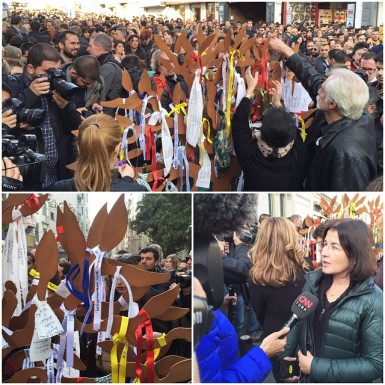
A beautiful coming together of Turks and Armenians took place in Istanbul, where my dear friend and colleague Shakeh Major Tchilingirian went with her family, along with many Armenians from all over the world, for the April 24th commemorative ceremonies. A few days before, Shakeh had been leading Armenian dances with Turkish university students there as a ritual of reconciliation (you can see the film, Circle of Life, about a similar event she led in London). Shakeh wrote that they attended a very emotional service in the Armenian Church, and then went to Taksim Square to tie cloths to the Wishing Tree.

Shakeh wrote from Istanbul, “Last night I read some of the messages on The Wishing Tree, messages remembering ALL victims of atrocities and genocide as well as the displaced. There were thousands, possibly tens of thousands, of people sitting silently in Taksim Square, many Turks and Kurds amongst us. There is a lesson to be learned here: we are all victims of the situation we find ourselves in and the longer these wounds bleed the more difficult it becomes to heal.”

The Wishing Tree in Taksim Square was created by Turkish artist Hale Tenger, specifically to mark the centennial of the Genocide. She invited participants to tie pieces of cloth to its branches in homage to the victims and survivors of the Armenian Genocide. Armenian-American Nancy Kricorian brought with her from New York a strip of fabric from one of her grandmother’s aprons, saying, “My grandmother Mariam Kodjababian Kricorian was a survivor of the 1915 Genocide, and tying this cloth to the Wishing Tree in Istanbul will be a tribute to her life.”

HaleTengerWishingTree


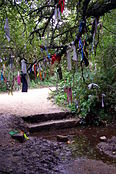
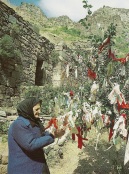
Clouties_near_madron_wellArmenian wishing tree cropCoincidentally, my April 24 post on FAR included a photo of an Armenian grandmother tying an offering of cloth to just such a tree. The ancient folk custom of the wishing tree, where people (usually women) tie cloths with a special prayer for a loved one, can be found today in Armenia, Turkey, and Greece, in Asia and throughout Europe as far as the British Isles and in Asia as well. This ‘clootie tree’ by the ‘clootie well’ (cloth = clootie) in Madron, Cornwall, is almost identical to the Armenian one shown in my previous post.

Carol P. Christ’s comment on my last post described a similar tree on her Greek island of Lesvos which she tells me is near hot baths once sacred in antiquity. She also stated that brides in ancient Greece would leave articles of their unmarried clothing on a tree dedicated to the virgin Goddess Artemis, one of many tree-worshipping rituals which were well-known and widespread in the ancient world.

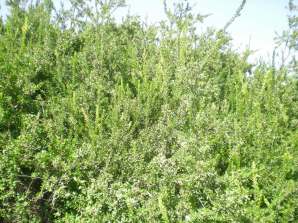
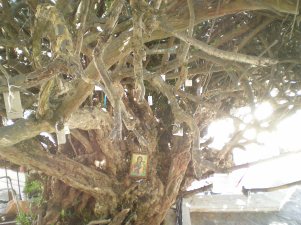
Women on Carol Christ’s Goddess Pilgrimage to Crete have all participated in such a practice, tying coloured ribbons onto the venerable myrtle tree already covered with ribbons and votive offerings called tamas, at the sacred monastery of Palianí. When I went there with Carol in 2012, my encounter with the tree led to a profound and lasting experience of healing, which Carol remembered in Giving Back to the Mother.

Paliani myrtle DSCN9080Paliani tamas DSCN9079

Tree emb Paliani DSCN9092Sisters on Carol’s pilgrimage also get to encircle the 2,000-year-old plane tree at Krasi. Even today village festivals are held under the canopy created by the ancient tree.  We know that tree worship on Crete has roots in Minoan times, as depicted in gold seal rings and other examples of Minoan art, and we know that tree worship is both ancient and widespread.  My life’s work researching the Goddess in traditional Balkan dance has shown that the Tree is often associated with the Goddess, for instance in many Balkan embroideries  This abstract but recognisable version comes from the curtains of the reception room in the Palianí monastery.

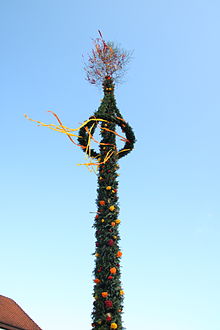
Maibaum_Ostfriesland967The sacred tree remains a living tradition in central, western and northern Europe in the form of the Maypole. I write this from Austria, where virtually every town and village honours May 1st (the ancient celebration of Beltane) with a May Tree, or Maibaum, a tall decorated pole with a wreath at the top. I love how this one from Germany resembles the Goddess.  Can you see her too?

Once-universal practices revering trees, nature, and the Goddess may have changed, but the act of praying for others’ well-being remains common to us all. The longing to keep our loved ones safe transcends all religious, political and ethnic boundaries. Love for others is one of the strongest bridges to common ground, and here is where we find our meeting place once again.

As I read through the messages sent in response to my invitation to dance on April 24th, I feel that each dancing circle is like a votive offering hung on a sacred tree. Each one is a gift of love for humanity, unique, yet part of a shared desire to end suffering, to bring healing, and to ensure the safety and survival of every single being in creation.

Laura Shannon has been researching and teaching traditional women’s ritual dances since 1987. She is considered one of the ‘grandmothers’ of the worldwide Sacred / Circle Dance movement and gives workshops regularly in over twenty countries worldwide. Laura holds an honours degree in Intercultural Studies (1986) and a diploma in Dance Movement Therapy (1990).  She has also dedicated much time to primary research in Balkan and Greek villages, learning songs, dances, rituals and textile patterns which have been passed down for many generations, and which embody an age-old worldview of sustainability, community, and reverence for the earth. Laura’s essay ‘Women’s Ritual Dances: An Ancient Source of Healing in Our Times’,  was published in Dancing on the Earth. Laura lives partly in Greece and partly in the Findhorn ecological community in Scotland.

The Dance of Memory: Commemorating the Centennial of the Armenian Genocide

Laura Shannon square crop

Friday, April 24, 2015 marks one hundred years since the start of the Armenian Genocide of 1915.

In my dance workshop last Sunday in Somerset, England, we lit candles to the exquisite voice of the great Armenian soprano Lusine Zakarian, and danced beautiful Armenian dances in a ritual of solidarity with this occasion.

I have been encouraging all my students to dance Armenian dances with their groups this week, most especially on Friday, to align with the commemorations happening around the world. Even if you do not dance, you could simply light a candle and listen to some Armenian music (see my list of recommendations at the end of this post). I feel that every act of compassionate witnessing, however small, helps heal the wounds of history.

Continue reading “The Dance of Memory: Commemorating the Centennial of the Armenian Genocide”

Twelfth Night: Men’s Dance Rituals in Northern Greece by Laura Shannon

Laura Shannon square crop

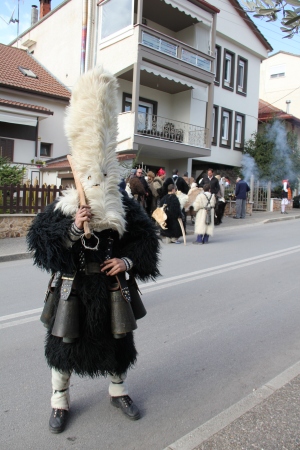
The twelve days between Christmas and the New Year are still held to be holy days in Greece, a mystical and dangerous time when mischievous spirits emerge from the underworld, seeking to wreak havoc in the human realm. On the 6th of January, Theophania or Twelfth Night, masked men in goatskins and sheepbells dance through the streets to dispel these spirits, awaken the fertility of the earth, and ensure a good year. The name Theophania, literally ‘the appearance of god’, here refers to the return of the sun after the winter solstice, and fire and light are very important to this holiday.

The rituals I describe here come from six tiny villages in the region of Drama, just south of the Rhodope Mountains, close to the border between northern Greece and Bulgaria. Similar rituals featuring masked, bell-wearing men appear all through the Balkans and Central Europe as far as the Swiss Alps. They will dance through the village streets, in the cemetery, and in front of every house, in a ritual of blessing and catharsis which has roots in age-old worship of Dionysus, god of fertility and wine.

For me, who came to Greece to study women’s traditional songs, dances and costumes, it makes a refreshing change to observe ritual customs almost exclusively performed by men. These activities take place in winter, either at Theophania or during Carnival, in contrast to spring and summer rituals which are chiefly in the hands of the women.  However, as we shall see, in order for men to assume ritual abilities and responsibilities normally ascribed to women, some of the men must dress in women’s clothes.

Here I would like to mention Carol Christ’s recent analysis of essentialism in feminist theory in her excellent post of September 15. In Carol’s words, the essentialist view holds that the “‘essential qualities’ of a thing (a table, a horse, a woman, or a man) precede the ‘existence’ of any individual in the group to which it belongs; these qualities are universally—always and everywhere—expressed by members of the group.”

Carol and I both live in Greece, where, as in many other parts of the world, tradition assigns quite different tasks and attributes to men and to women. Without reawakening the essentialist discussion here, I would just like to say that modern-day feminists do not have to agree on whether women and men are essentially or inevitably different; however, in order to understand Balkan culture, we do need to realise that people here believe in these differences and have done since ancient times.

Angelos Keras, the Archigos (leader) of the Arapides in Monastiraki (photo: Spyros Taramigos)
Angelos Keras, the Archigos of the Arapides in Monastiraki

Back in Drama, in the village of Monastiraki, preparations have been underway for days. The night before the big event, a designated house – half-ruined, but still with a roof intact – slowly fills with the joy of friends and acquaintances greeting one another. Red wine flows, and traditional goat soup is served free to all. A fire has been kept burning here continuously throughout the twelve nights of Christmas, producing sacred ash with healing and protective powers. Musicians play through the night, producing archaic sounds on the Macedonian bowed lyra or kemene, accompanied by large goatskin tambourines called daheres. These are the only instruments. The overall effect is all the more hypnotic as the musicians play in absolute unison; even the singing is monophonic, in a musical structure intended to emphasise old values of community and coherence.

Meanwhile, people dance the same few dances over and over. As on all ritual occasions, the repetition of familiar simple step patterns frees the dancers to focus on the inner work of igniting their own good mood and raising good energy (kefi) to bless the community.

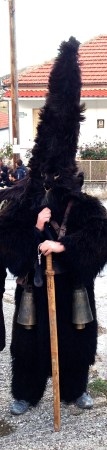
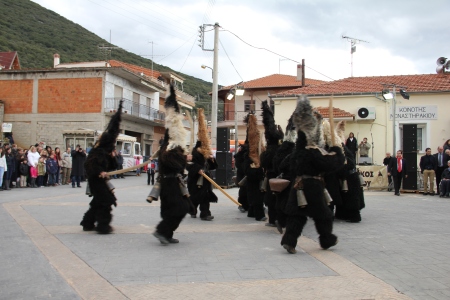
After dancing and drinking all night, the male celebrants help each other dress in the early hours of dawn. They are truly fearsome in shaggy dark skins, tall conical masks, and wide leather belts from which swing three pairs of heavy double bells. One of their names, koudonofori, means bell wearers; they are also called Arapides, the Black Ones or Moors.

Looking behind the apparent racism of the terminology, these ritual dancers blacken their skin with burnt cork both to invoke the power and protection of the sacred fire, and also in order to enter the realm of darkness. Here, the dark is seen as the repository of the earth’s fertile powers, which their bells and dances aim to awaken, as well as the realm of things ‘not seen’ , such as the spirits known as kallikantzari, which pose a threat to the new light and the new year. They themselves must go unseen, in masks and disguises, to enter this realm.

'Arapides', masked ritual dancers at Theophania (January 6) in Monastiraki (photo: Lenka Harmon)
‘Arapides’, masked ritual dancers at Theophania in Monastiraki

Brandishing long wooden swords, this group – known as a tseta – appears fully capable of driving out any number of kallikantzari. The phallic swords and headdresses leave one in no doubt that the Theophania rituals are men’s rituals, yet the ability to give new life, to enter the realms of the dead, and to bestow the blessing of fertility are essentially women’s powers. To claim these powers, some of the men must dress as women, as Dionysian revellers have done since ancient times. These are theGilinges, or Brides. 

Pappoudes ('Grandfathers') with lozenge-shaped beaded amulets, and Gilinges ('Brides') in Ksiropotamos (photo: Lenka Harmon)
Pappoudes (‘Grandfathers’) with lozenge-shaped beaded amulets, and Gilinges (‘Brides’) in Ksiropotamos

Wearing women’s clothing may be a means for men to temporarily gain access to the realms of life and death, where normally only women may go, or to symbolically give birth to the life-affirming fertility and joy which bring renewal at this dark and hungry time of the year. (Men wearing women’s clothing for ritual purposes are depicted in archaeological finds dating back to the 5th C. BCE; I think we see it today in the ecclesiastical robes worn by Christian priests.) In an additional affirmation of what is seen as women’s power, the Brides’ costume is rich in goddess embroideries, while all the members of the party wear beaded amulets in the lozenge-shaped symbol of female fertility going back to Neolithic times. Goddess symbols are also stamped on many of the bells.

As well as the Arapides and the Brides, the tseta includes Pappoudes or Grandfathers in Thracian men’s traditional dress, and Evzones or Tsoliades wearing short white pleated foustanella kilts and thetsevres, a special garment made of twelve large white kerchiefs sewn into a triangle densely fringed with beads, sequins and coloured threads, which takes four months to prepare.

Musicians and 'Tsoliades' ritual dancers in Monastiraki (photo: Lenka Harmon)
Musicians and ‘Tsoliades’ ritual dancers in Monastiraki

There is also an occasionally appearing Bear, who some say represents ancient worship of the Goddess Artemis.

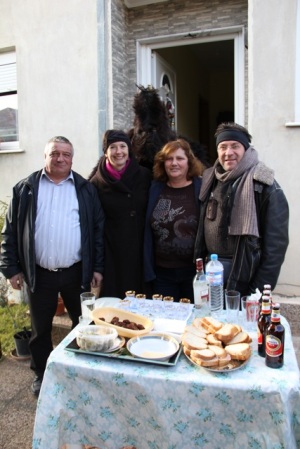
As they journey together through the village, the bell-wearers leap and stamp, swinging their bells back and forth in an apotropaic din – this will indeed awaken the earth! – almost drowning out the eerie sound of the lyras and daïres. The Evzones dance with athletic half-turns which send their short kilts sailing up to their waist, emphasising (so I am assured) the fertile power of the male generative organs, without revealing the organs themselves.  At every house the entire tseta is rewarded with abundant food and drink, in the living tradition of sacred hospitality which is the most powerful blessing of all.

Hospitality to strangers in Ksiropotamos (photo: Lenka Harmon)
Hospitality to strangers in Ksiropotamos

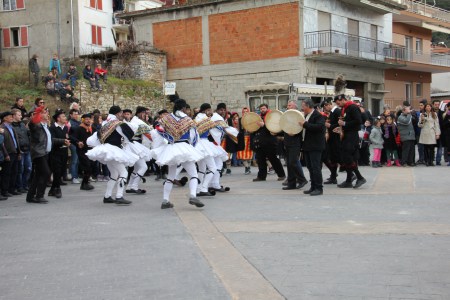
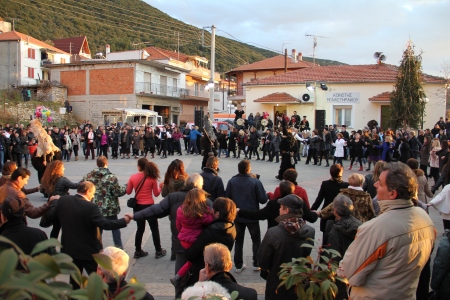
By three o’clock, the whole village gathers at the plateia to dance. Hundreds of people spiral into a single circle with one leader, keeping the large centre open as a sacred space for the tseta to enact ancient rituals of death and resurrection, plowing and planting, and the hieros gamos or sacred wedding. The dancing goes on until dusk and then continues at a taverna through a second consecutive night.

IMG_4982 - 4
Everyone joins in the great circle dance in the plateia of Monastiraki

Each village has its own variation of the Theophania rituals. In some places, children and women also participate: in Ksiropotamos young girls dance in traditional costume, while in Petrousa, all the dahereplayers are teenage girls. Some traditionalists view this change with unease, but I must confess my pleasure at seeing thirteen young women lined up like priestesses of Cybele from the time when the drummers were women. Here too, people dance at crossroads, springs, sacred trees and finally around an enormous bonfire.

Cauldrons at the crossroads in Ksiropotamos (photo: Laura Shannon)
Cauldrons at the crossroads in Ksiropotamos

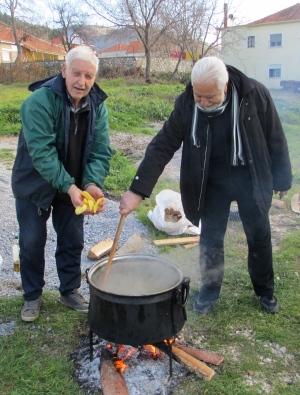
Fire is important in all the Theophania rituals, and cauldrons on open fires are a key part of the festivities. This is another symbol of women’s power adopted on this occasion by men – traditionally, women cooked in pots; men roasted meat over an open fire. In Petrousa, the Dance of the Cooks can still be seen. Although it is no longer danced around the cauldrons themselves, the symmetrical step pattern still focuses the energy or ‘fire’ of the dancers in a particular way.

It seems to me that these fire-focused rituals hint at the unnamed presence of the Goddess Hestia, whose domain is centred on the hearth, source of light, warmth, food and all that is beneficial to the home. The nikokira, the lady of the house, was seen since ancient times as Hestia’s priestess. Her role is to tend the sacred fire through practical and ritual work and to literally focus its brilliance (estiazo, fromHestia, means ‘to focus’) so that it may bless the household and all its inhabitants. In ritual activities such as the Theophania, through the mediation of men dressed as women, this focused fire can be brought once a year from the private space of the home – the realm of the women – into the public space of the village, the realm of the men.  This union of men’s and women’s fertile powers is the hieros gamos, the holy spark of blessing which ensures health, wealth, happiness and abundance for all in the coming year.

Nikos Papadimitriou, an Arapis in Ksiropotamos (photo: Lenka Harmon)
Nikos Papadimitriou, an Arapis in Ksiropotamos

Continue reading “Twelfth Night: Men’s Dance Rituals in Northern Greece by Laura Shannon”

Dancing Daughters of the Living Goddess by Laura Shannon

Laura Shannon

A lifetime of research has convinced me that the women’s ritual dances and costumes of Greece are living remnants of ancient Old European Goddess traditions.  In previous posts on FAR I have written about these dances and embroideries, as well as the Midwives’ day rituals which honour the wise women, and the healing effects the women’s circle dances can have. All of these threads came together again in my most recent trip to Thrace.

Today trisected into Greek, Bulgarian and Turkish parts, Thrace is a wild landscape of mountains, forests, rivers and fertile fields. Less than one hundred years ago Greeks, Slavs, Turks, Pomaks, Gagaouzides and other ethnic groups lived and mingled freely throughout the whole area, and although the traumatic wars of the 20th century precipitated a huge upheaval of refugee movement and new settlement, Thrace is still home to a great variety of different peoples here who have kept their customs alive.

In Greece, Thrace is the most northeasterly region, and Evros is the very topmost bit of it, rising up like a thumb between Turkey and Bulgaria. I started visiting the villages of Evros some years ago and have  been back many times. When friends invited me to celebrate my birthday there recently I jumped at the chance. All the villages we went to are Greek Orthodox, with visible elements in costume and culture – such as the Goddess embroideries – which survive from pre-Christian times.

We started off in Pentalofos, my favourite village, with music, dance, song, feasting, and wonderful grandmothers in splendid traditional costumes. In this village they still spin, weave, sew and embroider their festive dress by hand. I have my own costume from Pentalofos like the one Kyria Koula is wearing (on the left), made for me by her, Kyria Loulouda and other women of the village.
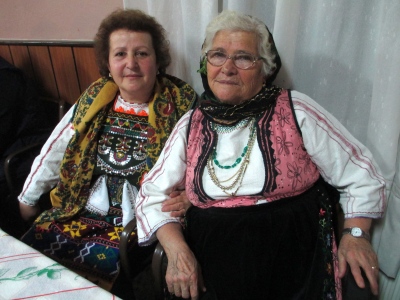
photo 2

The bodice features a triple butterfly design, connected to the ancient labyris / double axe. It is also a symbol of transformation, not least the transformation of individual women – through dance, song and ritual dress – into manifestations of radiant feminine strength and beauty, moving beyond their personal identity and concerns in order to embody a larger power. This phenomenon is represented by the image of a woman with wings, easily discerned in the butterfly design here and in other villages.
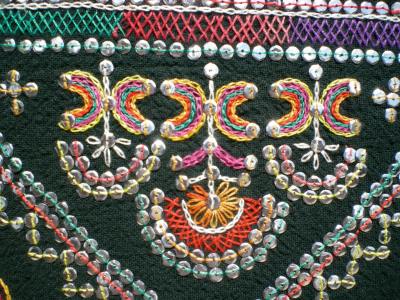
Photo 1

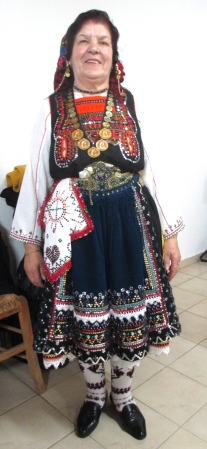
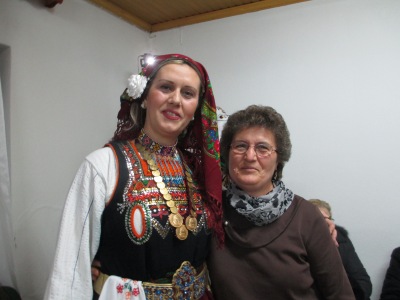
Other villages have their own version of the Thracian women’s costume, as in Doxapara where we went next:
3_IMG_5562

4_IMG_5610
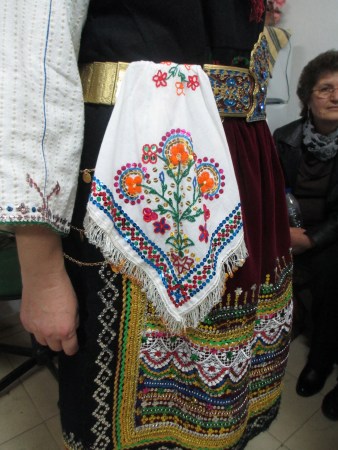
Chryssa, on the left, wears the costume made by her mother, on the right.
5_IMG_5609

Chryssa’s handkerchief is embroidered with a flamboyant sun-headed Goddess/flower motif.  An ancient V-shaped motif of spiral horns, or perhaps a pair of wings, appears on her sleeve in red. This motif is more discreet, but its central location affirms its importance. Women’s hands – which created all this and much more – were considered holy and worthy of protection. As on the handkerchief, Goddess figures are often depicted with radiant, extra-large or winglike hands.
6_IMG_5567
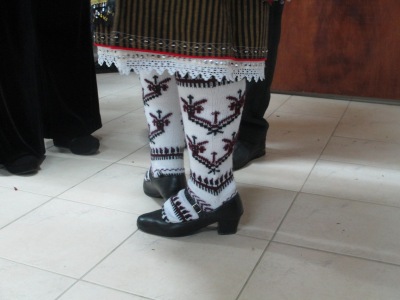
Knitted socks in Doxapara depict winged Goddess figures in red, black and white.

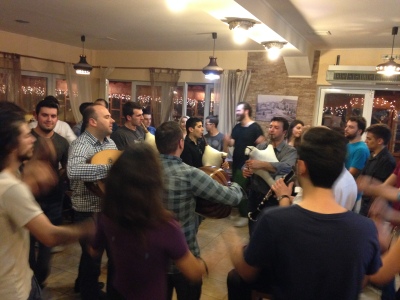
We celebrated my birthday eve in a little taverna in Oinoi, a village of Gagaouzides, Turkish-speaking Greek Christians from Bulgaria. Friends (and friends of friends) needed no persuading to dance up a storm.
7_IMG_1444

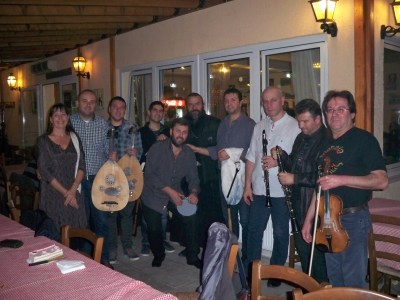
Music was provided by gaidas (bagpipes), laoutos (lutes), clarinets, violin and doumberleki, not to mention everyone singing along. The ‘Happy Birthday’ songs, both English and Greek versions, sounded fantastic with this orchestra.
8_100_0896

9_IMG_1436
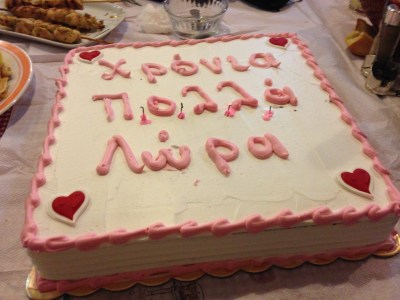
Hospitality is a sacred obligation in Greece, as in many parts of the Balkans, and dancing must be accompanied by feasting. My birthday cake weighed 3 kilos and fed 75 people. ‘Many years, Laura’!

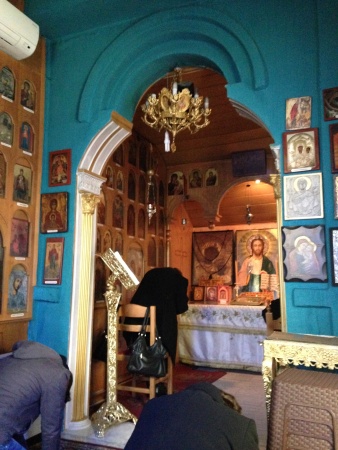
On the morning of my birthday, while everyone else was still asleep, I went to a favourite church in Kleissos, which has a little side chapel filled with 144 icons of the Virgin Mary, whom Greeks call the All-Holy One, the Panayia. As you see, people pray to her very fervently here. The images are copies of famous miraculous icons from other places like Tinos and Kythira. The Panayia of Kleissos is also believed to be a miracle-working icon; I can attest to its power from past experience.
10_IMG_1466

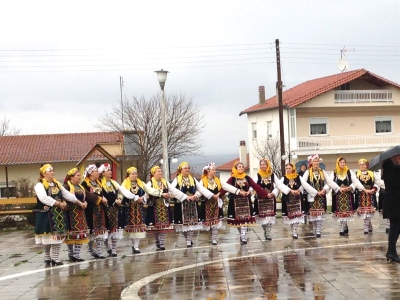
Later we proceeded to Ambelakia, a village I had not visited before.
11_IMG_1576

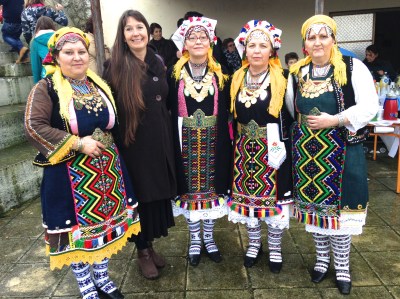
These women are Marides, an ancient Thracian tribe. Their costumes feature many Goddess embroideries and, on their socks, the recurring motif of the wild bee. Priestesses in Thrace and other areas were once known as bees (mélisses).

The women here told me about the ancient festival they keep, called ‘Gynaikokrateía’, Gynocracy or Women’s Rule. It is related to Thracian Midwives’ Day celebrations (described in a previous post) and falls on the same day, January 8th.  On this day, they told me, gender and power roles are reversed and women take over the town hall, village square, cafes and other male-dominated public spaces. They exact toll payments from passing vehicles, which they use to buy wine. The women’s unrestrained merriment and public drunkenness, unthinkable on the other days of the year, is combined with ribald and satirical skits lambasting men’s misbehaviour. This sharp commentary is remembered, laughed over and talked about for months afterwards, thus providing an apparently innocent, yet effective, social deterrent to abuses of power.
12_IMG_1593
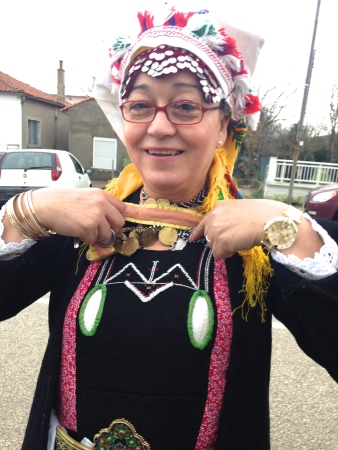
Marides women’s costumes can be ‘read’ as a treasury of ancient women’s wisdom hidden in plain view, an open secret for those with eyes to see. Yellow headscarves with long fringes resemble both sun and rain, life-giving elements of agriculture both originally identified with the Goddess. Woven aprons illustrate flowing life force, womb energy and women’s awesome creative power, with Goddess/Tree of Life figures inside the central rhombs.
13_IMG_1617
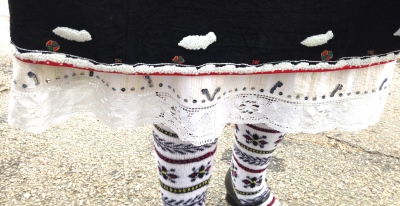
Spiral horns reappear on the hem of the underdress. Sacred symbols on this spot simultaneously pronounce and protect the power of what lies directly above. ‘Doves’ encircle the hem of the black overdress; ‘bees’ adorn the socks.
14_IMG_1614
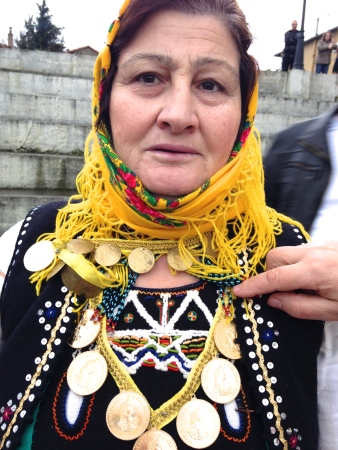
In the central place on the heart of the bodice: the winged Goddess motif, a sign of the dancing priestess and a key Thracian symbol for thousands of years. This powerful image is usually invisible, hidden under scarf fringes, beaded necklaces and garlands of gold coins, but the women revealed it to me because I knew it was there and asked to see it.
15_IMG_1648

16_IMG_1603
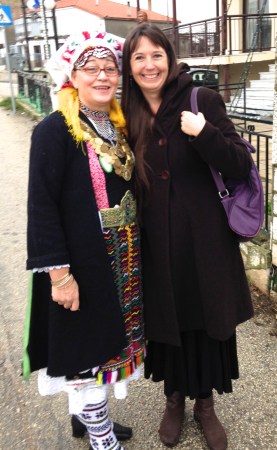
As much as I loved meeting them, they loved meeting me – as they would love to meet any woman who can recognise them for what they are and what they wear.
17_IMG_1571
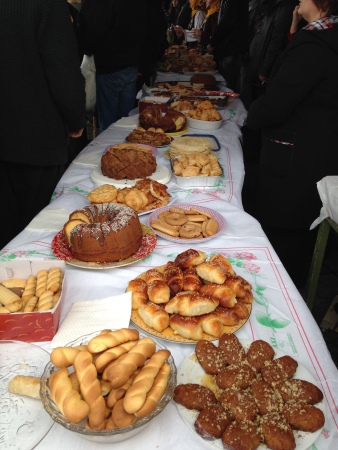
And of course there was another feast.

It was a fabulous birthday. I even danced, managing to overcome lingering injuries from a bicycle accident I had had some months before. Giving myself to the healing energy of women sharing steps together, I felt radiantly joyful and truly alive, as if at a momentary crossroads of space and time, simultaneously fleeting and eternal.

In Thrace, I feel extremely privileged to witness the survival of motifs and ritual customs with roots in Neolithic Old Europe, as well as key values from the Old European worldview articulated by Gimbutas, Carol P Christ, and others: respect for nature, a sense of interdependence, the need for social justice and the importance of community celebration.

We are blessed to live in an age where these and other ancient treasures of women’s wisdom, are now returning, visibly and consciously, to our own culture. Patriarchal domination has not and will not manage to destroy these riches from the past. At this time of the winter Solstice, I wish us all the healing joy, connectedness, and love in abundance which these dances embody, to warm us and guide us all into the rebirth of the year.

Love & blessings,
Laura

Laura Shannon has been researching and teaching traditional women’s ritual dances since 1987. She is considered one of the ‘grandmothers’ of the worldwide Sacred / Circle Dance movement and gives workshops regularly in over twenty countries worldwide. Laura holds an honours degree in Intercultural Studies (1986) and a diploma in Dance Movement Therapy (1990).  She has also dedicated much time to primary research in Balkan and Greek villages, learning songs, dances, rituals and textile patterns which have been passed down for many generations, and which embody an age-old worldview of sustainability, community, and reverence for the earth. Laura’s essay ‘Women’s Ritual Dances: An Ancient Source of Healing in Our Times’,  was published in Dancing on the Earth

Dance of the Bees: Reading the Language of the Goddess by Carol P. Christ

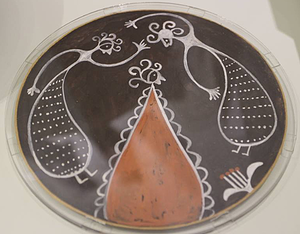
bee women dancing croppedThe image from an ancient Cretan bowl (c.1700 BCE) from the Sacred Center of Phaistos pictured here has often been interpreted as an early depiction of Persephone’s descent or rising. But are clues from later Greek mythology pointing in the right direction in this case?

Recently, my colleague Mika Scott posted the Phaistos bowl image on our Goddess Pilgrimage Facebook site in conjunction with the bee pendant from Mallia. This juxtaposition led me to think again about the importance of bees and pollination in agricultural societies and to offer an alternative reading of the symbolism on the bowl. Continue reading “Dance of the Bees: Reading the Language of the Goddess by Carol P. Christ”

Kali Ma (Part 3 of 3) by Nancy Vedder-Shults

nancymug_3In contrast to the linearity of our time concept in the West, Indians view life as infinite and cyclical.  Although Hindus, like ancient Greeks, believe in four ages of humanity (the so-called yugas), these occur not just once, but repeat cyclically every several million years.  Similarly, the creator god Brahma is said to have a daily cycle which has recurring effects on the existence of the world.  When Brahma awakes the world is created anew, and when he falls asleep it dissolves once again into the primal waters of eternity.  Fortunately for us, Brahma’s day lasts 4,320,000,000 human years.
Holland Cotter, in reflecting on Eastern art, once brought these temporal differences into sharp focus when he contrasted two of the major icons of East and West  — Christ on the cross and the dancing Shiva.  He said, “The Christ figure embodies the Judeo-Christian concept of divine history as a straight, purposeful line from the Fall of Man (sic.) to redemption, but with a tragic human story of self-sacrifice, loss and atonement at its heart.  The dancing Shiva is, by contrast, a dynamic, joyous cyclical image: a poised, uplifted foot and hands form a circle echoing the nimbus of flames surrounding the figure.  The image represents a culture which…views both humans and gods as participants in a cosmic game that periodically grinds to a catastrophic halt only to begin again.”[i]

Like Shiva, Kali has been depicted surrounded by a halo of flames.  But unlike Shiva, her portrait is far from a joyous image.  In one example, a 17th or 18th century North Indian sculpture, Kali is personified as a voracious, old hag squatting on a victim whose entrails she eats.  Slicing open the belly of the anonymous corpse, Kali scoops out its intestines with her bony fingers and gobbles them with her protruding teeth.  The anonymity of the victim brings home to the viewer the fact that ultimately we are all Kali’s prey.  And the flames burning around her head reemphasize this point, for as the aureole of the Dancing Shiva, they are the fires of the final conflagration at the end of each world period.  But in this image we realize that such flames flicker constantly, since time erodes all that has ever existed and Kali swallows all she has ever birthed.[ii] Continue reading “Kali Ma (Part 3 of 3) by Nancy Vedder-Shults”

Painting Martha Graham by Angela Yarber

angela

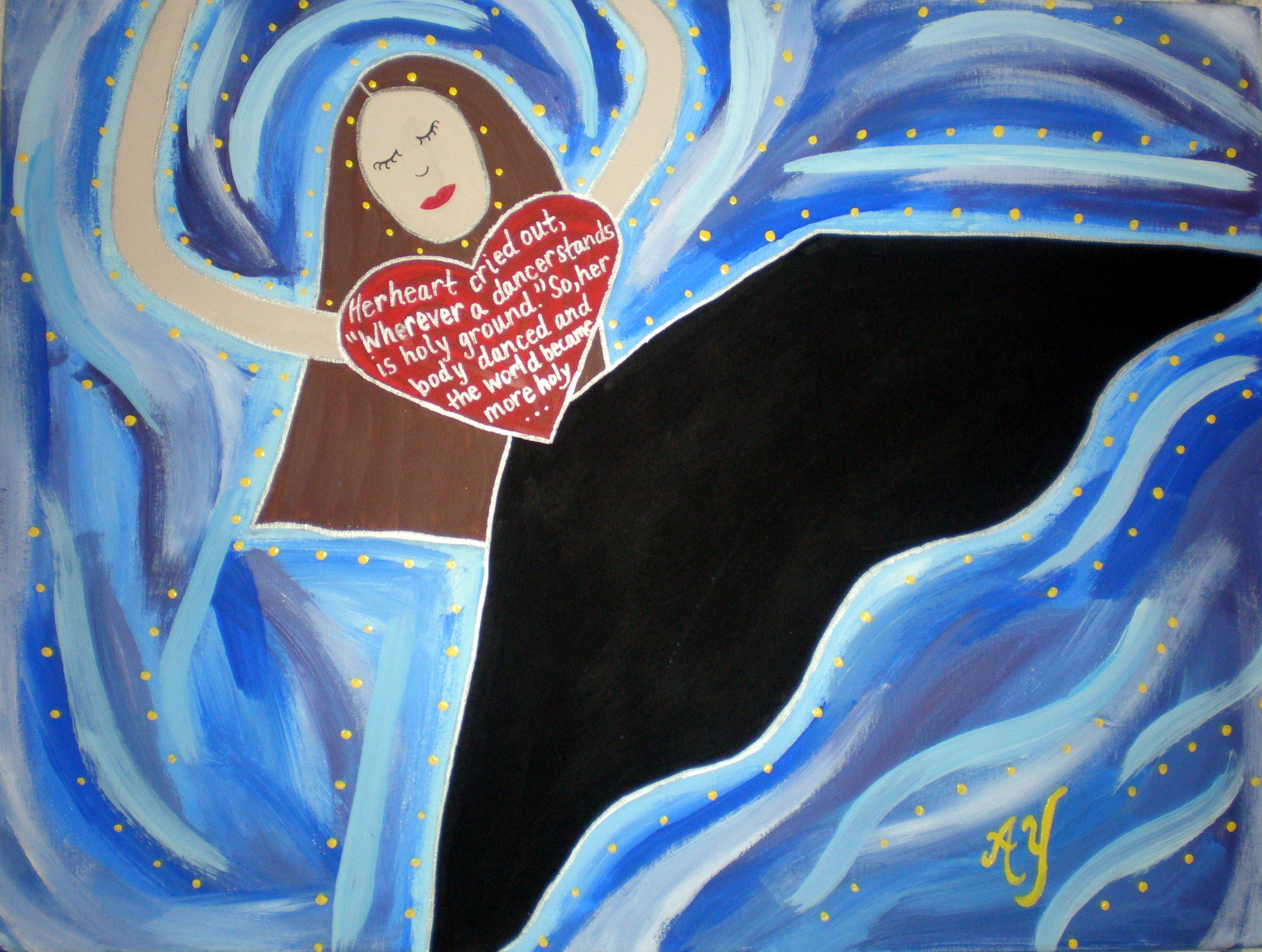
Joining Virginia Woolf , the Shulamite, Mary Daly, Baby Suggs, Pachamama and Gaia, Frida Kahlo, Salome, Guadalupe and Mary, Fatima, Sojourner Truth, Saraswati, Jarena Lee, Isadora Duncan, Miriam, Lilith, Georgia O’Keeffe, Guanyin, Dorothy Day, Sappho, Jephthah’s daughter, Anna Julia Cooper, the Holy Woman Icon archetype, Maya Angelou, and all my other Holy Women Icons with a folk feminist twist  is the dancing revolutionary Martha Graham. So, as the contemporary and modern dancers on So You Think You Can Dance continue to amaze us this summer, let us remember from whence they came.

Martha Graham’s contribution to the world of dance cannot be overestimated. She is regaled as the Picasso of the dance world, revolutionizing it by introducing an entirely new quality of movement known as modern dance. Not only did Graham revolutionize the dance world, like Isadora Duncan before her, she also made great contributions to feminist spirituality. One of her most famous statements may well have been “wherever a dancer stands is holy ground.” Like most dancers who are so in tune with their bodies, Graham new the holiness therein, the ways in which the body can express the ineffable when words alone simply cannot. “The body never lies,” she famously reminds us.

Martha Graham Continue reading “Painting Martha Graham by Angela Yarber”

Tis Babos: The Dance of the One Who Gives Life by Laura Shannon

Laura Shannon

The one who gives life, the one who gives birth: this was the original image of the Creator. Not God but the Goddess, both mother and midwife to the world. Throughout Eastern Europe, Asia Minor, North Africa and beyond, Goddess worship laid the foundation for European culture. Thousands of years later, a deep reverence for the woman who gives life – the midwife – survives in Greek and Balkan dance rituals which still echo from the distant past.1

The mamí (from mámmo, grandmother) or bábo (old woman) was a respected woman, usually older, with the wisdom and experience of age. The midwife is publicly honoured on Midwivesʼ Day, January 8th. Known as Babinden in Bulgaria, Tis Babos in Greece, this women-only celebration is an important holiday in Bulgaria and in numerous villages of displaced Thracians now relocated in Greek Macedonia. One such village is Kitros, whose inhabitants originally came from Bana, on the Black Sea coast of northern Thrace (today Bulgaria). A hundred years have passed since they left, but the womenʼs festive costumes still indicate their old Bana neighbourhoods; traditional foods, songs, dance, and other customs are kept alive despite decades of brutal loss and change. Continue reading “Tis Babos: The Dance of the One Who Gives Life by Laura Shannon”