A “Wicked Witch” Discovers Gratitude by Barbara Ardinger

Once upon a time there lived a youngish woman and her husband on a tiny farm outside the capital city. Their life was satisfactory. But when el presidente declared war on another country, the husband was press-ganged into the army, leaving his wife alone on the farm. Well, alone with a milk cow, a sow, a rooster, a dozen hens, and, on one side of the house, seven tiny graves holding stillborn babies.

The woman was devastated. “What am I going to do?” she asked herself over and over again. “The land here is poor and infertile. I’m poor and infertile.” She was so unhappy, all she could do was mope around. The animals went untended and soon began foraging for food. The seven tiny graves went unweeded. Their one good field went unplowed. The woman stopped taking care of herself.

The war went on and on. She could still hear explosions in the capital city, and now there were people traveling along the road at the edge of her field. Telling herself the explosions and the refugees from the city were none of her business, she just sat inside, feeling sorry for herself.

Time went by, and one morning when the youngish woman happened to look in the mirror (which was cracked), she was both surprised and not surprised by what she saw. Her hair was gray and ragged and dirty. Her face was wrinkled and dirty. Her clothes were wrinkled and dirty.

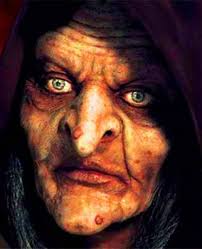
witch“My goodness!” she said. “I look like an old wicked witch!” She gave this some thought. “Well,” she finally said, “why not? I’m alone and friendless. I have barely enough to eat. I remember hearing about other old women who lived alone. People thought they were wicked witches. Hunh! I guess that’s what I’ll do now. Go into the wicked witch business.” She thought some more. “Well, maybe semi-wicked. My grandmother taught me stuff her grandmother taught her—how to mix potions to heal or kill. How to read the cards. All I need to do is remember those lessons. Then I can go into the wicked witch business.” Continue reading “A “Wicked Witch” Discovers Gratitude by Barbara Ardinger”
Dystopian Fiction Inspiration and Religious Lessons by Ivy Helman

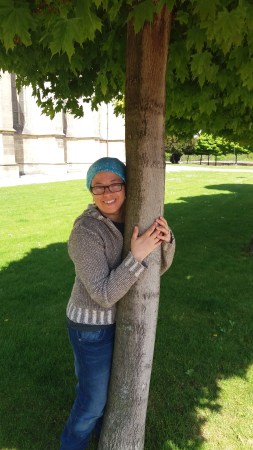
me-hugging-treeWe live in a dystopia.  This world is filled to the brim in dichotomies: poverty and extreme excess, hunger and mountains of food, disease and cutting-edge medicine, materialism and an immense environmental crisis, and hour-long walks for water and hour-long luxurious baths.  There are so many parts of our world that are not just unfair, unequal, broken and undesirable, but violent, traumatic and deadly.  And, sometimes it feels like it is only getting worse, or at least, again teetering on the edge of yet another catastrophe.

Most of the world’s religious traditions agree that this is not the way the world should be.  My own religious tradition, Judaism, traces this separation between the Creator’s utopia, the Garden of Eden, and our current situation all the way back to the beginning of humankind.  The actions of the first two humans resulted in exile from the Garden: enter the world diametrically opposed: dystopia.  Nonetheless, the Jewish religious tradition’s call for tikkun olam (repairing the world) suggests that it is possible to lift the veil between the Divine and us and consequently recreate the utopian Eden once again.  One could say it is why we are here.

That being said, while the dystopian genre has been around for many decades, I have noticed a recent rise in the popularity of dystopian fiction.  While I have always had a keen interest in science fiction, from Star Trek to FireFly and beyond, I myself have, as of late, become an avid reader of dystopian novels.  I blasted through the Divergent series by Veronica Roth, have reread The Fifth Sacred Thing by Starhawk more times than I can count and just began my dip (25 pages) into The Mandibles by Lionel Shriver – not so action-packed as the others.  I’ve also been, one could say, addicted to dystopian films (yes many were books first) like The Hunger Games, Maze Runner, Gattaca, The Fifth Element and Serenity to name just a few.

Continue reading “Dystopian Fiction Inspiration and Religious Lessons by Ivy Helman”

The Emperor’s New Clothes by Barbara Ardinger

On the day the Big Boss decided he wanted to be the Emperor of Everywhere, the first thing he did was pull on his red cap embroidered with the words Make Me Greater Again. He tied the strings under some of his chins and adjusted the earflaps so he could more plainly hear the Spirit of the Cap. The first thing the Spirit of the Cap told him was that an Emperor needed appropriate clothing. The Big Boss pulled out the mail-order catalogue from which he ordered his custom-tailored suits and paged through until he came to the perfect photograph of the perfect Emperor’s New Clothes, which was a royal robe of pure silk the color of peacocks’ tails. “Yesss,” said the Spirit of the Cap. “Order this one.” The Big Boss picked up one of his phones and placed the order. “I want it right now,” he told the operator. “I am very, very important. I always demand very, very immediate service.”

red capWhen the Spirit of the Cap upon which were embroidered the words I Am Always Very, Very Great told the Big Boss he needed consultants, the Boss called his posse together and ordered referrals. “I always get what I want very, very quickly,” he told the posse, which consisted of several of his wives and the goodfellas that ran the real estate where Ladies of the Night and their Good Friends gambled the nights away. “I make very, very good deals,” said the Big Boss. “Find me some very, very good advisors. If you don’t, you’re fired.” Continue reading “The Emperor’s New Clothes by Barbara Ardinger”
Dandelion Warriors, Incest Survival and An Artist Statement on That Christmas Morning Feeling by Marie Cartier

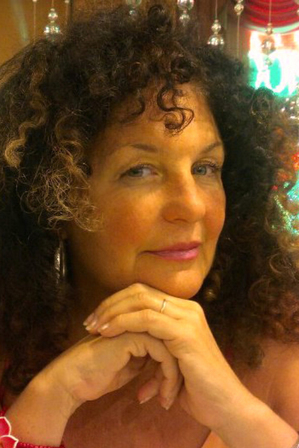
MarieCartierforKCETa-thumb-300x448-72405I have blogged excerpts from my novel That Christmas Morning Feeling in progress previously—the first excerpt here and additional ones here and here. This blog serves as an “artist statement” regarding the novel in progress.
I want to discuss in this blog thoughts on my own creative process—how a project can percolate for years (this one for well over ten years) and be in pieces in several places (handwritten, hard drives, on a laptop, here in FAR) and then some magical “tipping point” comes that creates the necessary conditions to put other things aside and work on that project, birthing it forward.

Certainly the death of both my parents in one year, and the resulting fallout in the last two years, complicated relationship struggles both to be sure, prompted me to want to write this novel and put it out into the world in a finished form, which is what I’m trying to accomplish now.

This book is not an autobiography…it’s not “my story.” But, to be sure, I am a survivor of childhood sexual abuse and the feelings and experiences from that time have been published in autobiographical form in my poetry book, I Am Your Daughter, Not Your Lover,  a play (of the same title, while much of this dramatic work is out of print, my work is catalogued at UCLA; here is the finding aid) based on the book produced in Los Angeles, and a one woman show I did entitled Blessed Virgin. I also created the activism project, Dandelion Warrior, which awarded medals to survivors who came to my numerous readings in the nineties who were willing to give up the option of suicide. To date I awarded well over a thousand buttons/medals to survivors in the States and internationally. When the buttons ran out I simply shook hands with the survivors who were willing to stand shoulder to shoulder with me and make the commitment to stay on the planet.  

dan_but

I was the first artist the state of California awarded an Artist in Residence grant to, to work specifically with incest survivors, and I worked also with women from forced marriages, and also prostitutes, creating dialogues with them and with survivors of childhood sexual abuse and created projects that showcased their voices coming together in the struggle for survival. I performed slam poetry about incest survival when it was just called reading poetry in bars; I did one woman shows and got flack in my reviews, as well as praise. For instance, one reviewer simply said “Speak Repressed Memory,” as he went on to say he didn’t believe survivors’ stories coming forward and did not at all review my play or performance except to say I was an “accomplished actress.” The rest of his review was about how he hated incest survival stories, and therefore the reader was to assume also my play.

I continued with my work. Continue reading “Dandelion Warriors, Incest Survival and An Artist Statement on That Christmas Morning Feeling by Marie Cartier”

Naked and Unafraid: Mahasveta Devi (1926-2016) by Vibha Shetiya

03devi-obit-master768
Photo credit: The New York Times

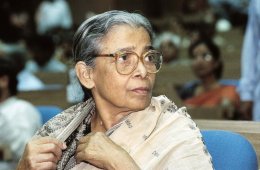
Mahasveta Devi died last month at the age of 90 in Kolkata, India. A widely acclaimed Bengali writer, she identified as an activist first, clearly evident in her meticulously researched “fiction.” Most of her stories champion the cause of those living on the margins of society, particularly the Adivasis or original inhabitants of India; poor, unemployed and itinerant, they traditionally subsisted off the land, and continue to struggle against exploitative upper caste landowners.

I cannot claim to be an expert on Devi or her activism, but there is a story I read a few years ago, which never fails to haunt me, whether because of the rawness with which she describes the harsh reality faced by tribal people or because of what can be seen as the violent but ultimate triumph of its female protagonist, I cannot tell. Perhaps because of both, or because of more complex emotions which are hard to capture as they manifest in goose-bumps and a deep pain in the inner recesses of the chest when reading it for the seventh or eighth or twentieth time. Continue reading “Naked and Unafraid: Mahasveta Devi (1926-2016) by Vibha Shetiya”

Reading for Fun and Compromise—My Ongoing Search for Feminist Literature by Sara Frykenberg

What I mean to say is, what if, when I wanted to read for fun or simply for the pleasure of reading, I were to put down any book that demonstrated buy-in to kyriarchal ideas, overtly or even in micro-aggressive ways? I have flippantly responded to this question, “then, I may never read any piece of fantasy literature again.”

Sara FrykenbergI love reading fiction, particularly science fiction and fantasy literature. However, since the birth of my daughter I have been pondering the stories we tell and the language we use a great deal; and I have begun to feel a little bit like my ‘fun’ reading almost always involves some kind of compromise. For instance, when I first started reading  Song of Ice and Fire by George R. Martin (the series which inspired the HBO hit series Game of Thrones), I greatly enjoyed the series. The five competed books are ripe with intrigue, complex interpersonal and political relationships, the rebirth of magic in a world, and characters you love to hate. But, continuing to read and watch this series unfold, I have grown to suspect that Martin may hate women because he seems to punish them over, and over, and over again. The most recent book, A Dance with Dragons is so full of sexual violence it is actually hard stomach.
Continue reading “Reading for Fun and Compromise—My Ongoing Search for Feminist Literature by Sara Frykenberg”

Who’s In That Clock? by Barbara Ardinger

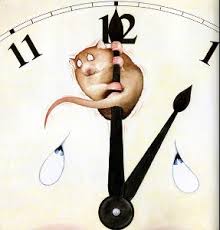
Hickory, dickory, dock,
The mouse ran up the clock;
The clock struck one,
And down he run,
Hickory, dickory, dock.

Someone’s been watching that mouse with the suction-cup feet. From her mouth to our ears.

Hickory dickory image2You all know my story, at least the popular version of it. I was an only daughter, the princess (so to speak) of the house until Mama died. Then Papa, who couldn’t seem to manage anything, much less a busy household, went out and got married again and brought Stepmother and her two ugly daughters into the house…and the princess was promptly reduced to servitude.
One of the things Mama brought to Papa when they married was her longcase clock, which she had inherited from (yes) her grandfather. That clock is ten feet tall, and it stood in our grand parlor until Stepmother moved it into the hall beside the stairs. Now it stands outside my bedroom under the stairs. (It’s my own little corner and I have my own little chair there.) I’ve been looking at that clock all my life. Although it, and our household, ran smooth as the day is long while Mama was alive, it doesn’t always go bong on the regular hours anymore. And when it strikes, something weird often happens. Like, one time when it struck eight, I heard this invisible chorus start singing about going into the woods and being happy ever after. Like, one time when it struck two, three mice came dancing out of it, and when it struck three, they went blind and I had to lead them to their hole in the wall. And one time when it struck twelve, the front door flew open and this beam of light came shooting down from the sky and shone down the hall the lit up the clock’s face. But it was twelve midnight, not twelve noon! The face changes, too. Sometimes it’s smiling, sometimes it has eyes that follow the hands around, and sometimes frowns. And on Sundays, when Stepmother gets her lazy daughters out of bed and I have to help them get dressed (forget about bathing!) and then they all go to the new church, well, that big old clock looks like it’s shaking its head. Continue reading “Who’s In That Clock? by Barbara Ardinger”

Humpty Had A Mother by Barbara Ardinger

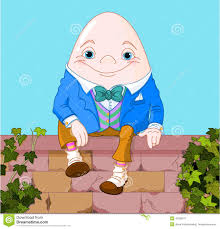
Humpty Dumpty sat on a wall,
Humpty Dumpty had a great fall;
All the king’s horses and all the king’s men
Couldn’t put Humpty together again.

From her mouth to our ears.

Humpty1You see that kid sitting over there on the wall? The one wearing the Jester’s hand-me-down suit? The Jester also gave him that funny name. That kid is looking for his father. That kid is my son.

My father the King is a tyrant, and he has more bastards than any other king in our nations history except for one other King, a long time ago. (Maybe these Kings try to populate the land all by themselves.) I’m one of his bastards. My mama travels with the Players, and after I was born, she traveled on and left me here. Oh, the Players come back every year, and she always tells me about her adventures, like when they went to visit that Prince up north, the one who was pretending to be crazy and got killed in a duel. My father the King lets his sons take the name Fitzroy, but us girls? What do we get? We’re lucky we get to live in the palace. That’s thanks to the Queen, who is kind and protective of all the King’s children, legitimate or not. I’m part of her court. A minuscule part, but she knows who I am and has answered my prayers several times. I’ll never rise in society. But I’m making plans for my son. Continue reading “Humpty Had A Mother by Barbara Ardinger”

Practical Lessons in Kindness from the Grasshopper and the Ant by Barbara Ardinger

Barbara Ardinger(With apologies to Jean de La Fontaine for significant changes to his fable)
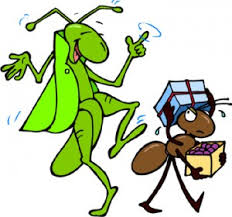
“Curses on that grasshopper!” exclaimed the ever-busy Madame Fourmi. “All he ever does is play. He’ll be sorry when winter comes.”

And so it went. Every day, Mme. Fourmi spent the morning scrubbing her front steps. And Monsieur Cigale?

“Partaaaaayyyyy!” Every day, he sped by on his skateboard. “Hey, Auntie Ant, stop cleaning the concrete and come and play with us. We’re gonna start a band!”

Grasshoppper and ant“Not on your life,” muttered this grandmother, most of whose conversations with her many daughters and granddaughters consisted of instructions on how to properly clean their homes and hills and how to prepare and store food for the winter. “Life is serious business, it is, it is. We need to plan ahead.”

“Oh, Auntie Ant,” Cigale called back, “lighten up!” Then he called his friends. “Yo, dudes! Let’s rock!” Continue reading “Practical Lessons in Kindness from the Grasshopper and the Ant by Barbara Ardinger”

Mary, Mary, Quite Contrary by Barbara Ardinger

Barbara ArdingerMary, Mary, quite contrary,
How does your garden grow?
With silver bells and cockleshells
And pretty maids all in a row.

From her lips to our ears.

Who wrote that poem? I’ve heard that some so-called scholars think it’s about a queen of England named Mary Tudor (slandered as “Bloody Mary” because she stuck to her religion after her father declared himself head of his own bloody church) or Mary Queen of Scots (slandered for other reasons, and then murdered). Well, much as I feel sorry for those two queens, the poem’s about me, and I don’t grow any little garden. I am a gentlewoman farmer. The fellow who wrote that silly poem probably works for one of those corporations that want to buy my land and plant their engineered crops on it and create monocultures that murder the land. Continue reading “Mary, Mary, Quite Contrary by Barbara Ardinger”