Traumatic Narrative on the Screen: Is there a Grey Area? by Stephanie Arel

Arel - AAUW HeadshotOn May 8, Fifty Shades of Grey became available in DVD format. Marking its release, this post reflects on the mass consumer consumption of this provocative film and the abuse inherent in its script previously discussed here by Michele Stopera Freyhauf. Grossing $500 million dollars at the box office, Fifty Shades will most certainly sell as an unedited DVD. While some self-proclaimed feminists like Emilie Spiegel commend the story, feminists and conservatives slam it, often pressing viewers to reject the film and deny it financial support. Nonetheless, The Fifty Shade of Grey franchise will most probably have a sequel in 2016, continuing to amass hundreds of millions of dollars.

Concerns about the book and film include how the storyline presents a romantic ideal for women wrapped surreptitiously in abuse. Peering deeper at the narrative reveals the potential for conflicted emotional responses including feelings of guilt and shame, revulsion and interest, disgust and seduction. Confronted with the writing of this post, I responded in turn, torn between whether to watch the film or not. While wanting to deny the franchise any monetary gain, I also wanted to both know what I was rejecting and what, if any, value existed in viewing. Continue reading “Traumatic Narrative on the Screen: Is there a Grey Area? by Stephanie Arel”

Restored in Beauty by Carol P. Christ

Carol Christ in LesbosThe path leading to the Klapados Waterfall begins at the edge of an open meadow in the pine and oak woodlands of a mountain in the island of Lesbos. After driving several miles on a very rutted dirt track, we parked under an oak tree, crossed the meadow and scrambled down a winding path. After about 20 minutes, it ended at a stream surrounded by plane trees. From there, we climbed over rocks to reach a pool created by the seasonal waterfall.

waterfall at klapados 1On the day we visited it, the waterfall was only a trickle of cascading drops that moistened its moss-covered path to the pool. The roots of a plane tree growing at the top of cliff followed the path of the water, weaving a web over the rockface all the way down to the pool.

Sitting on a rock at the edge of the pool I realized that the cliffs that embraced it on three sides were the remains of a crater formed twenty million (or so) years ago when a finger of molten lava pushed its way through the earth, exploding in clouds of dust and projectile rocks.

In Lesbos the volcanic activity came not from a single source–for example, from the highest mountain. Rather, like the plane trees in whose shade we rested, the volcano’s trunk with roots in the molten lava of the earth’s core, had many branches from which it erupted at different times. Huge boulders thrown out in the explosions can be seen in the meadows, while the trees in the forest curve their roots around them to reach the soil. The mountain was also shaped by the settling of volcanic dust that crumbles again into tiny fragments when exposed.

As I was thinking of all of this my friend Cristina climbed over the roots of the plane trees that surrounded the pool, removed her clothes, and slipped into the water. Soon I followed her. We sensed that we were in a sacred place, and as we have done rituals together many times before, our ritual emerged spontaneously: it almost seemed as if our minds and bodies were moving as one.

We renewed ourselves in beauty, submerging our bodies under the water three times, while floating in the embrace of the pool, gazing up at the rock formations, admiring trees that looked like dancing women, moss that looked like pubic hair, and blue black damselflies that all together had created a most beautiful place that called to something deep within us on that day.

Later we would sing the English version of the song of the Navajo Beautyway:

klapados waterfall 056


I walk with beauty before me.
I walk with beauty behind me.
I walk with beauty all around me.
As I walk the beauty way.
I walk with beauty above me.
I walk with beauty below me.
I walk with beauty inside me.
As I walk the beauty way.

We are the creative process of life.

We are restored in beauty.

Blessed be!


Carol leads the life-transforming Goddess Pilgrimage to Crete (facebook and twitter).  Carol’s books include She Who Changes and and Rebirth of the Goddess; with Judith Plaskow, the widely-used anthologies Womanspirit Rising and Weaving the Visions and forthcoming next year, Goddess and God in the World: Conversations in Embodied Theology. Explore Carol’s writing.

Um… Happy Mother’s Day? By Natalie Weaver

Natalie Weaver editedIn the Smithsonian Museum of American History, there is an exhibit on food and the way it has changed on the American table over the years.  It is an interesting exhibit for a number of reasons.  It shows, for example, a reproduction of Julia Child’s kitchen.  It shows the advent of T.V. trays and Swanson frozen dinners.  It shows when wine became a staple beverage.  And, there is one of the most entertaining images in all of Washington, D.C. …

In what I believe was a 70s era campaign to popularize frozen food, there is a magazine article featuring a woman on the floor, cleaning up a milky cereal mess. The caption above her reads, “My favorite part of breakfast is when it is over.”  At first, I thought the woman had vomited her food, emphasizing (if not also explaining) the point that she hates breakfast.  Then, I noticed the dejected-looking child in a highchair, scowling at her mother, down on the ground, managing what was in fact a spill.  In the center panel, a mother looks on at her frowning child, who is this time refusing to eat lunch.   In the third and final panel, a miserable child now rejects dinner, but mom, still working the situation, observes, “Dinner isn’t so bad because it is almost over.”  One understands that soon the unhappy little darling will be in bed, and mom won’t have to do this again until tomorrow. Continue reading “Um… Happy Mother’s Day? By Natalie Weaver”

#WATERTalk: Feminism and Religion in the 21st Century

May-WATERtalk-1.2-1030x343

WATERtalks: Feminist Conversations in Religion Series 

Feminism and Religion in the 21st Century:
Technology, Dialogue, & Expanding Borders

with

Xochitl Alvizo, Gina Messina-Dysert, & Rosemary Radford Ruether

Wednesday, May 6, 2015 at 1 p.m. ET

The editors of Feminism and Religion in the 21st Century: Technology, Dialogue, and Expanding Borders (Routledge, 2015) will discuss new movements in feminism and religion, as well as the ways in which technology creates spaces for expanded dialogue and change. Their volume brings together more than 15 feminist theologians across generations to reflect on the state of the art. The hour will offer an insightful portrait into the history and modern direction of feminist religion.

Xochitl Alvizo recently completed her Ph.D. in Practical Theology at Boston University School of Theology. She will be Assistant Professor of Religious Studies in the area of Women and Religion and the Philosophy of Gender (LGBT), Sex, and Sexuality at California State University, Northridge, in the fall. Xochitl is co-founder of Feminism and Religion, an online project that brings together multiple feminist voices from around the world to dialogue about feminism in religion at the intersection of scholarship, activism, and community. She is co-founder of the Pub Church, Boston.

Gina Messina-Dysert is Dean of the School of Graduate and Professional Studies at Ursuline College and co-founder of feminismandreligion.com. She is the author of Rape Culture and Spiritual Violence (Routledge, 2014), and co-editor (with Rosemary Radford Ruether) of Feminism and Religion in the 21st Century (Routledge, 2014). She is active in movements to end violence against women and explores opportunities for spiritual healing for those who have encountered gender-based violence. See her TEDx Talk here. Gina can be followed on Twitter @FemTheologian and see her website, http://GinaMessinaDysert.com.

Rosemary Radford Ruether is a renowed feminist scholar and Catholic theologian. She is currently Senior Visiting Professor of Theology at Claremont School of Theology and Graduate University, where she earned a Ph.D. in classics and patristics in 1965. Rosemary is the author of more than 40 books and hundreds of articles on feminism, eco-feminism, and Christianity. She has also lectured all over the world. Rosemary has held numerous teaching positions including as the Georgia Harkness Professor of Applied Theology at Garrett-Evangelical Theological Seminary Northwestern University and the Carpenter Professor of Feminist Theology at the Graduate Theological Union in Berkeley. She is the recipient of more than ten honorary doctorates in humane letters.

Recommended Resources: 
• Feminism and Religion in the 21st Century (Routledge, 2015) 
• “What is Feminism and Why Should we do it?”
“Our Sisters’ Feminism”
• 
“The New Feminist Revolution in Religion”

Register Here

Email Cathy Jaskey at waterstaff@hers.com if you have any trouble registering or need more information. Thank you!


Take Only What You Need and Give Away: Fundamental Principles of Sustainability Ethics

carol mitzi sarahWhy is it so important to take only what we really need? Because everything we take harms another life. I included this Native American teaching as one of the Nine Touchstones I offered as a counterpoint to the Ten Commandments in Rebirth of the Goddess.

Recently, I have begun to realize that the concept of taking only what you need is the heart* of sustainability ethics, an ethical system that can orient us to living in harmony with others and the natural world. The practice of great generosity is its counterpoint. When you have worked for, received, or accumulated more than you need, you should give it away.

The reason these principles are important is because “taking what you need” is “taking” from the web of life. We “take” other lives (whether plants or animals) in order to eat, to clothe ourselves, to build houses, and in agricultural societies to clear land to plant, to remove unwanted plants (weeds) from cultivated land. In our industrial age, we “take” so much more to fuel our cars and to provide electricity. To take more than we need is to do unnecessary violence to the web of life. When we give away what we don’t need we help others to survive, and we also help to ensure that no more lives than necessary are taken.

On the first Goddess Pilgrimage to Crete, we decided to incorporate the give-away as part of our closing ritual. It is nice to give and receive a gift at the end of an intense two weeks spent with other pilgrims. However, I am coming to realize that in comparison with the deeper meaning and intention of the ritual, our give-away, like the practice of giving presents in our wider culture, is superficial. When we give gifts to friends we try not to give too much or too little. When we give to children we often do so without regard to what they really need. When we receive gifts, we may feel burdened with one more thing we don’t want or need.

Being raised in acquisitive and throw-away cultures, it is not surprising that few of us have any real idea what the principles of taking only what you need and giving away mean. In traditional cultures, there are constraints on accumulation. If women in your family had to weave and sew and embroider all of your clothing, and if this process was time-consuming and involved time taken from other tasks, you would not be likely to have been given or to have learned to demand more clothes than you really need. Similarly, if all of the food for a clan is produced by its own labor, people would be unlikely to grow more than they needed to eat and store for the winter.

I suspect that all of this changed when wars of conquest became integrated into social structures. When other groups were conquered, their precious goods, including ritual items and ritual clothing and jewelry, were appropriated by the victors as “the spoils of war.” Land and people too were “the spoils of war,” and with the introduction of slave labor and the acquisition of lands that belonged to others, an excess of everything could be produced for the benefit of the ruling class, or to be more accurate, the war lords. This is another story, and I have discussed it elsewhere.

To return to the question at hand, I am suggesting that if we wish to live sustainably on planet earth, we must return to the values of our ancestors, distant and not so distant, who practiced taking what you need and sharing what you don’t need. These values are not the exclusive property of Native Americans, but are the values of the ancestors of all of us, if we go back far enough. As I have discussed, these values are still practiced in rural Crete. And they are the foundation of living matriarchal cultures. Many of us who have traveled have met people in rural cultures who have little, yet seem happier than anyone we know at home.

At some level we know that accumulating things does not make us happy. At the same time, prodded by advertising, we continue to shop compulsively and to buy things we don’t need. It will not be an easy task to change our patterns of consumption. If we could do so, our economic system would collapse, because it is based on creating needs for more and more things. This is why chosen or forced “austerity” threatens the capitalist system. You and I may not need all of the things we are used to buying, but if large numbers of us stop spending, the makers and sellers of goods suffer. On the other hand, the world will not survive if we carry on as we are, because we are depleting the world’s resources.

walk in closet
Dream Closet

What would happen if each of us, like the subjects on the popular reality programs on hoarding, went through each of the rooms of our homes and designated the things we really need and gave the rest away? What if we then took a good look at our homes and asked if we really need the space we have. I presume this would be a long term process in which we would continually discover that we don’t need things we have always thought we could not live without.

Hoarding-Buried-Alive
Hoarder’s Home

What if we stopped buying what we do not need and gave a large portion of our income and savings to others? Would we discover what it means to live in harmony with others and the whole web of life? Could we learn how to flourish with others, not at the expense of others?

*I am not saying these are the only ethical touchstones we need to build an ethics of sustainability, but I do believe they are at its center.

Carol leads the life-transforming Goddess Pilgrimage to Crete (facebook and twitter).  Carol’s books include She Who Changes and and Rebirth of the Goddess; with Judith Plaskow, the widely-used anthologies Womanspirit Rising and Weaving the Visions and forthcoming next year, Goddess and God in the World: Conversations in Embodied Theology. Explore Carol’s writing.

Howl: A Mashup Story by Barbara Ardinger

Barbara ArdingerHowl!

For centuries, the wolves were the lords of the forests, ruling wisely and carefully culling the herds of the dumber animals, which actually helped to preserve many species. The wolf packs, led by their alpha females, worked to maintain the balance established by Great Mother Earth. But now a new predator was coming into the forests. Men were cutting down trees and making farms and towns and cities. They were forgetting the stewardship assigned to them by Great Mother Earth, upsetting the natural balance, making enemies of the wild creatures.

wolf

Something had to be done to save the wild places and the wild creatures. The great wolf packs called a World Parliament of Lupine Peoples, which met in a secret location in Mitteleuropa. The werewolves who attended had their own breakout session later in the week, but the men who cast wolf whistles at young women were chased away, as were all wolves in sheeps’ clothing and all wolves of Wall Street. Although there was some discussion about admitting the medieval English queens called she-wolves after a queen in one of Shakespeare’s plays (if you’re curious, it’s in Henry VI, Pt. 3), they were admitted because they were intelligent, brave, and cunning women. The Princess Lupa, stepmother of Romulus and Remus, was a special guest.

Continue reading “Howl: A Mashup Story by Barbara Ardinger”

The Dance of Memory, Part 2: The Wishing Tree Laura Shannon

Laura Shannon square crop

Now is the time of Beltane, the great festival celebrating life and fertility.

Last week, on April 24th, in my post The Dance of Memory I wrote about the centennial of the Armenian Genocide, and invited everyone to join in this worldwide day of remembrance through prayer, meditation, music and dance. Subsequently I received testimony from students and colleagues all over the world about dance events they had organised in response to my call.

Dancing friends from Europe, North America, South America, and Australia told how moved they felt to be part of a larger whole, connected through the wordless beauty of music and dance, and by our compassion and caring for all those affected by genocide. Many, including my sister Leslie, thanked me for my ‘call to include Turkish and other dances in the Armenian commemoration activities’. She wrote from New Zealand, ‘The world needs more of this kind of inclusiveness!’

In Germany, Sybille Kolaric danced Armenian dances and a Turkish dance with her group, saying, “I really liked the idea to combine in the dance circle what is so separated in reality.”

A beautiful coming together of Turks and Armenians took place in Istanbul, where my dear friend and colleague Shakeh Major Tchilingirian went with her family, along with many Armenians from all over the world, for the April 24th commemorative ceremonies. A few days before, Shakeh had been leading Armenian dances with Turkish university students there as a ritual of reconciliation (you can see the film, Circle of Life, about a similar event she led in London). Shakeh wrote that they attended a very emotional service in the Armenian Church, and then went to Taksim Square to tie cloths to the Wishing Tree.

Shakeh wrote from Istanbul, “Last night I read some of the messages on The Wishing Tree, messages remembering ALL victims of atrocities and genocide as well as the displaced. There were thousands, possibly tens of thousands, of people sitting silently in Taksim Square, many Turks and Kurds amongst us. There is a lesson to be learned here: we are all victims of the situation we find ourselves in and the longer these wounds bleed the more difficult it becomes to heal.”

The Wishing Tree in Taksim Square was created by Turkish artist Hale Tenger, specifically to mark the centennial of the Genocide. She invited participants to tie pieces of cloth to its branches in homage to the victims and survivors of the Armenian Genocide. Armenian-American Nancy Kricorian brought with her from New York a strip of fabric from one of her grandmother’s aprons, saying, “My grandmother Mariam Kodjababian Kricorian was a survivor of the 1915 Genocide, and tying this cloth to the Wishing Tree in Istanbul will be a tribute to her life.”
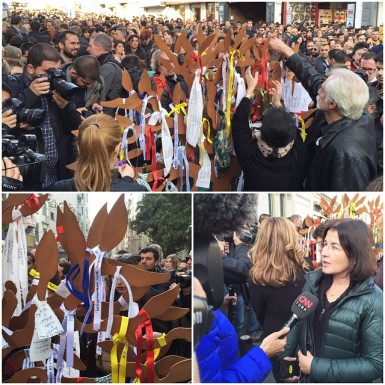
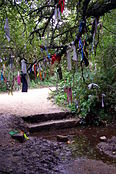
HaleTengerWishingTree


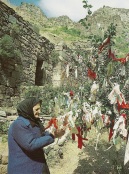
Clouties_near_madron_wellArmenian wishing tree cropCoincidentally, my April 24 post on FAR included a photo of an Armenian grandmother tying an offering of cloth to just such a tree. The ancient folk custom of the wishing tree, where people (usually women) tie cloths with a special prayer for a loved one, can be found today in Armenia, Turkey, and Greece, in Asia and throughout Europe as far as the British Isles and in Asia as well. This ‘clootie tree’ by the ‘clootie well’ (cloth = clootie) in Madron, Cornwall, is almost identical to the Armenian one shown in my previous post.

Carol P. Christ’s comment on my last post described a similar tree on her Greek island of Lesvos which she tells me is near hot baths once sacred in antiquity. She also stated that brides in ancient Greece would leave articles of their unmarried clothing on a tree dedicated to the virgin Goddess Artemis, one of many tree-worshipping rituals which were well-known and widespread in the ancient world.

Women on Carol Christ’s Goddess Pilgrimage to Crete have all participated in such a practice, tying coloured ribbons onto the venerable myrtle tree already covered with ribbons and votive offerings called tamas, at the sacred monastery of Palianí. When I went there with Carol in 2012, my encounter with the tree led to a profound and lasting experience of healing, which Carol remembered in Giving Back to the Mother.
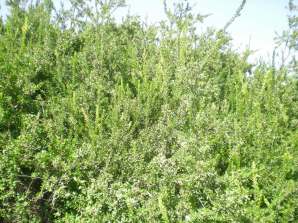
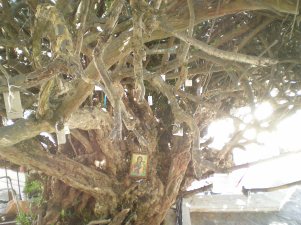
Paliani myrtle DSCN9080Paliani tamas DSCN9079

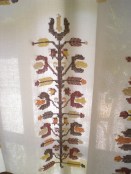
Tree emb Paliani DSCN9092Sisters on Carol’s pilgrimage also get to encircle the 2,000-year-old plane tree at Krasi. Even today village festivals are held under the canopy created by the ancient tree.  We know that tree worship on Crete has roots in Minoan times, as depicted in gold seal rings and other examples of Minoan art, and we know that tree worship is both ancient and widespread.  My life’s work researching the Goddess in traditional Balkan dance has shown that the Tree is often associated with the Goddess, for instance in many Balkan embroideries  This abstract but recognisable version comes from the curtains of the reception room in the Palianí monastery.
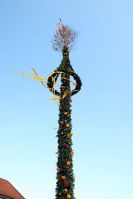
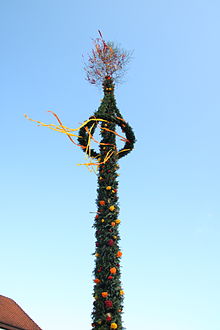
Maibaum_Ostfriesland967The sacred tree remains a living tradition in central, western and northern Europe in the form of the Maypole. I write this from Austria, where virtually every town and village honours May 1st (the ancient celebration of Beltane) with a May Tree, or Maibaum, a tall decorated pole with a wreath at the top. I love how this one from Germany resembles the Goddess.  Can you see her too?

Once-universal practices revering trees, nature, and the Goddess may have changed, but the act of praying for others’ well-being remains common to us all. The longing to keep our loved ones safe transcends all religious, political and ethnic boundaries. Love for others is one of the strongest bridges to common ground, and here is where we find our meeting place once again.

As I read through the messages sent in response to my invitation to dance on April 24th, I feel that each dancing circle is like a votive offering hung on a sacred tree. Each one is a gift of love for humanity, unique, yet part of a shared desire to end suffering, to bring healing, and to ensure the safety and survival of every single being in creation.

Laura Shannon has been researching and teaching traditional women’s ritual dances since 1987. She is considered one of the ‘grandmothers’ of the worldwide Sacred / Circle Dance movement and gives workshops regularly in over twenty countries worldwide. Laura holds an honours degree in Intercultural Studies (1986) and a diploma in Dance Movement Therapy (1990).  She has also dedicated much time to primary research in Balkan and Greek villages, learning songs, dances, rituals and textile patterns which have been passed down for many generations, and which embody an age-old worldview of sustainability, community, and reverence for the earth. Laura’s essay ‘Women’s Ritual Dances: An Ancient Source of Healing in Our Times’,  was published in Dancing on the Earth. Laura lives partly in Greece and partly in the Findhorn ecological community in Scotland.

What “I Believe” and Found Worth Sharing by Xochitl Alvizo

Incarnation, Goddess spirituality, Xochitl Alvizo, god became fleshThe end of my Ph.D. program is in sight. Originally, in 2004, I came to Boston University School of Theology (BU STH) from Los Angeles for a two-year masters program. Along the way I switched to a three-year masters program, after which I ended up staying for the Ph.D. Now, eleven years later, the end is actually in sight.
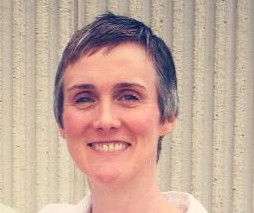
Last week I successfully defended my dissertation, “A Feminist Analysis of the Emerging Church: Toward Radical Participation in the Organic, Relational, and Inclusive Body of Christ.” Two days ago I had the last class section that I will ever teach as TA (teaching assistant) – next time I teach I will be doing so as a professor of religious studies at Cal State Northridge.  Finally, because I am one of the students who will be graduating this year, I was invited to participate in the last chapel service of the year and be a speaker for the “This I Believe” service – themed after the NPR series by the same name. Yesterday, I was one of six students who were given three minutes each to share what we believe – which, let me tell you, is not a small task!  Continue reading “What “I Believe” and Found Worth Sharing by Xochitl Alvizo”

Reconstructions of the Past: Hafsa bint Sirin (“Introduction”) by Laury Silvers

silvers-bio-pic-frblog - Version 2This blog and those to follow will be taken from an academic talk I gave on the life of the early pious worshipper, scholar of Qur’an, Hadith, and their legal meanings, Hafsa bint Sirin (d. ca. 100/800). I used some of the material for the talk in my chapter on early pious, mystic, and Sufi women in the Cambridge Companion to Sufism, but most of what I will share with you here and in the future has never been published. Whenever I sat down to write this material up for a journal, I realized I would not be able to expand the piece in the way I wanted in keeping with a properly skeptical historical attitude. I would need to hem and haw in all those places I just want to be bold and write what I think, without concession.

I want to tell her story as I have imagined it. Granted, what I have imagined is rooted in what can be known about the historical circumstances of her life and the lives of other women in that time and place. But I want to be honest about my agenda. My feminist agenda. In telling Hafsa’s story, I want to address and produce my own counter narrative to those stories told about pious and Sufi women over the years that hold up women’s silence and seclusion as the height of women’s piety. Continue reading “Reconstructions of the Past: Hafsa bint Sirin (“Introduction”) by Laury Silvers”

Experiencing Divinity in the World by Carol P. Christ

carol mitzi sarahAs I work on revisions of the new book, Goddess and God in the Worldthat Judith Plaskow and I are writing, I am thinking again about John Cobb’s notion of the “two ultimates” as two different ways of thinking about divinity. Cobb suggested that religions have defined the nature of ultimate reality as personal and as impersonal, as God and as the ground of being. The ground of being is the impersonal ultimate: the metaphysical principles that structure all of life, principles that he described as creativity or the creative process.

Judith describes God as the impersonal creative process and views personal language for divinity as metaphoric or symbolic. I define Goddess as personal, yet also view the impersonal ultimate, the creative process, as sacred. For me, this raises the question of the relationship between Goddess and the creative process.

In Cobb’s view, the two ultimates are co-eternal: the personal God did not “create” the creative process, nor was the personal God “created” by the creative process. Rather, for Cobb, God as the personal ultimate, like all other individuals, participates in the creative process. What then is the creative process? Although the term “creativity” has multiple meanings, in process philosophy it has a specific one.

Whitehead’s description of the creative process is rooted in the insight of modern science that the most basic components of our universe are particles of atoms that defy being categorized as either matter or energy, but seem to move and change, depending on their relationships. It is from the relationships of these tiny individuals that the evolutionary process of our universe began. This insight led Whitehead to recognize that the nature of reality (or being) is not fixed and static (as Western philosophers before him had concluded) but is always moving, changing, or “in process.” Whitehead’s understanding of the creative process is summed up in his much-quoted phrase, “the many become one, and are increased by one.”

The creative moment in the creative process (which is in fact every moment in the life of an individual) is the moment when the individual (whether particle of an atom, cell, animal, human, or divinity) in an act of creative freedom unifies the world (the many) into a new synthesis (the one): this new synthesis adds a new fact to the world (the many is increased by one). This is an abstract description of the creative process in its most basic form. In fact, however, we do not experience the world in the abstract, but in the concrete.

In this moment I (Carol) remember my past (many different Carols situated in many different worlds and some of the books I have read) as I shape this sentence (with my hands on my computer acting in concert with the feelings of my body and the thoughts that are flowing in my mind) and unite myself and my world in a new synthesis (which is this sentence). As I do so, I add a new fact to the world (the many are increased by one), a sentence that may be read by others in the future, therefore influencing their lives.

The reader who reads my words (you) reflects on them in relation to her or his memory (your memories of your past selves in your past) and asks if what I am saying makes sense: in the moment that she or he (you) decides if it does or it doesn’t, a new fact is added to the world (the many are increased by one), an opinion that in turn may be expressed to someone else (the many is again increased by one) who in turn responds to it (the many is increased by one more).

Though this description of the creative process focuses on mental actions, our mental processes are not divorced from our bodies and feelings, and the relations of mind, body and feeling are complex. In some creative moments, feelings are primary, while in others the body leads. This second richer description of the creative process is still an abstraction. We do not generally experience life as a series of moments but as a flow in which one moment is indistinguishable from the others; nonetheless, we can recognize that our lives are made up of a series of moments in which we along with others create the world anew.

Sometimes we take a longer and broader view of the creative process, recognizing patterns and cycles within the world that we share with other than human life. Traditional peoples, for example, often speak of or invoke the creative processes of birth, death, and regeneration that are the basis of life on this earth. This is also an important way of describing the ground of being because it situates human creativity within the creativity of the web of life. In our time we might also speak about the evolution of life. Taking a long view, we experience the sacrality of the web of life.

I experience—feel and sense—the personal ultimate, the presence of Goddess as intelligent love in my body, mind, and spirit and in all bodies, minds, and spirits, as I go about my everyday life. She is always there: feeling the love and joy I feel; supporting and understanding me when things are difficult; inspiring me to share the grace of life with everyone and everything. I also feel the power of the impersonal ultimate, the creative process that supports the creativity or freedom of all individuals who interact with each other in the web of life. For me the two ultimates—Goddess and the web of life—are both real.

Though the two ultimates are separate in the abstract, in the concrete experience of those of us who affirm a personal divinity, they are intertwined because the personal divinity is experienced through the creative process that is the basis of life. Thus, at one and the same time, I experience myself and divinity within me, other individuals and the divinity with in them, the creative process and the divinity within it.

I celebrate the creative process and its fruits, the powers of birth, death, and regeneration and the evolutionary process as a whole, as the ground of all being as well as the Goddess I experience as a personal, intelligent, loving, compassionate presence who cares about me, all other individuals in the world.

Carol leads the life-transforming Goddess Pilgrimage to Crete (facebook and twitter).  Carol’s books include She Who Changes and and Rebirth of the Goddess; with Judith Plaskow, the widely-used anthologies Womanspirit Rising and Weaving the Visions; and forthcoming in 2016, Goddess and God in the World: Conversations in Embodied Theology.