Recently, my local newspaper (yes, I still get a paper delivered to my “newspaper box” every morning!) carried a short article that caused me to stop and reflect.
The headline read, “Use of ‘Jihad’ on school test assailed.” A local, elementary school principal had pulled a math problem from the school’s resource pool when some parents and other community members objected to the use of “Jihad” as a name for one of the characters in the math exercise. In the exercise, Roberto, Kwame, and Nika (along with Jihad) collected leaves for a science project. The elementary school students’ assignment involved drawing bar graphs, showing how many leaves each character collected.
A local resident brought what he termed an “inappropriate name” (Jihad) to the attention of the School Board. He said, “I believe this [using Jihad as a character name] is a very subtle desensitization of impressionable young minds,” citing Webster’s College Dictionary’s definition of jihad as “a war by Muslims against unbelievers or enemies of Islam, carried out as a religious duty.” Continue reading “My Name is Jihad by Esther Nelson”
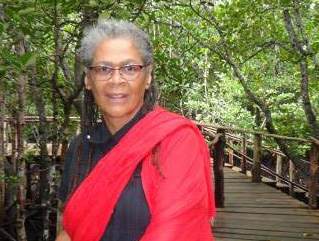
It has been a marvelous experience for me, these past few years, to be connected with this community Feminism and Religion. Still, sometimes even good things have to come to an end. I’ve decided to discontinue my regular blog contributions. The organizers have graciously allowed me the possibility to do a guest blog in the future; so I may yet contribute.
Here’s the thing: I don’t think folks who read this blog know fully just what goes on—seemingly seamlessly in the background. So before I go, let me expose how this has been for me, to give greater credibility to my first sentence: it has been a marvelous experience.
I was asked to start blogging with FAR while living in another country, another time zone, and inconsistent internet access. Truth be told, inconsistency characterizes my life-work since I travel extensively and cannot predict the regularity of the internet in some of the parts of the world where I might be located. Still I made the commitment to blog twice a month, every first and third week. Continue reading “Good Things Come to an End by amina wadud”
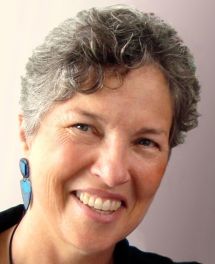
About 15 years ago, I was writing a book entitled Embracing the Dragon: A Myth for our Times. In it I critiqued the so-called heroic myth, which I call the dragon-slaying myth. My research led to the discovery of many Western dragon tales, which I retold from the dragon’s perspective. “Tiamat’s Tale,” transcribed below, was one that I offered orally – as a storyteller.
~~~~~~~~~
“The ocean is the beginning of the earth. All life comes from the sea.” And at the outset Her name was Tiamat. Tiamat, the watery womb where all is amorphous and malleable. Tiamat, the primeval cauldron where one thing shapeshifts into another in the eternal whirlpool of creation. Tiamat, the unfathomable abyss. Before Her there was nothing. Without Her there is nothing. And after Her there will truly be nothing.
Those who learn to trust Her, discover Tiamat’s bliss, the creative ebb and flow of Her salt flood. Foremost among these was Apsu, Tiamat’s husband and lover, for he was the first to issue from Her tidal wave. His sweet waters mingled with Her salty brine, and together they brought forth gods and goddesses as silt precipitates from a stream or sand washes up on a shore. Tiamat’s undulations and Apsu’s wet dreams stirred the ardor of their children in turn, and soon there were many generations of gods and goddesses. Continue reading “Tiamat’s Tale by Nancy Vedder-Shults”
“So, when we in the West talk about religion as the cause of this violence, how much are we letting ourselves off the hook, and using religion as a way to ignore our role in the roots of this violence?” Karen Armstrong, author of Fields of Blood This statement was made by scholar of religions Karen Armstrong in an interview in Salon magazine in response to characterizations of Islam as a violent religion by Bill Maher and others. Speaking in the context of the rise of anti-Islamist prejudice in Europe, Armstrong said that Maher’s demonization of “the other” was the kind of talk that could lead us back to the concentration camps.
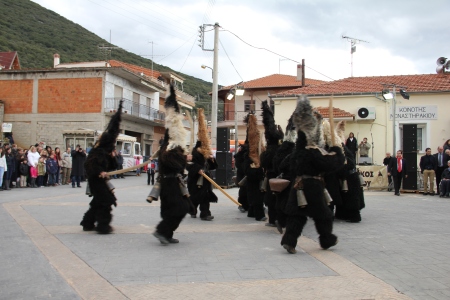
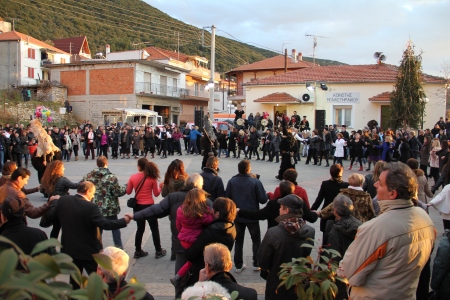
The twelve days between Christmas and the New Year are still held to be holy days in Greece, a mystical and dangerous time when mischievous spirits emerge from the underworld, seeking to wreak havoc in the human realm. On the 6th of January, Theophania or Twelfth Night, masked men in goatskins and sheepbells dance through the streets to dispel these spirits, awaken the fertility of the earth, and ensure a good year. The name Theophania, literally ‘the appearance of god’, here refers to the return of the sun after the winter solstice, and fire and light are very important to this holiday.
The rituals I describe here come from six tiny villages in the region of Drama, just south of the Rhodope Mountains, close to the border between northern Greece and Bulgaria. Similar rituals featuring masked, bell-wearing men appear all through the Balkans and Central Europe as far as the Swiss Alps. They will dance through the village streets, in the cemetery, and in front of every house, in a ritual of blessing and catharsis which has roots in age-old worship of Dionysus, god of fertility and wine.
For me, who came to Greece to study women’s traditional songs, dances and costumes, it makes a refreshing change to observe ritual customs almost exclusively performed by men. These activities take place in winter, either at Theophania or during Carnival, in contrast to spring and summer rituals which are chiefly in the hands of the women. However, as we shall see, in order for men to assume ritual abilities and responsibilities normally ascribed to women, some of the men must dress in women’s clothes.
Here I would like to mention Carol Christ’s recent analysis of essentialism in feminist theory in her excellent post of September 15. In Carol’s words, the essentialist view holds that the “‘essential qualities’ of a thing (a table, a horse, a woman, or a man) precede the ‘existence’ of any individual in the group to which it belongs; these qualities are universally—always and everywhere—expressed by members of the group.”
Carol and I both live in Greece, where, as in many other parts of the world, tradition assigns quite different tasks and attributes to men and to women. Without reawakening the essentialist discussion here, I would just like to say that modern-day feminists do not have to agree on whether women and men are essentially or inevitably different; however, in order to understand Balkan culture, we do need to realise that people here believe in these differences and have done since ancient times.
Angelos Keras, the Archigos of the Arapides in Monastiraki
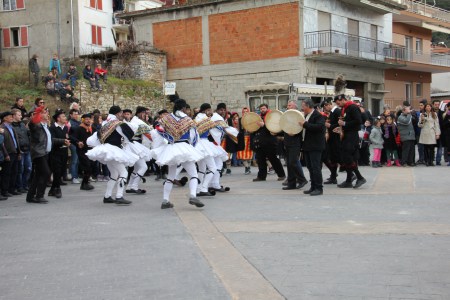
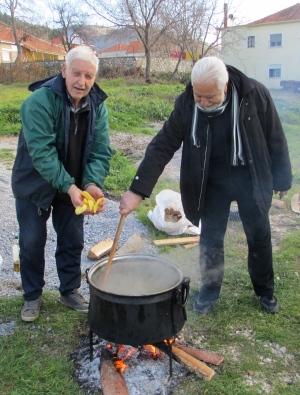
Back in Drama, in the village of Monastiraki, preparations have been underway for days. The night before the big event, a designated house – half-ruined, but still with a roof intact – slowly fills with the joy of friends and acquaintances greeting one another. Red wine flows, and traditional goat soup is served free to all. A fire has been kept burning here continuously throughout the twelve nights of Christmas, producing sacred ash with healing and protective powers. Musicians play through the night, producing archaic sounds on the Macedonian bowed lyra or kemene, accompanied by large goatskin tambourines called daheres. These are the only instruments. The overall effect is all the more hypnotic as the musicians play in absolute unison; even the singing is monophonic, in a musical structure intended to emphasise old values of community and coherence.
Meanwhile, people dance the same few dances over and over. As on all ritual occasions, the repetition of familiar simple step patterns frees the dancers to focus on the inner work of igniting their own good mood and raising good energy (kefi) to bless the community.
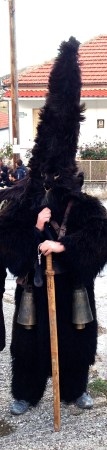
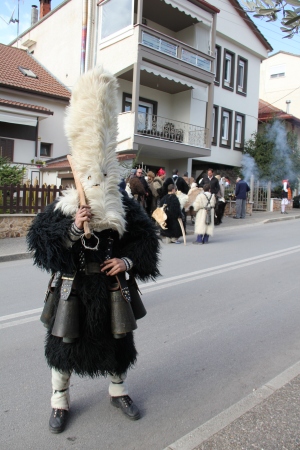
After dancing and drinking all night, the male celebrants help each other dress in the early hours of dawn. They are truly fearsome in shaggy dark skins, tall conical masks, and wide leather belts from which swing three pairs of heavy double bells. One of their names, koudonofori, means bell wearers; they are also called Arapides, the Black Ones or Moors.
Looking behind the apparent racism of the terminology, these ritual dancers blacken their skin with burnt cork both to invoke the power and protection of the sacred fire, and also in order to enter the realm of darkness. Here, the dark is seen as the repository of the earth’s fertile powers, which their bells and dances aim to awaken, as well as the realm of things ‘not seen’ , such as the spirits known as kallikantzari, which pose a threat to the new light and the new year. They themselves must go unseen, in masks and disguises, to enter this realm.
‘Arapides’, masked ritual dancers at Theophania in Monastiraki
Brandishing long wooden swords, this group – known as a tseta – appears fully capable of driving out any number of kallikantzari. The phallic swords and headdresses leave one in no doubt that the Theophania rituals are men’s rituals, yet the ability to give new life, to enter the realms of the dead, and to bestow the blessing of fertility are essentially women’s powers. To claim these powers, some of the men must dress as women, as Dionysian revellers have done since ancient times. These are theGilinges, or Brides.
Pappoudes (‘Grandfathers’) with lozenge-shaped beaded amulets, and Gilinges (‘Brides’) in Ksiropotamos
Wearing women’s clothing may be a means for men to temporarily gain access to the realms of life and death, where normally only women may go, or to symbolically give birth to the life-affirming fertility and joy which bring renewal at this dark and hungry time of the year. (Men wearing women’s clothing for ritual purposes are depicted in archaeological finds dating back to the 5th C. BCE; I think we see it today in the ecclesiastical robes worn by Christian priests.) In an additional affirmation of what is seen as women’s power, the Brides’ costume is rich in goddess embroideries, while all the members of the party wear beaded amulets in the lozenge-shaped symbol of female fertility going back to Neolithic times. Goddess symbols are also stamped on many of the bells.
As well as the Arapides and the Brides, the tseta includes Pappoudes or Grandfathers in Thracian men’s traditional dress, and Evzones or Tsoliades wearing short white pleated foustanella kilts and thetsevres, a special garment made of twelve large white kerchiefs sewn into a triangle densely fringed with beads, sequins and coloured threads, which takes four months to prepare.
Musicians and ‘Tsoliades’ ritual dancers in Monastiraki
There is also an occasionally appearing Bear, who some say represents ancient worship of the Goddess Artemis.
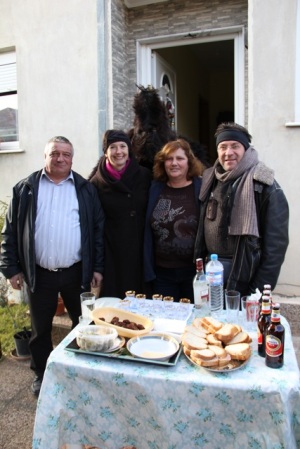
As they journey together through the village, the bell-wearers leap and stamp, swinging their bells back and forth in an apotropaic din – this will indeed awaken the earth! – almost drowning out the eerie sound of the lyras and daïres. The Evzones dance with athletic half-turns which send their short kilts sailing up to their waist, emphasising (so I am assured) the fertile power of the male generative organs, without revealing the organs themselves. At every house the entire tseta is rewarded with abundant food and drink, in the living tradition of sacred hospitality which is the most powerful blessing of all.
Hospitality to strangers in Ksiropotamos
By three o’clock, the whole village gathers at the plateia to dance. Hundreds of people spiral into a single circle with one leader, keeping the large centre open as a sacred space for the tseta to enact ancient rituals of death and resurrection, plowing and planting, and the hieros gamos or sacred wedding. The dancing goes on until dusk and then continues at a taverna through a second consecutive night.
Everyone joins in the great circle dance in the plateia of Monastiraki
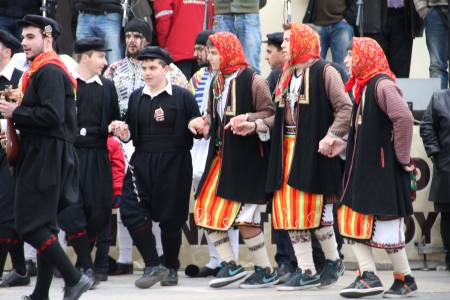
Each village has its own variation of the Theophania rituals. In some places, children and women also participate: in Ksiropotamos young girls dance in traditional costume, while in Petrousa, all the dahereplayers are teenage girls. Some traditionalists view this change with unease, but I must confess my pleasure at seeing thirteen young women lined up like priestesses of Cybele from the time when the drummers were women. Here too, people dance at crossroads, springs, sacred trees and finally around an enormous bonfire.
Cauldrons at the crossroads in Ksiropotamos
Fire is important in all the Theophania rituals, and cauldrons on open fires are a key part of the festivities. This is another symbol of women’s power adopted on this occasion by men – traditionally, women cooked in pots; men roasted meat over an open fire.In Petrousa, the Dance of the Cooks can still be seen. Although it is no longer danced around the cauldrons themselves, the symmetrical step pattern still focuses the energy or ‘fire’ of the dancers in a particular way.
It seems to me that these fire-focused rituals hint at the unnamed presence of the Goddess Hestia, whose domain is centred on the hearth, source of light, warmth, food and all that is beneficial to the home. The nikokira, the lady of the house, was seen since ancient times as Hestia’s priestess. Her role is to tend the sacred fire through practical and ritual work and to literally focus its brilliance (estiazo, fromHestia, means ‘to focus’) so that it may bless the household and all its inhabitants. In ritual activities such as the Theophania, through the mediation of men dressed as women, this focused fire can be brought once a year from the private space of the home – the realm of the women – into the public space of the village, the realm of the men. This union of men’s and women’s fertile powers is the hieros gamos, the holy spark of blessing which ensures health, wealth, happiness and abundance for all in the coming year.
I wish the analysis that accompanies this quote had been mine, but maybe I should be glad that it comes from an insightful young man who goes by the name liamcdg. He argues that the real beef the New York police have with Bill de Blasio is his challenge to their definition of masculinity as dominance, or shall we say white male dominance.
As noted by liamcdg, in the NYPD version of reality, parents should teach children to comply “to comply with New York City police officers even if they think it’s unjust.” In terms of competing definitions of masculinity, the NYPD version is that men in power should be respected simply in virtue of their position, even if they are acting or appearing to act unjustly. In other words we should respect the powerful because they are powerful.
To be empathetic is to be able to put yourself in another person’s place, and in its literal meaning, to feel the feelings of another. In the recent public conversations about race and the police, both Obama and de Blasio have invited white Americans to put themselves in the place of a black man stopped by the police for little or no reason and to ask themselves how they would feel in that situation.
In so doing, liamcdg asserts, Obama and de Blasio were not only trying to explain the feelings of those on the other side of the racial divide, but they were also redefining masculinity. We all know that according to traditional stereotypes, the realm of feeling is the realm of women. And of course we also know that real men don’t cry. Yet what is happening to black men is enough to make anyone who feels their feelings want to cry.
The conflicts between de Blasio and the police and between Obama and a large segment of the older white male voting public may have as much to do with the challenge to white male privilege as it has to do with any particular event or issue. White male privilege involves a complex interconnection of race and sex. It is about the power that comes or is expected to come to one simply by virtue of being born into a white male body.
Forty years ago, inspired by the feminist movement, men began to speak about redefining masculinity. This was easier said than done. It is so easy to accuse men who criticize male power as domination of being “sissies,” “girls,” or “gay.” Even men who might want to discuss the subject may be afraid of being labeled.
I say the fact that the NYPD is turning its back on de Blasio is one measure of how far we have come. I suggest that the NYPD recognizes that a different definition of masculinity and male power is being born right before their eyes. And it is this that they cannot bear to see.
We have been taught that feeling and feeling the feelings of others belongs in the feminine realm. What if it doesn’t? What if in the end male power and female power are much the same? And what if they both begin with empathy?
What if Freud got it wrong? What if males do not have to differentiate themselves from their mothers by becoming “not like” women and girls? What if masculinity and femininity are not polar opposites? What if all any of us has to do is to learn to embody the qualities of those who nurture us?
We are beginning to glimpse a different world. Any thoughts on how to bring the NYPD and other older white males into a new world along with us?
Social justice. Progressive politics. Improper media depictions. What exactly is the F-word (feminism) about?
I have always understood feminism as a project that casts a very wide net, the goals and values of which can keep quite a few people dry under the shade of its umbrella. But more and more, I see a narrowing of who can count as a feminist. There are a few reasons for this constriction. First, the more the F-word becomes a pejorative in contemporary society, the greater the need is to circle the bandwagons and set up camp. Second, when a particular group has elevated levels of in-fighting occurring, it makes sense to start psychologically splitting people into “feminist” and “not feminist.” Or, on a spectrum, “strong feminist” vs. “weak feminist.” Third, there is a pragmatic need for groups to find an optimal tension with society. When social groups are too counter-cultural or revolutionary, they get branded extremist and fanatical, but when they are wishy-washy and lukewarm, they become another extension of the status quo and lose their prophetic fire.
As an atheist, I see all of this occurring in non-believing circles as well. And I’m not really sure how to navigate it. There is also no shortage of men in this social group–from Dawkins to Boghossian–who think of feminism in the negative. All of this has to do with what they think the F-word amounts to. Continue reading “What is the F-word Anyway? by Kile Jones”
I have spoken about the Social Responsibility of the Artist on numerous occasions. This blog approaches similar subject matter, but in relation to using art as a potent tool for change and as a platform for raising awareness of important environmental and ecological issues that all of humanity is currently faced with.
All forms of art have the potential to be tools for healing. I believe that through the creative process the relationship with self and the environment can be transformed. Why? Because when creative work is approached from a place of passion and purpose and art is brought to life with intention, great shifts can occur. Not only for the artist, but also for the viewer. I believe wholeheartedly that I can approach the canvas and paint intentionally to heal the earth and deepen my connection to it, and in doing so inspire others to deepen and honour a connection to the earth creatively.
There are many contemporary artists who are agents of environmental change and who are using their creative gifts and talents to build awareness and provoke thought through their work and process. Many artists, such as myself are working with transformative approaches and processes towards a new vision that is ecological and participates with the living cycles of nature. Many topics are approached such as oceans, climate change, water quality, recycling, water purification, natural disasters, de-forestation, endangered species and more.
Artists today are finding all sorts of inventive ways to call attention to the problems facing our environment, as corporate greed and profit impose destruction on our planet. While each artist works very differently and explores diverse territories, they share awareness about the critical loss of natural resources and a desire to save the planet from human destruction.
“Today the talk of the world is about an endangered Earth. One often wonders how much of the talk is backed with genuine concern and the will to take positive steps. But it should not surprise the world that artists are in the forefront of the discussion on the environment.”
Eco-feminist artist Ann T. Rosenthal and activist artist Steffi Domike have been collaborating on environmental installations for years. Their wall installation, Watermark: Wood, Coal, Oil, Gas (2011) consists of four panels that illustrate an evolutionary timeline of energy resources—wood, coal, oil and natural gas.
Dominique Mazeau is a poet and artist from Santa Fe, New Mexico. She has made an exquisite journal of poems and drawings of cleaning up the Rio Grande River over many years. She has made sculptures from the trash and she teaches school children about the river with her poems and her art.
There are many more Eco-feminist and Environmentalist/Activist artists such as Charla Puryear and Helene Aylon using their art to raise awareness of ecological issues. These few examples alone demonstrate that art, in its myriad of forms, has the capacity to effect positive change on the earth and its environments.
Artists are catalysts for change, and this “change” takes place when we feel deeply for a precious cause. I feel deeply for the state of the earth and feel that it is largely humanity’s spiritual disconnection from the earth and from the earth as sentient that has contributed to the current state of not only the health of the earth body, but also the health of our bodies.
Coming up in October I will be presenting an exhibition ‘Voices for the Earth’ in Bundaberg, QLD Australia. This exhibition will feature the works of select regional artists who are using their art to speak for the earth. It is held in conjunction with RONA-16 an Earth Arts Festival as part of the The Rights of Nature Tribunal that is taking place the same month. Artists of all genres from around Australia are participating in creative activities to raise awareness of the urgency required to make the necessary changes so that ways can be found to make the health of our planet an absolute priority.
I know that more has to be done, and some might see ‘art’ as a hedonist, self absorbed way to attempt to bring about change – but the power of image should NEVER be underestimated.
I am Painting for the eARTh.
This Earth is my sister I love her daily grace Her silent daring And how loved I am. How we admire this strength in each other All that we have lost All that we have found We are stunned by this beauty, And I do not forget What She is to me And what I am to Her.
Jassy Watson, who lives on the sub-tropical coast of Queensland Australia, is a Mother of four, passionate organic gardener, Intuitive/Visionary & Community Artist, Teacher, Intentional Creativity Coach and a student of Ancient History and Religion at Macquarie University, Sydney. She is the Creatress of Earth Circle Studios; a school for the Sacred Creative Arts. Jassy teaches regular painting workshops in person, nationally and internationally, and online based around themes that explore myth, history and our connection to the earth.
Morrigan, Celtic Goddess of War and Death, is a dark goddess we mortals tend to approach with fear and trepidation. A great Warrior Goddess, She represents the more terrifiying aspects of female energy; sensuality, magic, prophecy, revenge, and war. She could either shapeshift into a crow or raven or be accompanied by them. In the Ulster cycle stories she also appears as a cow, a wolf and an eel. This indicates Her connection to prosperity, sovereignty and the land. Encompassing all essential divine functions, She is the Goddess of War, Sovereignty, Fertility and the Land.
My friends make my life difficult. They make me see what I could not see before. Kecia Ali, Aisha Geissinger, Karen Ruffle and Kathleen Self taught me how to read for gender in the classical texts I use for my academic work. It’s a way of doing close readings by paying attention to the way gender shows up in the text. Aisha sat with me one afternoon and walked me through my own sources pointing out references to gender in the sources. She showed me how the sources I was reading used gender to express social norms. She kept asking me, “What work is gender doing in the text?”
Don’t laugh you been-reading-gender-forever-and-a-day people! Okay laugh. I was a bit slow to pick up this gender thing at first, but I caught up okay. Now I cannot unsee it. I see it everywhere. For instance, I was heading to the stairs at work after a long day and was brain tired. I saw this sign at the stairs:
I nearly kept walking past the stairs thinking for a second that it meant they were for people that society designates as having “male” bodies only. I actually thought that. Then I started laughing at myself. I took a picture and posted it on social media with a story complaining how my friends have absolutely ruined me! Continue reading “Reading “Women” by Laury Silvers”



 It has been a marvelous experience for me, these past few years, to be connected with this community Feminism and Religion. Still, sometimes even good things have to come to an end. I’ve decided to discontinue my regular blog contributions. The organizers have graciously allowed me the possibility to do a guest blog in the future; so I may yet contribute.
 About 15 years ago, I was writing a book entitled Embracing the Dragon: A Myth for our Times. In it I critiqued the so-called heroic myth, which I call the dragon-slaying myth. My research led to the discovery of many Western dragon tales, which I retold from the dragon’s perspective. “Tiamat’s Tale,” transcribed below, was one that I offered orally – as a storyteller.
 Social justice. Progressive politics. Improper media depictions. What exactly is the F-word (feminism) about?


 My friends make my life difficult. They make me see what I could not see before. Kecia Ali, Aisha Geissinger, Karen Ruffle and Kathleen Self taught me how to read for gender in the classical texts I use for my academic work. It’s a way of doing close readings by paying attention to the way gender shows up in the text. Aisha sat with me one afternoon and walked me through my own sources pointing out references to gender in the sources. She showed me how the sources I was reading used gender to express social norms. She kept asking me, “What work is gender doing in the text?”
 Feminism and Religion