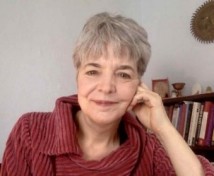
Outside my childhood home grows a yellow rose bush descended from one planted by my great-grandmother, Jennie, a century ago. That bush has given her descendants many gifts of spirit over the years— her love of beauty despite a life of tragedy and constant toil, her deep connection to nature persisting through four generations, her hope for the future inherent in planting anything that will take years to fully develop. When I contemplate my own fall garden and its plants sowing seeds for next year, I ponder the special responsibility we, as spiritual feminists, have for leaving to those who will come after us a legacy of inner resources that they will need to meet the challenges of the planet they will inherit and hopefully make into their own sustainable world of equality, peace and happiness.
In my mind I sit with a circle of spiritual feminists of the future. Around me might be a hairdresser or a President, a doctor, barista, poet, scientist, salesclerk, priestess, or elder. They could be old or young or in-between, from anywhere on Earth, of any spiritual tradition or practice. For one moment of time, I can speak directly to them of what I have distilled from my life that I would like them to know. I say to them: Continue reading “Planting Roses for Our Daughters: Creating a Community in Time by Carolyn Lee Boyd”
This is a continuation of Molly’s piece from Wednesday, 10 August 2016. You can read Part 1 here.
After explaining that the homebirth of her second son was her, “first initiation into the Goddess…even though at that time I didn’t consciously know of Her,” Monica Sjoo writing in an anthology of priestess essays called Voices of the Goddess, explains:
The Birthing Woman is the original shaman. She brings the ancestral spirit being into this realm while risking her life doing so. No wonder that the most ancient temples were the sacred birth places and that the priestesses of the Mother were also midwives, healers, astrologers and guides to the souls of the dying. Women bridge the borderline realms between life and death and in the past have therefore always been the oracles, sibyls, mediums and wise women…
…the power of original creation thinking is connected to the power of mothering. Motherhood is ritually powerful and of great spiritual and occult competence because bearing, like bleeding, is a transformative magical act. It is the power of ritual magic, the power of thought or mind, that gives rise to biological organisms as well as to social organizations, cultures and transformations of all kinds… (page unknown).
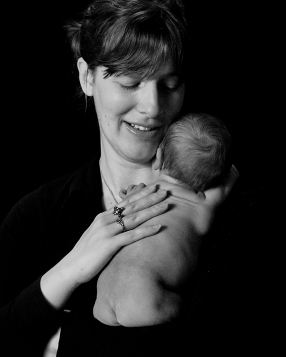
I have been a childbirth educator since 2006 and I have given birth five times. Each birth brought me the gift of a profound sense of my own inherent worth and value. It was the shamanic journey through the death-birth of my tiny third child, however, that ushered in a new sense of my own spirituality and that involved a profound almost near-death experience for me. After passing through this intense, initiatory crisis, the direction and focus of my life and work changed and deepened. Shortly after the death-birth of my third son, I wrote: Continue reading “Priestess as Shamanic Path – Part 2 by Molly Remer”
It is late autumn, 2009. I am 30 years old and pregnant with my third baby. He dies during the early part of my second trimester and I give birth to him in my bathroom, on my own with only my husband as witness. The blood comes, welling up over my fingers and spilling from my body in clots the size of grapefruits. I feel myself losing consciousness and am unable to distinguish whether I am fainting or dying. As my mom drives me to the emergency room, I lie on the back seat, humming: “Woman am I. spirit am I. I am the infinite within my soul. I have no beginning and I have no end. All this I am,” so that my husband and mother will know I am still alive.
I do not die.
This crisis in my life and the complicated and dark walk through grief is a spiritual catalyst for me. A turning point in my understanding of myself, my purpose, my identity, and my spirituality.
It is my 31st birthday. May 3rd. My baby’s due date. I go to the labyrinth in my front yard alone and walk through my labor with him, remembering, releasing, letting go of the stored up body memory of his pregnancy. I am not pregnant with him anymore. I have given birth. This pregnancy is over. I walk the labyrinth singing and when I emerge, I make a formal pledge, a dedication of service and commitment to the Goddess. I do not yet identify myself verbally as a priestess, but this is where the vow of my heart begins.
I do not know at the time, but less than two weeks later, I discover I am in fact pregnant with my daughter, my precious treasure of a rainbow baby girl who is born into my own hands on my living room floor the next winter. As I greet her, I cry, “you’re alive! You’re alive! There’s nothing wrong with me!” and feel a wild, sweet relief and painful joy like I have never experienced before.
If you ever eavesdrop on a conversation between my husband and me around the clamor of our four children’s voices, you will probably hear me making a tired lament: “All I want is a broad swath of uninterrupted time.” In listening to Elizabeth Gilbert’s newest book, Big Magic, on audio book I was interested by her mention that many creative people lament not having long stretches of uninterrupted time available in which to work. She quotes a letter from Herman Melville to Nathaniel Hawthorne, lamenting his lack of time and how he is always pulled “hither and thither by circumstances.” Melville said that he longed for a wide-open stretch of time in which to write. She says he called it, “the calm, the coolness, the silent grass-growing mood in which a man ought always to compose.”
…I do not know of any artist (successful or unsuccessful, amateur or pro) who does not long for that kind of time. I do not know of any creative soul who does not dream of calm, cool, grass-growing days in which to work with- out interruption. Somehow, though, nobody ever seems to achieve it. Or if they do achieve it (through a grant, for in- stance, or a friend’s generosity, or an artist’s residency), that idyll is just temporary—and then life will inevitably rush back in. Even the most successful creative people I know complain that they never seem to get all the hours they need in order to engage in dreamy, pressure-free, creative exploration. Reality’s demands are constantly pounding on the door and disturbing them. On some other planet, in some other lifetime, perhaps that sort of peaceful Edenic work environment does exist, but it rarely exists here on earth. Melville never got that kind of environment, for instance. But he still somehow managed to write Moby-Dick, anyhow.
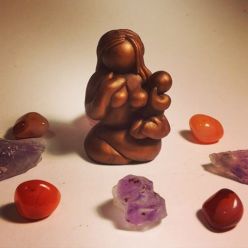
When I create a new sculpture, I am most often creating something that I need to remember or want to learn. The original figures for my Centered Mama sculpture and my Meditation Goddess sculpture were both created while at a friend’s house for a weekend work exchange as my baby toddled around. While I love making figures of mothers and babies, I was feeling a strong urge to make a goddess representation complete unto herself. It felt like a reclaiming of my non-maternal identity and a declaration of self-sovereignty. She turned out a little bigger than some of my other figures, strong and secure and independent. Then, the baby crawled over and knocked off one of her breasts, knocked her over on the tray, smashing the side of her head. I came close to crying. I felt annoyed with my husband who’d “let” him come over and destroy my work rather than noticing him doing it and stopping him. I was frustrated, dismayed, and my feelings felt hurt in a sense. First I felt like, Argh! This is a metaphor for life! And, then I realized it was not just a metaphor for life, it is my actual life! I pouted a bit and said I was just going to smash her and give up and I made some bitter faces at my husband and some long-suffering huffs and signs, but then the baby fell asleep in the Ergo, held close against my chest. I kissed his soft hair and I took my clay and started again. I reclaimed her from the smashed parts and she sat stronger and taller than ever.
She reminds me not to give up and that beautiful work can come from struggle, but also of interdependence (not just the independence I was going for!), co-creation, and tenacity. When the finished version of her, cast from the original sculpt, sits by my bed at night or overlooks my dinner preparations, she reminds me that I am strong and that persistence is worthwhile. She also tries to remind me to be calm and steady, centered and Zen, even though I more often feel like a whirlwind.
That same Saturday at my friend’s house, as my baby tentatively toddled around the kitchen, chewed on a piece of watermelon, and snoozed on my chest, I felt moved to begin creating a new Centered Mama sculpture. I had been going through an emotional rough patch, feeling buffeted by variable emotions and erratic and unpredictable in my enthusiasm and confidence. I was also feeling impatient, snappy, and irritable.
“I will be gentle with myself. I will be tender with my heart. I will hold my heart like a newborn baby child.”
This song by Karen Drucker replayed in my mind as I sculpted. The baby woke, the watermelon got dragged along the floor collecting dust, and it was time for our collaborative dinner, so I had to put her away unfinished. When we got back to our own home, I was compelled to finish her, working feverishly as the baby pulled on my legs and I said, “just a few more minutes!” to the older kids who were trying to play with him to let me work. Again and again I re-rolled the clay baby’s head, trying to make it “perfect,” and worked to lay down the strands of her hair, against of the backdrop of this often-chaotic, noisy, home-based life we’ve consciously and intentionally created together. She was created to represent holding my own center in the midst of motherhood. I will be tender with my heart. I don’t create sculptures like this because I AM so “Zen” and have life all figured out, I make them to remind me what is possible if I listen to my soul.
As I do extensive rearranging, construction, and reconstruction on my slowly ongoing dissertation project, I typed out a quote from the book Priestess: Woman as Sacred Celebrant by Pamela Eakins about her past life memories of making clay goddess figures as a temple priestess:
…to me it brought a continuation of the energy of the sacred objects of the grandmothers. I contained this energy in a new form in the dolls that would be placed upon the altars and in the graves of the daughters living now and the daughters to come…
I felt this process made my own clay stronger, too. Some of the pieces cracked in the fire because of the added ‘impurities’…but, in this case, I felt the impurities were the purest of pure and I worshipped each crack knowing the crack contained the wisdom of the priestesses who had occupied the doll-making table for more moons than I could even imagine. It contained too, the devotional energy of every grandmother who had held it in her hands or placed it on her altar. Sometimes ‘impurities’ sanctify further that which is holy to begin with.
While I tend to have a knee-jerk skepticism about past-life memories, there is something in Eakins’ words that I know at a bone-deep level as I do my own work with goddesscraft:
…Each goddess was imprinted with the sound of sacred life coursing through the Universe. I changed with the priestesses as the figures came through my hands. Each doll received the sacred vibration of life…For seventy-seven moons I made the dolls at the long table with the young Sisters of Nun. My hands were so fast. I made thousands of figures: beautiful little faces, etched collars of gold plates, pubic hair swirled into tiny rows of connecting spirals. They were so precious. At the end of the day, my baked clay shelves were covered with little women.
The clay goddesses healed…
This is how I apprenticed. I learned, in this manner, the art of healing. I learned that to heal means to make whole, and that becoming whole involves learning many levels of purification, balance, and reformation” (p. 32-33).
In Anne Key’s marvelous priestess memoir, Desert Priestess, she makes this important point: “It is of course no small wonder why graven images are so tightly controlled by religious traditions.” (p. 52) Sometimes I feel like this is what I’m tapping into when I make my own goddess sculptures—a resistance to tight control over graven images and over personalization of divinity as male.
I occasionally get requests to make bigger goddesses–-people ask about figures that are large altar pieces 12-18 inches tall or taller. The goddesses I make are all about three inches tall and there’s a reason for that: they fit in the palm of my hand. When I create them, I feel as if I’m part of an unbroken lineage stretching back 30,000 years to the person who carved the Goddess of Willendorf. I feel connected to the priestesses of the Mesopotamian temples who sculpted hundreds upon hundreds of tiny clay goddesses. Someone commented on my sculptures once saying, “echoes of Mesopotamia.” And, I said, “exactly.” I feel the connection between the clay in my hand and the clay in their hands, running through the ripples and eddies of time.
I’ve been inspired recently to re-read Starhawk’s The Spiral Dance, finding new bits of wisdom from it that speak to something different in me than they did the first time I read it. She writes of the attempts to discredit Goddess religion by invalidating the historical narratives or archaeological evidence: “The idea seems to be that if they can disprove our origin story, they can invalidate our spirituality…Is Buddhism invalid if we cannot find archaeological evidence of Buddha’s existence? Are Christ’s teachings unimportant if we cannot find his birth certificate or death warrant?…the truth of our experience is valid whether it has roots thousands of years old or thirty minutes old…a mythic truth whose proof is shown not through references and footnotes but in the way it engages strong emotions, mobilizes deep life energies, and gives us a sense of history, purpose, and place in the world. What gives the Goddess tradition validity is how it works for us now, in the moment, not whether or not someone else worshipped this particular image in the past” (p. 4).
The ancestry of my goddess sculptures may not be the same energy that raised temples and built monuments (or walls), it is the energy that carried a baby on one hip and a basket of supplies on the other and needed a goddess just the right size to tuck down the front of a shirt…
Sometimes I describe my life in the woods as being held in the hand of the goddess. And, I make goddesses that I hold in my hand. Am I in the palm of her hand or is she in the palm of mine? The answer is both.
(One of my all-time favorite fan photos–a rainy day traveling goddess picture, taken by my friend/SIL (this one is only an inch tall, but look how she calls in the waters of the world!)
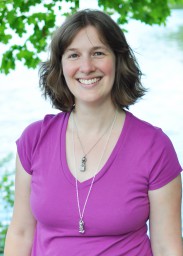
Molly has been “gathering the women” to circle, sing, celebrate, and share since 2008. She plans and facilitates women’s circles, seasonal retreats and rituals, mother-daughter circles, family ceremonies, and red tent circles in rural Missouri. She is an priestess who holds MSW and M.Div degrees and she is finishing her dissertation about contemporary priestessing in the U.S. Molly’s roots are in birth work and in domestic violence activism. She has worked with groups of women since 1996 and teaches college courses in group dynamics and human services. Molly is the author of Womanrunes: a guide to their use and interpretation, Earthprayer, Birthprayer, Lifeprayer, Womanprayer, and The Red Tent Resource Kit, as well as three social service oriented booklets and a miscarriage memoir. She has maintained her Talk Birth blog since 2007 and writes about thealogy, nature, practical priestessing, and the goddess at her Woodspriestess blog. Molly and her husband Mark co-create original birth art, goddess sculptures, ceremony kits, and pendants at Brigid’s Grove.
In my last post, I discussed the uses of dreamwork for Jewish women who are uncovering their own spiritual language. The protagonists of recorded Jewish dreams, from Joseph to the dream interpreters of the Talmud to the kabbalists, tend to be male. Yet there is a legacy of Jewish women dreaming, occasionally documented, and painstakingly uncovered by researchers. This hidden history offers us resources for understanding the women of the past, and for connecting to women in the present.
The Roman poet Juvenal (2nd. cent. CE) mocks a poor Jewish woman of his time for sitting under a tree and telling the meaning of dreams, calling her “high priestess with a tree as temple.” Much later in history, Hayyim Vital, the disciple of master kabbalist Isaac Luria, records in his diary that Jewish women in the city of Sfat (Jewish holy city in Galilee known as a center for Kabbalah) in the early 17th century were actively engaged (along with men) in recording, sharing, and interpreting dreams. Vital mainly records women’s dreams when the women dream about him! He saves these dreams from the dustbin of history, ironically, because he sees the dreams as prophecies of his greatness.
For example, Vital records the dream of a friend and patron, Rachel Aberlin. In the dream, Aberlin watches Vital eat a feast of vegetables at a table full of sacred books. Behind Vital, a fire rages, yet does not consume the pile of straw in which it burns. When Aberlin shares the dream, Vital understands this dream to be a manifestation of a biblical verse: “The house of Jacob shall be fire, and the house of Joseph flame, but the house of Esau shall be straw” (Obadiah 1:18). Aberlin, however, responds to Vital’s interpretation: “You quote me the words as they are written, but I see them as a reality.” (Between Worlds: Dybbuks, Exorcists, and Early Modern Judaism, p. 106ff).
Vital sees the dream’s fire as his own spiritual fire, witnessed by Aberlin. Yet we might read the dream differently. In our dream of Aberlin’s dream, we might imagine that Aberlin’s dream encodes her experience of watching Vital consume the nourishment of sacred books, which she, as a woman, is denied. Yet, the dream suggests, the fire of revelation is behind Vital, eluding him. Within the dream and in waking life, Vital is focused on text, but Aberlin, like Moses, perceives the fire that does not consume. Aberlin, not Vital, is the prophet in the dream— and the waking Aberlin says so. Vital records the dream, without recognizing Aberlin’s implicit criticism of his way of knowing.
Dreams are my window on my wildest self. They are also a way to observe the conflicts within, and therefore they are a feminist practice, teaching me about my relationship to power, gentleness, love, and brokenness. Claiming my dreams is a way of claiming all the parts of myself. I am inspired in my dream practice by my own Jewish tradition, which has many dream practices, as well as by contemporary knowledge about dreams. Frequently in my dreams, I am able to observe my own longing for the company of women and for the presence of Goddess—deity in a female mode—in my life. Frequently, I learn about my experience as a woman by watching my dreams.
In one recent dream, I found myself in a town called Ursula, visiting a cave. Inside the cave were statues of holy women. After my visit, I expressed a desire to move to this town, Ursula. When I woke up, I remembered a painting I had seen in London when I was young: a depiction of St. Ursula, a fourth-century Catholic saint said to have led eleven thousand women on pilgrimage. Ursula is also the she-bear, an archetype of the sacred feminine. The desire to live in the town of Ursula could be read as a desire to live in the realm of the she-bear: in the company of women. The town of Ursula is also a town of the ancestors: the priestesses, prophetesses and wise women of old, represented by the statues in the cave. Though the imagery in my dream comes from a variety of cultures, the dream reminds me of my desire to connect to the women my tradition through dreams.
I teach Jewish dreamwork (based on biblical, Talmudic, kabbalistic and contemporary texts) to rabbinical and cantorial students at the Academy for Jewish Religion. I have seen how deeply it adds to my students’ spiritual lives. And, as one of the co-founders of the Kohenet Hebrew Priestess Institute, I have seen dreamwork transform the lives of women who are becoming ritual leaders and healers. Kohenet’s dream practice includes dream circles in which each participant offers a different reading of each dream, beginning with “In my dream of this dream.” We begin this way because each of us has a different understanding, influenced by who we are.
At Kohenet retreats, we often find that the dream of one person provides powerful healing for the whole community. For example, one woman dreamed of finding a bearded father-figure in a house. When she went into the basement, she found her mother working and writing next to a goddess shrine (Jill Hammer and Taya Shere, The Hebrew Priestess: Ancient and New Visions of Jewish Women’s Spiritual Leadership, p. 70). The dream expressed an experience many of us shared: the process of unearthing the power of women and the mythic feminine in our own lives.


 Outside my childhood home grows a yellow rose bush descended from one planted by my great-grandmother, Jennie, a century ago. That bush has given her descendants many gifts of spirit over the years— her love of beauty despite a life of tragedy and constant toil, her deep connection to nature persisting through four generations, her hope for the future inherent in planting anything that will take years to fully develop. When I contemplate my own fall garden and its plants sowing seeds for next year, I ponder the special responsibility we, as spiritual feminists, have for leaving to those who will come after us a legacy of inner resources that they will need to meet the challenges of the planet they will inherit and hopefully make into their own sustainable world of equality, peace and happiness.
 Goddess, explains:
 part of my second trimester and I give birth to him in my bathroom, on my own with only my husband as witness. The blood comes, welling up over my fingers and spilling from my body in clots the size of grapefruits. I feel myself losing consciousness and am unable to distinguish whether I am fainting or dying. As my mom drives me to the emergency room, I lie on the back seat, humming: “Woman am I. spirit am I. I am the infinite within my soul. I have no beginning and I have no end. All this I am,” so that my husband and mother will know I am still alive.
 “If there is one chant in the universe it is to create.”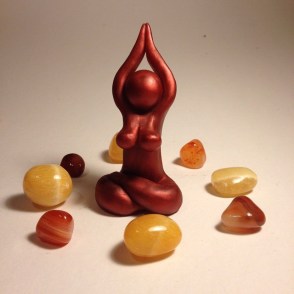
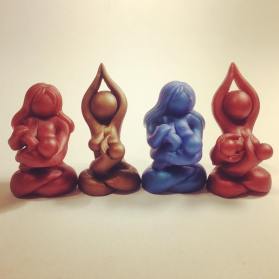
 inches tall or taller. The goddesses I make are all about three inches tall and there’s a reason for that: they fit in the palm of my hand. When I create them, I feel as if I’m part of an unbroken lineage stretching back 30,000 years to the person who carved the Goddess of Willendorf. I feel connected to the priestesses of the Mesopotamian temples who sculpted hundreds upon hundreds of tiny clay goddesses. Someone commented on my sculptures once saying, “
 In my last post, I discussed the uses of
  Feminism and Religion