From the Archives: Writing: Changing the World and Ourselves. By Ivy Helman

This was originally posted on October 12, 2014
20140903_180423

I still remember the first time I read Mary Daly’s Gyn/Ecology. It awoke something within me. Her use of language, the power of her writing and the ease with which she created new words taught me so much about the world around me and about the way the language, and subsequently its use in writing, shapes lives, choices, abilities and destinies. She also taught me about myself.

I was hooked, but not just on Mary Daly. Shortly after I finished her book, I moved onto other feminists writing about religion like Katie Cannon, Judith Plaskow, Alice Walker, Carol Christ, Rita Gross, Gloria Anzaldua, Audre Lorde, Adrienne Rich, Margaret Farley and Starhawk to name just a few. All of them, in fact every feminist I’ve ever read, has shown me the way in which words have power and how words speak truth to power. Ever since, I’ve wanted to be the kind of writer whose words carry a power that not only affects people but also inspires a more just, more equal, more compassionate and more humane world. In other words, I wanted to be a writer activist.

Continue reading “From the Archives: Writing: Changing the World and Ourselves. By Ivy Helman”

Archives from the FAR Founders: The Sainthood of Hildegard von Bingen by a Feminist-Friendly Pope? by Cynthia Garrity-Bond

This was originally posted May 18, 2012

While I celebrate the rise in status of Hildegard to official saint and soon to be Doctor of the Church, I cannot help but be suspicious of the Vatican’s motivations.  One only has to take in the last two months behavior of the CDF, sanctioned by Pope Benedict, to see the real intentions of this papacy—the continued subjugation of all women to clerical authority.

The past month or so has been a very busy time for the Congregation for the Doctrine of Faith or CDF and their examination of women. First they (and this includes Pope Benedict XVI) decided American nuns are guilty of the sin of silence by not speaking out on abortion & homosexuality.  Their “radical feminist” ideology of standing with the poor and disenfranchised, while good, is not good enough for the CDF.  The firestorm of solidarity coming from both laity and religious surely caught the Vatican off guard.  Right?  Well, not quite.  This past week the CDF began its investigation of the Girl Scouts for their purported association with the likes of Planned Parenthood and Oxfam.  While both address the needs of the poor, it is the latter and its troubling advocacy for safe sex via condom use that initiated the inquiry. Keep in mine that in 2010 Pope Benedict retracted from his earlier position and bane on condoms, seeing instead their use as a “lesser evil” in the fight against HIV/AIDS.  The CDF angst is that the message of condom use might be too much sex-talk for impressionable young women. And now the real conundrum, Pope Benedict officially declared Hildegard von Bingen a saint and will soon declare her the fourth female Doctor of the Church along with Catherine of Sienna, Theresa of Avila & Teresa of Lisieux.  News articles credited the pope as feminist-friendly and minded by his endorsement of Hildegard.  It is stated that Pope Benedict turned to the writings of the 12th century visionary with her sharp critique of clergy and the church during her own 12th century milieu as a contemporary diagnosis for the sins of its priest in the global sex scandal.  So what is it that attracts Pope Benedict to Hildegard? 

Continue reading “Archives from the FAR Founders: The Sainthood of Hildegard von Bingen by a Feminist-Friendly Pope? by Cynthia Garrity-Bond”

Archives from FAR Founders: Rosemary Radford Ruether’s Quests for Hope and Meaning by Gina Messina-Dysert

This was originally posted on December 18, 2013. This is part of a project to highlight the work of the four women who founded FAR: Xochitl Alivizo, Caroline Kline, Gina Messina, and Cynthia Garrity-Bond

Rosemary Radford Ruether is one of the most brilliant theologians of our time and her newly released autobiography, My Quest for Hope and Meaning, is a gift to those of us who have been so touched by her work.  In this intimate and beautiful piece, Ruether shares her personal journey in feminist scholarship and activism.  The autobiography opens with a profound forward by Renny Golden (that is also shared here on Feminism and Religion) and continues with an introduction and six chapters where Ruether guides us through an exploration of the influence of the matriarchs in her life, her interactions with Catholicism, her continued exploration of interfaith relations, her family’s struggle with mental illness, and her commitment to ecofeminist responses to the ecological crisis.

Ruether states that “Humans are hope and meaning creators” (xii), and her autobiography details her own quests for hope and meaning.  She reflects on the incredible impact made by the female-centered patterns in family and community in her life.  According to Ruether, these “matricentric enclaves” grounded and shaped her interest in feminist theory and women’s history.  She also describes the spiritually and intellectually serious Catholicism that she received from her mother and articulates her continued frustration with Vatican leadership that has undermined the efforts of Vatican II.  For Ruether, her ongoing affiliation with feminist theological circles is crucial as she continues to work toward shaping an ecumenical and interfaith Catholicism.

Continue reading “Archives from FAR Founders: Rosemary Radford Ruether’s Quests for Hope and Meaning by Gina Messina-Dysert”

Remembering Rosemary Part 2 by Janice L. Poss and Theresa A. Yugar

Editor’s Note: A more formal memorial to Catholic Feminist Theologian Rosemary Radford Ruether was posted here at Feminism and Religion at the time of her passing. Now we are delighted to share these memories of her by two scholars, Theresa A Yugar and Janice L. Poss, who knew her well, especially in her last months. Therese’s reflection is below and Janice’s will appear tomorrow. As Janice notes in her post, “More than any deep theological concept, doctrinal exegesis, or other hyper-scholarly thought, she taught me simply by being who she was – a woman – and she gave me the ultimate gift, the gift of herself.” Through these posts, Theresa and Janice pass on some of Rosemary’s wise and caring gifts to our FAR readers. Part 1 was posted yesterday. You can read it here.

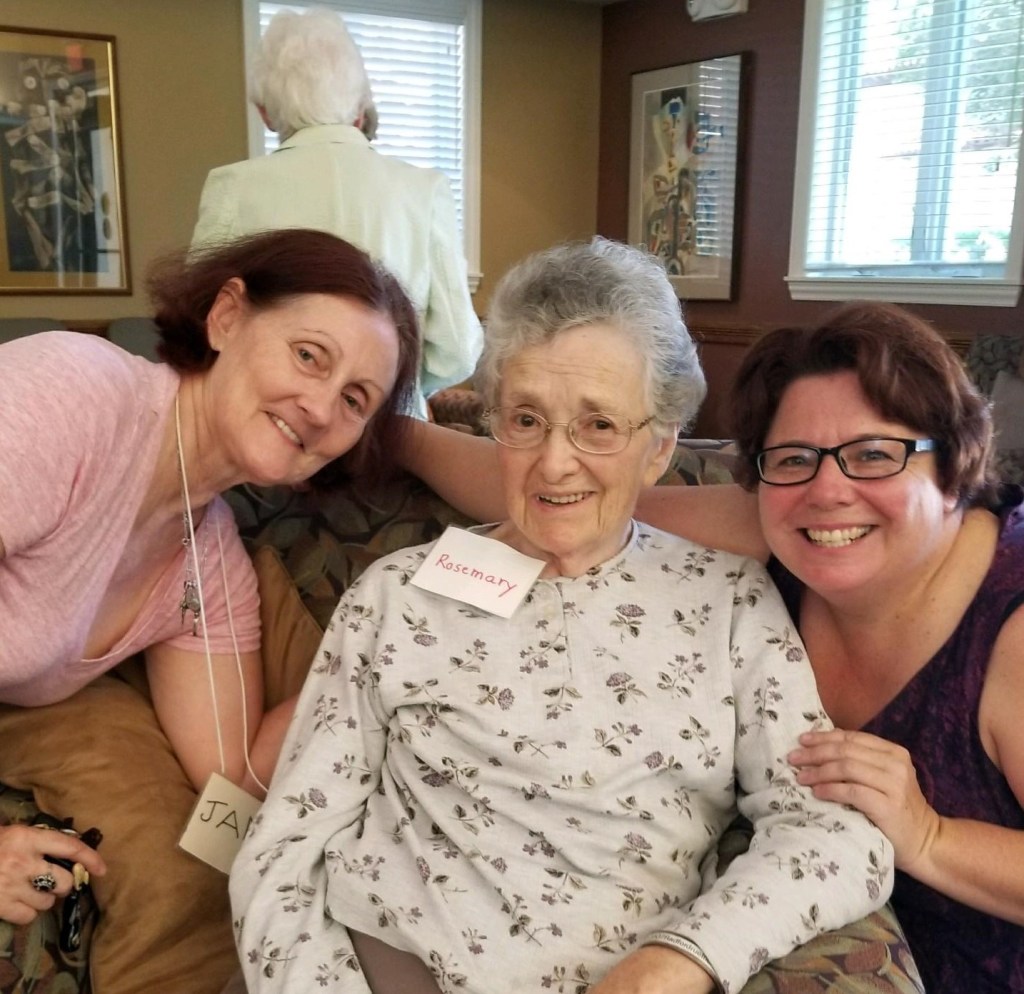
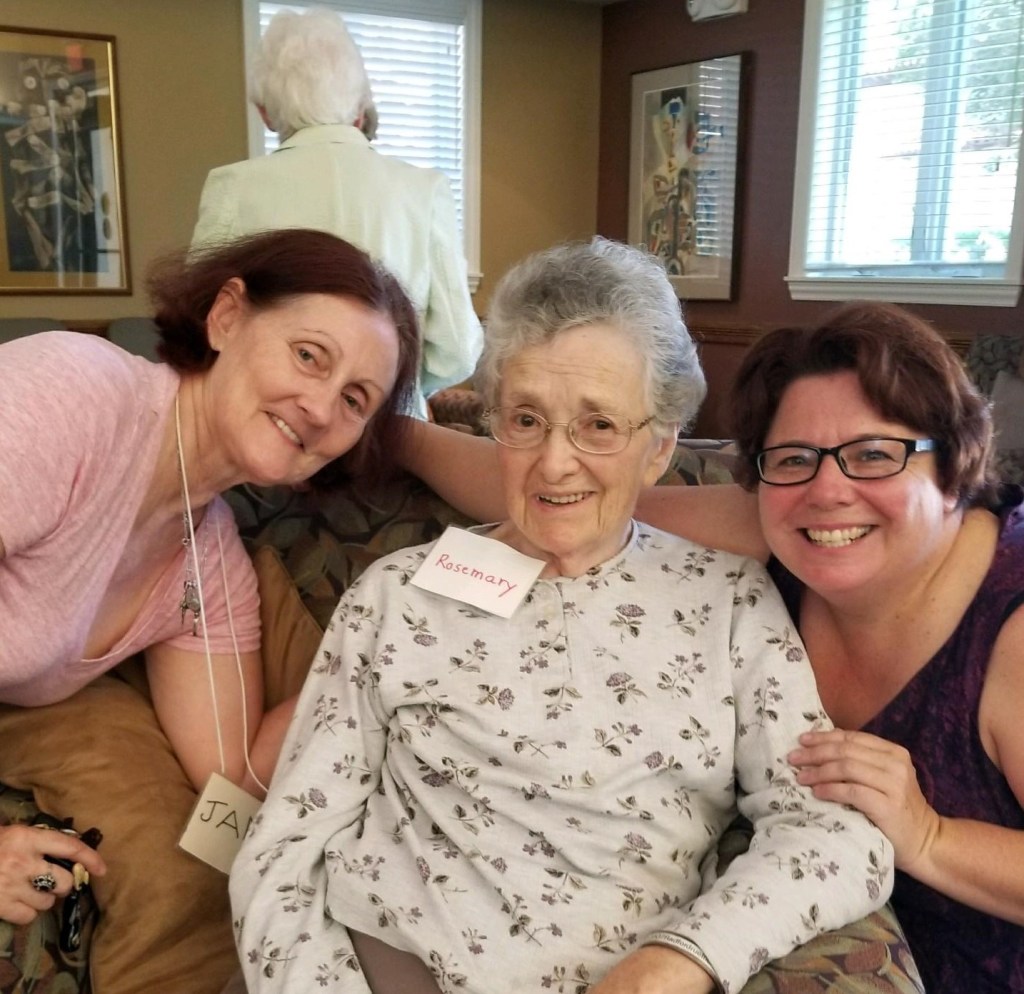
Janice, Theresa with Rosemary

Almost five years ago, Rosemary Radford Ruether suffered a devastating stroke that left her partially paralyzed and no longer able to speak or write, activities that were integral to her life as a writer, teacher, activist, and scholar. During her difficult last years Janice and I learned new ways of engaging her that were academically stimulating and fulfilling for her. We became advocates for her during her disability as she had been an advocate for us. Thus, out of pain grew blessings.

Janice and I dedicate and share with you these two short reflections that reflect our struggle to find our way without her. We know there will be many more reflections composed and shared by others whom she mentored, influenced and touched. Now—in the midst of our grief and sadness at her loss—we offer our personal memories of how she enriched our lives every day until she passed from our midst at 2pm, on Saturday, May 21, 2022.

Continue reading “Remembering Rosemary Part 2 by Janice L. Poss and Theresa A. Yugar”

Remembering Rosemary Part 1 by Janice L. Poss and Theresa A. Yugar

Editor’s Note: A more formal memorial to Catholic Feminist Theologian Rosemary Radford Ruether was posted here at Feminism and Religion at the time of her passing. Now we are delighted to share these memories of her by two scholars, Theresa A Yugar and Janice L. Poss, who knew her well, especially in her last months. Therese’s reflection was posted yesterday and Janice’s is below. As Janice notes in her post, “More than any deep theological concept, doctrinal exegesis, or other hyper-scholarly thought, she taught me simply by being who she was – a woman – and she gave me the ultimate gift, the gift of herself.” Through these posts, Theresa and Janice pass on some of Rosemary’s wise and caring gifts to our FAR readers.

Janice L. Poss, Rosemary and Theresa A. Yuger

She’s gone, but not forgotten. She is there, presence felt. The Spirit, as they say, works in mysterious ways. I knew about Rosemary for several years after attending two presentations  on feminist topics that she gave at Loyola Marymount University in 2005 and 2008. In 2006, I also recall hearing about her while organizing the first Roman Catholic Women Priests (RCWP) Mass in Los Angeles. Once I entered Claremont Graduate University as a Ph.D. student I heard quite a bit about her because my colleague and friend, Theresa Yugar, mentored me through orientation until she graduated. Occasionally I would see Theresa and Rosemary at Pilgrim Place when I attended Women Church Services. Although Rosemary was still teaching one class a semester, I could never attend because I was working full-time.

Continue reading “Remembering Rosemary Part 1 by Janice L. Poss and Theresa A. Yugar”

In Memoriam: Rosemary Radford Ruether by Elizabeth Ann Bartlett

Yet another of my great feminist and spiritual teachers has died.  Rosemary Radford Ruether, ecofeminist Catholic theologian, died on May 21st.  Her work challenged my thinking and gave me new understandings and perspectives. She was a prolific writer, authoring hundreds of articles and 36 books, and was the quintessential scholar and historian of world religions and ecofeminist thought and theologies. A scholar of the scholastics, she examined the three strains of Western thought: the Hebraic tradition; Platonic-Gnostic; and Pauline-Augustinian in all their complexities to develop an understanding of the nature of Western thought and its implications for the domination of women, nature, and colonized others. As she described her own approach, she drew out the contradictions and complexities in these theologies, careful “to see both negative and positive aspects . . . and to be skeptical of exclusivist views on either side.”[i] Her thought and writing was ever-expanding, and always striving “to see the dominant system of patriarchy, including its racism, classism, and colonialism, in critical perspective,” and to put herself “in places where in solidarity with its victims, I can see it from its underside.”[ii]To this end, she brought together the ecofeminist theologies of women from around the globe, particularly the global south.[iii] Her thought also grew to include critiques of militarism and corporate globalization.  Needless to say, I cannot begin to encompass all of her contributions here. So I will focus on the ways her thought has most deeply influenced and inspired my own, as well as my students’.

Continue reading “In Memoriam: Rosemary Radford Ruether by Elizabeth Ann Bartlett”

Hearing Grief by Xochitl Alvizo

I was writing this blog post on the same day that Rosemary Radford Ruether died, receiving the news during my writing process. The timing of that still has me feeling something I cannot yet express…

One of the most meaningful concepts I learned very early on from my education in feminist theology was “hearing to speech,” from Nelle Morton. I have written about this before, sharing that at times when I have struggled with my academic writing, I try to imagine that I am writing to my peer group, which helps open the path because not only are they a trusted circle of friends that I know loves me deeply, but they are friends who hear me into speech (and in that way, to writing, as well).

Nelle Morton coined this feminist principle of “hearing to speech.” [1] Morton’s new understanding of hearing and speaking came to her while she was with a group of women who gathered to tell their stories. As one woman shared her story – a story which at times reached points of excruciating pain – no one moved or interrupted, everyone seemed to be holding their breath. At the end, when the woman finally finished, she said, “You heard me. You heard me all the way – I have the strange feeling you heard me before I started. You heard me to my own story.”

Continue reading “Hearing Grief by Xochitl Alvizo”

Feminist Interpretations by Elise Edwards

Elise EdwardsI’ve written a few posts recently referencing biblical themes or stories. I’m not a biblical studies scholar; I’m an ethicist and theologian. So I know that ways I use the texts disturb some people who study them from a historical or biblical studies perspective. To say I don’t use the Bible as those scholars do, though, doesn’t mean I don’t have a disciplined approach. I aim to apply a consistent approach to scripture and to encourage my students to do the same.

I get really annoyed when someone proclaims a variation of “The Bible says it; I believe it; that settles it!” in moral debates. Obviously, people within a religious tradition are going to believe there is truth in the scriptures of their tradition. That’s simply how scripture functions. So I’m okay with “I believe it.” I have a problem with the two other parts of the statement – the Bible says it, and that settles it. The assertion that “the Bible says it” masks the task of interpretation that anyone encountering a text takes on. The statement “that settles it,” when adopted in moral debate, rejects the accountability and humility in sharing our interpretations with others. Continue reading “Feminist Interpretations by Elise Edwards”

Writing: Changing the World and Ourselves. By Ivy Helman

I still remember the first tim20140903_180423e I read Mary Daly’s Gyn/Ecology. It awoke something within me. Her use of language, the power of her writing and the ease with which she created new words taught me so much about the world around me and about the way the language, and subsequently its use in writing, shapes lives, choices, abilities and destinies. She also taught me about myself.

I was hooked, but not just on Mary Daly. Shortly after I finished her book, I moved onto other feminists writing about religion like Katie Cannon, Judith Plaskow, Alice Walker, Carol Christ, Rita Gross, Gloria Anzaldua, Audre Lorde, Adrienne Rich, Margaret Farley and Starhawk to name just a few. All of them, in fact every feminist I’ve ever read, has shown me the way in which words have power and how words speak truth to power. Ever since, I’ve wanted to be the kind of writer whose words carry a power that not only affects people but also inspires a more just, more equal, more compassionate and more humane world. In other words, I wanted to be a writer activist.

Yet, I’ve always carried around with me a sneaky suspicion that people don’t consider writers true activists. If you aren’t holding a sign, screaming or participating in some sort of public demonstration or civil disobedience, then you have no right to call yourself an activist. Is that really true? Continue reading “Writing: Changing the World and Ourselves. By Ivy Helman”

Rosemary Radford Ruether’s Quests for Hope and Meaning by Gina Messina-Dysert

Gina Messina-Dysert profileRosemary Radford Ruether is one of the most brilliant theologians of our time and her newly released autobiography, My Quest for Hope and Meaning, is a gift to those of us who have been so touched by her work.  In this intimate and beautiful piece, Ruether shares her personal journey in feminist scholarship and activism.  The autobiography opens with a profound forward by Renny Golden (that is also shared here on Feminism and Religion) and continues with an introduction and six chapters where Ruether guides us through an exploration of the influence of the matriarchs in her life, her interactions with Catholicism, her continued exploration of interfaith relations, her family’s struggle with mental illness, and her commitment to ecofeminist responses to the ecological crisis.

Ruether states that “Humans are hope and meaning creators” (xii), and her autobiography details her own quests for hope and meaning.  She reflects on the incredible impact made by the female-centered patterns in family and community in her life.  According to Ruether, these “matricentric enclaves” grounded and shaped her interest in feminist theory and women’s history.  She also describes the spiritually and intellectually serious Catholicism that she received from her mother and articulates her continued frustration with Vatican leadership that has undermined the efforts of Vatican II.   For Ruether, her ongoing affiliation with feminist theological circles is crucial as she continues to work toward shaping an ecumenical and interfaith Catholicism.

Continue reading “Rosemary Radford Ruether’s Quests for Hope and Meaning by Gina Messina-Dysert”