We live in a very small and connected world that at the same time is a very large and disparate one. Sometimes I am overwhelmed by all the news available of the things that occur all over the world, to which I have such quick and easy access online. It makes everything feel so close and connected. At the same time, I also experience a huge disconnect between my very particular and local context and that of others around the globe; women whose reality and life experience I know little about. Even as news about them flash before my eyes, it’s not possible to reduce them to those brief flashes of information or claim to know something substantive about them. In reality, how much am I even able to say about the woman who lives across the street from me, much less women who I only know about online? And yet, my feminism compels me to call them my sisters.
Category: Sisterhood
Hidden Meanings in the Rituals of the Assumption by Carol P. Christ
“[T]he Old European sacred images and symbols were never totally uprooted; these persistent features in human history were too deeply implanted in the psyche. They could have disappeared only with the total extermination of the female population.” Marija Gimbutas, The Language of the Goddess, 318.
August 15 is known to Greek Christians as the date of the Koimisi, “Falling Asleep” or Dormition of the Panagia, She Who Is All Holy. December 25 is a minor holiday in the Orthodox tradition, while Easter and August 15 are major festivals. The mysteries of Easter and August 15 concern the relation of life and death. In Orthodox theology, both Easter and August 15 teach that death is overcome: Jesus dies and is resurrected; Mary falls asleep and is assumed into heaven. These mysteries contain the promise that death is not the final end of human life. Yet this may not be the meaning of the rituals for many of those who participate in them.
In Christus Victor, Gustaf Aulen argued that Eastern (Orthodox) and Western (Catholic and Protestant) traditions understood salvation differently. The Western Church focuses on salvation from sin, while the Eastern Church focuses on transcending death. This contrast is not absolute, as for the Western Church sin is the cause of death and when sin is overcome, immortal life is restored. While Orthodoxy has strong ascetic and monastic traditions, it does not teach ordinary Christians to focus on sexual purity and impurity as Western traditions have done. Nor is there a strong emphasis on transforming collective sin in movements for social justice. Significantly, though Roman Catholics and others consistently refer to the “Virgin Mary,” Orthodox Christians prefer “Panagia,” She Who Is All Holy.
In Greece the ordinary rhythms of life are disrupted at Easter and in August. During lent, many women (and some men) fast, while in August women named Mary and Panagiota–as well as others who wish to honor or petition the Panagia–wear black for two weeks.
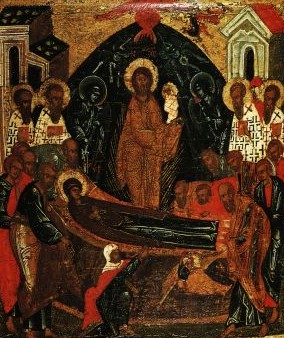
Throughout the first 2 weeks of August, Greek Christians focus on the death of the Panagia. According to theology, her Son appears after her death and “assumes” her into heaven. The Orthodox icon depicts Mary surrounded by the Apostles, while Jesus holds the assumed body of Mary depicted as an infant wrapped in swadling clothes.
When she first saw this icon, my friend Naomi Goldenberg commented that it is an example of the widespread attempt on the part of men to appropriate the power to give birth. The icon reverses the symbolism of the nativity where the baby wrapped in swadling clothes is held in the hands of his mother. Christian baptism described as re-birth through the Father, Son, and Holy Spirit is another version of “male birth.” Continue reading “Hidden Meanings in the Rituals of the Assumption by Carol P. Christ”

Re-membering the Revolution by Xochitl Alvizo
This post includes information about a conference scheduled for next spring at Boston University: A Revolutionary Moment: Women’s Liberation in the late 1960s and early 1970s. The Call for Papers is due July 1st – just two days away!
I remember how Mary Daly used to ask me where the feminists were – what were they up to today? I would try to update her on the things I was aware of here in Boston, events at the Women’s Center in Cambridge, conferences by Women, Action, and the Media, the latest publication of Rain and Thunder: A Radical Feminist Journal of Activism and Discussion, and the myriad of things happening within feminist theology with which I was most familiar. Nonetheless, Mary was never satisfied with my responses, “Where is the revolution?” she would ask. At the time, I didn’t quite understand her disappointment. I could tell she wanted me to update her on something big – she wanted to hear of sweeping changes, lots of them. I often thought that the changes were already there, that big things had taken place and were incorporated into the daily life of society. I was always vexed that I couldn’t give her the answer she was looking for – but also, I didn’t know exactly what she was looking for. Then one day she asked me to find her a book that was on one of her shelves – she didn’t know which shelf – so I went searching, and in that search I discovered a world that gave me a glimpse of the revolution Mary wanted and I understood a little bit more why Mary was dissatisfied with feminism today. Continue reading “Re-membering the Revolution by Xochitl Alvizo”
Emergence and the Spirituality of the Sacred Feminine by Anne Kathleen McLaughlin

Kathleen and Marie are friends who met at the event in Canada that inspired this post. Marie has given her monthly spot on Feminism and Religion to Kathleen so she can share her reflection with you.
Emergence: the universe flares forth out of darkness, creating, over billions of years, through trial and error and trying again, astounding newness: carbon for life in the middle of a star…. the birth of planets, our earth holding what is required for life to emerge…. the creation of water from hydrogen and oxygen….the emergence of a cell with a nucleus.
Each of these seemingly impossible happenings did happen, offering us humans the hope that the impossible tasks confronting us in our time can be creatively addressed, showing us, as Brian Swimme expressed it, a domain of the possible beyond imagination. Our human endeavour has been powered by non-renewable energy resources. Our task now is to reinvent the major forms of human presence on the planet in agriculture, architecture, education, economics…. We need to align ourselves with the powers of the universe, consciously assisting, amplifying, accelerating the process of creative endeavour. Continue reading “Emergence and the Spirituality of the Sacred Feminine by Anne Kathleen McLaughlin”
Three Sisters by Deanne Quarrie
From time to time I dive into the idea of seeing the Triple Goddess as Sisters rather than Mother, Maiden, Crone. I have to confess that the idea of Sister Goddesses, complete in their familial connectedness, representing unity, connection, and interdependency, is very appealing. We, who practice Goddess Spirituality, strive in our relationships to reflect this in our work together. Shared power!
If I were to look at the sisterhoods individually, I enjoy the Ananke and the Moirae from Greek mythology. I like them because they represent a balance. One side setting the standards and the other, enforcing them! A perfect example of the laws of cause and effect! Continue reading “Three Sisters by Deanne Quarrie”
Like Rain on Dry Land by Marcia Bedard
When first I moved to a rural mountain community near Yosemite, I was spiritually parched, and my soul felt dry as a bone. Desperate for the rich conversations of my sisters, after taking an early retirement from the CSU Fresno Women’s Studies Program, I had an intuitive sense that I might find some like-minded women friends in a small group that met weekly at our local church, led by Diana, our courageously and outrageously feminist pastor, who has since moved on to what I hope are friendlier communities for feminist pastors.
If PFLAG, and similar marginalized groups, had found an oasis there, in what was called (in order to please the church fathers) a Women’s Bible Study Group, so could I. A year before, this would have been my last choice of groups to join, but in a town where fundamentalist churches thrived, and Starbucks was the only place you could find a copy of literature as subversive as The New York Times, it was my only choice. It was in the church basement, amidst a thinly disguised knitting/bible study group, that we gathered weekly to receive what turned out to be a truly holy (meaning wholly) communion of spirit, enriched by various reading that Diana generously shared with us. Continue reading “Like Rain on Dry Land by Marcia Bedard”
Why a Goddess Pilgrimage? by Carol P. Christ
What is a Goddess Pilgrimage and why are so many US, Canadian, and Australian women making pilgrimages to ancient holy places in Europe and Asia? The simple answer is that women are seeking to connect themselves to sources of female spiritual power that they do not find at home.
Traditionally pilgrims leave home in order to journey to a place associated with spiritual power. “Leaving home” means leaving familiar physical spaces, interrupting the routines of work and daily life, and leaving friends and family behind. For the pilgrim, “home” is a place that has provided both comfort and a degree of discomfort that provokes the desire to embark on a journey. The space of pilgrimage is a “liminal” or threshold space in which the supports systems of ordinary life are suspended, as Victor Turner said. A pilgrim chooses to leave the familiar behind in order to open herself to the unfamiliar—in hopes that she will return with new insight into the meaning of her life. Continue reading “Why a Goddess Pilgrimage? by Carol P. Christ”
The Solace of Another Woman’s Story by Yvonne Augustine
This week, I read an excellent, gripping, poignant blog post by Feminist Philosopher Leanne Dedrick entitled “Things That Make Me Cry: The Practice of Unbelief.” The purpose of the piece was Leanne’s desire to address a misperception by some non-atheists that atheists are devoid of emotion, violently hostile to anything associated with faith, and unable to deal honestly with the Divine. She also corrects the erroneous assumption that atheists seek to “hide from, or purposefully turn […] away from, the ‘saving grace’ of religion.” In the post, she wrote specifically about her own journey from ultra-conservative Christianity to atheism. Continue reading “The Solace of Another Woman’s Story by Yvonne Augustine”