A Personal Journey of Embodiment by Stacia Guzzo

My struggle and fascination with the subject of embodiment began at a young age. Perhaps my first sense of the nuances of being an embodied being began with the realization that my younger brother was considered “different” as a result of being born microcephalic (having an abnormally small head and brain) and therefore having lifelong developmental delay. I remember wondering: How is it that the body can work so perfectly sometimes and yet have so many complications other times? What had happened to make his development so starkly contrast my own? And why can’t it fix itself?

As a high school student, my struggle manifested in the forms of anorexia and bulimia. The anorexia came first, and began almost as if a switch had been thrown. I dieted severely and dropped 60 pounds in a little under 3 months, in the end making it a goal to lose a pound a day. My cheeks sunk in. I slept through lunch. I found little occasion to laugh. And still I could not see an ounce of beauty or satisfaction when I looked at my body. I poked at the jutting bones of my pelvis and wished my bones were smaller. I saw my body as a devious enemy. During my junior year, I became bulimic as a means of coping with increasing pressures by family and friends to eat. Continue reading “A Personal Journey of Embodiment by Stacia Guzzo”

Songs We Sing By Barbara Ardinger

Even though I’m a spiritual feminist—and a pretty cranky one—I like the old familiar Christmas carols. I’m listening to a CD of Christmas songs in my car. One of the songs on the CD has the line, “God is watching us from a distance.”

There’s a reason Plato banned music from the Republic. Music gets into our heads and it stays there. Not only the tune and the rhythm, but the lyrics, too. So what idea does this song plant in our heads? God is out there. Watching us like we’re being baby-sat From a distance. So if we should happen to fall down, maybe he’s only watching and he doesn’t have long-enough arms to reach down and pick us up.

Passive watching is a key difference, of course, between the standard-brand religions (also called the religions of the book) and the Goddess religion. They’ve got a transcendent god somewhere up in heaven, up in outer space, up on the mountain, sitting up in the judge’s throne. Keeping an eye on us so if we misbehave, he can slam some thunderbolts down at us. Continue reading “Songs We Sing By Barbara Ardinger”

The Dark Half: Reflections on the Winter Solstice By Xochitl Alvizo

Photo by Chris Pinkham

I’m a Capricorn. People seem not to be surprised when they find out. I’m also the oldest of three siblings and a keeper of people’s secrets. Stories and secrets – my family’s included – I hear them all, take them all in. Sometimes someone will share something with me that involves another and afterward say, Now, don’t you go telling so and so that I said this. And of course I always reply, I don’t tell no one nothin’. And it’s true, I don’t tell – I simply take it in. I listen and I take it all in. The stories shared, stories of joy and of love, excitement and disappointment, of hurt feelings and misunderstandings, all of them inform me. They all cause me to reflect and consider the fragility of us all, the precariousness of life. We affect each other so much, from the smallest moment to the largest system, all of it makes such a difference to us.

Tonight we celebrate the Winter Solstice – it marks the boundary of darkness and light – it is the shortest day and longest night of the year.  Continue reading “The Dark Half: Reflections on the Winter Solstice By Xochitl Alvizo”

The Paradoxical Perception of Midwifery in American Culture By Stacia Guzzo

This past Sunday night, midwife Robin Lim was named CNN Hero of the Year at a formal award ceremony in Los Angeles, California. The award, which was given after eleven weeks of public voting on CNN.com, came with $250,000 to support Lim’s quest to provide quality prenatal, labor, birth, and postpartum care for the poor and underserved in Indonesia.  She accepted the award amidst a standing ovation, and closed her words of acceptance by simply saying: “Every mother counts. And health care is a human right.”

The recognition of Lim—or Ibu (“Mother”) Robin, as she is called by those whom she serves— is well-deserved.  An American woman, Lim provides midwifery care at the Bumi Sehat clinics which she helped to establish. Each year, she helps thousands of Indonesian women get care and attention during their pregnancies and the births of their children.  She began her work in 1994, seeing pregnant women and children under five for free out of her home. As her reputation spread, supporters of Lim, along with local business and community leaders, helped to advance her cause. Today, the village-based Bumi Sehat clinics are located in both Bali and Aceh. They provide free prenatal and birthing care as well as breastfeeding support to any woman who needs it, regardless of her ability to afford it.  Ibu Robin’s words to CNN reflect that her commitment to her cause is an altruistic one: “”Every baby’s first breath on Earth could be one of peace and love. Every mother should be healthy and strong. Every birth could be safe and loving.” Continue reading “The Paradoxical Perception of Midwifery in American Culture By Stacia Guzzo”

God As Seductress: The Call of Nature By Stacia Guzzo

When my husband and I decided to move out of the city, we knew what we wanted as an alternative.

We wanted land. Land to grow things, to raise animals, to build upon, to tend. We wanted blisters on our hands and calluses on our feet. We wanted to taste our sweat, feel our muscles burn, and then relax with some homemade beer in front of a roaring fire at the end of a long day. We wanted to harvest honey, gather eggs, spin fiber, and split wood. We wanted to raise sons and daughters to appreciate the sound of silence and the clarity of a night sky so clear that you can see the Milky Way in cold of winter. We wanted to be in community with other fellow homesteaders, sharing ideas and breaking freshly baked bread together. These were all things that had only been dreams when living in a cramped, rented apartment with little sun and neighbors who ducked into their houses before anyone could mumble a friendly hello.

And thus was the way that Mother Nature courted us. Her sensual beckoning drove us mad with desire and frustrated with impatience. She danced slightly out of our reach, ducking behind obstacles like home loan approvals and darting in and out of practicalities like job security and worries over distance from loved ones. Ah, she was a sly one, that Mother Nature. Her siren song was irresistible, and eventually, we bent beneath the strain. Continue reading “God As Seductress: The Call of Nature By Stacia Guzzo”

LGBT Saints: Feminism Leads to a Queer Theology of Sainthood By Kittredge Cherry

Kittredge Cherry

The following is a guest post written by Rev. Kittredge Cherry, lesbian Christian author and art historian who blogs about LGBT spirituality and the arts at the Jesus in Love Blog.  Her books include “Equal Rites” and “Art That Dares: Gay Jesus, Woman Christ, and More“.

Feminists have criticized saints as top-down tools of the dominant morality, but as a lesbian Christian I find that sometimes the opposite is true.  The desire for saints rises from the grassroots, and LGBT saints can shake up the status quo.  Feminist theology is helping me in a quest for new models of sainthood that lead to LGBT and queer saints.  The LGBT saints attract people with the quality of their love.  They show us not only THEIR place in history, but also OUR place — because we are all saints who are meant to embody love. Continue reading “LGBT Saints: Feminism Leads to a Queer Theology of Sainthood By Kittredge Cherry”

A Spirit of Competition By Elise M. Edwards

Elise M. Edwards is a Ph.D. candidate in Theology, Ethics, and Culture at Claremont Graduate University and registered architect in the State of Florida.  She does interdisciplinary work in the fields of theology, ethics, and aesthetics, examining how they inform and shape each other and express the commitments of their communities.

“You should watch this.  It’s inspiring,” my sister said to me about Born to Dance: Laurieann Gibson, the dance competition show on BET.  So I watched. And I loved it.  I can’t remember watching any other reality show–especially a competition-based one- that left me with such a sense of the spirituality of its star.

Laurieann Gibson fulfills many roles on Born to Dance: host, mentor, judge, and executive producer.  Laurieann is a respected dancer and choreographer.  TV viewers may remember her from MTV’s Making the Band franchise, in which she trained members of Dannity Kane in dance and sometimes clashed with P. Diddy, the star and producer of that show.  In this show that features her name, we learn more about her approach to dance and to life.  On Born to Dance, we see the same drive and demanding ethic that she displayed in other shows, but we also see her spirituality.  She says grace before eating dinner with the contestants.  She speaks of God and gifts.  And most surprisingly, she prays in Jesus’ name before very elimination.   These prayers are for the contestants that will be eliminated, that they may continue to grow in confidence and belief in their dreams to become dancers, and that they may have many opportunities and paths in the future to do so.     Continue reading “A Spirit of Competition By Elise M. Edwards”

Mary’s Feast Rooted in Lesbian Goddesses Diana and Artemis By Kittredge Cherry

Kittredge Cherry

The following is a guest post written by Rev. Kittredge Cherry, lesbian Christian author and art historian who blogs about LGBT spirituality and the arts at the Jesus in Love Blog.  Her books include “Equal Rites” and “Art That Dares: Gay Jesus, Woman Christ, and More“.

August 15 was once the festival of the lesbian goddess Diana (Artemis), but it has been adapted into a feast day for the Virgin Mary.

Midsummer feasts have celebrated the divine feminine on this date since before the time of Christ.  Now devoted to Mary, August 15 carries the torch of lesbian spiritual power to a new generation.

Saint Mary, mother of Jesus, is honored by churches today in a major feast day marking her death and entrance into heaven.  Catholic and Orthodox churches call it the Feast of the Assumption or Dormition, when Mary was assumed into heaven, body and soul.

The Virgin Mary’s holiday was adapted — some would say appropriated — from an ancient Roman festival for Diana, the virgin goddess of the moon and the hunt.  Diana, or Artemis in Greek, is sometimes called a lesbian goddess because of her love for woman and her vow never to marry a man.  The ancient Roman Festival of Torches (Nemoralia) was held from Aug. 13-15 as Diana’s chief festival. Continue reading “Mary’s Feast Rooted in Lesbian Goddesses Diana and Artemis By Kittredge Cherry”

Artemisia Gentileschi: Baroque artist and rape survivor painted strong Biblical women, By Kittredge Cherry

Kittredge Cherry

The following is a guest post written by Rev. Kittredge Cherry, lesbian Christian author and art historian who blogs about LGBT spirituality and the arts at the Jesus in Love Blog.  Her books include “Equal Rites” and “Art That Dares: Gay Jesus, Woman Christ, and More“.

Originally posted at Jesus in Love.

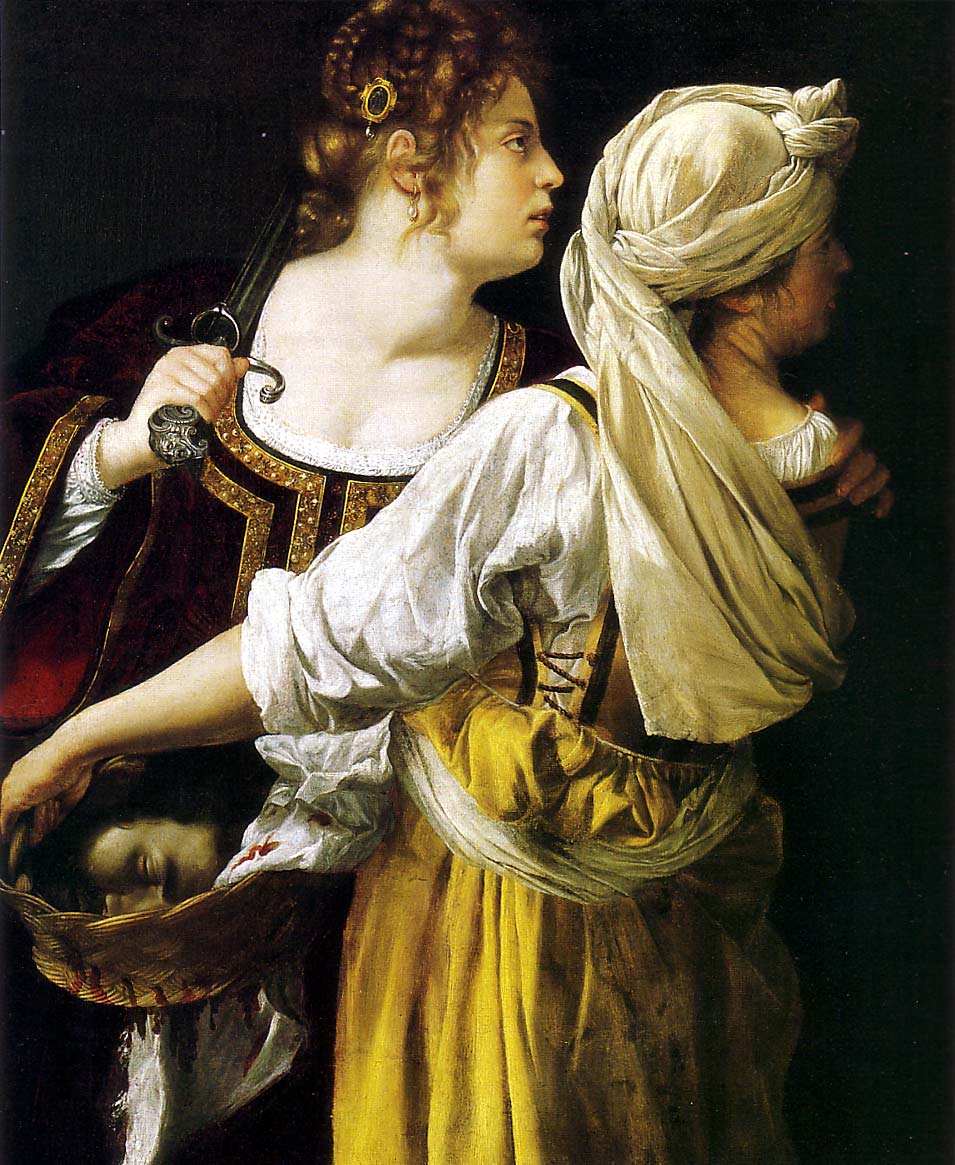
Baroque artist Artemisia Gentileschi inspires many with her paintings of strong Biblical women — created despite the discrimination and sexual violence that she faced as a woman in 17th-century Italy.

Gentileschi (1593–1652) was successful in her own day, but was mostly written out of art history until the 1970s, when feminist scholars rediscovered her work. Now she is celebrated in many books, films and plays, and her work is widely reproduced. Her greatest paintings include “Judith Beheading Holofernes” and “Susanna and the Elders.”

Many women and queer people can relate to her battles against prejudice and sexual violence, documented in her rape trial in 1612. She could be considered the patron saint of women artists.

"Judith and Her Maidservant" by Artemisia Gentileschi

Although Gentileschi was apparently heterosexual, lesbians have drawn energy from her life and art.

Lesbians who have created tributes to Gentileschi include painter Becki Jayne Harrelson and playwright Carolyn Gage. In the play “Artemisia and Hildegard,” Gage has two of history’s great women artists debate their contrasting survival strategies: Gentileschi battled to achieve in the male-dominated art world while Hildegard of Bingen found support for her art in the women-only community of a medieval German nunnery.

The daughter of a painter, Gentileschi was born in Rome and trained as a painter in her father’s workshop there. She was refused admission to the art academy because she was a woman, so her father arranged for her to have a private painting teacher — who raped her when she was about 19. Gentileschi herself was tortured by thumbscrews during the seven-month rape trial, but she stuck to her testimony. The teacher was convicted, but received a suspended sentence. Continue reading “Artemisia Gentileschi: Baroque artist and rape survivor painted strong Biblical women, By Kittredge Cherry”

On the Murders in Norway: The Need for a Multicultural Vision By Starhawk

The following is a guest post written by Starhawk, lifelong activist in peace and global justice movements, a leader in the feminist and earth-based spirituality movements, and author or coauthor of ten books, including The Spiral Dance, The Fifth Sacred Thing, Webs of Power: Notes from the Global Uprising, and her latest, The Last Wild Witch.

Cross posted at Dirt Worship.

This summer has been a whirlwind of teaching permaculture and working on making a movie from my novel, The Fifth Sacred Thing.  But a few days ago I took a break to attend a performance of Guys and Dolls put on by SF Arts Education, in which my fifteen-year old Goddess-child Kore was singing and dancing. SF Arts Ed runs a wonderful program where students from middle schools and high schools put on Broadway musicals, complete with singing, dancing, and a full jazz orchestra.  We had balcony seats behind the stage, so I was looking down on these bright and beautiful young people of all different backgrounds and ancestry, reflecting the multicultural nature of San Francisco itself.   They are a talented bunch, but I also know how hard they work, how much time they rehearse and the discipline they develop.  What a gift it is to have such wonderful youth growing up in our city! Continue reading “On the Murders in Norway: The Need for a Multicultural Vision By Starhawk”