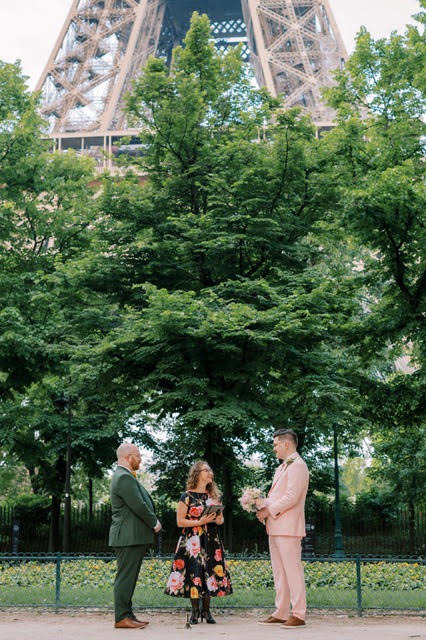
Veiled by Michelle Wahila

Photos by Paige Gribb Photography
 https://paigegribbphotography.com/

Springtime in Paris brings the magnificence of cherry blossoms, the scent of sweet crêpes, and an influx of tourists eager to capture their own moment of passion on the cobblestone streets of the world’s most romantic city. I may be biased because Paris is my home, but there’s no denying its magic. With its art, history, cuisine, fashion, and architecture, the city offers extraordinary experiences. It’s no wonder so many couples choose to marry in the City of Light.

Years ago, when I entered the wedding industry, I did so reluctantly, only after leaving the one profession I had ever known – ministry. What I didn’t expect was that I would become a bridge for couples navigating the ever-widening gap between love and institutional religion. The so-called “rules” of tradition are often mislabeled as matters of faith but are more accurately named as remnants of the heteropatriarchy. They place enormous pressure on engaged couples. It’s no surprise that many of the eloping couples I meet in Paris have chosen their path simply because it is less stressful than trying to appease tradition, religion, family, or friends (or all of the above).

Continue reading “Veiled by Michelle Wahila”

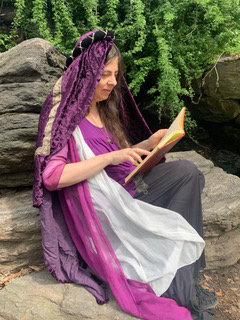
An Omer Calendar of Biblical Women by Jill Hammer

Jill as the prophetess Huldah

Right before Passover every year, my wife and I visit a botanical garden to look at the spring flowers: daffodils, tulips, cherry and apple blossoms, magnolia.   One year, in 2004 or so, we were on our way there when I had an idea. I grabbed a pen and started scribbling long lists of biblical women.

“What are you doing?” my wife asked.

“Making an Omer Calendar,” I said. 

Since biblical times, there is a Jewish practice of counting the forty-nine days between the holiday of Passover (the barley harvest and festival of freedom) and the holiday of Shavuot (the first fruits festival and the season of receiving Torah).  These forty-nine days were the time of the barley and wheat harvest and were a fraught time for biblical farmers.  According to the Talmud, each day of the Omer must be counted along with a blessing.  One must count consecutively each day (usually in the evening) and one loses the right to say the blessing if one misses a full day of the count.  The Omer is often understood as a time of semi-mourning because of plagues said to occur during this time, but it is also a joyful season when nature’s abundance is at the forefront.  This seven-week period embodies both fear that the harvest will be damaged and gratitude for the harvest.

Continue reading “An Omer Calendar of Biblical Women by Jill Hammer”

Sacred Secrets: The Legacy of Women’s Wisdom Across Generations by Rabbi Nadya Gross

From my earliest memories, I saw things that others didn’t see and knew things I had no business knowing. But at the time, I didn’t realize that others didn’t witness the dance of light around their bodies or the life forms at the base of trees. I didn’t know that the insights I had into people’s emotions were not universally shared. My curiosity led me to ask questions about these things… until my grandmother, Savta (Heb), took me into the kitchen (where everything important happened), closed the doors, and told me never to talk about these things with anyone except her. And so, my training began.

Savta was gifted in ways different from mine. She had grown up in a circle of women and their daughters, a circle where women educated each other, shared their unique gifts and insights, and passed down a legacy of wisdom.

The wisdom she shared with me was as ancient as the land on which we lived. We began with reverence for the Earth and all her elements—pre-patriarchal Goddess wisdom. We explored what it means to be intimately connected to all aspects of Creation, understanding that we are interdependent. Harm to a tree, an insect, or the water harms us. We learned that the respect we wish to receive from others must first be shown by us. I learned to never pick up a beautiful stone that caught my attention without first asking permission to remove it from its resting place. When harvesting fruit from one of the many trees in my grandparent’ yard, I expressed deep gratitude to the mother-tree whose body nurtured that fruit to ripeness.

Continue reading “Sacred Secrets: The Legacy of Women’s Wisdom Across Generations by Rabbi Nadya Gross”

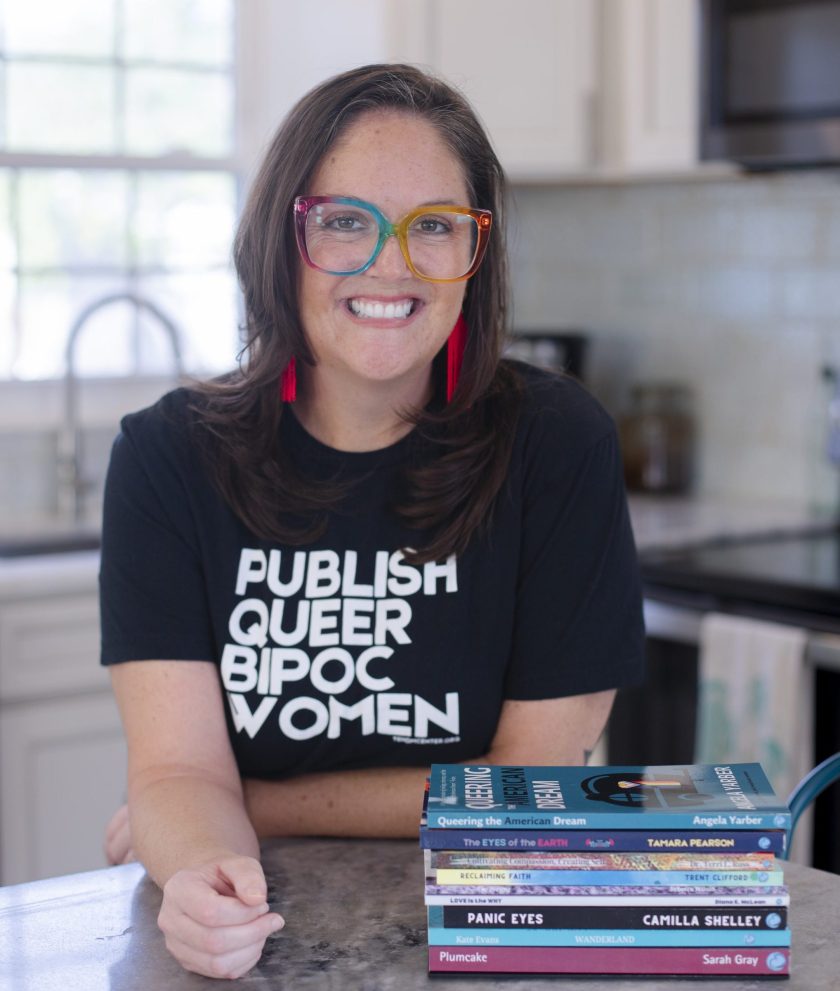
Preaching with a Predator in the First Pew by Angela Yarber

Seeing him in the first pew was distracting. Legs splayed in expert manspreading fashion, both arms draped unaware across either side of the backrest, belly protruding over a worn leather belt. He wasn’t a tall man, yet his sprawling body occupied nearly six feet of space. A slight smirk was always smeared across his lips and his eyes were fixed on me.

Preaching to a predator is never easy. So, while I could never imagine what it would be like to speak truth to power like Bishop Budde at the National Prayer Service, I’m confident that, like me, every clergywoman in America knows what it’s like for a pussy grabber to leer at you from the first pew. Even the finest vestments, highest clerical honors, and the divine herself cannot protect you from that.

Continue reading “Preaching with a Predator in the First Pew by Angela Yarber”

How the Nineteenth-Century Spiritualist Movement Gave Voice to American Women -Part One by Theresa Dintino

Moderator’s Note: This post is presented as part of FAR’s co-operation with The Nasty Women Writers Project, a site dedicated to highlighting and amplifying the voices and visions of powerful women. The site was founded by sisters Theresa and Maria Dintino.

Throughout history women have found power and position in spiritual communities. They have acted as leaders, priestesses, oracles, mediums, disciples, saints, preachers and more. And yet these roles and positions of power are often overlooked in the story of women, and the general story of humans.

Still today many women function as leaders in a variety of spiritual disciplines, yet they do not receive the attention, respect and clout that men in similar positions do. More often women who hold roles of power in spiritual communities are dismissed or discredited.

If their spiritual community is not considered a formally accepted religion where their position was bestowed to them by a man ranking above them, women spiritual leaders are often ignored. This marginalization goes unquestioned.

Continue reading “How the Nineteenth-Century Spiritualist Movement Gave Voice to American Women -Part One by Theresa Dintino”

A House for the Goddess by Annelinde Metzner

For the past few years I’ve been contributing to FAR as a poet.  So grateful for the opportunity to connect with you wise women!  This month I realize I should share with you another side of me, my music.

      On June 8th, I produced, directed and composed the music for “A House for the Goddess” in Asheville, North Carolina, featuring 29 performers including two sopranos, a cellist, myself and another pianist, two dancers, an MC and a women’s choir.  The concert, whose venue was offered generously by Land of the Sky United Church of Christ, was a sellout, and over three thousand dollars was raised for the Linda Norgrove Foundation for the women and children of Afghanistan (https://lindanorgrovefoundation.org.)

      My compositions, both choral pieces and solo art songs, always find their birth through the inspiration of poetry.  At this venue, the texts of the poetry were displayed on two screens overhead as the songs were sung.

Continue reading “A House for the Goddess by Annelinde Metzner”

Bible Believing Church Sign by Michelle Bodle

A dear colleague is retiring from ministry this year. As I often do at times of celebration, I think about the most meaningful conversations, questions, and impact that person has offered my life. As I was thinking of this colleague in particular, what came to mind was a statement that made to him that sparked a conversation that has been ongoing between us for almost a decade: “That church is not for me.”

            My friend talked about driving his motorcycle down a well-traveled highway and seeing church after church. If you know churches, you know that church signs can be anywhere from enjoyable to problematic. Some church signs try to convey witty messages, but they often miss the mark. Other times, a church speaks of its beliefs or current sermon series, using insider churchy language that does not hit with those whom the sign may be trying to reach in the first place. But church signs do exist for a purpose – to catch the eyes of travelers, which was undoubtedly the case with my colleague. 

            “I was driving down this road, and the sign that caught my attention said, ‘Bible Believing Church,’ and I’ve been thinking about that repeatedly,” he stated. I replied that I didn’t need to think about that sign; I knew exactly what it was trying to convey—that I was not welcome there. 

Continue reading “Bible Believing Church Sign by Michelle Bodle”

Life-Giving Blood by Michelle Bodle

“What did you think?” This question was posed to me by a young woman I am mentoring in ministry. After receiving The Book of Womanhood by Amy Davis Abdallah as a gift, she asked me to walk through the book and discuss it with her, as suggested in the introduction. 

            I inhaled deeply before replying that I thought Davis Abdallah was writing from a posture of privilege that she was completely unaware of – and that deeply troubled me.

            Davis Abdallah’s premise is that Christian women need a rite of passage accompanying the journey of getting to know themselves. Piloted at the former Nyack College where Davis Abdallah taught, Woman was a program that sought to develop a Christian right of passage for women focused on relationships with God, self, others, and creation. 

Continue reading “Life-Giving Blood by Michelle Bodle”

Genuine Inclusivity Means Rejecting “Comparative Suffering” by Dr. Hadia Mubarak

Moderator’s Note: Part 1 was posted yesterday. You can read it here.

Rejecting the notion of “comparative suffering” is critical for those who are committed to the work of social justice, human rights, and antiracism. There is no Guinness world record for “human suffering” for which groups or individuals need to vie to outrank one another. The human capacity to empathize with one people’s suffering does not diminish our capacity to empathize with another group’s suffering, even when those respective groups are at war with one another.

On March 26, I began my talk on a women’s panel titled, “Global Women Speak,” for Mount Saint Mary University with this reminder. Before I could speak about the humanitarian challenges facing Palestinian women in Gaza today, I felt compelled to make this argument due to my experience six days earlier at another women’s interfaith panel. In this previous panel, a co-panelist rudely cut me off four times within a span of one minute when I began to address Palestinian suffering, although she had already addressed Israel’s current challenges in response to a question that we were all asked. For several days following this jarring experience, I kept wondering, what felt so threatening to this co-panelist about the stories of Palestinian suffering that she felt compelled to shut it down?

Continue reading “Genuine Inclusivity Means Rejecting “Comparative Suffering” by Dr. Hadia Mubarak”

The Policing of Muslim Women’s Speech: Invited, then Silenced on a Women’s History Month Panel by Dr. Hadia Mubarak  

Moderator’s Note: This is part 1 of a 2 part series. A version of this article first appeared in The Charlotte Post on March 25

In her paradigm-shifting book, Why I am No Longer a Feminist: A Feminist Manifesto, Jessa Crispin reminds us that having token “female representation” does not solve the problem of systemic oppression or marginalization.  I was recently reminded of this truth when a female co-panelist attempted to silence me twice, when I shared my perspective on women’s challenges in Gaza.

On March 20, I joined an all-female interfaith panel for an elite retirement community center in Charlotte, NC in honor of Women’s History Month. As three female panelists, we were invited to represent our respective faiths, Judaism, Islam, and Christianity. After we each responded to the scripted questions posed to us, community members began to ask us questions. One man stood up and said, “I have visited Jordan, Egypt, and Israel. Will it be safe to travel to Israel again given the current situation?”

Continue reading “The Policing of Muslim Women’s Speech: Invited, then Silenced on a Women’s History Month Panel by Dr. Hadia Mubarak  “