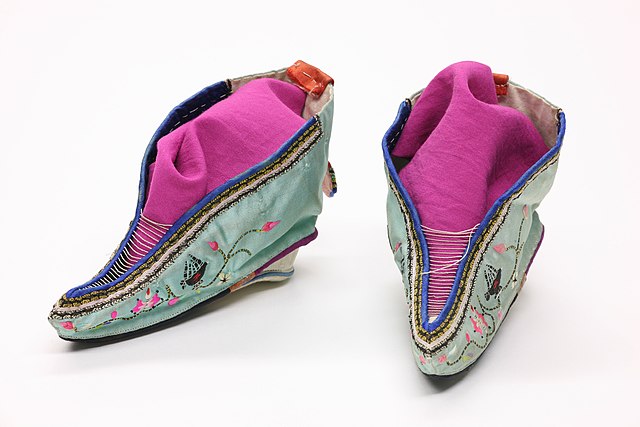
My husband, Marty, is a retired podiatrist. He worked in pockets of New York City that were poor and largely immigrant. When he first started his practice, he treated women from China whose feet had been bound. Despite being officially outlawed 1912, footbinding was still being practiced well into modern times. He saw these patients in the 1970s and 80s.
For those who don’t know what it is, young girls, as young as 3-5 would have the bones in their feet broken and then the feet bound with cloth strips. Every few years, the feet would be broken again until the desired result was created. To create that affect, the toes would be flattened against the bottom of the foot and arch would be so broken and damaged that the heel would curl back to the front of the foot. At each of the breakings the girl would need to learn to walk again. One can only imagine that pain of walking on foot bones that had been repeatedly broken. And here is an especially chilling part. The mothers would do it to their own daughters. I won’t go into further gruesome details because they can be easily looked up on the internet. It left the girls crippled for life.
During late summer a few years ago I had a vision. I know it was summer because it was hurricane season and there were several active storms in the Atlantic & Caribbean. Since I grew up in Florida and lived in New Orleans for many years, I have a lot of experience with hurricanes.
In this vision, I found myself seated at the side of the Great Mother Goddess looking down thru a portal at planet Earth. The Goddess looked at me and then turned back to the portal. She put a finger out and touched a place on the planet with a spark of light. Then She turned to me and said, “The energy must be discharged!” She repeated this multiple times and ultimately put her finger on planet Earth five times, each time touching a spot where a hurricane was active.
Moderator’s Note: The was originally posted on January 20, 2014
Last week I reflected on Angela Yarber’s insightful essay and painting on Jephthah’s daughter. For those who did not read the earlier posts, the story of Jephthah’s daughter is found in the Hebrew Bible. Jephthah’s daughter was sacrificed by her father after he swore in the heat of battle that if his side won, he would sacrifice the first person he would see on returning home. Angela called us to reflect on who Jephthah’s daughter is in our time.
The Torah portion for 20 August is Eikev, or Deuteronomy 7:12-11:25. Eikev describes the importance of spirituality in one’s life and proscribes the actions of spiritually-attuned people. The portion returns time and again to whom one should be spiritually connected: the deity, a jealous, angry, and fierce warrior who freed the Israelites from Egyptian slavery. Yet, if we look closely at the language of Eikev, there is a disconnect between this warrior imagery, other language in Eikev about the divine, and how the spiritually-attuned should behave. It is as if there are two understandings of divine nature here, and they are at odds with one another. In spite of itself, the language of the parshah decidedly favors a more feminist understanding of the divine.
Let us begin by looking at what Eikev says about spirituality. Deuteronomy 8:3 asserts that one needs not just bread to live, but connection to the divine as well. In other words, humans have concrete material needs that are extremely important. However, there is also more to life than just the material.
But, to whom is one supposed to spiritually connect? It cannot be denied that there is a lot of language in Eikev that refers to the deity as a fierce warrior, quick to anger, whose principle act was freeing the Israelites from slavery. A typical example of this language can be found in verse 7:19. “The great trials that your eyes saw, the signs, the wonders, the mighty hand, and the outstretched arm with which the L-rd, your G-d, brought you out. So will the L-rd, Your G-d, do to all the peoples you fear.” The deity showed strength and power when rescuing the Isrealites from slavery and will not hestitate to bring low those who threaten them. The deity is also often depicted as jealous and vengeful and quick to anger at Israelite misbehavior (9:7-8, 18, and 22). It is even said in Eikev that the deity gave the Israelites the Land not because of their goodness but because of the wickedness of the Land’s inhabitants (9:4-5).
Yet, in Eikev, one can read other passages in which that fierceness is overshadowed, where instead the deity displays love, care, and concern, and blesses the Israelites. This model for the divine is considerably more feminist because, as I have explained in numerous other posts, it is definitively not based on a patriarchal model of anger, jealousy, or power-over others.* The main example of the juxtaposition between the angry, vengeful warrior deity and the loving, kind one is in Deuteronomy 8. The deity both punishes and provides. But, in the end, divine care and concern outweigh more warrior-like behavior (verses 3-4), because despite the tests and trials, the people had food, water, their health, and clothing.
There are other examples in Eikev that highlight the divine as care and acts of loving-kindness. In Deuteronomy 7:13-14, we read about the many blessings the divine will bestow on the Israelites including fertility of the people and of the land. People will not suffer disease in the land (7:15). The deity makes sure to bring the Israelites to a good land with water, hills and valleys for mining and fertile fields for raising animals and planting crops and various fruit trees; no one will go hungry (8:7-10).
Why does the deity do this? Because of love. The parshah’s second verse (7:13) says that the Israelites are blessed because of divine love for them. The deity operates out of love for the stranger as well (10:18). Love is also part of how the Israelites should behave. They should love the divine (10:12, 11:1 and 22). And, because they love the divine and the divine loves the stranger, they too should love the stranger (10:18-19).
This very much reminds me of the sentiments expressed in Leviticus. We are to be holy like the divine is holy (Lev. 11;44-45 and 19:2). Just sixteen verses later, we read “…Love your neighbour as yourself,” (19:18). However, in Eikev, there is a more immediate connection between who the divine is and how the Israelites should behave. As I have already mentioned above, one should love because the divine loves, do acts of loving-kindness because the divine does, shelter, clothe, feed, and so on. Operating out of an understanding of the divine as angry, vengeful, jealous warrior would produce very different behavior, would it not?
Spiritual connection and action go hand-in-hand. Be holy for I am holy. Love because I love. Be kind because I am. Take care of others as I have taken care of you. This is Eikev’s message, one I think we should heed.
Ivy Helman, Ph.D.:A feminist scholar and faculty member at Charles University in Prague, Czech Republic where she teaches a variety of Jewish Studies, Feminist and Ecofeminist courses.
*A partial list of my past blog posts that critique the patriarchal model of divinity as a jealous, fierce, angry warrior: Balak; Vayikr; Sh’lach; and Ha’azinu.
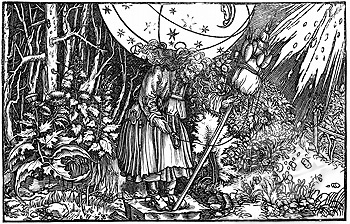
Old woman (witch or fairy) spinning. Woodcut attributed to Holbein from Boethius, De consolatione philosophiae 1547
The Pendle Witches
As a spiritual person, I am fascinated with women’s experience of the sacred. We women, for the past five-thousand years of patriarchy, have been side-lined and marginalized by every established religion in the world. But in every age, there have been women who have heroically rebelled against this patriarchal stranglehold to claim their authentic spiritual experience. Often it has involved looking within rather than without for spiritual guidance.
Thus far in my essay series, A Visionary History of Women, I’ve discussed Hildegard of Bingen and Margery Kempe who carved out their own woman-centered paths as mystics.
But what about women whose mystical experiences fell outside of the parameters of any organized religion?
One of the most important texts I have ever read was J. Kelly Gadol’s essay, “Did Women Have a Renaissance?” She points out that while elite European men were experiencing a Renaissance, women’s rights and lifestyle choices were becoming increasingly constricted during this period. The Renaissance was a very dangerous time to be female–women were the primary targets of the mass witch-hunting hysteria sweeping across Europe. Witchcraft persecutions were not a phenomenon of medieval superstition, as is commonly believed, but of the Renaissance and the Reformation, stretching up to the dawn of the Age of Enlightenment.
Anton Woensam’s idea of the perfect Renaissance woman: silent and obedient
The pre-Reformation Catholic Church, for all its problems and abuses, at least offered a space for female mystical and visionary experience. However, the hard-line Protestantism that followed the Reformation offered no space at all. If you saw visions or whispered prayer charms or left offerings at a holy well or lit a fire on midsummer eve to protect your cattle, you were suddenly seen as a witch, in league with the devil.
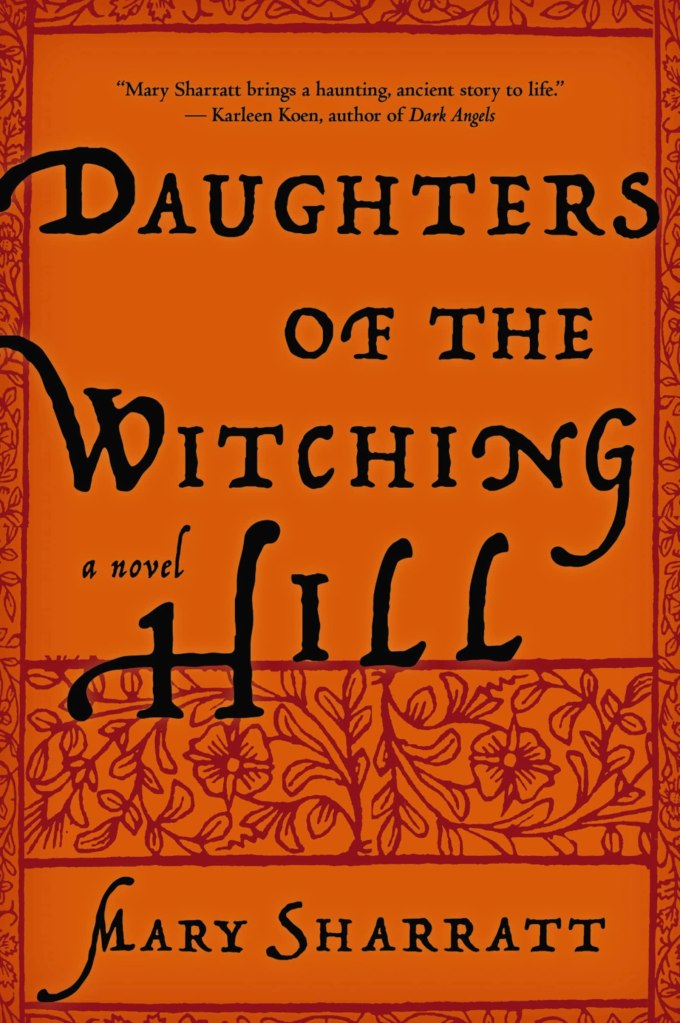
In winter 2002, I moved to Lancashire, in northern England. The back of my house looked out on Pendle Hill, famous for its legends of the Pendle Witches of 1612, the amazing real women at the heart of my novel Daughters of the Witching Hill.
In 1612, in one of the most meticulously documented witch trials in English history, seven women and two men from Pendle Forest were hanged as witches, based on testimony given by a nine-year-old girl.
The most notorious of the accused was Elizabeth Southerns, alias Old Demdike. Allow me to introduce you to a woman of power who changed my life forever.
This is how Thomas Potts describes her in The Wonderfull Discoverie of Witches in the Countie of Lancaster, the official trial transcripts.
She was a very old woman, about the age of Foure-score yeares, and had
been a Witch for fiftie yeares. Shee dwelt in the Forrest of Pendle, a vast
place, fitte for her profession: What shee committed in her time, no man
knows. . . . Shee was a generall agent for the Devill in all these partes: no
man escaped her, or her Furies.
Bess Southerns was a wisewoman of longstanding repute. What fascinated me was not that she had been arrested on witchcraft charges, but that she practiced her craft for decades before anyone dared to interfere with her or stand in her way. Cunning craft, the art of using charms to heal both humans and livestock was her family trade. When interrogated by her magistrate, she freely admitted to being a wisewoman and healer, even bragged about her familiar spirit Tibb, who appeared to her in the likeness of a beautiful young man.
At the time of her arrest, she lived in a place called Malkin Tower. Widow and matriarch of her clan, she lived with her widowed daughter and her three grandchildren, the most promising one being Alizon, a teenager who showed every promise of becoming a wisewoman as mighty of her grandmother.
In England, as opposed to Scotland and Continental Europe, witchcraft persecutions had been rare. Bess had been able to practice her craft in peace. This all changed when the Scottish King James I ascended to the English throne. King James was obsessed with the occult and had even written a book called Daemonologie—a witchhunter’s handbook—that his magistrates were expected to read.
The tide was turning for Bess and her family.
When a pedlar suffered a stroke after exchanging harsh words with Bess’s granddaughter Alizon, the local magistrate, eager to make his name as a witchfinder, played neighbors and family members against each other until suspicion and paranoia reached frenzied heights.
Alizon, first to be arrested, was the last to be tried at Lancaster in August, 1612. Her final recorded words on the day before she was hanged for witchcraft are a passionate tribute to her grandmother’s power as a healer. John Law, the pedlar Alizon had supposedly lamed, appeared before her. John Law, perhaps pitying the condemned young woman, said that if she had the power to lame him, she must also have the power to cure him. Alizon sadly told him that she lacked the powers to do so, but that if her grandmother, Old Mother Demdike, had lived, she could and would have healed him and restored him to full health.
Other novels have been written about the Pendle Witches, but mine is the only one to tell the story from Bess and Alizon’s point of view. I longed to give these women what their own world denied them—their own voice, their own story.
May the voices and visions of our motherline guide us to claim our own voice, our own story, our own vision, our own power. May we all be wisewomen walking forward.
Mary Sharratt is committed to telling women’s stories. If you enjoyed this article, you might want to check out her novel Daughters of the Witching Hilland visit her website.
I find it interesting how certain or settled we often expect our little ones to be instead of getting curious about them or acknowledging that they are curious.
My daughter, Hazel, is six years old and will be starting first grade next week. She loves cats, swimming, her cousin, and food. Purportedly, Chinese style barbecue pork buns come first in her heart, even before mommy and daddy (though we are a close second). She also prefers to run instead of walk; and has recently declared that she is Taoist and Shinto. This determination came after some discussion which went something like this:
Sitting at the kitchen table one morning, Hazel declares “My best friend asked me if I was a Christian and I told her I was. I am a Christian.”
Mommy the agnostic is a little surprised. Daddy, the atheist, is biting back a retort—he is somewhat hostile towards Christianity. I am only hostile to abusive, hetero-Patriarchal Christianity. I say to Hazel, “Oh. That’s interesting. Do you know what that means?”
*Warning* – contains spoilers about the movie “Turning Red” as well as “Brave,” “inside Out,” and “Encanto.”
Imagine something with me for a moment. Imagine there is a movie about an adolescent boy who discovers that he has magic shapeshifting powers to become a fierce, powerful animal. The males in his family have had this power for generations because a deity granted the power to a male ancestor in order to help him protect his family from enemy invaders. The boy has to learn to control the amazing power and potential of this fierce warrior alter-ego. What’s the next part of the story?
Would he save his family from an evil ruler trying to harm them?
Would he save his town from an earthquake that almost destroys a stadium full of people?
Would he save his city from an evil power that wants to enslave the population?
Or… would he get in an argument with his dad about going out with his friends and end up doing intense emotional labor to heal intergenerational dysfunction in his wider family?
Do you think boys and men would ever, in a million years tolerate that last option? This boy superhero uses his superpower to… do emotional labor for his family. The end.
If I squint, I can almost see steam lifting from a cauldron in the forest and smell change drifting through the air. I am looking at the shards of the year, some new-broken, some re-collected, some shining with possibility, and I feel the call, the urge, the promise, to tip them all into that bubbling vat and see what She will steep me into next.
Each year, in August, I honor what I call a “Cauldron Month” for myself. This is a month in which I “take it all to the cauldron” and let it bubble and brew and stew and percolate. I pull my energy further inward to let myself listen and be and to see what wants to emerge. It is a month in which I delete my social media apps and mindfully, intentionally draw my scattered attention inward in order to listen to my inner wisdom, to take all of my bubbling ideas to the metaphorical cauldron of my own being and see what is brewing, what is stewing, and what is ready to be dished up. I clarify goals for the remainder of the year, my next word of the year usually finds me, and I take time to consciously “steep” in my own flavor. It is a time of clarity and renewal for me, a time when I withdraw from outer life and re-collect my energy in order to determine where to put my focus for the remainder of the year.
It may seem strange to withdraw energetically at such a ripe and burgeoning time of the year, when life is bursting with things to harvest and ideas to share, but that is exactly why I do it—because when life feels the most full, is when I known I most need some dedicated time of discernment. August, I find, is always a crucible of change and choice for me. It is when big projects are birthed, when new doors open, and when I reach metaphorical crossroads of change—crossroads in which I decide what to harvest, see what has withered, and come to understand what to sacrifice.
We are held between summer’s fatigue and summer’s fire, there has been a blooming and a ripening, and now a harvesting and a fading, as the time comes to turn the page.
Cauldron Month dates back to 2016, a year in which my pace of living became unsustainable and I experienced a persistent and inexplicable cough that lasted for six full months. After this experience, I came to clearly see a pattern in myself, of speeding up and revving harder and harder through the spring and summer, until I reach an annual point of having taken on too much, in which I must make choices about what to let go of and what to pursue. It helps to know it, to name it, to say to myself: oh, yes, this. Cauldron time is here again. The understanding of this pattern has helped me to prepare for it, when I feel the familiar tension, the drive to push and speed, I step back instead. I sit down. I shut things off. I get still and I listen.
That first year, feeling overwhelmed by commitments and at my physical and temporal limits. I did a guided meditation called the Moon Goddess Ally Journey. During the meditation, in the temple in which I met the moon goddess, right as the meditation was coming to a close, the Cauldron from the Womanrunes oracle card system appeared quite clearly etched on the floor of the temple–it was very large, covering the whole floor, and felt like a dramatic and powerful wake-up call. I knew in this moment: I need to take my life into the Cauldron. I need to see what is brewing. I need to steep in my own magic. August has never been the same since.
Future Cauldron Months after have held varying experiences—some rich and powerful and some painful and challenging, what they all hold in common is that they illuminate the next steps and invite me into the next chapter. Some years I’ve joked with friends have been “Slow Cooker Months” instead and some years—like 2020—have felt like Cauldron Years, in that the whole year is a process of transformation and re-emergence. I have written some more about these experiences in a past post for FAR here.
Each year, I do what I can to honor the call of the Cauldron—persistent and insistent—and in so doing I remember that it is often in the mess that the story lives. What sometimes bubbles up from the Cauldron during this period of incubation isn’t particularly pretty, it can even be hard to confront, and yet, we continue to let it bubble, we continue to breathe and bear witness to our own interior lives, beyond the clamor and confusion of so many other voices that may fill our lives and days.
The Cauldron is a rune of alchemy and change, but also of centering of containment and contemplation—a marrying of what might seem like opposites, but that which really co-exist. During this month or another one that feels right to you (a lot of people choose December or January), consider taking it all to the metaphorical Cauldron of your life…what are you cooking? What flavors do you want to add? What do you want to create? What needs time and focus to bubble and brew? Can you allow yourself to steep in your own flavors? The Cauldron asks us what we’re cooking, but it also offer boundaries, containment, a safe space in which to stew up our truest magic.
May you be inspired by some time in cauldron, may you be inspired by time with yourself, may you be inspired by that which surrounds you, connected to Goddess, connected to the earth, connected to the animals, plants, the wisdom of the wind, the song of branches, and the symphony of river, stone, leaf, and breath.
Take it to the Cauldron and listen to the deep within.
Sending you all love. Glad to share some of the miracle of being here with you.
There are days when the sky holds its breath and dreams seep up from the skin of the world and into my feet.
Molly Remer, MSW, D.Min, is a priestess, mystic, and poet facilitating sacred circles, seasonal rituals, and family ceremonies in central Missouri. Molly and her husband Mark co-create Story Goddesses at Brigid’s Grove. Molly is the author of nine books, including Walking with Persephone, Whole and Holy, Womanrunes, and the Goddess Devotional. She is the creator of the devotional experience #30DaysofGoddess and she loves savoring small magic and everyday enchantment.