You are the living Goddess
and I bow to You.
All the crickets chant OM
and the moon glows.
Time lies down
in the corpse pose.
And the night births
hundreds of thousands of galaxies. Continue reading “Mystery by Janine Canan”

Exploring the F-word in religion at the intersection of scholarship, activism, and community.

You are the living Goddess
and I bow to You.
All the crickets chant OM
and the moon glows.
Time lies down
in the corpse pose.
And the night births
hundreds of thousands of galaxies. Continue reading “Mystery by Janine Canan”
 A little over a week ago, hundreds if not thousands of Mormon women across the world participated in Wear Pants to Church Day, a movement orchestrated by some feminist Mormon women in an effort to bring attention to issues of gender inequity in the Mormon faith. Pants were the chosen symbol because there are strong cultural norms against women wearing pants to church. This event was conceived as an opportunity to make visible the fact that Mormons are questioning traditional sex-segregated customs in the LDS Church and want to dialogue about these issues. Supportive men were asked to wear purple shirts or ties to signify their solidarity.
What surprised everyone in the Mormon feminist community was the vicious response by some other Mormons to this proposed action. On the event’s Facebook page, other Mormons attacked idea, hurling insults at the women. One man even made what sounded like a death threat, saying that people who participate in activists movements like this “should be shot … in the face … point blank.” The negative reactions centered around two issues: 1) that it’s inappropriate to engage in any form of protest – no matter how subtle — in church and 2) that it’s inappropriate for women to wear pants to church. Continue reading “Pantspocalypse: It’s Time for Conversation about Mormon Gender Norms by Caroline Kline”
 This holiday season I have something warm and fuzzy to be thankful for—Goldilocks, the kitten who came for the holidays.
As I was preparing for Thanksgiving, I opened my front door to the sound of really loud really pitiful crying. A tiny grey kitten with a large golden spot on nape of her neck was howling in the middle of the street just a few feet from my door. Living as I do in a town where there are many homeless cats and kittens, I do not usually respond to such cries. My dogs maintain “cat patrol” in my back garden and quickly chase strays away.
However, the cries of this little kitten were so insistent that I picked her up. She was smaller than my hand. My neighbor who was sweeping his porch offered to take her in. A few hours later he returned her. She was still mewing loudly, and, he said, she had not stopped crying all day long. I found a syringe and fed her some milk. Soon the crying stopped and she began purring in my lap. Continue reading “The Kitten Who Came For The Holidays by Carol P. Christ”

The annual meeting of the Society of Christian Ethics is just around the corner (Jan 3-6, 2013). One of my responsibilities will be to meet again with members of the 2020 Future of Christian Ethics task force.
Our “charge” according to the chair of the committee, Charles Matthewes, is as follows:
Continue reading “The Future of Christian Ethics by Grace Yia-Hei Kao”

The notion of the bad body allows for bad things to be done to any body and anything human or non-human that has become body identified.
Where did it all begin? How has it happened that we have nurtured such an ethos of disrespect for the earth and all that is therein? How has it happened that we have fostered an ethic of indifference for that which is different? How has it happened that we have cultivated an environment hostile to the well-being of our very selves? Where did this cycle of violence against the sacredness of all that is begin?
These are the questions that have troubled my mind and soul over these last few days as we have once again been reminded of the unimaginable and painful price we pay for not asking the hard questions of ourselves and trying to discover the seeds of our inhumanity. As I have tried to answer these questions one word has continually come to the forefront of my mind: “wholeness.” As a womanist, informed by Alice Walker’s definition of a womanist as one who strives for wholeness, I have increasingly recognized that perhaps it all begins with a betrayal of the wholeness of creation itself. Most of us are influenced by a Western view of the world that sees things in either/or paradigms. The way in which we engage the world and ourselves is shaped by a dualistic consciousness. Thus, distinctiveness becomes “other,” paradoxes become opposition. Such a dualistic worldview undermines the unity of all being. It defies the complex harmony of the universe. And, it most especially disrupts our appreciation for our own bodies and the bodies of others. Disdain and cavalier regard for the body and the earth becomes virtually inevitable. Continue reading “Random Questions? by Kelly Brown Douglas”
 If you are reading this, then we survived another apocalypse. People are fixated on end-times; especially predictions, prophecies, etc. Specials on Nostradamus, the Book of Revelation, TV Evangelists looking for end signs plague television shows, movies, and writings. Countdown clocks and reminders to repent are all around us.
What is unnerving is how we obsess about the end of the world instead of living in the world we have right now.
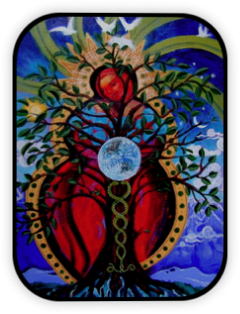
I would like to share a Mayan poem that I came across. It is called “Imix”- a Mayan Oracle Interpretation translated by Ariel Spilsbury and Michael Bruner and I am drawn to it due to the imagery and symbolism:
I Am Imix, Primal Mother.
Still, dark womb of the patterned potential of becoming, sacred, interstellar genesis, I Am.
Nourishing, fertile abyss, I birth you.
Benevolent, my mighty cauldron of primal waters, enveloping the living seed. Eternal is my embrace. Continue reading “Imix: Primal Mother and Dawn of a New Age by Michele Stopera Freyhauf”
 Throughout history and all around the world, people have celebrated midwinter and the rebirth of the sun. My favorite night of the solstice-Hanukah-Christmas season is December 24, Modranicht. If we have Mother’s Day in the springtime, it seems only fair that we should celebrate Mother’s Night in the winter. We get the term Mothers’ Night from the English monk, Bede, who said that the Angles began their year on the night of December 24–25.
The winter solstice this year falls on December 21, though it can also occur on December 22 and December 23. The word “solstice” means “sun stand still.” No, it’s not Joshua’s long day again. On the solstice, the sun rises from the same point on the horizon for a couple days (this is the standing still), is at its lowest point in the sky at noon, and (in the Northern Hemisphere) is at its southernmost point. It’s the longest night of the year, and when the sun is reborn, it moves across the sky for six months to the summer solstice, where it’s at its northernmost point.
Continue reading “Happy Birthday, Solar Gods By Barbara Ardinger”
 The Cailleach (KAL-y-ach), which literally translates as the “Veiled One” is an ancient Goddess whose origins are unknown. When the Celts arrived in Ireland and Scotland she was there. Over time Her name came to mean “old wife” or “old woman”. And yet she was thought to never grow old, an all powerful, ageless, Goddess of transformation.
In one of her stories, Cailleach, as an old hag, seeks love from the hero. If he accepts Her, She then transforms into a beautiful young woman, symbolizing the transformation occurring in the depths of winter when the seeds lay dormant in the earth. Yet alive within this dormancy is the promise of rebirth in the spring. She is the guardian of the life force, finding and nourishing the seeds, commanding the power of life and death. As the final phase of the Triple Goddess, she rules the eternal wheel of reincarnation. Cailleach personifies death and the transformative power of darkness. She leads us through death to rebirth. Continue reading “Cailleach, The Queen of Winter by Judith Shaw”

Winter’s hungry hand has taken another powerful and precious older woman. No one knew Ellen beyond her family and friends, her church and her neighbors. She was 90, a nurse, faithful to her church and of service to her community, and quiet in manner and tone. In my work in elder services over 25 years, I have come to know many Ellens, older women who have labored relentlessly in their homes or in the outside world for little recognition or financial recompense but who have made a tremendous difference in the lives of other. For reasons that may have to do with the harshness of New England winters, or maybe just coincidence, or maybe only perception, winter seems to be the time when they leave the Earth and we are bereft.
Ellen and the many older women I have known like her do not fit into any standard or feminist image of a powerful woman. They do not generally challenge the status quo, except with occasional complaints about unfairness to women in comments to friends. They may not feel comfortable labeling themselves as “feminist.”
Continue reading “Honoring the Older Women of December’s Darkness by Carolyn Lee Boyd”
 Actually it comes twice, once in midsummer, the longest day of the year, and once in midwinter, the longest night. Winter Solstice is also known as the first day of winter.
For those of us attuned to the cycles of Mother Earth, Winter Solstice is a time to celebrate the dark and the transformations that come in the dark. Many of the customs associated with Christmas and Hannukah, including candles, Yule logs, and trees decorated with lights were originally associated with Winter Solstice. The extra pounds put on during winter feasting were insulation against the cold winter nights.
Those who fear that many of the customs of the Christmas season might be pagan are right. As we learn again to honor our place within the cycles of birth, death, and regeneration, we can return these customs to their roots in the circle of life.
Continue reading “Solstice Comes But Once A Year, Now It’s Here! by Carol P. Christ”
 Feminism and Religion