The following is a guest post written by Monica A. Coleman, Ph.D., scholar and activist committed to connecting faith and social justice. An ordained elder in the African Methodist Episcopal Church, Coleman has earned degrees at Harvard University, Vanderbilt University and Claremont Graduate University. Coleman is currently Associate Professor of Constructive Theology and African American Religions and Co-Director of the Center for Process Studies at Claremont School of Theology in southern California. She is also Associate Professor of Religion at Claremont Graduate University.
This article was originally posted on the Beautiful Mind Blog. Be sure to check in there and follow Monica’s journey.
“You have to believe in it. It won’t work if you don’t have some faith that it will work.”
These are the words my friend said to me years ago when I realized I could no longer manage my depressive condition without medication. Friend to friend, depressive to depressive, minister to minister . . . he told me to have faith.
Last month I was at an event that I helped organize. Inevitably I was here and there and everywhere: greeting people, making sure things were in place, answering questions, and taking pictures (I’ve been the official ‘unofficial’ photographer at this event for 4 years now). But, the one thing that will stick in my memory was the reminder that the little things count: “What we are doing in the present is creating the future, is the future.”[1]
You see, while I was taking pictures of people at one of the tables I ended up in front of someone I had not yet met, so I introduced myself and asked him his name. After he told me his name, Joe – a first year masters student, immediately proceeded to tell me how intimidated he was by me. He told me that I was famous and that he got so nervous each time I came around that he tried not to look at me because he wouldn’t know what to say. (Obviously he couldn’t have been truly intimidated since he was able to tell me all this – but the lightning speed in which he talked and his obvious nervousness made me realize there was some truth to what he was expressing). Continue reading “Seeds of Hierarchy By Xochitl Alvizo”
Jaji Crocker received her MFA in Creative Writing from Northwestern University, and is now pursuing a dual degree at Claremont Graduate University, studying for her PhD in English and MA in Religion. Her research interests and approach are innately interdisciplinary as she explores the evolution of the ethics buttressing and changing religious philosophies and practices in North America and the Middle East, as well as the evolution of the theological imagination and feminist influences in post WWII American literature. Jaji continues to write fiction and teach creative writing.
I’m not generally an eye closer during prayers. Nor am I an arm folder. If I’m in a public space like my Mormon church, I tend to slightly bow my head so as to not make any other non-eye closers uncomfortable. I’m not a very consistent personal prayer, but when they do happen, most of them occur as I lie in bed before I sleep. I’m not a kneeler, either.
I’ve not ever thought much about this before, but now that we have a five year old, I’m seeing my child being taught prayer postures by his Sunday School teachers that don’t resonate with me personally. It’s caused me to think a little more deeply about why I don’t conform to typical Mormon prayer posturing.
I found an article* about eye positioning during prayer helpful as I thought about this question. According to the author Thomas Ellis, members of Abrahamic religions tend to view deity as an “intra-tribal rank superior.” In other words, the same way these ancient people approached their social superiors with supplications, they approach their deity with supplication. This usually involves lowering the eyes and head in order to not appear challenging or demanding. Contemporary Mormonism seems to fall into this category.
Prayer Tree by Janet Chui
One exception to this generalization about Abrahamic religions is Marian worship. Catholic or Eastern Orthodox adherents tend to approach Mary with a direct gaze, seeking out visual reciprocity. They often look at icons and pray to her simultaneously. The submissive lowering of head and eyes is not present. Ellis postulates that this is because these adherents are approaching deity not as an “intra-tribal rank superior” but instead as an “attachment figure,” just as babies and young children approach with eyes open the loving mother or father.
Interesting. Does my lack of desire to close my eyes and bow my head mean that I think of deity more like Catholics think of Mary? Do I approach deity as loving parents**, rather than social superiors? Do I want to emphasize our similarities and talk to them as loving friends, rather than focus on the vast difference of our hierarchical positions?
Yes, I think I do.
*Natural Gazes, Non-Natural Agents: The Biology of Religion’s Ocular Behaviors” by Thomas B. Ellis in the book The Biology of Religious Behavior
**Mormons believe in both a Heavenly Father and a Heavenly Mother, though Mormons are instructed to not worship her or pray to her.
The following is a guest post by John Erickson, doctoral student in Women’s Studies in Religion at Claremont Graduate University. His research interests involve an interdisciplinary approach and are influenced by his time as the director of a women’s center and active member in the GLBTQ and women’s rights movements. His work is inspired by the intersectionality of the feminism, queer identity, and religious political and cultural rhetoric. He is the author of the blog, From Wisconsin, with Love and can be followed on Twitter at@jerickson85.
I often read on this blog about the effects various religious traditions have on people’s personal and professional psyches. As I sit in class, I listen to people tell their harrowing stories of how they “escaped” restrictive religious practices or were able to “work within” their religious community to attempt to or even in some cases create the change they wanted to see.
Although I enjoy listening to my peers talk about the issues that have followed them along throughout their life, I find myself struggling to personally validate these experiences in relation to my non-religious background. More specifically, I want to associate with your feelings but I just cannot seem to relate in any way no matter how hard I try. Continue reading “Outsider Looking In: A “Tradition” of a Different Name By John Erickson”
The receipt of an invitation to the Fortieth Anniversary Celebration of the Women’s Caucus in the American Academy of Religion and the Society for Biblical Literature this week, takes me back to the summer of 1971. At the first meeting of Women Theologians at Alverno College (which was followed up at Grailville in succeeding years), I proposed that we form a feminist caucus in the field of religion, as had already been done by feminists in several other fields.
Since I was one of the few women at Alverno who had attended the annual meetings in the field of religion, I was delegated to call Harry Buck, then director of the AAR, to ask for space on the program. Harry, who continued to support the work of women in the field through lecture series at Wilson College and the magazine Anima which he founded, offered not only space at the meetings, but a print-out of the names and addresses of all of the members of the AAR who were not obviously male. I invited all of them to come to a feminist meeting at the AAR in Atlanta. It is hard to imagine now, but before 1971, the women who attended the AAR in any given year could probably have been counted on one hand. Continue reading “Forty Years and Counting: Women and Religion in the Academy By Carol P. Christ”
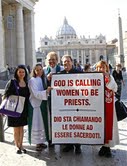
This past August I wrote about the canonical warning that Fr. Roy received and the issue surrounding the exercise of conscience over church teaching. For a more detailed explanation of the warning and the background regarding the ordination of women, please see my prior article.
present a petition containing 15,000 signatures supporting full and equal participation of women as deacons, priests, and bishops in a renewed church. The group was not permitted in St. Peter’s Square because of their signs; they did not have the proper permit. Access was also denied to the Women who wore albs/stole because their dress was considered a form of protest. “We love our family, the Catholic Church,” stated Miriam Duignan of Women-Priests. “We feel obliged in conscience to make our carefully considered reasons known. In doing so, we fulfill our canon law duty to speak out, as our present Pope has encouraged us to do.” Koturbash states “even though canon law invites our Church leaders to hear from the faithful, our leaders are silent when we try to engage.” Continue reading “Pink Smoke, Call to Disobedience, and a Holy Shake-Up: Is it Time to Convene the Third Vatican Council? By Michele Stopera Freyhauf”
Having been critically impacted by the work of Rosemary Radford Ruether, I was anxious for the release of the second edition of her crucial book, Women and Redemption: A Theological History. Redesigned with illustrative material, research questions, and suggested reading for further research, as well as the addition of a new chapter exploring recent developments in feminist theology, this text does not disappoint.
With this newest edition, Ruether acknowledges the ongoing journey in the field of feminist theology and emerging issues faced by women in religion and society. Examining the Christian claim of an inclusive and universal redemption in Christ, she traces paradigm shifts in understandings of gender over the last two millennia. Ruether offers an historical exploration of women and redemption in the first five chapters followed by a global survey of contemporary feminist theologies in the final four chapters, which includes a concluding section that gives attention to “Fourth World” feminisms and post-colonialism in an effort to “bring this volume up to date” (xvii). Continue reading “Rosemary Radford Ruether’s Women and Redemption: A Theological History By Gina Messina-Dysert”
The first time I became aware about my birthing choices was during a call to a local midwife to inquire about her practice. By this time, I had been diagnosed with PolyCystic Ovarian Syndrome, uterine fibroids, a possible uterine septum, and had experienced a miscarriage two months before becoming pregnant with my son. On spiritual and psychological levels I didn’t trust my body, and certainly wasn’t experiencing the empowerment and holy wonder that I expected pregnancy to bring. Instead of feeling the strength of my ability to bear life, I felt the frailty of the threshold between life and death, and struggled with my body’s role in that space. I acutely felt my body’s assumed “brokenness.” I couldn’t access my inherent dignity, nor could I grasp the “hope [that] does not disappoint” (Romans 5:5). I was willing to let anyone tell me what I needed to do because I felt I couldn’t trust myself. I just wanted to be able to bring my baby to term and to have a healthy son.
During this time I didn’t even consider how the pregnancy or labor would affect me—emotionally, physically, psychologically, or spiritually. Yet my discussion with that midwife made me realize how deeply the experience of pregnancy was shaping me. The space God was carving out within me was incredibly powerful, and the closer I got to birthing my son, the more I realized how spiritually and psychologically charged the birth experience could be. It was laden with the potential for either transformative beauty or despair. Continue reading “A Different “Right to Choose”: America’s Cultural Denial of True Choice in Childbirth By Stacia Guzzo”
and these are the forces they had ranged against us,
and these are the forces we had ranged within us,
within us and against us, against us and within us.
Adrienne Rich
Last week a colleague of mine forwarded the sad news that Anita Caspary, IHM, had died at the rich age of 95. This was the same day (October 5) that Steve Jobs passed away from his battle with pancreatic cancer. The tension between the two figures was not lost on me. The death of Jobs, an icon of ingenuity and leadership, wonderful husband and father, is mourned throughout the world. The life and legacy of Anita Caspary will be remembered and mourned as well, but by comparison, on a much smaller scale. That’s unfortunate, because the life and legacy of Caspary as an instrument for change in the lives of Catholic women in general, and Women Religious in particular is what legends are made of.
As an IHM sister, Caspary was teacher, poet, author, and president of Immaculate Heart College (1958-1963), but is best known in her role as Mother General Sister Humiliata (1963-1973) of the IHM’s. In Witness to Integrity, Caspary dramatically chronicles the painful struggles and controversies between the IHM sisters and Cardinal Archbishop of Los Angeles, James Francis McIntyre, in which 600 IHM Los Angeles nuns were released from their canonical vows in 1970. Released because of their self-determination in remaining at the center of their religious fidelity and thought by putting into practice The Second Vatican Council’s Decree on Up-to-Date Renewal of Religious life, or Perfectae Caritatis. Addressed to priest and religious, this decree sanctioned the exodus from the middle ages for the sisters by insisting they join the modern world in both dress and discernment of vocation that best utilized each sister’s talents. In an exert put forth from the 1967 Decrees of the Ninth Chapter, the IHM community clarify their position for renewal: Continue reading “Anita Caspery, IHM: Prophetic Icon of Renewal By Cynthia Garrity-Bond”


 The following is a guest post written by Monica A. Coleman, Ph.D., scholar and activist committed to connecting faith and social justice. An ordained elder in the African Methodist Episcopal Church, Coleman has earned degrees at Harvard University, Vanderbilt University and Claremont Graduate University. Coleman is currently Associate Professor of Constructive Theology and African American Religions and Co-Director of the Center for Process Studies at Claremont School of Theology in southern California. She is also Associate Professor of Religion at Claremont Graduate University.





 Feminism and Religion