We’ve Seen This Playbook Before by Janet Maika’i Rudolph

Wikimedia Commons

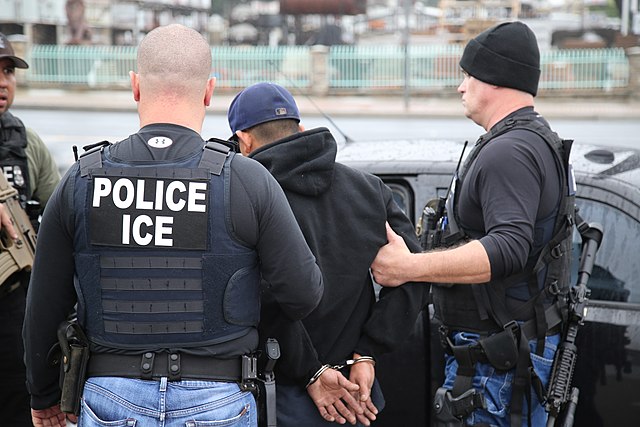
ICE has been doing mass round-ups of anyone who looks like “the other.” The people cheered.  “This is my country,” they shouted to the deportees. “Go back where you came from.” The people are flush with excitement thinking this is what we voted for, meanwhile ignoring that they came from someplace too. We know this is a publicity stunt. How? Dr. Phil tagged along on one of round-ups.  Newly minted secretary Kristi Noem also took her role in the spotlight attending one in NYC and saying dehumanizing words I will not repeat here. 

We’ve seen this playbook before. Creating chaos, disorientation and suffering for political points, TV or other publicity ratings. It doesn’t end well – EVER!

The NY Times had a report of how deportees were treated in a dehumanizing manner, being held on a broken plane in the Amazonian heat with no AC, people shackled, children were on board.  There are always people available to treat other people as less than human. “I was just doing my job.”  “I was only following orders.” 

We’ve seen this playbook before.  It doesn’t end well – EVER!

Continue reading “We’ve Seen This Playbook Before by Janet Maika’i Rudolph”

St. Brigid: Reproductive Justice and the Realms of the Miraculous by Elanur Williams

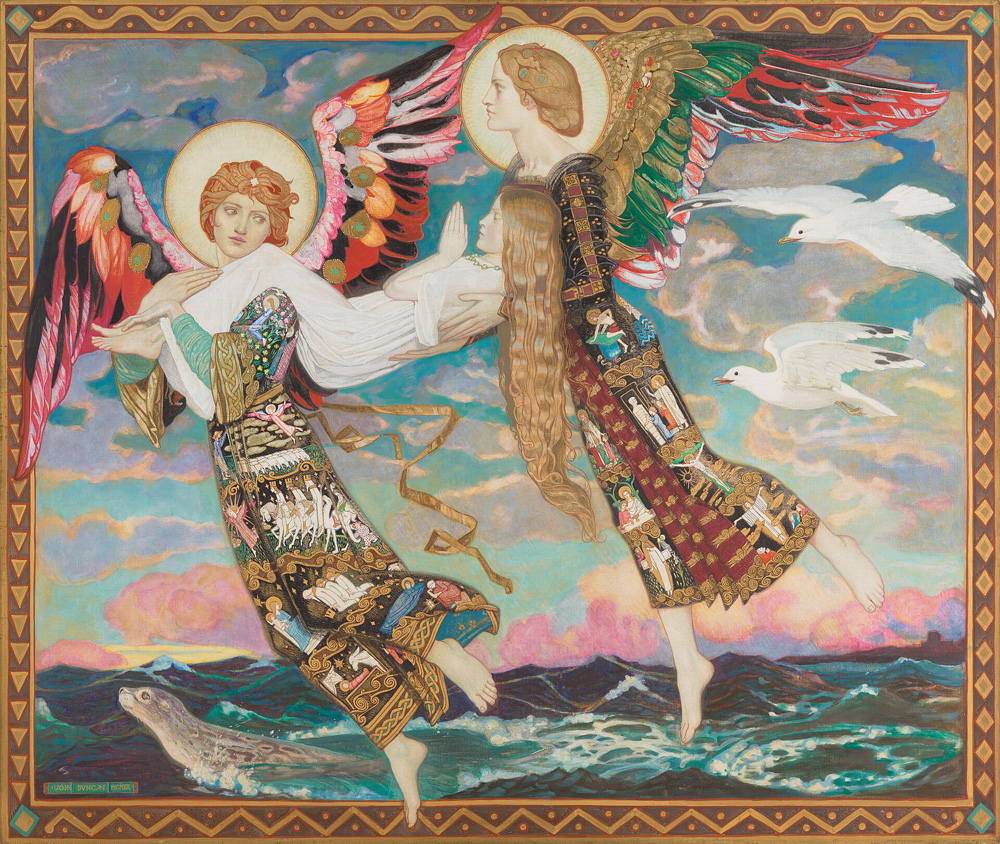
St Brigid being carried away by angels, in a painting by John
Duncan (1913)

One of my favorite saints is St. Brigid of Kildare, the patroness of poetry, learning, healing and protection. She is frequently called upon during childbirth. Brigid’s hagiographies are noteworthy for her remarkable abilities to heal and perform miracles—including her ability to make pregnancies vanish, for those who ask. In Vita Prima and Vita Brigitae (Life of Saint Brigit) published around 650 C.E. by Cogitosus, an Irish monk from Kildare, it is claimed that “Saint Brigid, by the very powerful strength of her faith, blessed a woman who had fallen [pregnant]…and the conception in the woman’s womb decreased and she restored her to health…without childbirth and its pangs.” The pregnant people in Brigid’s tales turned to Brigid to help them reclaim and restore their dignity. Consequently, their abortions served as catalysts for change. “Abortion miracles” have narrative and theological functions: they expose constructs of sexuality, chastity, purity, and sin. In addition, they test our understandings of healing—physical and spiritual—by revealing the intersectionality between medicine, pregnant people, power, and personal agency. Scholars have theorized the presence of “abortion miracles” in hagiographies, and whether they are to be read as a kind of defiance towards early Christian morality, or as a demonstration of chastity’s role and value in early medieval Irish Christianity. Some Irish penitentials view medieval abortions as malefic acts or as a kind of malevolent magic; however, according to Arica Roberts (2020), it can be argued the abortion miracles found in Irish hagiography can instead be read as “medicines of penance” and as contributing to healing.

Continue reading “St. Brigid: Reproductive Justice and the Realms of the Miraculous by Elanur Williams”

Women’s Bodies As Battlefield by Janet Maika’i Rudolph

Elizabeth Cady Stanton wrote in the introduction to her book The Women’s Bible:

The Bible teaches that woman brought sin and death into the world, that she precipitated the fall of the race, that she was arraigned before the judgement seat of Heaven, tried, convicted and sentenced. Marriage for her was to be a condition of bondage, maternity, a period of suffering and anguish, and in silence and subjection, she was to play the role of a dependent on man’s bounty for all her material wants . .

We are facing the long-term results of these biblical writings. This upcoming election is so unsettling because it is showing patriarchy in all its ugliness. We see how this is being played out, especially regarding abortion, but in all areas of the functioning of women’s bodies. The reason abortion is at the foundation of it all is that the drive to police women’s bodies is the crux which justifies all sorts of cruelties. It is the same with racism. These are issues that span the pantheon of rights; human, economic, healthcare, bodily autonomy. It takes a police state to quell all of these.

Continue reading “Women’s Bodies As Battlefield by Janet Maika’i Rudolph”

From the Archives: A Chorus of Need: I Need an Abortion by Marie Cartier

This was originally posted June, 2022

I need an abortion and I can’t get one

Because I don’t have the money to fly somewhere else other than …here

Where I can’t get one

I need an abortion and I can’t get one

Because the kid, or the cells of a maybe kid, were put in here by the guy that raped me and if I have to have it, I will kill myself

I need an abortion and I can’t get one

Because I have four kids already and I can’t feed another one

I need an abortion and I can’t get one

Because it’s my dad’s…did you hear me say that? I have never said that. I have never said what he does to me…and now I have to show everyone… if I can’t get this out of me I will…

I have to get this thing out of me

I need an abortion and I can’t get one

Continue reading “From the Archives: A Chorus of Need: I Need an Abortion by Marie Cartier”

Women’s Rights: How Far Back in Time Will our Legal System Go? by Janet Maika’i Rudolph

Wikimedia Commons

I was in the process of writing this blogpost last week when the Arizona supreme court decided to turn abortion rights back to the civil war era (1864). This was a time when women had no rights at all and abortion from conception was illegal. But civil war era laws are downright quaint and modern compared the legal underpinnings of the supreme court’s Dobbs decision.  

In his decision, Mr. Alito cited four “great” and “eminent” legal authorities, Henry de Bracton, Edward Coke, Matthew Hale, and William Blackstone. For perspective here are their dates. 

Henry de Bracton  c. 1210 – c. 1268
Edward Coke 1552 – 1634
Mathew Hale 1609-1676
William Blackstone 1723 –1780

To help me understand Alito’s logic, I read up on some conservative commentary. Here is what I learned: When the founding fathers needed to create legal documents, they didn’t create them out of thin air. They relied on the logic of the four men (and others) listed above. Yes, they did pick some enlightened aspects of these thinkers of the time, esp. in regard to the rights of the common people in relation to royalty. The thought of commoners having rights was revolutionary in its day. But as we have learned so painfully, our founding fathers limited who those rights applied to. They did not take into consideration the rights of anyone other than landowners, which at the time meant white men.

Continue reading “Women’s Rights: How Far Back in Time Will our Legal System Go? by Janet Maika’i Rudolph”

Can Feminist Christians Hasten the Advent of Reproductive Liberation? by Elizabeth M. Freese, PhD

Wikimedia Commons, Servite Church in Hungary

The collision of the 2023 Christian liturgical season of Advent with American reproductive politics has been jarring. Feminist religious critique and transformative activism are imperative.

With the Texas Supreme Court decision on a dire abortion case, alongside increasing criminalization of women having miscarriages, we are witnessing the principle of patriarchal dominance of female reproductive capacity and the denigration of women’s full, equal personhood pushed to the extreme. In part, this barbarity is perpetuated by Christianity. Even though this tradition often challenges social systems of injustice, and it does not actually support their hollow theology of “life at conception,” misogynist oppressors have plenty of Christian religiosity to stand on.

Continue reading “Can Feminist Christians Hasten the Advent of Reproductive Liberation? by Elizabeth M. Freese, PhD”

Women’s Sovereignty and Body Autonomy Beyond Roe v. Wade: Book Review by Beth Bartlett

A Girl God Anthology Edited by Arlene Bailey, Pat Daly, Sharon Smith and Trista Hendren

Women’s Sovereignty and Body Autonomy Beyond Roe v. Wade was not what I was expecting.  Given the title, I thought it would be similar to Robin Marty’s New Handbook for a Post-Roe America – a practical guide for ways to gain access to reproductive care in the wake of the overturning of Roe v. Wade.  Instead, I found, in contributor Mary Saracino’s words, “the howl of ages” – a deeply passionate and spiritual collection of poetry, prose, and visual art expressing  women’s outrage, grief, resistance, and empowerment in response to the U.S. Supreme Court decision of June 2022 denying women the right to abortion care that had been settled law in the U.S. for nearly fifty years.

Continue reading “Women’s Sovereignty and Body Autonomy Beyond Roe v. Wade: Book Review by Beth Bartlett”

Future of Mifepristone by Winifred Nathan

Today is the one year anniversary of the Dobbs decision.

The alarm grows louder. How far will the antiabortion lobby restrict women’s reproductive health care before they are satisfied? If they successfully secure a complete abortion ban, will they stop? Or will they go on to control women’s dress, education, travel, etc.?

Reportedly, Dobbs v Jackson overturned Roe v Wade so the states could set the legal boundaries of abortion through the democratic process. But on November 18, 2022, the US District Court of Northern Texas delivered Alliance for Hippocratic Medicine et al. v US Fodd and Drug Administration et al., a decision that stops medical abortion in all fifty states by ending FDA approval of mifepristone. The Supreme Court has stayed (paused) the Texas order as the appeal works its way to their docket. Mifepristone continues to be available, but for how long? Will the Supreme Court eventually side with the plaintiffs?

Continue reading “Future of Mifepristone by Winifred Nathan”

Who Gets to Define What it Means to be Pro-Life? by Janet Maika’i Rudolph

The sky and sun on June 7th in the afternoon on Long Island.

Today I am coughing and choking here on Long Island because of our unhealthy air quality.  The smoke from the wildfires of Canada have reached us. We, here in NY, are not alone in dealing with air so polluted that breathing is at risk. I think of the CA wildfires, the SpaceX rocket that exploded in April, the Ohio train derailment in Feb. No place is safe.

While coughing and thinking about this, two bits of news came into my consciousness, The first was the Supreme Court ruling narrowing the scope of the Clean Water Act.

My first thought was, do they and their children not have to live in this world too?  Do they think they can buy a clean environment for themselves and their families and the rest of us be damned? 

The next report I heard was from a prominent conservative commentator who explained how “prolife” he is and went on to describe his “deep concern” for life.

Continue reading “Who Gets to Define What it Means to be Pro-Life? by Janet Maika’i Rudolph”

ESCORT SERVICE by Esther Nelson

These days, I spend most of my time in Roanoke, Virginia.  I moved here—a three-hour drive west—from Richmond, Virginia.  One of the ways I’m settling into my new community is by volunteering as an escort at Planned Parenthood.

The job is straight-forward:  Greet people as they exit their vehicle when they arrive at the medical facility’s parking lot.  Usually, there are several protestors in front of the building, and clients must drive past them before turning right into the driveway.  Protestors wave pink, plastic bags filled with anti-abortion literature as well as pamphlets that outline a specific, Christian view of “salvation.”  Not many drivers stop.  If they do, I walk over to the line that divides Planned Parenthood property from public space and wave the cars forward.  The drivers are grateful.  So many clients are nervous, upset, and unsure of protocol.  One woman asked me if I was associated with “those people out there,” pointing to the protestors.  “Not at all,” I assured her.  She smiled with relief.

Continue reading “ESCORT SERVICE by Esther Nelson”