

Part 1 was posted yesterday
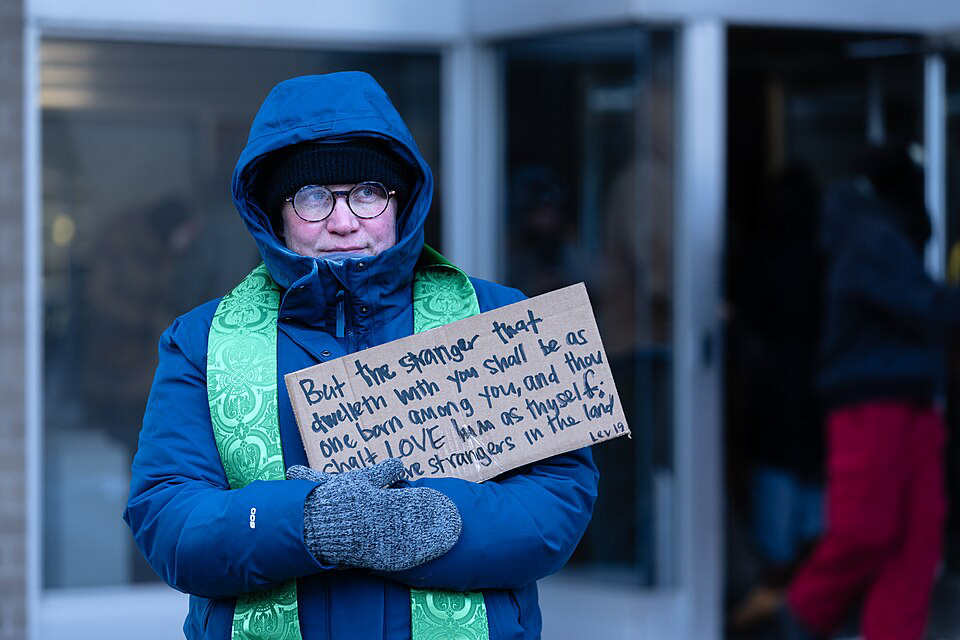
The Minnesota resistance went far beyond Gene Sharp’s catalog of techniques. Minnesotans kept their resistance up through creativity, celebration, fun, and humor in those dark, cold days. On a cold, clear January night, hundreds gathered on Lake Nokomis using hand-held candles and ice candles to spell out the words, “ICE OUT.”
The annual sled art contest was turned into a spoof of ICE – with a giant cardboard bowling bowl rolled down the hill to knock down fascist kingpins – Trump, Putin, Orbán; a young boy on his plastic sled festooned with Monarca’s butterflies saying “We Are Family” and “Justice for Renée Good”; sleds with messages of “Resist” and “Love Melts Ice” on a giant heart; a sled decorated as a bottle of de-icer and one of a chicken wearing a whistle with the message, “ICE OUT MSP.”
The whistle was to represent one of the most noteworthy and effective resistance strategies. Whenever witnesses spotted ICE agents in the area or an arrest in progress, they would blow their whistles to alert those close by – short bursts to indicate ICE is nearby or long blasts to indicate ICE is actively detaining someone, with the added instructions to “Form a Crowd. Stay Loud. Stay nonviolent.” The whistles, most given out free by local businesses and activist groups, became a symbol of resistance and more importantly, solidarity, as whole neighborhoods came together to protect their neighbors.
Thousands of Minnesotans have been trained to be constitutional and legal observers. Their role has been to show up, observe from a safe distance, insure that those being arrested and detained are clearly identified and know their rights, and that the civil rights of those witnessing ICE detentions are upheld as well. In addition, witnesses voluntarily pulled out their cellphones to record ICE actions – arrests, detentions, violence – including the murders of Renée Good and Alex Pretti. Others followed ICE agents at a distance in their cars – both to let ICE agents know they were being watched and to be on hand should they be needed at the scene of an arrest. Many of those engaging in these activities were themselves arrested and detained with no legal grounds. People showed up daily, hourly, to confront, oppose, and bear witness to the often brutal and cruel actions of ICE agents. They were undaunted even amidst the tear gas, bullying, and threats of and actual arrests. And they never gave into violence themselves.
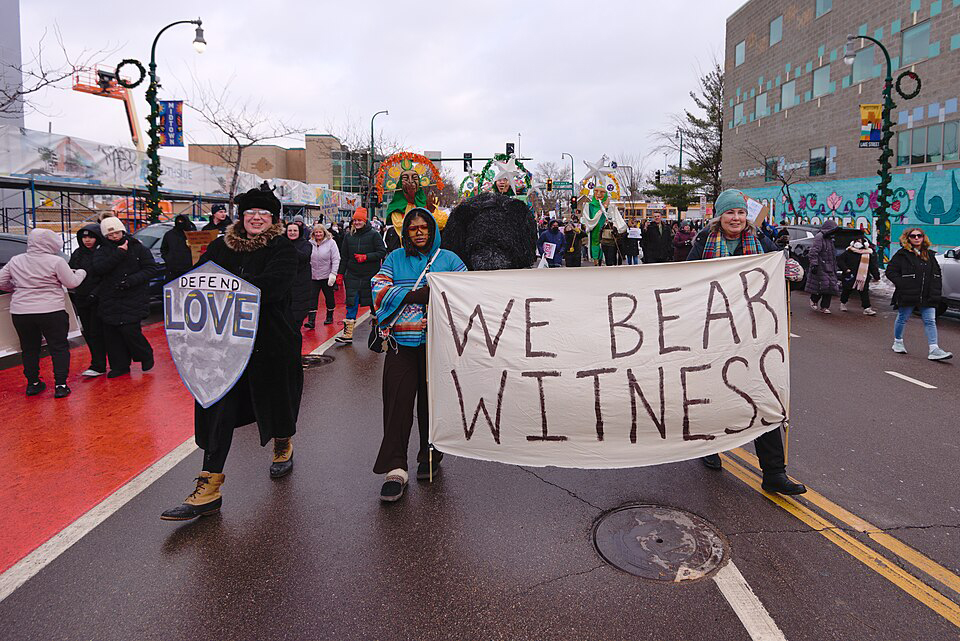
At the time that Operation Metro Surge was being carried out, I was participating in an anti-racism circle where the question was raised, “What are acts of resistance?” We responded with the usual – protests, sit-ins, walkouts, general strikes – but the response that touched me with its humanity and profundity was simply, “kindness.” As journalist Michelle Norris said of the resistance in her hometown, it was a “cocktail of kindness, community, and creativity.”[i]
The group Haven Watch began with an act of kindness. When Natalie Ehret brought hand warmers, cookies, and protein bars to observers and protestors outside the Whipple Building detention center, her son found two girls who had just been released without coats or phones or rides home. He gave them food and water, brought them to their car and gave them his phone to call home. That’s what Haven Watch does now every day. Volunteers wait outside the Whipple Building where detainees are released, often in the middle of the night and even in winter’s frigid temperatures, without warm clothes, food, water, phones, ID, or transportation and provide them with a warm sheltering car in which to wait for a ride, a phone, food, water, or a warm cup of cocoa. They have extended their mission to providing help with legal and immigration questions, healthcare referrals, economic needs, and more.
The kindness of Minnesotans extended even to those who sought to oppress them. When an ICE agent had a seizure while taking two women into custody, they provided him with medical care. When far-right activist Jake Lang was confronted with counter-protests to his anti-Islam protest in the midst of Operation Metro Surge, he was pulled to safety by Isaiah Blackwell, an African American man, and then was driven away by two unsuspecting Black women who saw only a bloodied man running down the street. They responded simply to his humanity.
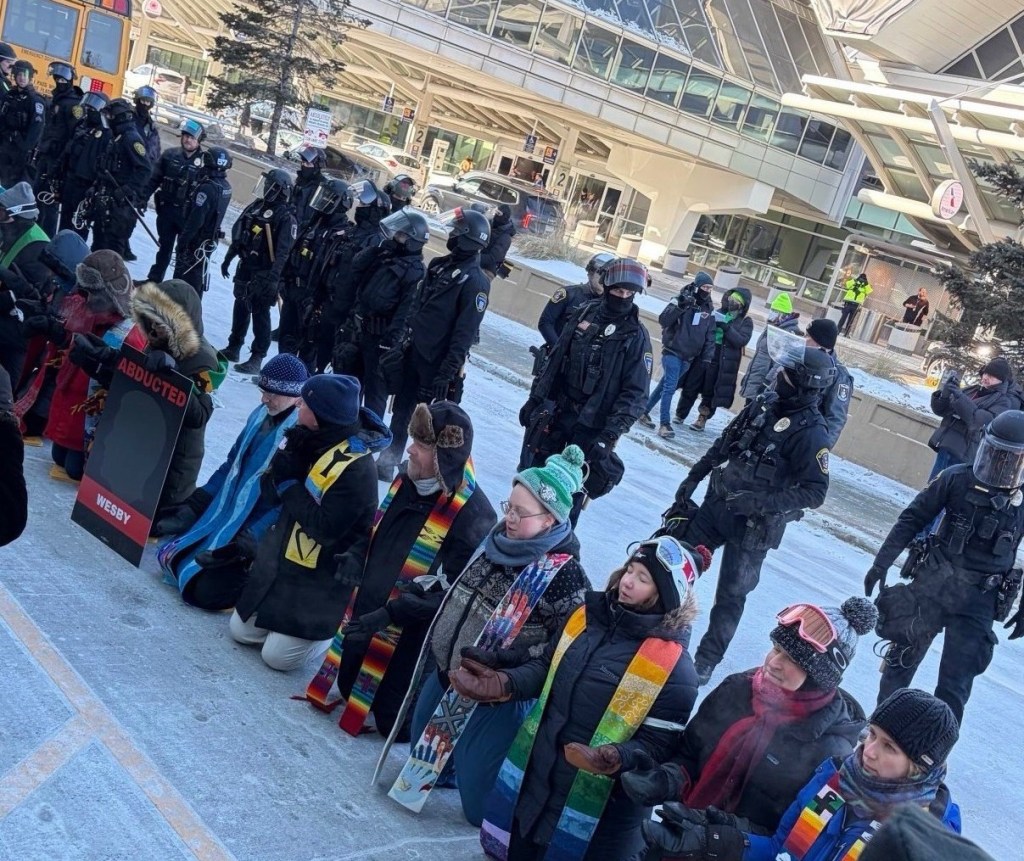
The people of Minnesota responded to the attacks on immigrant neighbors with individual and communal acts of kindness – mutual aid in the form of grocery runs for those afraid to leave their homes, raising money for rent and electricity and medical bills for those unable to work for fear of being detained, taking children to school or bringing their schoolwork home, arranging playdates for kids who had been forced to stay isolated in their homes out of fear, massive food and diaper distributions, and just checking in and helping to meet everyday needs.
The Minnesota resistance to the siege of violence, intimidation, and oppressive actions has been the best of what Albert Camus called the ethic of rebellion – of at once saying ‘no’ to injustice and ‘yes’ to the inherent dignity of every individual. More than acts of sheer opposition, it has been grounded in positive acts of love and support, collaboration and community, and deep regard for the humanity of all – solidarity at its finest. It has been, to use Camus’s words, a movement of “insane generosity . . . which unhesitatingly gives the strength of its love and without a moment’s delay refuses injustice. . . .it is the very movement of life. . .”[ii]
The people of Minnesota showed the world that, to quote Mulford, “There is an alternative to violence. . . .We can . . . keep our ethical ideal relatively uncorrupted and at the same time overcome invaders and correct social injustice. In fact, we can in the long run accomplish these objectives better through non-violent than through violence, even against ‘totalitarian’ systems. . . . In trying to work out techniques and strategies of non-violent power, [nonviolent resisters] endeavor to show us how we can keep our integrity as human beings both with respect to means and in relation to ends. . . .”[iii]
Sources
Anti-ICE protestors use annual sled art event to hit out at Trump
Camus, Albert. The Rebel: An Essay on Man in Revolt. Trans. Anthony Bower. New York: Vintage Books, 1956.
Hutton, Rachel. “From ‘The Good Life’ to good neighbors.” The Minnesota Star Tribune. March 6, 2026. E 1,4.
Sibley, Mulford, ed. and with an Introduction and Afterword by. The Quiet Battle: Writings on the Theory and Practice of Non-violent Resistance. Boston: Beacon Press, 1963.
Walsh, Paul and Kim Hyatt. “The Black man and women who rescued anti-Islam Jake Lang from protestors in Minneapolis.” The Minnesota Star Tribune. January 19, 2026.
Whistles become a tool of resistance and symbol of solidarity against ICE in Minneapolis
[i] Morris, quoted in Hutton. E 4.
[ii] Camus, 304.
[iii] Sibley, 2.
Discover more from Feminism and Religion
Subscribe to get the latest posts sent to your email.


“saying ‘no’ to injustice and ‘yes’ to the inherent dignity of every individual” is what sustained the protesters during the 60’s and led to the end of the war in Vietnam -… this approach can make a difference –
LikeLike
Absolutely.
LikeLike