


I’ve climbed on a stool (which I swore I wouldn’t do again after having a bad fall while helping a friend paint a bathroom ceiling) and up onto the washing machine. A cabinet door just above has come unhinged (not unlike this author). I have considered unscrewing it and taking it off, have located the proper screwdriver, but the screw will not budge, no matter how I contort my body in this small space. If I can’t get the cabinet door to stop flopping open, I will not be able to load the washer. My hope and salvation is…duct tape. So my husband stands holding the cabinet door more (or less) still while I tear off and attach pieces of duct tape, which will more (or less) serve my purpose, till someone more skilled can do a real repair.
“Do you remember,” I ask, “when I used to say, Douglas, fix it! Whatever needed fixing.”
“No, I don’t remember.” His response to most such queries. “I don’t remember that at all.”
I do remember. Now that I have taken over everything in our lives, I have been disturbed, as a lifelong feminist, to realize how traditional in many ways our division of labor used to be, when I had believed it wasn’t. We pulled in harness pretty well, both doing our share of cooking and housework without much conflict. We shared childcare to some extent, though our styles conflicted. We had separate bank accounts and divided up the bills, but complex finances and taxes were his, and yes, dealing with trash and recycling. Like many women, I took care of the human affairs, family on both sides, community. I cultivated many friendships, my own and ones we shared. He was content with what I provided and did not pursue friendships on his own.
The first signs of dementia probably appeared as early as 2018. By 2024 he gave up driving when the auto insurance company cancelled his/our policy due to his many fender benders. My learning curve began in earnest. I discovered I’m good at record keeping and finances and have some ability to understand how things work—and break down—though my repair skills, as noted, rely on duct tape. “I don’t want to figure out one more thing!” I have been known to rail. Yet I am absurdly proud of myself when I do, always remembering that women who are not in such traditional marriages have always exercised these skills.
Dementia progresses and/or regresses. He has no short-term memory and not much long term. His confusion increases. He sometimes hallucinates. I can’t leave for more than an hour or so without arranging for someone to be with him. I maintain my counseling practice working from home on zoom, but I have finally accepted that I don’t have the focus to start a new novel. I keep faith with the muse by writing a poem a day good, bad, or indifferent. I will close with a small selection.
waking
I wake as so often, screaming
help! silently as you do in nightmares
when your voice too is lost
and you can’t run. and then
you remember your waking life,
the outlet that won’t work
a beloved plant that fell like
a tiny tree, its trunk-like stem
broken. your husband’s mind
not all there. “No I don’t remember
what a circuit breaker is.” the transit
between waking and sleeping
even more uncertain for him.
it takes time and determination
to summon courage, it takes
coffee savored after the first round
of chores are done. I’ve
committed to drinking the whole
cup as I sit in the rocking chair
letting my mind racket till
it’s almost quiet and the sun rises
further and further to the north, then
I set down the cup and listen for wisdom:
“it’s not a nightmare, it’s just life.”
sartorial crisis
does he need help dressing?
the neurologist asks at every visit
no, I always says, not adding
of course not, it won’t come to that!
and now it has, several mornings
he insists he can’t find pants
at night he has pajama bottoms
below and a dress shirt on top
today I found him in rain pants
which at least fit him, but….
his drawers are crammed with
clothes that might or might not.
pants, shirts, socks, all crowded
together from top to bottom drawers.
if I don’t want to spend my
precious contemplative coffee time
letting the coffee grow cold
while I rummage and reason
without much result, I need to
(please goddess no!) take charge.
grace
can grace be this simple?
is it a synonym for surrender,
not as I will but as it fucking is,
crying uncle, letting life,
in its infinite inscrutability, win?
all I know is all at once
everything seems gentler
the blossoms passing so soon
the hard-to-reach receptionist
my stubborn demented spouse
saying thank you instead of fighting.
some voice in me murmuring,
“you don’t have to give anymore
than you’re giving, which is
everything. the troubled world?
you’re just part of it. escape
routes blocked? just take it easy.
you have nothing left to prove,
nothing left to do but whatever’s next,
no one thing more important
than another.” maybe this is grace
but I don’t need to decide.
I have no idea if it will last.
I can’t tell the fleeting from
the eternal. what mortal being can?
I am glad I made no predictions. Grace, or my ability to receive it, comes and goes. My new tagline for myself: “I have the im/patience of a saint.”
dementia
dementia is slowly,
quickly taking over two lives.
when I am not angry,
I am scared. surely rage
and fear skirt oceanic grief
too vast to explore—I dash
off poems on the changing
shore.
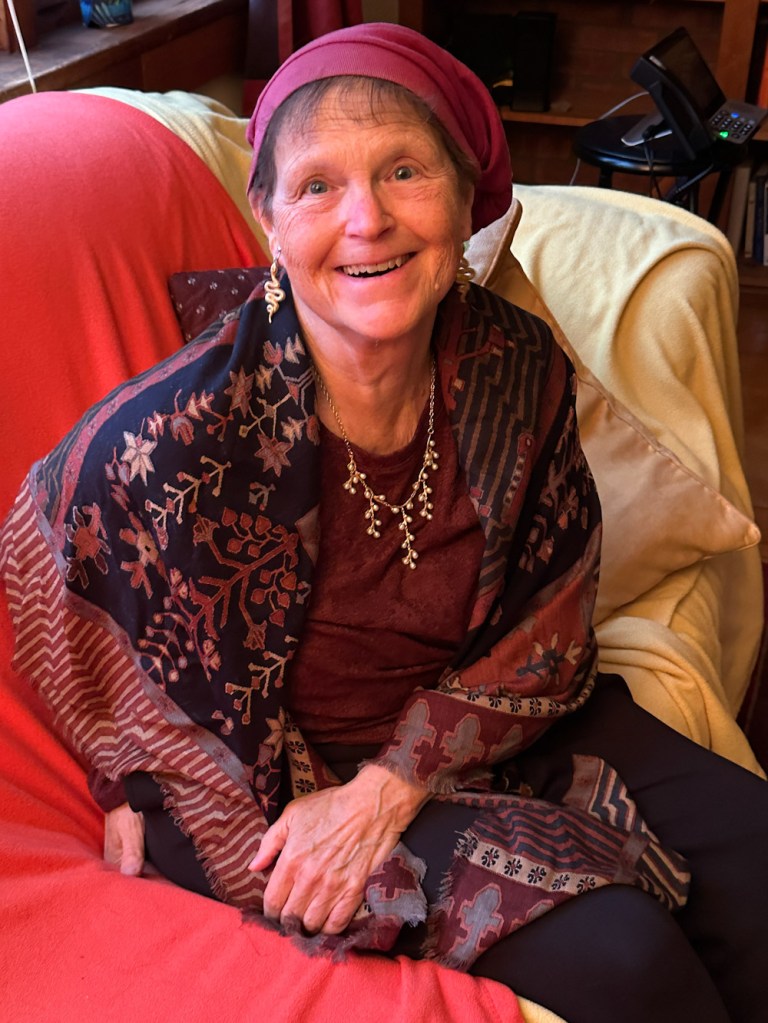
Elizabeth Cunningham is the author of ten novels, including The Maeve Chronicles, and five collections of poems. Her most recent work includes Over the Edge of the World, a fairytale novel and Holding Our Brokenness, a gathering of poems. She is a long time reader and occasional contributor to FAR. For more please visit her website: https://elizabethcunninghamwrites.com/
Discover more from Feminism and Religion
Subscribe to get the latest posts sent to your email.


Oh, those last few lines…The poet in you RISES like a Great White Bird flying free. What extraordinary courage it took for you to pen this heartrending story… I applaud your willingness to allow yourself to be so vulnerable -what happens to us when we suffer alone is that rage and grief run sideways and this is what we must really fear. Who knows who you helped by writing about how impossible mental deterioration can become… you certainly helped me and hopefully there will be other women who will have the courage and the willingness to share their stories too – such as stupid thing to say – but life just is – punctuated by moments of grace – and yes, grace does enter opening dark doors when we least expect it to help us keep going. Maybe this is the time for the poet in Elizabeth to takeover? Oh Elizabeth my heart goes out to you -our situations may be different but inside we are one…. Thank you
LikeLiked by 1 person
Thank you so much, Sara. Your words go right to my heart and bring hearts ease. Thank you for your words of encouragement to the poet in me from the poet you are. I often think of you when I have moments of communion and grace with the green world. Thank you!
LikeLike
Oh I don’t think I am even a poet – I just write stuff as it appears in my mind in that weird style I use – there’s probably no such thing – sort of like the rest of my writing! However you are a poet!
LikeLike
so sorry my reply yesterday did not post. It was about the way you see, relate and describe trees, flowers, streams, forests, bears, birds, your beloved canine companions, Lily B, and on and on. Whether is poem or prose, pure poetry!
LikeLike
Thank you dear Elaizbeth – as you know I write because it is my primary survival tool besides the shrinking shrinking woods… – and images just pop up!
LikeLike
This is beautiful, Elizabeth. This sentence says so much: “He was content with what I provided and did not pursue friendships on his own.” That “emptiness” (if you will) becomes heavier and heavier as the years pass as married women (of a certain generation) shoulder all that empty weight. Dementia, I’m sure, brings it all to the fore.
LikeLike
Thank you, Esther! Yes, dementia brings everything to the fore and things I never anticipated. I am grateful to have the friendships which do benefit us both! Thank you for reading and understanding.
LikeLike
Thank you, Esther! Looks like my previous response did not come through. Thank you for your insightful reading!
LikeLike
I was so touched by your post, your poems, your truths. I’ve walked this walk with a close friend, whose husband also had dementia, my father, and more intimately with my sister. “It’s not a nightmare/just life” . . .It’s difficult when the two seem to merge. What resilience and grace that you continue to write a poem every day, that you wrote this beautiful piece and shared it with us. Thank you.
LikeLike
Beth, thank you so much for reading and for responding. So sorry for all the loss you’ve witnessed and experience. My father, mother-in-law, and two close friends had dementia, but this, as you said of your sister, is more intimate. Your kind words are a comfort and an encouragement. Thank you again and thank you for all your beautiful, thoughtful writing here on FAR.
LikeLiked by 1 person
Thank you for so poignantly sharing your experience. In the poem, this line resonates deeply, “dementia is slowly,
quickly taking over two lives.”
LikeLike
Thank you so much!
LikeLiked by 1 person