Practical Lessons in Kindness from the Grasshopper and the Ant by Barbara Ardinger

(With apologies to Jean de La Fontaine for significant changes to his fable)

Note: We watch TV or read posts on the social media, and what do see? People attacking other people. People with guns shooting other people. Racist and fascist groups trying to stomp our democracy into the mud. I first wrote this story several years ago for a Llewellyn annual. A few years later, I secured permission from them to post it on this site. I’m reposting it today because—especially on Independence Day—we need a few chuckles and some practical lessons in kindness. My friends, I hope you enjoy this story.

“Curses on that grasshopper!” exclaimed the ever-busy Madame Fourmi. “All he ever does is play. He’ll be sorry when winter comes.”

Continue reading “Practical Lessons in Kindness from the Grasshopper and the Ant by Barbara Ardinger”

A Wish-Fulfillment Dream by Barbara Ardinger


Rest awhile, Dear Reader, and dream along with me. We’re standing on a corner, call it Main Street, Any City, USA. We’re chatting, passing the time of day, being happy we can stand among other people without the fear of a giant virus jumping out of someone’s breath and attacking us. It’s a nice day here on the street. Not much traffic.

Oh, look—there’s a huge box in the middle of the intersection. It’s shabby, looks to be made of old, thin wood loosely clamped together. The box starts shaking, rocking back and forth. What’s in there? Something is obviously trying to get out. As we watch, an orange mist starts seeping out through the cracks in the box. More shaking. Now the box seems to be jumping. More orange mist. And the box shatters. An orange form—is it human? It’s fat. It’s shaking an iPhone. Or is that a golf club? The orange one speaks. “Do you miss me yet?” “Stand back and stand by.” “I’ll be baa-ack.”

Continue reading “A Wish-Fulfillment Dream by Barbara Ardinger”

Thrice-Born Athena, Pt. 3 by Barbara Ardinger

Note: If you’ve been reading Athena’s story for the past two days (link to Part 2 here), you know what’s happened to her before her third birth. You’ve read her version as I heard it in my mind and wrote it down. Part 3, here, is mostly speculative, based on hints in books I’ve read during the past twenty-plus years. If you’ve read The Greek Myths by Robert Graves (who is said to be The Authority), you’ve met Medea in the context of the yarn about the Golden Fleece, but I’m leaving Jason out of this story. I’m also leaving Theseus (also associated with Medea) out. These boys have no role in Athena’s story of her meeting and her shamanic rebirth at the hands of the great Medea, who is sometimes called a sorceress. Read on.

Athena

And so with the help of the great Hera, who remembered how I had once loved her (and she still loved me), I left Zeus’ stony kingdom. Hera helped me depart, though I soon forgot her help. I suppose she is still there. After all, her own lands had been taken long before, her own throne stolen long ago, her temples and altars supplanted. I suppose she has nowhere to go now. For all I know, great Hera remains at the declining god-king’s side, where poets still deprecate her and laugh at her and call her a nagging wife. A god-king as impotent as he is now needs such a strong wife, does he not? I regret that I no longer know her.

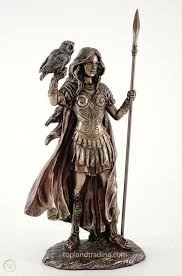
But I could find no other kingdom that would give me charity or honor, found no other king or god who would wed me or let me speak for him, and so I become disillusioned with kings and gods and epic tales. I put down my spear and shield and abandoned my armor and helmet, though I always kept my owl (who often flew above me) and my ragged plume.

And so, twice homeless, twice born and twice dead, friendless and scorned by the men I had so harshly judged, I wandered through the world, and all anyone saw was a woman, a gray, anonymous woman carrying a stick and a drooping feather. I walked up and down in the world and had no home. I had neither friends nor sisters nor protégées to honor me, neither priestesses nor queens to love me. I had no one at all. I had nothing at all. I wandered alone through all the lands around the wine-dark sea, alone in the lands around the central sea, alone in the lands along the ocean sea and the northern sea. For uncounted years I wandered alone, stopping here and there, but never staying anywhere, searching for what I never found and no longer remembered. I went in a plain gray cloak with my stick in my hand, my sad plume in a pouch at my belt. Sometimes I ate, but more often I went hungry. Up and down upon the earth I walked, and so my pride and anger began to be worn away.

Continue reading “Thrice-Born Athena, Pt. 3 by Barbara Ardinger”

Thrice-Born Athena, Pt. 2 by Barbara Ardinger

Read Part 1 here.

Note: This part of the story concerns what nearly everybody who has read the mythology knows about the Goddess of Wisdom. But what you’ve read in, say, Edith Hamilton or Robert Graves is the patriarchal version. What would the story be like if Athena told it herself? That’s what I imagined as I wrote her story. Read on to learn more about her Greek incarnation.

Athena

After our tribe was conquered by the warriors who lived across the seas, I wished to die, and I was indeed close to death when I was carried off by the bloody hero who fancied me. I longed to die every time he violated my body, every time he crushed my mind. But I was carried away alive, a living trophy for that warrior-king. I was secured in his warship as it sailed across the sea to his hard and stony land. Weak though I was, men still fought over me. Eventually I was claimed by their god-king Dyaus, whom you may know by his commoner name, Zeus. I was claimed as his prize of war, dragged up the stony mountain that came to be called Olympus, and flung into his harem until I should become strong enough to bear his weight upon me in mating. And still I longed to die.

Continue reading “Thrice-Born Athena, Pt. 2 by Barbara Ardinger”

Thrice-Born Athena: A Secret History (Part 1) by Barbara Ardinger


Note: Inspired by Mary Sharratt’s excellent post on February 13 about the heroine’s journey and by Elizabeth Cunningham’s beautiful novel
The Wild Mother (who is Lilith), I took a dive into my archives and found this story about Athena, which I first wrote back in the late 1980s. That was about the time the Goddess rapped me on the head, so to speak, and said, “Pay attention.” The story is based on research I did at the time. I’ve now done some rewriting for FAR. Read on and hear the voice of Athena not as a player in the usual Greek myths but as a goddess of wisdom who is one-unto-herself.

  Athena

My first birth was in the dark continent to the south of the Black Sea, always described by Homer (who invented much of what you take as true in his two long stories) as the wine-dark sea. That is, I was born in what is now Libya in northern Africa. I was born in a many-chambered palace beside a clear lake and received into the world by a tribe of strong women. I was the first-born child of Metis the Wise. You may have read that Metis was the daughter of Oceanus and a Titaness of great cunning; that’s what the “traditional wisdom” says about her. Not true. Metis was one-unto-herself, the queen of a great tribe, holder of the sacred serpents, and painter of wild scenes on tall red cliffs that exist into your day. I was the daughter of daughters from the beginning of the earth, whom some have called Amazons. I knew nothing of that name, however, for I was simply a much beloved child of a thousand thousand foremothers and a hundred living mothers.

Continue reading “Thrice-Born Athena: A Secret History (Part 1) by Barbara Ardinger”

What’s Done Is Really Done by Barbara Ardinger

This is an encore performance of a satire I wrote in November 2019, when I thought Trump’s sociopathic behavior was at its height. Little did I know. Little did we know. Only a year later, following the 2020 election, we watched him lie and deny, spread conspiracy theories, and finally encourage his true believers to invade the Capital and “stop the steal.” It’s good to see that President Biden is a normal person who knows what presidential behavior and work really are. A small example: right after the inauguration, we watched him signing executive orders. Did he use a Sharpie? No. Biden used (and still uses) a normal pen to sign his name. And he doesn’t wave an illegible signature at the TV cameras.

Two brief notes: In his novel Metamorphosis, Franz Kafka does not say the protagonist is turned into a cockroach. He’s an ungeheures Ungeziefer, i.e., a “monstrous vermin.” But if you want to see Trump as a roach, that’s fine. Note also that Trump’s answers are spoken by Dogberry in Shakespeare’s Much Ado About Nothing. Dogberry, Messina’s police constable, is probably the stupidest character Shakespeare created. And so, here’s the encore. Enjoy! (And let’s squash that bug!) Continue reading “What’s Done Is Really Done by Barbara Ardinger”

A Handy Spiritual Practice By Barbara Ardinger

Here’s a simple spiritual practice that I’ve been doing for longer than I can remember. During the regime of the Orange T. Rex, I started doing it at bedtime to calm my mind so I could go to sleep. We’re hopefully living in a more optimistic and peaceable time now, but that’s no reason not to add a new spiritual practice to our lives. I hope you’ll like this one and will try it for yourself.

We’re accustomed to seeing people praying with rosaries or reciting mantras and counting repetitions with strings of beads. We can do that, too. But how about using a simpler “tool” to keep track of our mantras and affirmations—our own hands?

How to use your hand? Make a fist and extend each finger as you say its affirmation. If you’re seated, lay your hand on the arm of the chair or in your lap and tap one finger at a time. Or just find your own way to keep track.

In the next paragraphs, I interpret what the affirmations in the illustration mean to me.

Thumb: All seems well. Yes, this is ambiguous, but consider what we’ve been living through since 2016, especially in 2020 with the pandemic and the election. Perhaps things have improved now. Perhaps some things do seem well. This ambiguity is the baseline upon which the rest of the handy practice is built.

Pointer finger: All things shall be well. This and the next finger are my paraphrases of the writing of Dame Julian of Norwich (ca. 1314-1416), a medieval English anchorite. Dame Julian lived through the Black Death and the Peasants Revolt and was the author of Revelations of Divine Love, https://en.wikipedia.org/wiki/Revelations_of_Divine_Love which is the first surviving book in the English language written by a woman. An interesting note about the conjugation of English verbs: the declarative (everyday) mood is I/we shall, you will, he/she/it/they will. Note that when the “shall” and the “will” are reversed—I/we will, you shall, he/she/it/they shall—we get the imperative mood. It’s emphatic. “All things shall be well” means that’s how it’s gonna be. When you say this affirmation (aloud or silently), say it emphatically.

Long finger: All manner of things shall be well. Again, my paraphrase. (What she really wrote is what she heard Jesus say in a vision: “All shall be well, and all shall be well, and all manner of thing shall be well.”) Let’s look more closely at my version. “All manner of things”: not just a few things, but many things. What do you see as “all manner of things”? Your own welfare? The welfare of your family and friends? What’s happening in your neighborhood, city, state, nation? Think as personally or as generally as you want to when you say this. (You can of course change what things shall be well every time you repeat this affirmation.) Emphasize “all manner” as you think about what you want to be well. Then also emphasize “shall be well.” We’re not giving orders to the universe, of course, but we can shout if we want to.

Ring finger: All can only be well. A typical metaphysical affirmation. As you repeat it, see it as a universal goal. Try saying it five times, stressing each word in turn. ALL can only…. All CAN only…. All can ONLY…. Et cetera.

Pinkie finger: Om tare tuttare ture soha. Because I took refuge with Green Tara during a weekend workshop taught by Dagmola Jamyang Sakya many years ago, I use the Tara mantra. Translation: “I prostrate to the Liberator, Mother of all the Victorious Ones.” (Well, I don’t do the proper Tibetan prostrations. It takes me forever to get up off the floor.) Another goddess mantra is Vishwa Shakti Avaham. Translation: “Universal energy of the Divine Mother [Shakti], be present in my life.”

You can of course make other choices for your pinkie finger affirmation. Here are half a dozen ideas. Use them and/or make up new ones. Let your littlest finger be strong enough to hold a big intention.

  1. Deena Metzger’s Goddess Chant: “Isis Astarte Diana Hecate Demeter Kali Inanna.” You’re invoking seven powerful goddesses into your life.
  2. “We are the flow, we are the ebb. We are the weavers, we are the web.” (Probably composed by Shekinah Mountainwater.) We are active parts of the benevolent universe.
  3. A Beatitude. Here’s one I like: “Blessed are the merciful, for they shall obtain mercy.” I have long believed that if Christians paid more attention to the Sermon on the Mount there would be less conflict in religious discussions.
  4. The opening line of a Psalm. Here’s Psalm 19 (AV): “The heavens declare the glory of God; and the firmament sheweth his handywork.” Open your own Bible and select the Psalm that speaks to your heart.
  5. These lines spoken by the exiled Duke in the Forest of Arden in Shakespeare’s As You Like It: “And this our life…/ Finds tongues in trees, books in the running brooks,/ Sermons in stones, and good in everything./ I would not change it” (II, 1, 562-65). As we’ve seen in many posts by the FAR community, we can find much good in and learn much from Mother Nature.
  6. The first line of this Jerry Herman song from La Cage aux Folles: “The best of times is now.” Here’s the whole song from the 2010 Tony awards broadcast https://www.youtube.com/watch?v=PBZLCnF4KC0 as sung by Douglas Hodge (who won the Tony that year) and the whole cast. It’s enormous fun to watch. (Those are the Cagelles dancing in the aisles.) For a cheery and inspiring conclusion to your handy spiritual practice, learn and sing the whole song.

[Note: Many thanks to Jennifer Ardinger for turning my sketch of the hand into real art. Many thanks to Meloney Hudson for teaching me the Shakti mantra.]

Barbara Ardinger, Ph.D. (www.barbaraardinger.com), is a published author and freelance editor. Her newest book is Secret Lives, a novel about grandmothers who do magic.  Her earlier nonfiction books include the daybook Pagan Every DayFinding New Goddesses (a pun-filled parody of goddess encyclopedias), and Goddess Meditations.  When she can get away from the computer, she goes to the theater as often as possible—she loves musical theater and movies in which people sing and dance. She is also an active CERT (Community Emergency Rescue Team) volunteer and a member (and occasional secretary pro-tem) of a neighborhood organization that focuses on code enforcement and safety for citizens. She has been an AIDS emotional support volunteer and a literacy volunteer. She is an active member of the Neopagan community and is well known for the rituals she creates and leads.

It’s Time to Revisit A Christmas Carol By Barbara Ardinger

Scrooge … became as good a friend, as good a master, and as good a man, as the good old city knew…. Some people laughed to see the alteration in him, but he let them laugh, and little heeded them; for he was wise enough to know that nothing ever happened on this globe, for good, at which some people did not have their fill of laughter….. His own heart laughed: and that was quite enough for him. … It was always said of him, that he knew how to keep Christmas well, if any man alive possessed the knowledge.

You no doubt recognize this as the conclusion of A Christmas Carol by Charles Dickens, who wrote the book in six weeks in 1843 because the holidays were coming and he was nearly broke. He had to earn some money. The book was so immediately successful that it went into a second printing right before Christmas and has been in print ever since. There’s a memorable movie called The Man Who Invented Christmas (2017), starring Dan Stevens as an unstable Dickens. As the movie tells the story, most of the characters in the novel turn up in Dickens’ “real life” and either inspire or force him to write the book. Scrooge (Christopher Plummer) follows him all over London and forces him to confront his childhood. The climax is both dramatic and satisfying. Continue reading “It’s Time to Revisit A Christmas Carol By Barbara Ardinger”

It’s a New Day By Barbara Ardinger

It is just past mid-January. The almost-ex-prez is sitting at the desk, staring at his smartphone. It begins shaking in his hand. There is a pile of documents on the desk, his Sharpie lying on top. The Sharpie suddenly rises into the air, black ink dripping from its pointy end. Almost-Ex hears a strange sound and looks at the giant big-screen TeeVee hanging on the opposite wall. The TeeVee is sprouting red fur! It slides down the wall and lands on the floor with a furry crash. As it explodes, tiny people fall out and begin yelling in big voices. “It’s not over till the recount is done.” “Always attack.” “It’s a conspiracy.” “It’s Fake News.” “Don’t listen to nobody but us.” “We know the Real Truth.” “Never give up.” “Never give in.” “It’s time to fire—”

Almost-Ex fails to hear the door open. When he finally turns his head, someone is coming in. It’s a woman! She’s a goddess! She’s taller than he is. Continue reading “It’s a New Day By Barbara Ardinger”

Happy Thanksgiving by Barbara Ardinger

Will our families gather for Thanksgiving feasts this year? Will aunts and uncles and cousins come from near and far to sit around our dining room tables? Does anyone have a table that’s big enough for social distancing? As I write this before November actually arrives, it seems unlikely that we’ll have few traditional holiday events in our homes (or anywhere else) this year. Well, my friend, who cares? Let’s pretend our feasts will be just like they’ve always been.

Back before the turn of the century, I belonged to a group that met every month in my friend Sandy’s family room for companionship, study (we worked our way through two excellent books by Julia Cameron: The Artist’s Way and The Vein of Gold), celebrations of birthdays and other special events, and rituals honoring various goddesses. We also had potluck suppers. (That was when I found out I can’t even be in the same room with jalapeño chili peppers.) It was a friendly, caring group of about twenty-five women and a few men. Alas, many of these people have moved away, a few have died, and a couple have just disappeared. I miss this group. Continue reading “Happy Thanksgiving by Barbara Ardinger”