When I learned about the Navajo Beauty Way, I understood it to be a path in which human beings respect all beings in the web of life and live in harmony with them. But I didn’t understand why this path was called the “Beauty Way.” As a young woman, I knew that my worth was defined by many in terms of my ability to conform to ideals of female beauty promulgated in movies, tv, and advertising. I didn’t believe the Navajos were talking about beauty in that sense, but because of my conditioning, I was not yet able to fully grasp what they might mean by beauty. I would have called the way they were describing a “Way of Harmony” or a “Way of Respect for Life.”
The path leading to the Klapados Waterfall begins at the edge of an open meadow in the pine and oak woodlands of a mountain in the island of Lesbos. After driving several miles on a very rutted dirt track, we parked under an oak tree, crossed the meadow and scrambled down a winding path. After about 20 minutes, it ended at a stream surrounded by plane trees. From there, we climbed over rocks to reach a pool created by the seasonal waterfall.
On the day we visited it, the waterfall was only a trickle of cascading drops that moistened its moss-covered path to the pool. The roots of a plane tree growing at the top of cliff followed the path of the water, weaving a web over the rockface all the way down to the pool.
Moderator’s Note: We at FAR have been so fortunate to work along side Carol P. Christ for many years. She died from cancer in July 2021. To honor her legacy as well as allow as many people as possible to read her thought-provoking and important blogs we are pleased to offer this new column to highlight her work. We will be picking out special blogs for reposting. This blog was originally posted September 7, 2020. You can find the original post here to see the comments along with her responses.
This post was chosen to be first because it is so achingly beautiful as it speaks about joy, and healing. It truly shows Carol’s heart.
When I moved from Lesbos to Crete, I decided to take some 30 large and medium-sized handmade terra cotta pots acquired over the years along with me. As I had been living part-time in Crete for several years, most of the plants had died, but I managed to salvage freesia bulbs, chives, and cuttings from nutmeg-scented geraniums.
My friend Mavroudis helped me empty the soil into feed bags provided by a neighbor who keeps sheep. I decided to move the dirt too, as I didn’t fancy carrying numerous bags up to my apartment. The movers were not too happy about this, and by the time they were deposited higgledy-piggledy on my balconies in Crete, several of the pots were broken and the bags were leaking.
When I moved from Lesbos to Crete, I decided to take some 30 large and medium-sized handmade terra cotta pots acquired over the years along with me. As I had been living part-time in Crete for several years, most of the plants had died, but I managed to salvage freesia bulbs, chives, and cuttings from nutmeg-scented geraniums.
My friend Mavroudis helped me empty the soil into feed bags provided by a neighbor who keeps sheep. I decided to move the dirt too, as I didn’t fancy carrying numerous bags up to my apartment. The movers were not too happy about this, and by the time they were deposited higgledy-piggledy on my balconies in Crete, several of the pots were broken and the bags were leaking.
I mended the broken pots with trusty epoxy glue before I got sick, which was lucky, because, since then, I would not have been able to do it. A few weeks after arriving, I felt tired and had trouble eating. I was diagnosed with cancer and began chemo-therapy. I have little physical energy and spend much of my days resting in bed or sleeping. There are still many boxes to unpack and they can wait, but I felt the need to tend the balconies. Continue reading “With Beauty Around Me by Carol P. Christ”
Imagine my surprise when, a few days ago, I looked out my window to see a dappled horse munching on flowers in the field across the street from my house. In the next days I got used to her being there. I would look for her in the mornings and at odd times during the day. Sometimes she was visible and sometimes she was not. When I could see her, I would open the window and call out, “Hello, white horse, you are very beautiful.” Once or twice she turned her head to look at me and seemed to respond, “Thank you for noticing.”
Many hundreds of years ago, Sappho must have had a similar vision in a field near a grove of trees where she and her students waited for the Goddess to appear, for she wrote: “In meadows where horses have grown sleek among spring flowers, dill scents the air.“ These lines are part of a longer poem addressed to Aphrodite that begins: “Leave Crete and come to us.” In this place, “incense smokes on the altar,” there is a stream, there are apple trees and rose bushes and horses in a field of flowers. Continue reading “Visions of the Goddess: A White Horse by Carol P. Christ”
When I learned about the Navajo Beauty Way, I understood it to be a path in which human beings respect all beings in the web of life and live in harmony with them. But I didn’t understand why this path was called the “Beauty Way.” As a young woman, I knew that my worth was defined by many in terms of my ability to conform to ideals of female beauty promulgated in movies, tv, and advertising. I didn’t believe the Navajos were talking about beauty in that sense, but because of my conditioning, I was not yet able to fully grasp what they might mean by beauty. I would have called the way they were describing a “Way of Harmony” or a “Way of Respect for Life.”
Still, I wondered: why the Beauty Way?
Marija Gimbutas described the societies of Old Europe as peaceful, settled, agricultural, highly artistic, matrifocal and probably matrilineal, and worshipping the Goddess as the power of birth, death, and regeneration in all of life. Though I am impressed with the beauty of the many small works of art Gimbutas reproduced and interpreted in The Language of the Goddess, I sometimes inadvertently omit the words “highly artistic” when repeating in her definition of the culture of Old Europe. I have tended to view the fact that Old Europe was peaceful and matrifocal as more important than the fact that it was highly artistic.Yet this judgment is wrong. In calling the cultures of Old Europe “highly artistic,” Gimbutas was trying to convey her understanding that appreciation of the beauty of life was fundamental within them.
We have been taught that “high” or “great” art is most often monumental in size. The Pyramid of Giza is over 230 meters (756 feet) tall. The Great Sphinx of Giza is 20 meters (66 feet) high. The Parthenon rose to 14 meters (45 feet) and the statue of Athena inside it was 9 to 11 meters (35-40 feet). It is telling that we use the words “high” and “great” (originally measures of size) to describe the value of artistic creations.
Statue of Athena in Parthenon reproduction in Nashville, Tennessee
The purpose of monumental works of art is to diminish the viewer, to make the her feel small, to induce her to bow down, to worship, and to obey a power or powers greater and higher than herself.
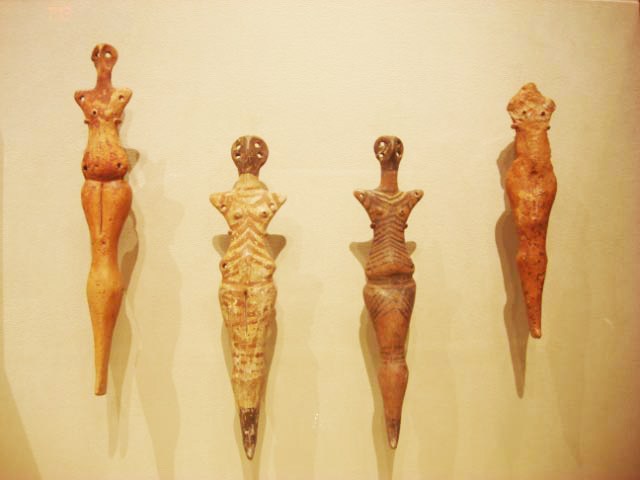
In contrast, the small scale of the art of Old Europe does not diminish anyone or anything. Its purpose is not to make anyone one want to bow down. Instead small works of art make the viewer feel comfortable, welcomed, and part of the beauty of life that is depicted.
Goddesses of Old Europe c. 5000 BCE
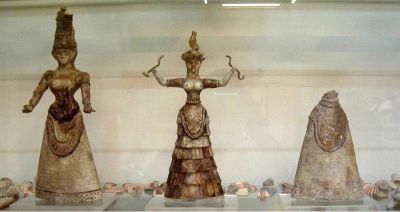
Marija Gimbutas viewed ancient Crete in the Bronze age as the final flowering of the culture of Old Europe. In Crete too, everything is on a small scale. Though the so-called Palaces or Sacred Centers are large, the rooms within them are small. There is not a single room where crowds could have bowed down to a King or Queen. Nor are there images of deities larger than life. The famous Minoan Snake Goddesses are less than 15 inches tall and the well-known pitcher Goddesses are even smaller. Such objects would have been held in hands during rituals or set on low benches in small rooms lit by oil lamps.
Snake Goddesses of Bronze Age Crete c. 1500 BCE
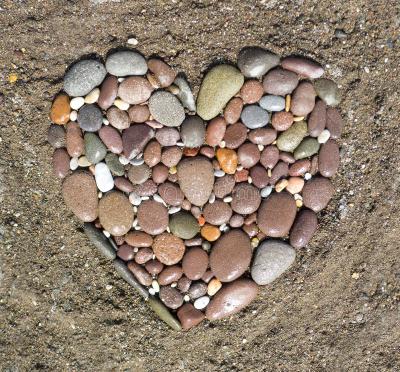
When my friend’s daughter Klia was seven years old, she spent her afternoons collecting stones by the sea. One day I asked her if the stones spoke to her. “Of course,” she replied. “What do they say?” “They say, ‘we are very beautiful.’”
Heart of stones in Lesbos
Klia intuited the meaning of the Beauty Way. It has nothing to do with artificial beauty standards. It has nothing to do with size. It is recognizing beauty everywhere and in everything. When we do so, we walk in beauty, in the grace and joy of life. And yes, the Beauty Way has ethical implications, for no one who truly recognizes beauty could want to harm it. This was understood by the Navajos, the Old Europeans, and the ancient Cretans, and many others. Only we seem to have forgotten. We can remember.



 When I moved from Lesbos to Crete, I decided to take some 30 large and medium-sized handmade terra cotta pots acquired over the years along with me. As I had been living part-time in Crete for several years, most of the plants had died, but I managed to salvage freesia bulbs, chives, and cuttings from nutmeg-scented geraniums.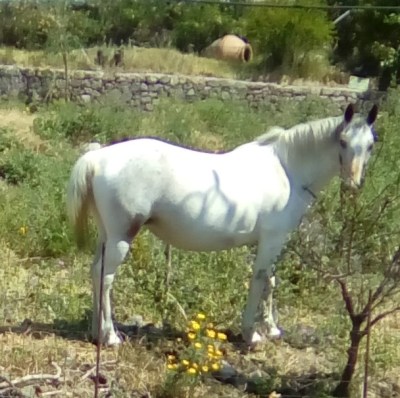
 When I learned about the Navajo Beauty Way, I understood it to be a path in which human beings respect all beings in the web of life and live in harmony with them. But I didn’t understand why this path was called the “Beauty Way.” As a young woman, I knew that my worth was defined by many in terms of my ability to conform to ideals of female beauty promulgated in movies, tv, and advertising. I didn’t believe the Navajos were talking about beauty in that sense, but because of my conditioning, I was not yet able to fully grasp what they might mean by beauty. I would have called the way they were describing a “Way of Harmony” or a “Way of Respect for Life.”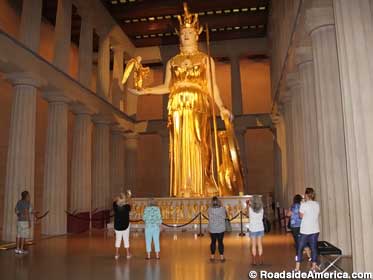
 Feminism and Religion