Empty Nest by Sara Wright

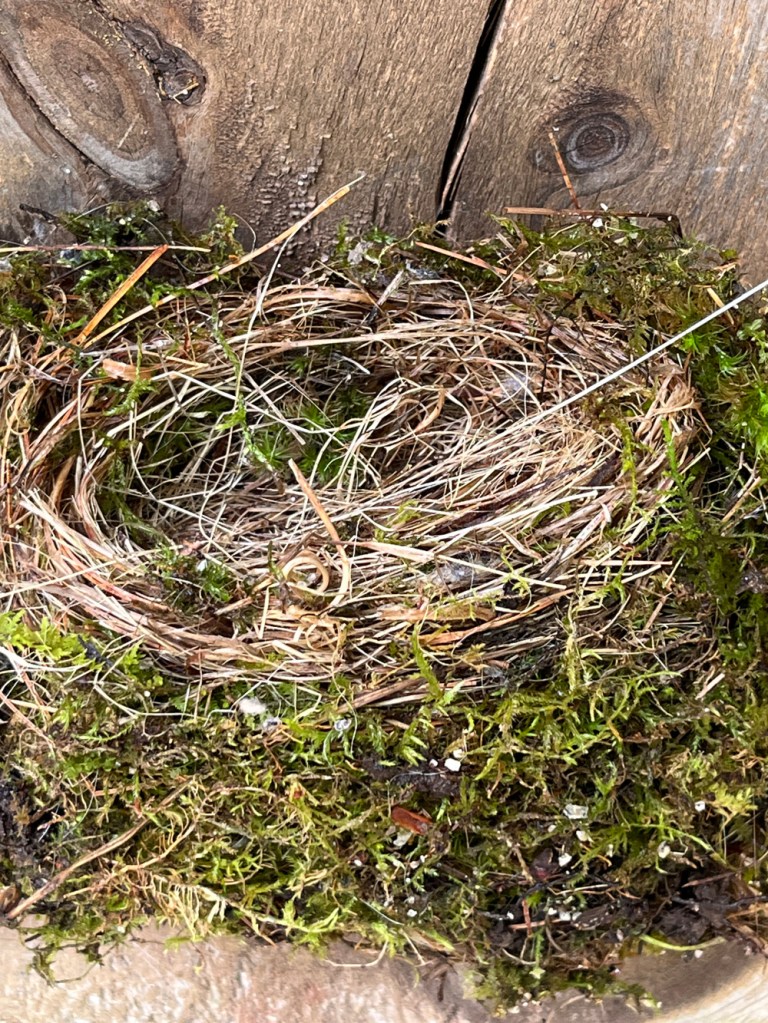
 She fluttered
out of a woven
mossy green
basket
above the door
at dawn
the
nest
had fallen
onto granite
stone.
Oh
my drowning senses
couldn’t
contain such grief
every cell
drilled
deeper
I gasped
this
cavernous
hole
had no
bottom
I continued
to fall
Nature had
Spoken
my silent
plea went
unanswered
Ki’s* message
was clear
I replaced
the nest
added a
cedar shingle
enticing
the phoebes
to return
listened
to a vibrating
body
whose mourning
bell
rang clear
Nature
had Spoken
my beloved
birds
and those
I loved
were gone.

Continue reading “Empty Nest by Sara Wright”

Deep Time and Dreaming by Sara Wright

   I am standing on top of a mountain looking over a landscape of unspeakable wild natural beauty that stretches as far as I can see. This is the ‘long view’ the dream -maker tells me. The trees are stretching out their lush green needles to the sky as if in prayer, and they are whole. The forests, clear waters, the animals, birds, insects. All of Nature has been returned to a State of Grace.

An Old red skinned Indian Man appears. He is a Grandfather. He is on the mountain with me but also stands below (both and). He speaks to me.

 “Sit, listen, this is the Song of Life”.

 A finely crafted flowing red clay seat appears below (it flows like a wave) although it is situated a few inches above the earth. Almost hovering. I also see a drum made from deerskin and red clay sitting on the ground. There is a four directional equilateral black cross on the skin of the drum. The cross is thick and around the cross an intricate design is etched/inked into its skin also highlighted in black.

Continue reading “Deep Time and Dreaming by Sara Wright”

Kinship, the Powers of Place, and Leavetaking by Sara Wright

What do I mean by the word kinship? I believe that kinship is the idea, and the belief that all aspects of nature from photons to galaxies are connected to one another. Practically, I think of kinship as my feeling/sense of being intimately linked to place/landscape. In my mind Kinship and Place are not only related, each is shaped by the other.

The powers of place are invisible threads that work by exerting a kind of physical and psychic pressure, pulling me into relationship. Place acts like an attractor site. My body behaves like a lightening rod or perhaps a tuning fork picking up information from the landscape. Once I have heard the “call” the door opens through my relationship with elements, trees, animals, stars or stones to name a few possibilities.

As this presence manifests through its individuals place begins to teach me what I need to know about an area and how I might best live in harmony with a particular landscape, if not its people. This learning occurs in bursts or very slowly just below the threshold of everyday consciousness. Either way, information seeps in through my body as I listen and pay close attention to what my senses are telling me. I allow animals, trees, plants to speak to me in their native language, and I note synchronistic occurrences. Information also comes to me through dreams. Eventually a discernable pattern emerges. My body acts as the bridge between self and the rest of Nature; the vehicle that keeps me connected to the whole.

Continue reading “Kinship, the Powers of Place, and Leavetaking by Sara Wright”

Legacy of Carol P. Christ: How To Find Those Lost Ancestors

 carol p. christ 2002 color

This post was originally published on Jan. 21st, 2013

Over the past year I have written several blogs on ancestor connection.  In this blog I will share what I have learned about how to find ancestors.

I recommend the popular television series Who Do You Think You Are? which has US, UK, and Australian, and other versions, and the PBS series hosted by Henry Louis Gates, African American Lives and Finding Your RootsWhile you might think, as I did, that genealogical research is about finding the names and birthplaces of ancestors, these programs set the genealogical quest in the great flow of history.

Records show that I have ancestors who immigrated to the United States from Ireland, Scotland, Prussia, and Germany in the early 1850s.  Historical research tells me that more than a million people left Ireland and Scotland in the 1850s due to the “potato famine,”* which affected the rest of Europe as well.  History explains why ancestors emigrated.

Begin your search by asking parents, grandparents, aunts, and uncles, for names, dates, places of residence, stories, and other information they remember.  Continue reading “Legacy of Carol P. Christ: How To Find Those Lost Ancestors”

Of Birds and Dogs –Invisible Birds and the Weaver by Sara Wright

Ovenbird nest by Geoff Dennis

I am not feeding my year-round avian friends in the hopes that ‘my’ phoebes can nest in peace above my door and raise their brood without red squirrel interference. Last night I startled a nesting mother by turning on an outdoor light, so egg laying has begun. Every day I apologize to my beloved chickadees who must find food elsewhere (for now).

It’s hard to ignore the truth. So many birds that used to be common around here are gone. Mourning doves and white throated sparrows are two species that I miss too much. Occasionally, I hear a solitary w/t sparrow’s call. In March one mourning dove visited for a day; the flocks are gone

In this space in between bird loss and my choice not to feed those that I recognize by sight and sound, I have gradually learned how to listen to the invisible warblers that have probably been here all along.

Continue reading “Of Birds and Dogs –Invisible Birds and the Weaver by Sara Wright”

‘Willowing’ at the Turning by Sara Wright

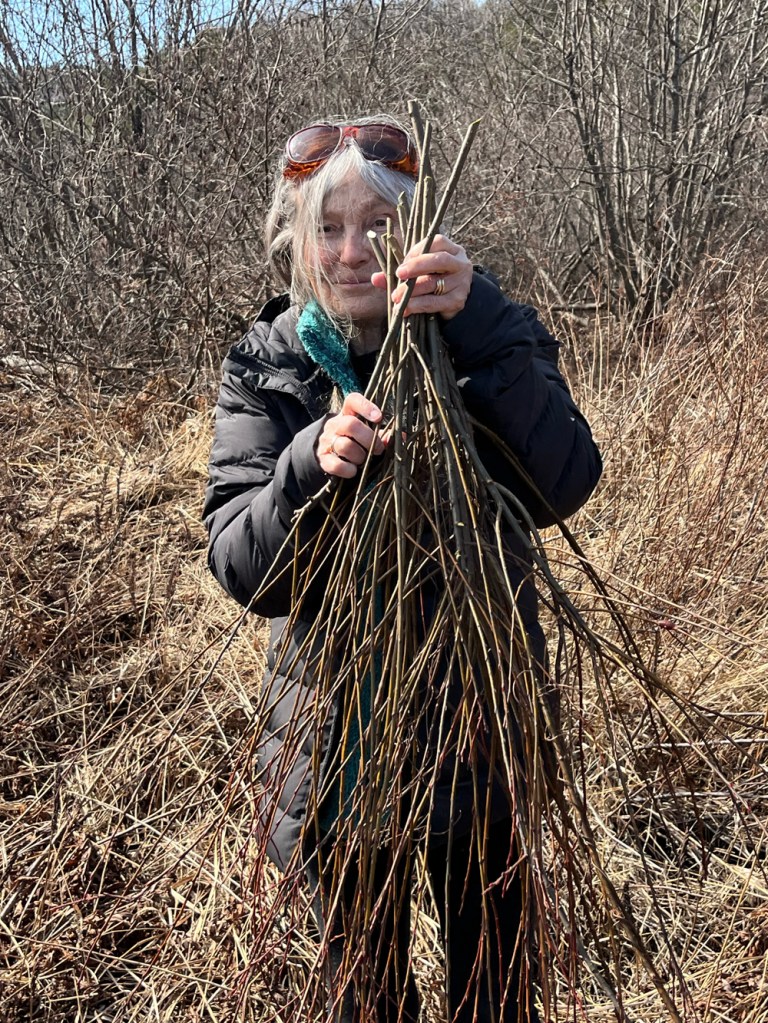
My relationship with and time spent with Indigenous peoples reinforced my intuitive sense that seasonal turnings like the Spring Equinox need to be honored and experienced when the ‘time’ is right. Time, in the Indigenous sense is fluid. Because of this learning I have come to understand that although it is important to write a little ceremony that includes guardians, elements, prayer, gratitude, framing intentions/release that I also need to allow the powers of nature to determine when the actual passage occurs. Indigenous people dance their ceremonies which helped me understand that any experience that transpires around these turnings may become the body of the ceremony if it feels right though the words were written earlier. This year around the equinox darkness reigned in every sense of the word. Having set my intentions, I waited, wondering when the door would open… yesterday it did, and this is the story of what happened. Only afterwards did I realize that in every sense we had honored and experienced the beginning of spring and the rising of clear waters.

My Vet and dearest friend made one of his unscheduled visits. The moment after I got the text my little dogs began to bark. This is normal behavior for both animals who adore their Uncle Gary and are tuned into him on levels that defy explanation (he lives more than a half an hour away). They bark until he arrives, regardless of whether this is a regular visit, or one that’s a surprise. We keep track of the exact timing of his leave – taking, their behavior and his arrival for fun.

Continue reading “‘Willowing’ at the Turning by Sara Wright”

Women and Trees: Little Red Pine by Sara Wright

Women and trees belong together; our relationships with them stretches back to antiquity. They have been our protectors, guiding us through grief and difficult times. They offer us gifts of beauty, fruits, and nuts, are receivers of prayers, sometimes speaking through prophecy. Sometimes healing springs appear at their feet. And always they are wisdom keepers, these Trees of Life. It is not surprising that women’s ceremonies were and are often enacted in the forest under a canopy of trees.

Weeping white tears

Emergence magazine recently posed three questions that I want to share because I think they might help raise awareness for women who love trees and the relatively small minority of other people who are attempting to deal with what is happening to the rest of nature during this political crisis and time of earth destruction.

Some folks who are not Indigenous still love and care for the land as a beloved friend, relative and teacher and it is to these people, both women and men, that I offer up these questions because I think they may help to keep us grounded in a painful but potentially creative way. Queries like these attach us to a larger long-term perspective that allows for a ‘both and’ approach to the future. The last question invites the reader to take personal action. Feeling that reciprocal connection between an individual and some aspect of the land s/he is attached to is a key that opens a door to deeper engagement with the rest of nature.

Continue reading “Women and Trees: Little Red Pine by Sara Wright”

Regeneration by Annelinde Metzner

This time one year ago, our world here in Appalachia seemed like it hadn’t changed in a thousand years.  The giant, churning, awesome power of Hurricane Helene had not yet whipped our waters into a frenzy, and caused the mountains to slide downhill, carrying our lives away.  And yet, from just below the earth’s surface, Spring reappears with all Her perseverance, Her steadfastness, Her fertile abundance.  The slow, steady regeneration of our Mother inspires me to keep going, day by day, hour by hour.

Primavera

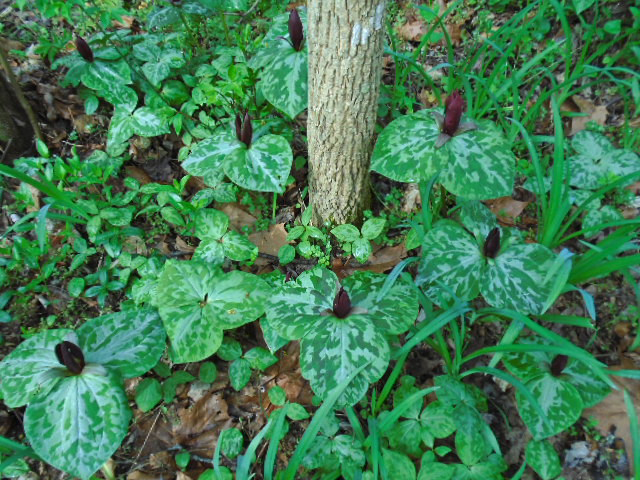
Toadshade Trillium

The newness of Spring, Primavera,
”first green,”
soft petals that banish Winter’s icy grip,
the return of the Galax, the trillium,
the return!
Full-blown rebirth,
bright, brilliant green shining in the sun,
Spring!
Rebirth decked out like a debutante
with a roomful of courtiers,
flipping the world from darkness to light.
Ferns unfurl,
fiddleheads play on the forest floor,
insects awaken and buzz 
in a hundred keys of life.
Humans awaken too, reminded once more
of the richness of the return.
A breeze blows over the galax,
the Mayapples spread their elegant leaves
The promise of the Great Mother:
we will begin again.

Continue reading “Regeneration by Annelinde Metzner”

Changing Woman’s Light, part 2 by Sara Wright

Last week Sara told the story of Changing Woman. You can read it here.

What I love the most about this story is that Changing Woman evolves from a woman who is passively acted upon into a self – directed deity  who stands up for what she wants and needs. A second reason I feel so strongly about this tale is that Changing Woman demonstrates the importance of having a relationship with more than human beings – animals and plants. A third reason I am so attracted to this myth is the gender balance that eventually evolves between the two – Changing Woman and the Sun. But I think the most important part of the story for all of us is that Changing Woman never dies. She grows old and then young again reflecting the powers of the Great Round to renew All Life.

Imagine if we were all brought up with this kind of myth to guide us…

  When I returned from NM five years ago, I brought home fragments of worked and unworked chert not realizing at the time that Changing Woman accompanied her stones and that they would continue to exert an influence on me. My relationship with that mountain is not distance dependent. I also continue to re – experience the wonder and awe I experienced as becoming part of that mountain, although these periods wax and wane like the moon. The Navajo call Changing Woman’s Mountain Tsip which means tree mountain and the Tewa use a similar word Tsip’in, to name this Being obsidian or flint mountain.  A shining mountain crafted of stones and trees, yes!

Continue reading “Changing Woman’s Light, part 2 by Sara Wright”

Legacy of Carol P. Christ: Connection to Ancestors in Earth-based Theology

carol p. christ 2002 color

This post was originally published on Jan. 14th, 2013

“I am Carol Patrice Christ, daughter of Jane Claire Bergman, daughter of Lena Marie Searing, daughter of Dora Sofia Bahlke, daughter of Mary Hundt who came to Michigan from Mecklenburg, Germany in 1854.  I come from a long line of women, known and unknown, stretching back to Africa.”

Like many Americans, my ancestral history was lost and fragmented due to emigration, religious and ethnic intermarriage, and movement within the United States.  Though one of my grandmothers spoke proudly of her Irish Catholic heritage and one of my grandfathers acknowledged his Swedish ancestry, I was raised to think of myself simply as “American,” “Christian” and “middle class.”  Ethnic and religious differences were erased, and few stories were told.

Over the past two years, I have begun to discover details of my ancestral journey, which began in Africa, continued in the clan of Tara, and was marked by the Indo-European invasions.  In more recent times, my roots are in France, Holland, England, Germany, Ireland, Scotland, and Sweden.  In the United States, my family has lived in tenements in New York City and Brooklyn, in poverty in Kansas City, and on farms in Long Island, Connecticut, upstate New York, Michigan, and Pennsylvania.  My parents and grandparents settled in northern and southern California during the 1930s.  I have lived in southern and northern California, Italy, Connecticut, New York, Boston, and now Greece.

Learning details about family journeys has created a shift in my sense of who I am.  Continue reading “Legacy of Carol P. Christ: Connection to Ancestors in Earth-based Theology”