Who Turns the Wheel? Gender in the Modern Pagan Year, part 2 by Myriapath

Part 1, yesterday traced how the eight-festival Wheel of the Year was assembled in the middle of the twentieth century from older ingredients, some surviving only in a line or two of medieval writing. It began with a blessing. Writing for this site in July 2017, Carol P. Christ closed a post with words that name no gender at all: “As we bless the Source of Life, so we are blessed.” We return to it at the end.”

The divine couple, and who was told no

The gendering was there from the beginning. Hutton describes Gardner’s earliest seasonal rites as pairing a god and a goddess, “a divine couple who were intrinsically linked to the annual cycle of winter and summer”, the god predominating in the cold-season festivals and the goddess in the warm-season pair.

The seasonal love story that many readers first meet as something ancient is a modern liturgical pattern, not a preserved pre-Christian myth. That does not make it less meaningful to those who keep it; it makes it datable.

The pattern also carried an exclusion. The World Religions and Spirituality Project, in its profile of the Minoan Brotherhood, describes Gardner’s Wicca as a “fertility religion” organized around male-female polarity, God and Goddess, high priest and high priestess, and records that “Gardner was homophobic and refused initiation to anyone whom he thought was homosexual”, noting that Alex Sanders and Doreen Valiente rejected that exclusion. A framework built on a heterosexual pair puts pressure on those it does not fit, and some people built elsewhere.

Continue reading “Who Turns the Wheel? Gender in the Modern Pagan Year, part 2 by Myriapath”
Who Turns the Wheel? Gender in the Modern Pagan Year, part 1 by Myriapath

A blessing, and a calendar younger than it sounds

Pick up almost any introduction to the modern Pagan festival year and you will meet a couple: a goddess of the growing season and a god born, crowned and cut down at harvest. Writing for this site in July 2017, Carol P. Christ described Lammas as the point at which “the young male God identified with the harvest … is sacrificed.” She closed the same post with a blessing that names no gender at all: “As we bless the Source of Life, so we are blessed.”

The eight-festival Wheel of the Year and its divine-couple story were assembled in the middle of the twentieth century by people whose names, meetings and dates are known. That recency is exactly why the wording has been open to revision, and revised it has been, in public and on the record. What follows traces that rewriting rather than judging it.

How the eight festivals came together

In a 2008 study in Folklore, the historian Ronald Hutton traces the eight festivals to two separate modern sources. The solstice and equinox feasts descend from Edward Williams, better known as Iolo Morganwg, who invented four Druidic solar festivals between 1792 and 1826. The quarter days come from Margaret Murray’s now rejected account of witch festivals.

Continue reading “Who Turns the Wheel? Gender in the Modern Pagan Year, part 1 by Myriapath”

Samhain Slowing by Molly M Remer

Today,
I sat and let both my breath
and my thoughts be soft,
extending my hands
and feeling my life and mind unclench
if only for these moments.
On Samhain morning,
we saw a buck
in the road,
trees still clad in autumn color
lit gold behind him
as he stood at the crossroads
before leaping away
between the trees.
On Samhain evening
we saw five bucks in the road,
young males teamed up
for this season of seeking and claiming.
On the drive home
an orange moon was on the rise
cresting dark trees
and peeking between hills
like something out of mystery.
I lifted my hand and blew it a kiss
this, my own solitary rite of Samhain.
On the first of November,
I sat with my memories,
naming off my most recent ancestors,
each face briefly coming to mind
as I felt grateful
for the oldest child privilege
of knowing each of them
in the flesh
and carrying the memory
deep inside me
of how my birth was celebrated
by so many loving people now lost.
We’ve had two frosts,
the hydrangea leaves
wilted to black,
the mulberry trees bare
and so we seek
the pines once more,
watching the sinking sun
illuminate the needles
and listening to the wind whisper
in the way it does
only through tall pines.
I feel my inner cauldron bubbling,
new ideas popping up
and beginning to rise.
But,
I stop and listen.
Now is not the time for production.
It is time for pine whispers
and slow mornings.
Time for tea and quiet reflection.
Time to be curious
about what might yet arise,
and yet,
patient
as it steeps.

Continue reading “Samhain Slowing by Molly M Remer”

Autumn Lessons, by Molly M. Remer

Keep it simple and sacred
whisper the trees,
let go with grace
and trust the turning,
watch how the leaf
rides the air
all the way to the ground.
Let life astonish you,
mess and magic all entwined.
Be patient with yourself.
Feel the mask slip away
as the mist rises
and mystery
invites you
in. 

I have now been writing for Feminism and Religion for 14 years. Last summer, I compiled a post with 13 summer lessons from 13 years of posts here at FAR. I bookended that post with a Winter Lessons post as well. And, then a Spring Lessons post. Now, finally, I am rounding out the series with thirteen lessons from Autumn:

Continue reading “Autumn Lessons, by Molly M. Remer”

Notes from the Cauldron of Change, by Molly Remer

Mirabai Starr writes that to be a mystic is to “harvest the bounty of your own soul garden,” a place that is “both wild and tended,” sometimes lush and sometimes arid.

As summer’s heat presses in
and the clamor of growth and change
rises to a peak of abundance and urgency,
we may begin to hear a summons
from deep within.
The cauldron call begins,
at first a whisper
and then an irresistible song
that leads us away from the to-do list
and into a mystical realm
in which dreams and desire meet
and begin to bubble into possibility.
May we grant ourselves space
for descent,
even in the middle of all that
is hot and bright and beautiful.
May we listen to the yearning we feel
to explore the depths,
stepping out of the light
and into the cool shadows
that beckons us to steep.
Right here,
right now,
in the middle of all that swirls,
is when we are invited to stop,
to put our ears back down
to our souls
and listen hard.
It is now that we are invited
to step into the cauldron of change,
to sink down
and in
and let everything we are carrying
soften and melt away
while we remember how it feels
to simmer in everything
we have made,
all that we love to taste
and serve.

For years now, August has been my “Cauldron Month,” a dedicated time in which I take my life into the metaphorical cauldron of being, to reflect, to re-collect, to reconnect, to consider what I’m “simmering” in, what is bubbling and brewing in my days, and what needs to be scooped out of the pot. It is time in which I review the year to date and consider where I’m going, what I’m savoring, and what I’m dishing up to serve.

Continue reading “Notes from the Cauldron of Change, by Molly Remer”

On Active Waiting, Counting the Omer, and Our Connection to Nature.

We wait.  We wait for the bus.  We wait for the spring to return. We wait for our first cup of coffee (or tea?  Do people actually wait for tea?) in the morning.  We wait at traffic lights.  We wait for test results.  We spend a lot of our lives waiting.

We also can’t wait.  To be 5 and a half.  To be an adult.  To start the school year.  To spend time with our friends.  To go on vacation.  To find a (new) (better) job.  We wait for a better world.  Waiting can be fraught with anything from nervous energy to debilitating anxiety.

This waiting happens for both seemingly insignificant but also profound reasons.  However, waiting does not mean inaction.  It does not mean that we sit around hoping something will happen for us or to us.  Yes, there are some aspects of life we cannot change or hurry the results.  Yet, there are many parts of waiting that require our active participation.

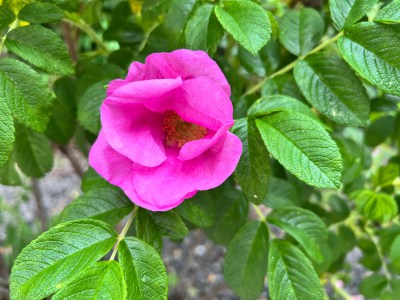
Author’s photograph of a rose.
Continue reading “On Active Waiting, Counting the Omer, and Our Connection to Nature.”

From the Archives: “The Czech Tradition of Čarodějnice (Witches).”

Author’s Note: This blog first published on May 14, 2023. Čarodějnice will take place this year on Thursday, April 30, 2026.

This post is a follow-up, in a way, to the post I published here on September 11, 2016, entitled “Continuing Pre-Christian Traditions in the Czech Republic,” and will be a combination photo essay* and elaboration on one of the rituals mentioned in that first post.  On April 30th, I was in the small village where my partner’s family has their summer house.  Yes, that same village that has inspired posts like this.  There, we celebrated Čarodějnice, or Witches. This holiday seems to be related to what is called May Day or Beltane in other countries. What is unique about this tradition isn’t necessarily the májka (May Pole) although it is different than other places May Pole, but the burning of the witch.

Throughout the day, everything is gendered.  The women and girls have certain tasks; the men and boys have too.  The women and girls create and decorate.  First, they create a witch to be burned on a large bonfire; the construction and shape of both can vary.  After creating the witch, the women and girls (although it should be virgins – but no one really follows that tradition) decorate the top of a cut-down, very tall pine tree with strips of brightly colored fabric and crepe paper, tying them on to create what will become vertical streamers blowing in the wind, thus creating what is called a májka.  

Continue reading “From the Archives: “The Czech Tradition of Čarodějnice (Witches).””

Spring Lessons, by Molly M. Remer

Let us trust the cycles
of retreat and renewal
alive in both the land 
and in our hearts right now 
as the melody of belonging 
continues to serenade us 
and we follow April’s determination 
to create and shape 
this world anew.

And, so,
April arrives 
all at once 
to enliven the land, 
trailing cool breezes 
and the first blush of pollen possibility 
across fields and forests, 
fence rows and farms. 
She blankets open spaces 
with purple clover and violets,
with chickweed and dandelion. 
When we pause to listen, 
we can hear the laughter of awakening rippling behind her. 
She brings an invitation into healing, 
into extending outward and reaching up. 
She offers wild promise 
and tender hope 
and the sweet, fresh breath of change. 
Let us soften into spring, 
into this invitation,
into restoration and reclamation. 
It is now that we choose. 
Let us be content to be here, 
witnessing the changes, 
leaning into the wind,
and savoring the blooming. 
Let us trust the cycles
of retreat and renewal
alive in both the land 
and in our hearts right now 
as the melody of belonging 
continues to serenade us 
and we follow April’s determination 
to create and shape 
this world anew.

I have been writing for Feminism and Religion for 13 years. This past summer, I compiled a post with 13 summer lessons from 13 years of posts here at FAR. I bookended that post with a Winter Lessons post as well. Now, here are thirteen lessons to share from past spring posts:

Continue reading “Spring Lessons, by Molly M. Remer”

In the Belly of Winter: Tending the Sacred Flame by Molly M. Remer

It is February, the belly of winter. We stand in the doorway between worlds, a thin, pale light ahead of us, just beginning to gather itself at the horizon. While life may feel still and inspiration frozen, something in us is listening for the first faint whispers of spring. In earth-centered, neopagan spiritual traditions drawing inspiration from old Celtic holidays, the holiday of Imbolc is on February 1-2. Imbolc is based on an old Irish word that means “in the belly.” One of my favorite reminders to myself at any time of year, not just February, is to cradle myself in the belly of the moment.* To be in the belly reminds us that we need not be focused on arriving or figuring it all out, instead we incubate, we gestate, we draw nourishment from deep within. We do not have to be ready. We are becoming. We are in the belly of winter, and the work of the belly is to hold, to warm, to nourish what is not yet visible.

In the middle of winter as well as in the middle of national crises, international conflict, and climate disaster, the world can feel grim and gray, and like hope and optimism are misplaced or even extinguished. We may feel burned out, used up, or simply too tired to offer anything of value.

Continue reading “In the Belly of Winter: Tending the Sacred Flame by Molly M. Remer”

A Prayer for Winter Solstice, by Molly M. Remer

A Prayer for Solstice
Winter’s Crone,
cave tender,
cauldron keeper,
mother of time,
guide us into stillness,
into a time of deep rest and reflection.
Unwind our knots
and soothe our scurrying,
remind us how to listen,
how to be still,
how to turn inward and know.
Remind us not to fear darkness
for it is a time of necessary patience and growth.
Help us to celebrate
the cycles of change
through which we move,
honoring the fallow times
and the flourishing times
as equally essential
for life.
Bone woman,
great mother of us all,
quiet our wondering
and our worries,
gentle our grief,
and soften our sorrow.
Restore our weary hearts
and renew our spirits
that we might turn
towards the light we carry within
and warm ourselves
by this,
life’s eternal and powerful flame,
knowing that we belong
to this great grand web of incarnation
and all it holds.