This post was originally published on July 6, 2011. Xochitl’s very first FAR post!
I love art. I especially love women’s art – women such as Frida Kahlo, Cathy Ashworth, Sudie Rakusin, and Alma Lopez. To me, their art is a reflection of women’s strength, creativity, and beauty. Frida Kahlo, for example, expressed so many aspects of herself and her experience through her art. In it one can glimpse her passionate love for Diego Rivera, her continuous physical pain, her search for meaning, and the unending hopefulness she maintained throughout it all. Frida Kahlo’s art, like her person, was vibrant and full of life, colorful and yet broken. She expressed the wide spectrum of her experience not in words only but in color and images, texture, paint and print. As she put it, “I paint my own reality” – her own reality is what she knew and it is what she painted.
Hildegard von Bingen (1098–1179) was a visionary abbess and polymath. She composed an entire corpus of sacred music and wrote nine books on subjects as diverse as theology, cosmology, botany, medicine, linguistics, and human sexuality, a prodigious intellectual outpouring that was unprecedented for a 12th-century woman. Her prophecies earned her the title Sybil of the Rhine.
Pope Benedict XVI canonized Hildegard on May 10, 2012—over eight centuries after her death. In October 2012, she was elevated to Doctor of the Church, a rare and solemn title reserved for theologians who have significantly impacted Church doctrine. Hildegard is the fourth woman in the entire history of the Church to receive this distinction.
When my husband and I decided to move out of the city, we knew what we wanted as an alternative.
We wanted land. Land to grow things, to raise animals, to build upon, to tend. We wanted blisters on our hands and calluses on our feet. We wanted to taste our sweat, feel our muscles burn, and then relax with some homemade beer in front of a roaring fire at the end of a long day. We wanted to harvest honey, gather eggs, spin fiber, and split wood. We wanted to raise sons and daughters to appreciate the sound of silence and the clarity of a night sky so clear that you can see the Milky Way in cold of winter. We wanted to be in community with other fellow homesteaders, sharing ideas and breaking freshly baked bread together. These were all things that had only been dreams when living in a cramped, rented apartment with little sun and neighbors who ducked into their houses before anyone could mumble a friendly hello.
And thus was the way that Mother Nature courted us. Her sensual beckoning drove us mad with desire and frustrated with impatience. She danced slightly out of our reach, ducking behind obstacles like home loan approvals and darting in and out of practicalities like job security and worries over distance from loved ones. Ah, she was a sly one, that Mother Nature. Her siren song was irresistible, and eventually, we bent beneath the strain. Continue reading “God As Seductress: The Call of Nature By Stacia Guzzo”
Recently Gina Messina-Dysert, on this blog, wrote about rape culture and the church’s role in preserving it instead of challenging the norm of violence against women and victim blaming. And in my last post, after having just watched the last installment of the Harry Potter movies, I wrote about Lily’s love for Harry as being what saves Harry and not the sacrifice of Lily’s life; my point being that we need to give more credit to love as salvific and redemptive and not to sacrifice or suffering. For too long within Christianity, Jesus’ death and ‘sacrifice’ have been held up as the core, the essence, the heart of Christianity – wrongly giving it a necrophilic emphasis that I do not believe is actually faithful to the Christian tradition. All this reminds me of why feminism is critical to my ability to stay within Christianity and that without feminism I would not be able to be a Christian-identified woman.
Every day in both small and enormous ways I see the effects and embedded patterns that result from the long history and dominance of patriarchy/kyriarchy. Everything from sexism and racism, to capitalism and the destruction of our world, these destructive systems are part of our daily environment and affect the quality of all our lives in devastating ways. And perhaps it is because I am a woman and I am directly and existentially affected, but, sexism, misogyny and violence against women are the things that most crush my spirit and break my heart. As I see these insidiously at work in many aspects of our society, and see the effects these have on us, women and men alike, I am saddened and angered to a level for which I have yet to find words to express. I feel it, the insidious trauma of sexism, misogyny, and violence against women, I feel their effects on me and others, but do so usually in silence or in tears. Lump in my throat. No words to speak. All I can do is continue in my commitment to live in a way that is different from these – in a way that is biophilic and affirming of all people as sacred and divinely in-Spirited. Continue reading “Speaking of Sacrifice and Rape Culture…by Xochitl Alvizo”
I love art. I especially love certain women’s art – women such as Frida Kahlo, Cathy Ashworth, Sudie Rakusin, and Alma Lopez. To me, their art is a reflection of women’s strength, creativity, and beauty. Frida Kahlo, for example, expressed so many aspects of herself and her experience through her art. In it one can glimpse her passionate love for Diego Rivera, her continuous physical pain, her search for meaning, and the unending hopefulness she maintained throughout it all. Frida Kahlo’s art, like her person, was vibrant and full of life, colorful and yet broken. She expressed the wide spectrum of her experience not in words only but in color and images, texture, paint and print. As she put it, “I paint my own reality” – her own reality is what she knew and it is what she painted.
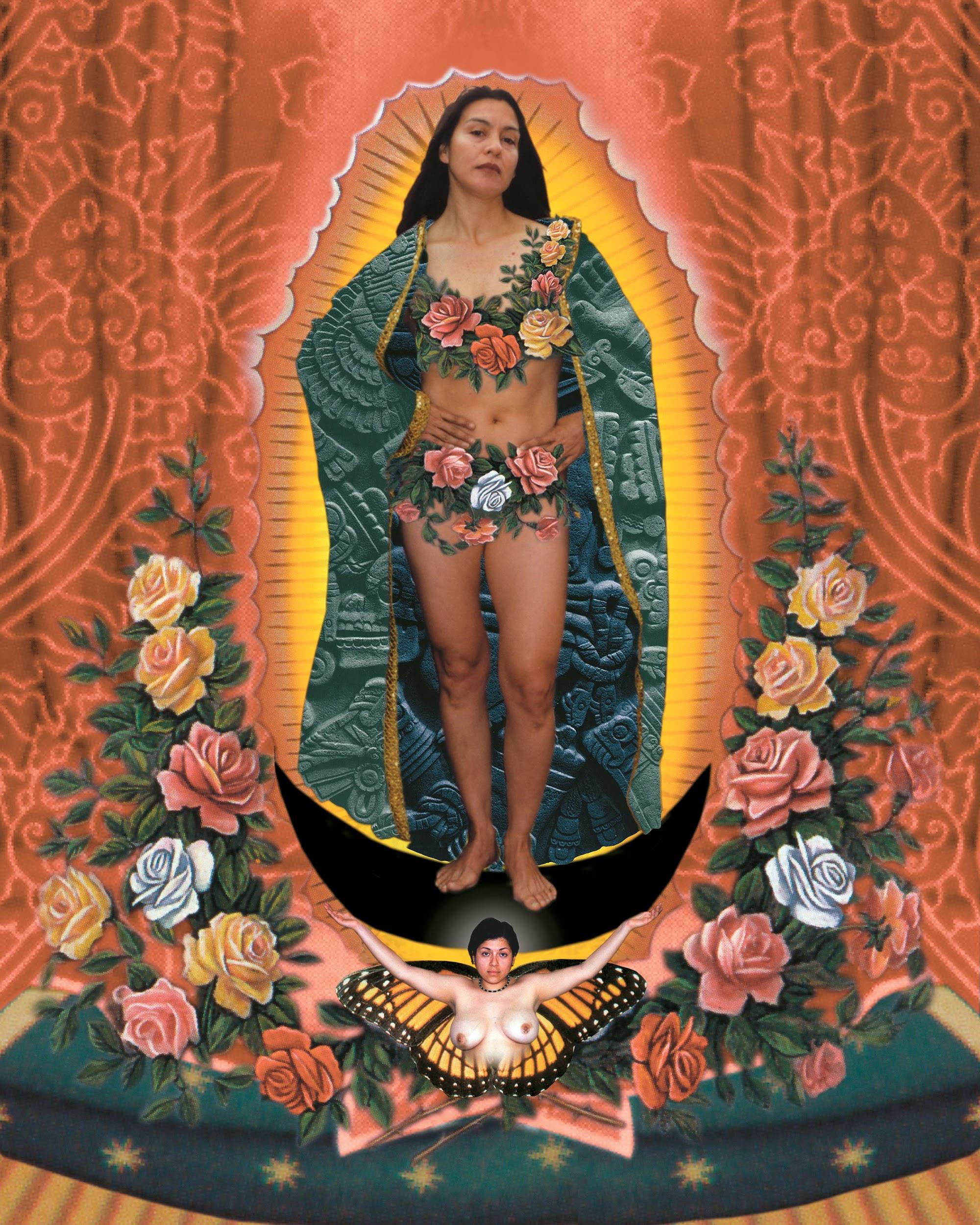
I rely on art to do what academics often cannot do well – what I cannot do well – which is to communicate the truths that rattle our being down to its deep core in ways that connect with others. There have been times in my academic life when I have encountered new insights that changed my life forever. Moments of being shaken and awakened at my very core by a truth that until then had eluded me. But such moments can be hard to share with others because they can be hard to translate to words, even if such moments have come to me by words. Learning about feminist theology and being shaken by the truths it spoke to me is one such encounter – and it was indeed an academic one that is often hard for me to put into words and explain to others. On the other hand, encountering Alma Lopez’s artwork was also a core rattling moment, but one which I can more easily share.
“Our Lady” by Alma Lopez (1999)
Alma Lopez’s Our Lady is a digital art piece in which Our Lady of Guadalupe is depicted (embodied, really) in a more obviously female form than is traditionally expected. For this, every time her piece is on exhibit, Lopez receives a barrage of protest and harassment – as does the sponsoring institution. Accusations of obscenity, profanity, and blasphemy come her way. But, why?
When I see Lopez’s Our Lady, I do not see blasphemy or obscenity, I see a celebration of the female and the sacred. I see the beauty of God’s queer incarnation – and I remember – I remember that the word became flesh and made her home among us. From the womb of a woman’s body, her life-giving body, the divine took human shape. Boundaries of sacred and profane forever blurred.





 Feminism and Religion