THE CARELESS SPIRIT OF ANNIE CORLISS: TRUMPING DESPAIR IN THE NEW WORLD by Carol P. Christ

Annie Corliss was my great-great-grandmother. The Corliss name, also spelled Corlis, Corless, Corlies, Corlers, and Carlis, is derived from “careless” meaning someone who is “carefree” or “happy-go-lucky.”

Annie Corliss was the daughter of James and Mary Corliss, both born in Ireland. Her parents may have been tenant farmers, but given that their surname could refer to someone who doesn’t settle or own property, they may have been Irish Travellers– itinerant craft persons and traders, sometimes called tinkers because they mended cooking pots and farm implements.  “Irish Travellers are a traditionally nomadic people of ethnic Irish origin, who maintain a separate language and set of traditions. … Irish Travellers have their roots in a Celtic (and possibly pre Celtic) nomadic population in Ireland.” Continue reading “THE CARELESS SPIRIT OF ANNIE CORLISS: TRUMPING DESPAIR IN THE NEW WORLD by Carol P. Christ”

ON NOT GETTING WHAT WE WANT AND LEARNING TO BE GRATEFUL FOR WHAT WE HAVE BY CAROL P. CHRIST

Many women’s dreams have not been realized. How do we come to terms with this thealogically?

Although I am as neurotic as the next person, I am also really wonderful—intelligent, emotionally available, beautiful (if I do say so myself), sweet, caring, and bold. I love to dance, swim, and think about the meaning of life. I passionately wanted to find someone with whom to share my life. I did everything I could to make that happen—including years of therapy and even giving up my job and moving half way around the world when I felt I had exhausted the possibilities at home.

For much of my adult life I have asked myself: What is wrong with me? Why can’t I find what everybody else has? Even though I knew that there were a lot of other really great women in my generation in my position and even though I knew that many of my friends were with men I wouldn’t chose to be with, I still asked: What is wrong with me? Continue reading “ON NOT GETTING WHAT WE WANT AND LEARNING TO BE GRATEFUL FOR WHAT WE HAVE BY CAROL P. CHRIST”

1, 2, 3, 4: FEMINISTS DON’T WANT ANOTHER WAR by Carol P. Christ

War is a feminist issue for many reasons, most importantly because war is always war against women.

Patriarchy, war, rape as the “spoils” of war, and the taking of women and children as slaves in the wake of war arose together.  Recent blogs on Feminism and Religion have addressed the war on women—from the rape culture, to Humane Vitae, to the Catholic Church’s and other church’s  attempts to remove birth control from health care, to the tolerance of sexist hate speech in the culture at large. While the issue of Rush Limbaugh calling Sandra Fluke a slut is being focused on in the press, the drums of war are being sounded again in the Middle East:  the US is considering bombing Iran or supporting Israel if it decides to do so.  Feminists must stand together against war and the harm it does to women, children, and all living things.

Military spending is 28-38% of US government spending.  US government spending accounts for 40% of total global arms spending. The US and its allies are responsible for up to 75% of total global spending on the military. It does not take a mathematical genius to figure out that if good-sized chunk of this spending were cut, the US budget could be balanced, the deficit covered, and there would be plenty of money left over for the social good. Continue reading “1, 2, 3, 4: FEMINISTS DON’T WANT ANOTHER WAR by Carol P. Christ”

WOMEN ARE NOT SLUTS, RUSH, DOUCHE-BAG IS NOT FUNNY, JON, AND SEXISM IS MORE THAN “INAPPROPRIATE,” MR. WHITEHOUSE SPOKESPERSON! by Carol P. Christ

Why is it OK to insult women, our bodies, and our sexuality in ways that it is no longer OK to insult other groups?

The recent controversy over Rush Limbaugh’s rant about Sandra Fluke would not be so important if Limbaugh were not the “voice” allowed to say things that Republican politicians cannot say in public. Republican politicians wish to appeal to men who would say exactly what Rush said, while watching Fox News or over a beer with their buddies.

The Virgin-Whore split is alive and well in our culture. Sandra Fluke  finally did get to testify in a hearing called by Nancy Pelosi.  She  assumed a woman’s right to choose when and with whom we have sex and whether and when we will have children, but she did not focus on sexual freedom. One of her examples was a married woman who could not afford birth control and another was a woman who needed birth control pills for reasons having nothing to do with sex or sexual activity. She did not appear in Congress in a mini-skirt (though she should have had every right to do so) but in a business suit. Yet she was called a slut and a prostitute and asked to post porno films of herself on the internet.

What upsets me even more was the response of men in power who would never have said what Rush said, at least not in public. Continue reading “WOMEN ARE NOT SLUTS, RUSH, DOUCHE-BAG IS NOT FUNNY, JON, AND SEXISM IS MORE THAN “INAPPROPRIATE,” MR. WHITEHOUSE SPOKESPERSON! by Carol P. Christ”

FORGIVENESS or TRUTH: WHICH IS THE BEST REMEDY? by Carol P. Christ

What happened to you really was bad. This should not happen to any child. It should not have happened to you.

In our culture there is often a rush to forgiveness that precedes acknowledging the harm that has been done. When I was a child and my father yelled at me or withheld love, I was told by mother, “He really does love you. He just does not know how to show it.” She sometimes added, “Even though he will never say he is sorry, you should forgive your father, because he did not really mean what he said.”

As a child I “learned my lesson well.” I came to the conclusion that women must “read between the lines” of the behavior and words of men, because men cannot and do not express their true feelings. This “lesson” did not serve me well in my life. Quite the opposite. When I loved a man and he did not treat me well, I remembered my mother’s words. “He does love me,” I told myself, “he just doesn’t know how to show it.” My mother passed on a very good recipe for accepting abuse.

“Hold on,” I can hear you thinking, “Your mother was only trying to protect you.” Of course she was, but her words had exactly the opposite effect. Instead of helping me to deal with life, my mother’s words confused me. My mother taught me that where men are concerned the word “love” does not have its ordinary meaning, the one I learned from her love for me. Where men are concerned “love” is complicated and mysterious: what does not look or feel like love really is love. Sorry Mom, but that was bullshit! I know you wanted me to find love and happiness and were often puzzled when I didn’t. You wondered if it was anything you did. Despite your best intentions, it was something you did. Continue reading “FORGIVENESS or TRUTH: WHICH IS THE BEST REMEDY? by Carol P. Christ”

A CLASH OF CULTURES IN OUR GENES by Carol P. Christ

I carry the exact replica of MDNA handed down from mother to daughter since the depths of the last Ice Age 17,000 years ago.  My father carries  the YDNA of the Indo-Europeans handed down from father to son since the time when his male ancestors invaded Europe about 5000 years ago.   

My female ancestors moved with the seasons as they gathered fruits and nuts, roots and greens to feed their families. Some of them may have blown red ochre around their hands to leave their marks in ritual cave-wombs.

Mitochondrial DNA is passed down exclusively from mothers to their children. My MDNA “T2b” was given the name “the clan of Tara” by Bryan Sykes in The Seven Daughters of Eve.  According to Sykes the earliest female ancestor with this gene lived about 17,000 years ago, perhaps in Tuscany. Continue reading “A CLASH OF CULTURES IN OUR GENES by Carol P. Christ”

Feminist Theologies: Past, Present, and Future

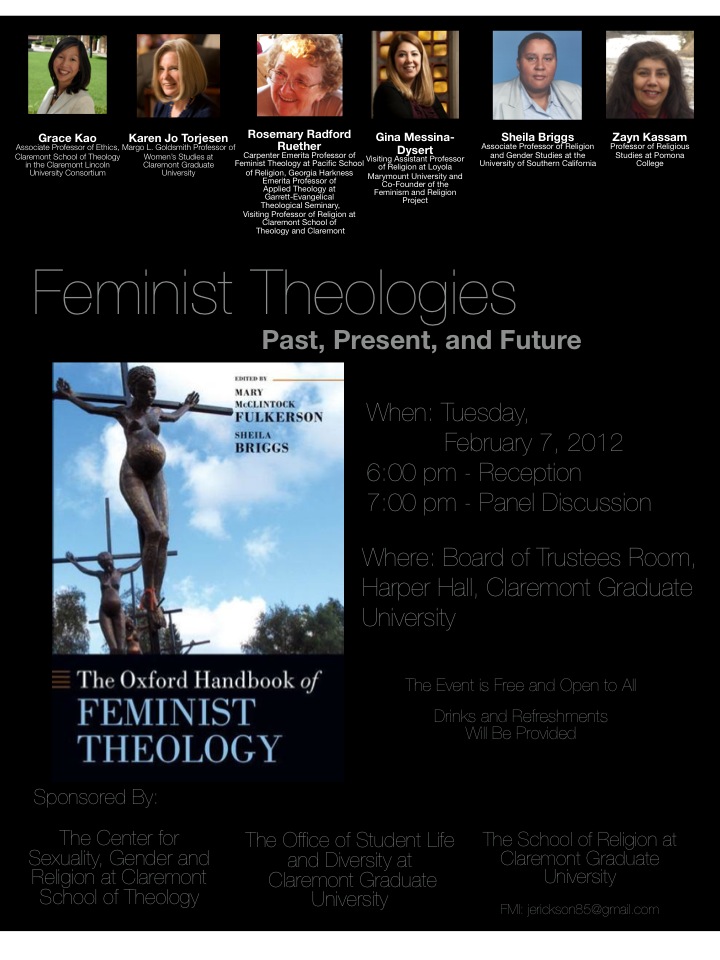
On February 7, 2012, a panel discussion focused on the past, present, and future of feminist theologies took place at Claremont Graduate University to celebrate the release of TheOxford Handbook on Feminist Theology.  The panel was organized by John Erickson, moderated by Grace Kao, and featured Karen Torjesen, Rosemary Radford Ruether, Gina Messina-Dysert, Zayne Kassam, and Sheila Briggs as presenters.  What resulted was a terrific discussion about women, religion, and feminist theologies.  Many were in attendance and participated in the panel; for those who were unable to attend, here is a video of the presentations from that evening.  We look forward to you sharing your thoughts and comments about the past, present, and future of feminist theologies.

REMEMBERING MERLIN STONE, 1931-2011 by Carol P. Christ

“In the beginning…God was a woman.  Do you remember?”  Feminst foremother and author of these words Merlin Stone died in Feburary last year.

I can still remember reading the hardback copy of When God Was a Woman while lying on the bed in my bedroom overlooking the river in New York City early in 1977.  The fact that I remember this viscerally underscores the impact that When God Was a Woman had on my mind and my body.  Stone’s words had the quality of revelation:  “In the beginning…God was a woman. Do you remember?”  As I type this phrase more than thirty-five  years after first reading it, my body again reacts with chills of recognition of a knowledge that was stolen from me, a knowledge that I remembered in my body, a knowledge that re-membered my body.  My copy of When God was a Woman is copiously underlined in red and blue ink, testimony to many readings.

Though I could then and can now criticize details in the book, the amassing of information and the comprehensive perspective When God Was a Woman provided was news to me when I first read it.  Despite having earned a Ph.D. in Religious Studies from Yale, I did not “know” that Goddesses were worshipped at the very dawn of religion.  I had not heard of the theories of Indo-European invasions of warlike patriarchal peoples into areas already settled by peaceful matrilineal, matrifocal cultures in Europe and India.  I had written my undergraduate thesis on the prophets, studying their words in the original Hebrew, but I did not understand that their constant references to the Hebrew people “whoring” after “idols” and worshipping “on every high hill and under every green tree” referred to the fact that many of the Hebrew people were choosing to worship Goddesses in sacred places in nature.  Nor did I understand that the Genesis story which I had studied and taught took the sacred symbols of Goddess religion– the snake, the tree and the fruit of the tree, the female body—and turned them upside down.  Continue reading “REMEMBERING MERLIN STONE, 1931-2011 by Carol P. Christ”

I am Beginning to Understand by Carol P. Christ

Elizabeth Kelly Inglis died in 1927 at age 62 from complications of a stroke. Secondary causes were malnutrition and exhaustion.

When I was a child, my father, though he was very close to his own parents and sister, spoke very little about his ancestors. I knew that both of his parents lost their fathers when they were small children. I was told that the Christs were German and the Inglises were Scottish and Irish. My grandmother Mary Inglis Christ was as Irish as the day is long. She prayed to the blessed Virgin and took me to church with her in the early mornings where she lit candles and whispered the rosary while fingering faceted lavender beads. She voted for Kennedy because he was Irish and Catholic—to the horror of my father and his father who had no use for the Democrats. My grandmother sometimes cried when she showed us photographs of her family, especially when she pointed to her sister Veronica, called Very. I sensed that my grandmother felt sad to have left her family in New York when she moved with her husband and children to California during the depression, but I was too young to understand fully. As far as I know, I never met any of the relatives from her side of the family, even when I moved to “back east.” Continue reading “I am Beginning to Understand by Carol P. Christ”

Feminist Theologies: Past, Present, and Future by Gina Messina-Dysert

I had the great honor to be a part of the Feminist Theologies: Past, Present, and Future panel on February 7, 2012 to celebrate The Oxford Handbook of Feminist Theology.  I presented with some feminist foremothers who have had a tremendous impact on me and my feminist ideals.  To say it was a wonderful experience would be a complete understatement.

Below is the talk I shared at the conference.  It focuses on my personal experience with feminist theology, the Feminism and Religion project, and how digital print will shape the future of feminist theology.  A very special thanks to John Erickson for organizing this important event.

It is truly a pleasure to be here today to celebrate the publication of The Oxford Handbook of Feminist Theology.  Certainly a foundational text that will be instrumental in moving the field of feminist theology forward by connecting feminists from different cultural and geographical backgrounds to discuss women and religion in a globalized world. Continue reading “Feminist Theologies: Past, Present, and Future by Gina Messina-Dysert”