Remembering Audre Lorde and “The Uses Of The Erotic” by Carol P. Christ

carol p. christ 2002 colorI was  given a copy of Audre Lorde’s essay “The Uses of the Erotic” in my first year of teaching at San Jose State by a young white lesbian M.A. student named Terry.  It was 1978.  I was in my early 30s.  This essay came into my life and the lives of my students, friends, and colleagues at “the right time.”  It became a kind of “sacred text” that authorized us to continue to explore the feelings of our bodies and to take them seriously.

The second wave of the women’s movement was about to enter its second decade. We had already been through years of consciousness raising groups.  There we learned to “hear each other to speech” about feelings we had learned to suppress because we had been told they were not acceptable for us as women to have or to express.  Those early days of the women’s movement were one big “coming out” movement.  We were bringing our feelings and ourselves out of the closet.

Many of us had been exploring various forms of body and feeling based therapies broadly called “humanistic” that encouraged the open acknowledgment and expression of feelings.  It was also the time when large numbers of women were beginning to “come out” as lesbian.  Some of these were women who had theretofore not “known” or even had any idea that they were lesbian. The song by Lavender Jane Loves Women with the refrain “any woman can be a lesbian” was well-known in feminist circles.  Women who did not stay lesbian explored their sexuality with other women. Women who did not do that were naming and recognizing the importance of female friendship and its life-saving and life-transforming part in their lives—an act that was in itself transgressive.

Audre Lorde told us that all of this was not only good–it was sacred. “The erotic is a resource exists in each of us on a deeply female and spiritual plane.”  Continue reading “Remembering Audre Lorde and “The Uses Of The Erotic” by Carol P. Christ”

When Feminists Disagree by Linn Marie Tonstad

Linn Marie TonstadA while back I gave a talk on feminist trinitarian theology to an audience of mostly progressive academics, including feminist and womanist scholars of religion. In the course of analyzing what I called the ‘trinitarian imaginary’ in Christianity and its often-patriarchal and masculinist forms, I suggested that transforming that imaginary might require recognizing the hypothetical character of theological statements until the eschaton, a theme that has been developed in depth by a German theologian named Wolfhart Pannenberg. Now, Pannenberg is decidedly neither a feminist nor a progressive theologian. To name just one example: in his three-volume Systematic Theology, his few explicit references to feminist or female theologians include a brief mention of Mary Daly (volume 1, p. 262) in connection with a critique of feminist theologians for projecting (!) masculinity into God in their readings of divine fatherhood, and a critique of Valerie Saiving and Susan Nelson Dunfee’s positions on the traditional Christian doctrine of sin as pride (volume 2, p. 243). So when I mentioned Pannenberg as a resource in my talk, one of the feminist scholars in the audience audibly gasped and flinched – it became clear in the Q&A that she had significant concerns about whether I could count as a feminist at all. After all, to mine someone like Pannenberg for constructive feminist theological work might imply an endorsement of his other positions, or might entail taking over aspects of his system that would taint my own project in anti-feminist directions – all legitimate concerns.  Continue reading “When Feminists Disagree by Linn Marie Tonstad”

The Joy of Honoring Rosemary Radford Ruether by Dirk von der Horst

DirkA cutting-edge voice in many theological conversations, Rosemary Radford Ruether has been an inspiration to many of us over the last few decades.  The tremendous joy of my last couple of years was co-editing a volume of essays in her honor.  Even discovering just how dreary indexing is was a labor of love for a true pioneer in feminist theology.  The result: Voices of Feminist Liberation: Writings in Celebration of Rosemary Radford Ruether, a collection of fourteen essays by Ruether’s doctoral students, put together by Emily Leah Silverman and Whitney Bauman, along with myself.

Voices of Feminist Liberation documents the current state of her impact and legacy.  The richness of her thought is manifest here in the variety of directions her students have taken her insights.  While most of the essays are scholarly works that engage her ideas above all else, some essays have more personal recollections.  Rosemary’s preface recounts her personal experiences of and with us, with descriptions of incidents from her relationships ranging from hearing a live-in student coming down the hall to slip a paper under the door, to seeing a student’s dissertation prospectus enrage a committee member, to switching from same-sex hand-holding in Palestine to male-female hand-holding in Israel as a small gesture of recognizing cultural difference. Continue reading “The Joy of Honoring Rosemary Radford Ruether by Dirk von der Horst”

Connection to Ancestors in Earth-based Theology by Carol P. Christ

carol p. christ 2002 color“I am Carol Patrice Christ, daughter of Jane Claire Bergman, daughter of Lena Marie Searing, daughter of Dora Sofia Bahlke, daughter of Mary Hundt who came to Michigan from Mecklenburg, Germany in 1854.  I come from a long line of women, known and unknown, stretching back to Africa.”

Like many Americans, my ancestral history was lost and fragmented due to emigration, religious and ethnic intermarriage, and movement within the United States.  Though one of my grandmothers spoke proudly of her Irish Catholic heritage and one of my grandfathers acknowledged his Swedish ancestry, I was raised to think of myself simply as “American,” “Christian” and “middle class.”  Ethnic and religious differences were erased, and few stories were told. 

Over the past two years, I have begun to discover details of my ancestral journey, which began in Africa, continued in the clan of Tara, and was marked by the Indo-European invasions.  In more recent times, my roots are in France, Holland, England, Germany, Ireland, Scotland, and Sweden.  In the United States, my family has lived in tenements in New York City and Brooklyn, in poverty in Kansas City, and on farms in Long Island, Connecticut, upstate New York, Michigan, and Pennsylvania.  My parents and grandparents settled in northern and southern California during the 1930s.  I have lived in southern and northern California, Italy, Connecticut, New York, Boston, and now Greece.

Learning details about family journeys has created a shift in my sense of who I am.  Continue reading “Connection to Ancestors in Earth-based Theology by Carol P. Christ”

The David Syndrome? By Marcia Mount Shoop

Is it just me, or does anyone else feel like we’re all in Junior High or High School again with the Petraeus scandal?  There is drama at every turn with boundaries crossed and accusations slung across every lunch table there is.

When I was a teenager we didn’t have emails, Facebook , and Twitter (thanks be to God).  We passed notes.  I remember getting a really mean one scrawled in deliberately messy handwriting to maintain anonymity about how annoying I was to the “populace” (yes I remember that word was in there) because I didn’t wear make up and I thought I was “so smart.”

Just like today’s cyber detectives who figured out Paula Broadwell’s identity from the fingerprints we all leave behind in the online lives we lead, I traced this note back to its source.  I did it the old fashioned way—I asked around.  Unfortunately I found out it was from a “friend” and teammate of mine.  When I went to her house and confronted her she admitted it.  Turns out she was envious about a boy.  Little did she know at the time that the boy she wished for was abusive and I was living in my own secret hell.  I remember thinking to myself “you can have him.”   The stakes seemed so high back then—friendships, acceptance, one’s whole sense of self were hopelessly tangled up in tenuous, even dangerous, relationships. Continue reading “The David Syndrome? By Marcia Mount Shoop”

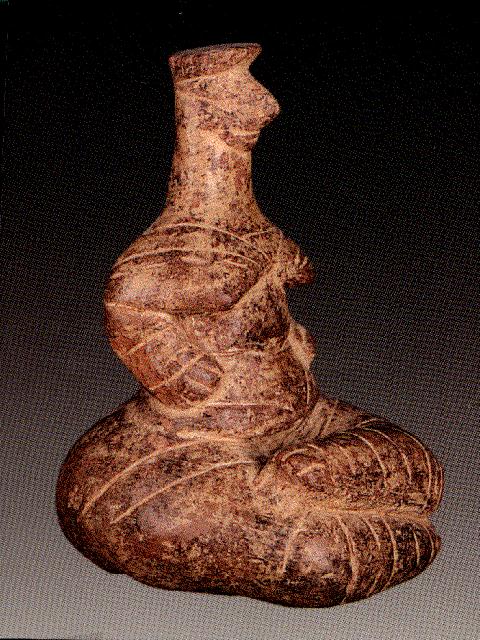
“The Language of the Goddess” In Minoan Crete by Carol P. Christ

While the “war against Marija Gimbutas,” rooted in what my friend Mara Keller calls “theaphobia,” is being waged in the academy, her theories continue to unlock the meaning of hundreds of thousands of artifacts from the culture she named “Old Europe.”

According to Gimbutas, the Neolithic and Chalcolithic cultures of Old Europe c. 6500-3500 BCE were peaceful, sedentary, agricultural, matrifocal and probably matrilineal, egalitarian, and worshipped the Goddess as the power of birth, death, and regeneration in human and all forms of life.  The cultures of the Old Europe contrasted with the Bronze Age cultures of the Indo-Europeans who brought the Indo-European languages and value systems to Europe and India and to all of the European colonies.  The Indo-European cultures were patriarchal, patrilineal, nomadic, horse-riding, and warlike, and worshipped the shining Gods of the sky. 

“The language of the Goddess” includes a series of signs and symbols that the people of Old Europe could “read” as surely as you and I know that a cross on top of a building marks it as Christian or that a woman wearing a star of David pendant is Jewish.  Gimbutas identified the meaning of these symbols through a painstaking process that involved comparison of artifacts, attention to where they were found, and clues from the recurrence of similar symbols in later cultures.  In twenty years of leading Goddess Pilgrimages to Crete, I have found Gimbutas’ theories an indispensible “hermeneutical principle” which unlocks the meanings of the artifacts we encounter.

  Continue reading ““The Language of the Goddess” In Minoan Crete by Carol P. Christ”

Goddess as Love: From Experience To Thealogy by Carol P. Christ

If theology is rooted in experience, how do we move from experience to theology? In my life there have been a number of key moments of “revelation” that have shaped my thealogy. One of these was the moment of my mother’s death.

In 1991 my mother was diagnosed with cancer. While she was being treated, I realized that I had never loved anyone as much as I loved her. When I wrote that to her, she responded that “this was the nicest letter” she “had ever received” in her life and she invited me to come home to be with her and my Dad.

My mother died only a few weeks after I arrived, in her own bed as she wished. She was on an oxygen machine, and I heard her call out in the dark of early morning. When my Dad got to the room, he tried to turn up the oxygen, but it didn’t help. Then he called the doctor who reminded him that my mother did not want to go to the hospital under any circumstances.

My Dad then sat by my mother’s bed and held her hand.  As my mother died, I felt that the room was” filled with love.” I sensed that my mother was “going to love.” Continue reading “Goddess as Love: From Experience To Thealogy by Carol P. Christ”

Are Most of Us Abused Children? And is Child Abuse the Root of Evil? by Carol P. Christ

Child abuse does not have to be physical or sexual. The most widespread forms of child abuse are psychological, and therefore harder to see, acknowledge, and eradicate. As abused children, we unconsciously pass on patterns of abuse visited on us to children, and to others we have power over including students, employees, and even friends and lovers.

The recent visit of a friend who is suffering greatly in a “battle” with her own “demons” reminded me of the important work of Alice Miller. My friend’s “demons” take the form of a persistent self-criticism laced with the feeling that “if only” she did or didn’t do certain things, her world would fall into place. My “demons” generally take a different form, telling me that I am helpless and that there is nothing I can do to ease my suffering.

Such “demons” were not implanted in my friend and me by the devil. They took root in interactions with our own parents, who were not themselves any different from most of the parents of their time and place. Recognizing that our parents were not “bad” people should not blind us to the great harm they did to us. However, when abused children speak of their abuse, the statement that their parents did not intend to harm them usually functions to deflect attention away from child abuse that really did occur. Continue reading “Are Most of Us Abused Children? And is Child Abuse the Root of Evil? by Carol P. Christ”

WHY DON’T FEMINISTS EXPRESS ANGER AT GOD? by Carol P. Christ

 My relationship to God changed when I accused “Him” of everything I thought “He” had done or let be done to women—from allowing us to be beaten and raped and sold into slavery, to not sending us female prophets and saviors, to allowing “Himself” to be portrayed as a “man of war.”

In the silence that followed my outpouring of anger, I heard a still small voice within me say: In God is a woman like yourself. She too has been silenced and had her history stolen from her. Until that moment God had been an “Other” to me. “He” sometimes appeared as a dominating and judgmental Other, and at other times as a loving and supportive Other, but “He” was always an “Other.” I as a woman in my female mind-body definitely was not in “His” image. 

After I expressed my anger to God, God transformed from an Other into what Whitehead once described as “a fellow [or should I say female] sufferer who understands.”  Although I had already been searching for a “God in my image” or “in whose image I could be,” I had yet to find Her. In the quiet after the storm, I came to believe that I would.   Continue reading “WHY DON’T FEMINISTS EXPRESS ANGER AT GOD? by Carol P. Christ”

On Winning and Not Winning in the “Fight” for “Justice” in the Web of Life by Carol P. Christ

The reason for hope is not the rational calculation that we will be able to save the world. The reason for hope is that it is important for us to try.

A few days ago, the United States Supreme Court upheld the deeply flawed heath care law passed by Congress. (I will not call it “Obamacare” as I do not believe Obama “owns” the concept of universal health care any more than Lyndon Baines Johnson or even Martin Luther King “owned” the concept of civil rights.) As a progressive I view universal health care as the only truly just health care system.  Still, I consider the Supreme Court decision a “victory.”

The same day the Supreme Court decided, I received a copy of a letter from the Greek government accessing 81,950 Euros in fines against the road-building company that violated the highly protected Natura wetlands while constructing the 36th National Road in Lesbos. Another “victory.”

Two weeks ago the cause of “justice,” as I see it, was not served when the center-right party New Democracy Party gained the majority in the Greek elections and became the central player in a coalition government. With New Democracy in coalition with the center-left Pasok, it is unlikely that corrupt politicians and tax evaders will be made to repay the money they have stolen from the Greek people. At the same time, it is likely that the Greek people in the middle and lower classes will be made to pay even more than they already have for the failure of a corrupt system of government.  The Green Party missed gaining 8 seats in Parliament in the first election by 4000 votes. In the second election we lost ground, while the fascist Neo-Nazi party that calls itself The Golden Dawn, garnered 18 seats. Continue reading “On Winning and Not Winning in the “Fight” for “Justice” in the Web of Life by Carol P. Christ”