FORGIVENESS or TRUTH: WHICH IS THE BEST REMEDY? by Carol P. Christ

What happened to you really was bad. This should not happen to any child. It should not have happened to you.

In our culture there is often a rush to forgiveness that precedes acknowledging the harm that has been done. When I was a child and my father yelled at me or withheld love, I was told by mother, “He really does love you. He just does not know how to show it.” She sometimes added, “Even though he will never say he is sorry, you should forgive your father, because he did not really mean what he said.”

As a child I “learned my lesson well.” I came to the conclusion that women must “read between the lines” of the behavior and words of men, because men cannot and do not express their true feelings. This “lesson” did not serve me well in my life. Quite the opposite. When I loved a man and he did not treat me well, I remembered my mother’s words. “He does love me,” I told myself, “he just doesn’t know how to show it.” My mother passed on a very good recipe for accepting abuse.

“Hold on,” I can hear you thinking, “Your mother was only trying to protect you.” Of course she was, but her words had exactly the opposite effect. Instead of helping me to deal with life, my mother’s words confused me. My mother taught me that where men are concerned the word “love” does not have its ordinary meaning, the one I learned from her love for me. Where men are concerned “love” is complicated and mysterious: what does not look or feel like love really is love. Sorry Mom, but that was bullshit! I know you wanted me to find love and happiness and were often puzzled when I didn’t. You wondered if it was anything you did. Despite your best intentions, it was something you did. Continue reading “FORGIVENESS or TRUTH: WHICH IS THE BEST REMEDY? by Carol P. Christ”

A CLASH OF CULTURES IN OUR GENES by Carol P. Christ

I carry the exact replica of MDNA handed down from mother to daughter since the depths of the last Ice Age 17,000 years ago.  My father carries  the YDNA of the Indo-Europeans handed down from father to son since the time when his male ancestors invaded Europe about 5000 years ago.   

My female ancestors moved with the seasons as they gathered fruits and nuts, roots and greens to feed their families. Some of them may have blown red ochre around their hands to leave their marks in ritual cave-wombs.

Mitochondrial DNA is passed down exclusively from mothers to their children. My MDNA “T2b” was given the name “the clan of Tara” by Bryan Sykes in The Seven Daughters of Eve.  According to Sykes the earliest female ancestor with this gene lived about 17,000 years ago, perhaps in Tuscany. Continue reading “A CLASH OF CULTURES IN OUR GENES by Carol P. Christ”

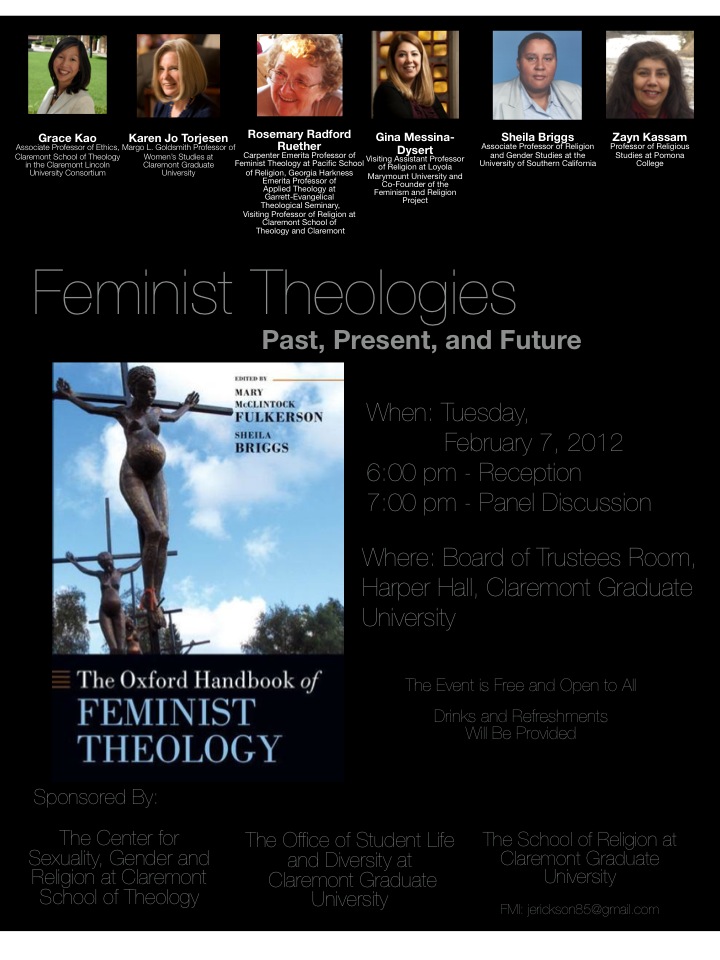
Feminist Theologies: Past, Present, and Future

On February 7, 2012, a panel discussion focused on the past, present, and future of feminist theologies took place at Claremont Graduate University to celebrate the release of TheOxford Handbook on Feminist Theology.  The panel was organized by John Erickson, moderated by Grace Kao, and featured Karen Torjesen, Rosemary Radford Ruether, Gina Messina-Dysert, Zayne Kassam, and Sheila Briggs as presenters.  What resulted was a terrific discussion about women, religion, and feminist theologies.  Many were in attendance and participated in the panel; for those who were unable to attend, here is a video of the presentations from that evening.  We look forward to you sharing your thoughts and comments about the past, present, and future of feminist theologies.

REMEMBERING MERLIN STONE, 1931-2011 by Carol P. Christ

“In the beginning…God was a woman.  Do you remember?”  Feminst foremother and author of these words Merlin Stone died in Feburary last year.

I can still remember reading the hardback copy of When God Was a Woman while lying on the bed in my bedroom overlooking the river in New York City early in 1977.  The fact that I remember this viscerally underscores the impact that When God Was a Woman had on my mind and my body.  Stone’s words had the quality of revelation:  “In the beginning…God was a woman. Do you remember?”  As I type this phrase more than thirty-five  years after first reading it, my body again reacts with chills of recognition of a knowledge that was stolen from me, a knowledge that I remembered in my body, a knowledge that re-membered my body.  My copy of When God was a Woman is copiously underlined in red and blue ink, testimony to many readings.

Though I could then and can now criticize details in the book, the amassing of information and the comprehensive perspective When God Was a Woman provided was news to me when I first read it.  Despite having earned a Ph.D. in Religious Studies from Yale, I did not “know” that Goddesses were worshipped at the very dawn of religion.  I had not heard of the theories of Indo-European invasions of warlike patriarchal peoples into areas already settled by peaceful matrilineal, matrifocal cultures in Europe and India.  I had written my undergraduate thesis on the prophets, studying their words in the original Hebrew, but I did not understand that their constant references to the Hebrew people “whoring” after “idols” and worshipping “on every high hill and under every green tree” referred to the fact that many of the Hebrew people were choosing to worship Goddesses in sacred places in nature.  Nor did I understand that the Genesis story which I had studied and taught took the sacred symbols of Goddess religion– the snake, the tree and the fruit of the tree, the female body—and turned them upside down.  Continue reading “REMEMBERING MERLIN STONE, 1931-2011 by Carol P. Christ”

I am Beginning to Understand by Carol P. Christ

Elizabeth Kelly Inglis died in 1927 at age 62 from complications of a stroke. Secondary causes were malnutrition and exhaustion.

When I was a child, my father, though he was very close to his own parents and sister, spoke very little about his ancestors. I knew that both of his parents lost their fathers when they were small children. I was told that the Christs were German and the Inglises were Scottish and Irish. My grandmother Mary Inglis Christ was as Irish as the day is long. She prayed to the blessed Virgin and took me to church with her in the early mornings where she lit candles and whispered the rosary while fingering faceted lavender beads. She voted for Kennedy because he was Irish and Catholic—to the horror of my father and his father who had no use for the Democrats. My grandmother sometimes cried when she showed us photographs of her family, especially when she pointed to her sister Veronica, called Very. I sensed that my grandmother felt sad to have left her family in New York when she moved with her husband and children to California during the depression, but I was too young to understand fully. As far as I know, I never met any of the relatives from her side of the family, even when I moved to “back east.” Continue reading “I am Beginning to Understand by Carol P. Christ”

Feminist Theologies: Past, Present, and Future by Gina Messina-Dysert

I had the great honor to be a part of the Feminist Theologies: Past, Present, and Future panel on February 7, 2012 to celebrate The Oxford Handbook of Feminist Theology.  I presented with some feminist foremothers who have had a tremendous impact on me and my feminist ideals.  To say it was a wonderful experience would be a complete understatement.

Below is the talk I shared at the conference.  It focuses on my personal experience with feminist theology, the Feminism and Religion project, and how digital print will shape the future of feminist theology.  A very special thanks to John Erickson for organizing this important event.

It is truly a pleasure to be here today to celebrate the publication of The Oxford Handbook of Feminist Theology.  Certainly a foundational text that will be instrumental in moving the field of feminist theology forward by connecting feminists from different cultural and geographical backgrounds to discuss women and religion in a globalized world. Continue reading “Feminist Theologies: Past, Present, and Future by Gina Messina-Dysert”

Rosemary Radford Ruether’s Women and Redemption: A Theological History By Gina Messina-Dysert


Women and Redemption : A Theological History. 2nd ed. By Rosemary Radford Ruether.Minneapolis: Fortress Press. 2011.

Women and Redemption: A Theological History

Having been critically impacted by the work of Rosemary Radford Ruether, I was anxious for the release of the second edition of her crucial book, Women and Redemption: A Theological HistoryRedesigned with illustrative material, research questions, and suggested reading for further research, as well as the addition of a new chapter exploring recent developments in feminist theology, this text does not disappoint.

With this newest edition, Ruether acknowledges the ongoing journey in the field of feminist theology and emerging issues faced by women in religion and society. Examining the Christian claim of an inclusive and universal redemption in Christ, she traces paradigm shifts in understandings of gender over the last two millennia.  Ruether offers an historical exploration of women and redemption in the first five chapters followed by a global survey of contemporary feminist theologies in the final four chapters, which includes a concluding section that gives attention to “Fourth World” feminisms and post-colonialism in an effort to “bring this volume up to date” (xvii). Continue reading “Rosemary Radford Ruether’s Women and Redemption: A Theological History By Gina Messina-Dysert”

Immortality: Distinctions and Confluences Between Feminist Theology and Mormonism By Caroline Kline

Kline, CarolineOn the whole, I like the Mormon concept of immortality. I like the idea of being with my family forever. I like the idea of being able to love and live with a child or spouse or parent that might have died too young. I like the idea of being eternally engaged in learning and working with others. I do fully admit, I am put off by the idea that I as woman might be eternally giving birth to spirit babies, and the status of Heavenly Mother – my immortal role model – is angst inducing if I sit down and think about it for very long. But in my positive moments, I have some hope that my husband and I would actually be equals in the next life – that the patriarchy of our Church and of our world is just a natural consequence of the fall and of human fallibility.

So I initially found it a bit jarring to read about Rosemary Radford Ruether’s take on immortality. Continue reading “Immortality: Distinctions and Confluences Between Feminist Theology and Mormonism By Caroline Kline”

Speaking of Sacrifice and Rape Culture…by Xochitl Alvizo

Recently Gina Messina-Dysert, on this blog, wrote about rape culture and the church’s role in preserving it instead of challenging the norm of violence against women and victim blaming. And in my last post, after having just watched the last installment of the Harry Potter movies, I wrote about Lily’s love for Harry as being what saves Harry and not the sacrifice of Lily’s life; my point being that we need to give more credit to love as salvific and redemptive and not to sacrifice or suffering. For too long within Christianity,  Jesus’ death and ‘sacrifice’ have been held up as the core, the essence, the heart of Christianity – wrongly giving it a necrophilic emphasis that I do not believe is actually faithful to the Christian tradition. All this reminds me of why feminism is critical to my ability to stay within Christianity and that without feminism I would not be able to be a Christian-identified woman.

Every day in both small and enormous ways I see the effects and embedded patterns that result from the long history and dominance of patriarchy/kyriarchy. Everything from sexism and racism, to capitalism and the destruction of our world, these destructive systems are part of our daily environment and affect the quality of all our lives in devastating ways. And perhaps it is because I am a woman and I am directly and existentially affected, but, sexism, misogyny and violence against women are the things that most crush my spirit and break my heart. As I see these insidiously at work in many aspects of our society, and see the effects these have on us, women and men alike, I am saddened and angered to a level for which I have yet to find words to express. I feel it, the insidious trauma of sexism, misogyny, and violence against women, I feel their effects on me and others, but do so usually in silence or in tears. Lump in my throat. No words to speak. All I can do is continue in my commitment to live in a way that is different from these – in a way that is biophilic and affirming of all people as sacred and divinely in-Spirited. Continue reading “Speaking of Sacrifice and Rape Culture…by Xochitl Alvizo”

Catherina Halkes – In Memory and Appreciation By Mary Grey

The following is a guest post written by Mary Grey, Ph.D., Professor of Feminist Theology at St. Mary’s University College, in Twickenham, London, and author of thirteen books including A Cry for Dignity: Religion, Violence, and the Struggle of the Dalit Women in India.

On April 21, 2011  Catherina Halkes, the founding mother of Feminist Theology in Europe, inspiration to me and countless others,  prophet, mentor – and much else – died in her home city of Nijmegen, the Netherlands. She certainly changed my life: I arrived in Nijmegen desperately searching for books in Feminist Theology when writing my Ph.D. thesis. I had read everything that England had to offer, (not a lot in 1986!) I could not afford to go to America, so the Netherlands was my only option. Catherine Halkes, (or Tine, as we all called her), welcomed and encouraged me: later she would come to the public defence of my thesis in Louvain – after which I became her successor to the chair of Feminism and Christendom in Nijmegen, 1988. Life was never the same again!

Catherina Halkes

Tine blazed a trail  for women’s role in theology in the Roman Catholic Church, as well as for all women in Feminist Theology in Europe in its key developing stages. She embodied the hopes and dreams of countless women – and men- beyond the boundaries of her small country. She influenced the development of Women Studies as an academic subject in the Universities of the Netherlands and wider. Her influence cannot be restricted to a single category. Rooted in the progressive theology of the Second Vatican Council, she developed a wide-ranging pastoral theological influence on theology. It could be said  – although an evaluation is still too early-  that her legacy will be seen as opening up different areas of theology and related disciplines to the feminist lens, and being at the forefront of developments in many fields, always with a critical eyes of a Christian faith that has never wavered, despite continuing disappointment and personal suffering at the unflinchingly repressive attitudes of the Roman Catholic Church, to which she remained consistently loyal. Continue reading “Catherina Halkes – In Memory and Appreciation By Mary Grey”