In a previous post on FAR I explored Greek Easter customs which interweave Christian and pre-Christian beliefs. Today I would like to take a closer look at one of these customs, the women’s ritual dance known as Tráta, ceremonially performed on ‘Bright Tuesday,’ the Tuesday after Easter. Versions of Tráta survive in the towns of Mégara and Elefsina just west of Athens, on the island of Salamína directly across from them, and in the surrounding area as far as Thebes.
Elefsina, of course, is Eleusis, where for over 2,000 years the Eleusinian Mysteries enacted the story of Demeter and her daughter Persephone’s descent to the Underworld. Choral dance was a central part of the ceremonies at Eleusis – as at other sacred sites including Delphi, Knossos, Athens, and Vravrona – and the ‘Well of the Beautiful Dances’ can still be seen at the archaeological site. It is a a visible reminder of the circle dancing which was a part of the initiatory experience, bringing cosmic order – symbolised by the circle – into the human world. This is still one of the functions of the Tráta as performed today.
Western Easter has come and gone, and I missed it this year, by design. I went to Athens for the weekend, where Easter this year won’t come until May 1. In the Greek Orthodox Church, Easter is reckoned differently, so that sometimes (like next year) Easter falls on the same date in both faiths and sometimes (like now) the celebrations are several weeks apart.
In contrast to the UK, where Easter now seems to be mostly about chocolate, Easter in Greece is the main festival of the Christian year, much more important than Christmas. Throughout the Lenten period, fasting foods – ‘nistisimo’ – are available everywhere (heaven for vegan visitors).
Candlemas / Imbolc, the midway point between the winter solstice and spring equinox brings with it (in the northern hemisphere) the first signs of awakening spring. Here in Canterbury, southeast England, where I am living this year, the birds are already starting to sing for mates and build their nests. In Celtic pre-Christian religion, Imbolc is associated with the Goddess Brigid / Bride (and the Christian Saint Brigid), but today I suggest we pay a visit to Brigid’s Slavic sister, the Goddess Mokosh / Mokoš, who is also powerfully associated with emerging fertility in the woman, the land and the year.
As well as fertility, Mokosh and Brigid bless and protect women’s crafts and women’s work, and share attributes of healing, motherhood and midwifery. They are both Goddesses of Fate and of destiny: spinning the thread of creation, giving life and cutting the thread, like the Three Fates of Greek tradition. Both have a special connection with sheep, wool, and weaving, and of course with textiles: Brighde is honoured through the tying of cloths or ‘clooties’ at sacred wells, while a favourite offering to Mokosh was a hank of spun wool dropped into a well. In the Slavic lands, Mokosh is a key figure on embroidered ritual cloths.
Mokosh, like Brigid, is associated with wells, springs and moisture; the name Mokosh comes from the root ‘mol’ meaning ‘moisture’, and is connected with the Slavic words mokry and moknut (‘wet’ and ‘to get wet’) . Mokosh brings the water of life and protects the life-giving waters on which human and animal existence depend. In this way Mokosh gives life to plants and animals, and is often portrayed with them. She is an important Slavic Mother Goddess, embodying fertility, femininity, prosperity, protection, health, good luck, abundance, and a successful future.
Mokosh is also a warrior goddess, in her fierce aspect as a goddess of protection. One of her epithets is ‘She who strikes with her wings’. The fact that she is a winged Goddess indicates her power and that which she grants to her priestesses and devotees, to travel between the worlds in trance, dream, and vision, for blessing and for healing on behalf of the community and all who are in need. Mokosh is also connected to butterflies, symbols of transformation, and bees, symbols of priestesses in antiquity. The beautiful Slavic embroideries shown here depict some of her typical manifestations as a tree/flower/goddess figure with branches/arms/wings/wheat ears, sometimes all at once.
Slavic Goddess Embroidery
Mokosh is a Slavic sister in the same lineage of water-loving fertility deities who were so important in ancient Greece, the Nymphs and Muses. Mokosh features centrally on women’s aprons, directly over the life-giving place of the womb, on sacred cloths for the icon corner in the home, or on cloth and clothing tied to birch or willow trees in Russia and the Ukraine. All over Europe, these elements of the Goddess and the divine fertile feminine can be found, disguised but discernible, in embroideries, dances, songs, fairy tales, ritual breads and other seasonal customs.
In the Christian era Mokosh continued to be worshipped in the form of the Virgin Mary, and more specifically was transformed into St. Petka / Paraskeva / Paraskevi, ‘Saint Friday’, which links her with the Norse Goddess Freya. Friday is the holy day of both Brigid and Mokosh.
Late winter/early spring, the time of Imbolc, is one of her sacred seasons. Whether you call her Brigid or Mokosh, or by another name or none, now is an opportune time to ask her help and invoke her presence. By lighting a sacred flame, tying a cloth to a tree in a fertile place, honouring the waters of Earth which give life to all, spinning and weaving threads of creation and creativity – literally or metaphorically – we too can connect once again with the source of all, and open ourselves to receiving Her blessings.
We may not be able to see what this year will bring, but we do know that the waters of the earth, the birds, bees and animals, the food sources which nourish all life, and the women of the human family, all need blessing and protection. Brigid and Mokosh can help with this. Reconnecting with these and other Goddesses also helps reawaken the Old European worldview as articulated by Marija Gimbutas, Carol P. Christ, and others: cooperation and community, respect for nature and shared resources, an understanding of our mutual interdependence, the value of craft and creative expression, and the need for social justice to protect what is precious.
As the spring returns, may we all both receive and give abundant blessings of new life and rebirth on every level.
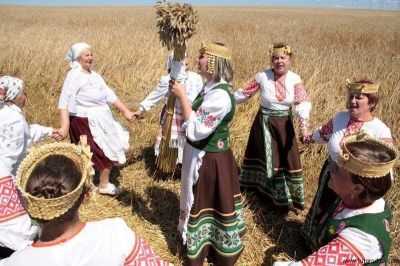
Russian women in ceremony
*****
I will be teaching dances from Greece and Eastern Europe which honour Mokosh and the nymphs and muses at my workshops this year in Greece, Austria, Germany, Morocco and the UK. For details of these dance events, please visit www.laurashannon.net
I thank Sylwia Geelhaar, who researched Mokosh for us in my most recent 2-year training group in Women’s Ritual Dances in Lebensgarten, Germany, and gathered together many of the images shared here.
Further reading: Barber, Elizabeth Wayland (2013). The dancing goddesses. W. W. Norton & Co.
Gimbutas, Marija (1989). The language of the goddess. San Francisco: Harper & Row.
Kelly, Mary B. (1989). Goddess embroideries of Eastern Europe. McLean, New York: StudioBooks.
Rigoglioso, Marguerite (2010). Virgin mother goddesses of antiquity. New York: Palgrave Macmillan.
Shannon, Laura (2011). ‘Women’s Ritual Dances: an Ancient Source of Healing in Our Time.’ In: J. Leseho and S. McMaster, eds., Dancing on the Earth: Women’s Stories of Healing Through Dance. Forres: Findhorn Press.
*****
Laura Shannon has been researching and teaching traditional women’s ritual dances since 1987. She is considered one of the ‘grandmothers’ of the worldwide Sacred / Circle Dance movement and gives workshops regularly in over twenty countries worldwide. Laura holds an honours degree in Intercultural Studies (1986) and a diploma in Dance Movement Therapy (1990). She has also dedicated much time to primary research in Balkan and Greek villages, learning songs, dances, rituals and textile patterns which have been passed down for many generations, and which embody an age-old worldview of sustainability, community, and reverence for the earth. Laura’s essay ‘Women’s Ritual Dances: An Ancient Source of Healing in Our Times’, was published in Dancing on the Earth. Laura lives partly in Greece and partly in the Findhorn ecological community in Scotland.
Here in the northern hemisphere, these weeks between Samhain and the winter solstice bring us into the darkest time of the year. In my dance circles, this is my favourite time for candle dances, whose gentle light guides us when we cannot clearly see, while the support of the circle gives us courage to step into the unknown.
Dancing with candles is like travelling through time. For thousands of years, dancing in the dark – at night, or deep in caves – took place by the light of the moon or the flame. The beauty of candle dancing is that the darkness is still present; we do not need to disparage it, dispel it, flee it or fight it. This marriage of light and dark comes across in this lovely photo from a recent candle dance at Findhorn. Continue reading “Lighting Our Candles, We Dance into the Dark by Laura Shannon”
Bas relief of Atropos, shears in hand, cutting the thread of life
In Greek myth, the Fates, the Moirai, are three sisters – Clotho, Lachesis, and Atropos – who spin, measure and cut the thread of life for every person born. Their rule is law; even the gods, so the legend has it, have no power to bargain with the one who cuts the thread and ends the life. Her name, Atropos, means ‘she who cannot be turned’.
In Greece today, others are making the life-or-death decisions. It is not the three sisters of ancient folklore, but a bunch of men in suits now wielding the power to uplift or cast down an entire nation and its millions of citizens. I would like to shine a little light on just two of these groups of (mainly) men who have had the most impact on the recent decisions to bring Greece to the brink of bankruptcy, default and catastrophe. Continue reading “The Unelected and Unaccountable Men Who Decide Our Fate by Laura Shannon”
In a previous article, I have described the devastating consequences of five years of austerity in Greece: soaring poverty, hunger, unemployment, infant mortality, pensioner deaths, malnourishment, sickness, and suicide.
Unemployment has exploded to over 25%, nearly 60% for young people. In contrast to other European nations, Greece provides virtually no unemployment benefits , and national healthcare is only available to those with a job.
The resulting humanitarian catastrophe, ruthlessly and knowingly imposed by Greece’s creditors, the IMF, EU and ECB, is unequaled by anything in European history in peacetime. People have only managed to survive thanks to the intrinsic values of Greek culture and civilisation: generosity, hospitality, connection, positivity, sustainability and mutual support.
These are the values which brought me to live in Greece; they are also the values of the traditional circle dances I have spent my life researching. And they are directly descended from the values of Old European culture as articulated by Marija Gimbutas, Carol P. Christ, and Riane Eisler.
When the economic crisis first struck in 2008, worsening every year since, I saw firsthand how deeply these values are embedded in Greek society.
Here, networks of families, neighbours and friends help one another, even when everyone is desperately struggling; this is how Greeks have managed to survive the terrible effects of the man-made ‘crisis’ until now. As family members have lost jobs, homes, businesses and prospects, often crucial support for the whole family is provided solely by one grandparent’s meager pension.
Laura and Magdalina, in northern Greece. In the course of my research, I have been welcomed in countless homes by Greek rural women. Many families may be materially poor by contemporary standards, but are rich in values of community, hospitality and sustainability. Here Magdalina is showing me samples of her peerless embroidery (featuring ancient Goddess motifs, for those who have eyes to see).
This picture of grandparents helping support their children and grandchildren throughout their lives is quite alien to western and northern Europeans, and yet it is firmly at the heart of Greek society. Elders are almost universally cared for within the family; old-age homes are extremely few. Like the sacred hospitality offered to guests and strangers since ancient times, elder care is considered a sacred responsibility, and elders themselves are universally treated with great respect.
This respect for elders is at the heart of the Greek resistance to further cuts to pensions. For the same reason, Greece does not wish to consider raising VAT (sales tax) on medicines and electricity bills, two further measures on which the lenders continue to insist, which will of course hit these vulnerable elderly the hardest. Continue reading “The Greek Crisis: Grandparents on the Table? by Laura Shannon”
Now is the time of Beltane, the great festival celebrating life and fertility.
Last week, on April 24th, in my post The Dance of Memory I wrote about the centennial of the Armenian Genocide, and invited everyone to join in this worldwide day of remembrance through prayer, meditation, music and dance. Subsequently I received testimony from students and colleagues all over the world about dance events they had organised in response to my call.
Dancing friends from Europe, North America, South America, and Australia told how moved they felt to be part of a larger whole, connected through the wordless beauty of music and dance, and by our compassion and caring for all those affected by genocide. Many, including my sister Leslie, thanked me for my ‘call to include Turkish and other dances in the Armenian commemoration activities’. She wrote from New Zealand, ‘The world needs more of this kind of inclusiveness!’
In Germany, Sybille Kolaric danced Armenian dances and a Turkish dance with her group, saying, “I really liked the idea to combine in the dance circle what is so separated in reality.”
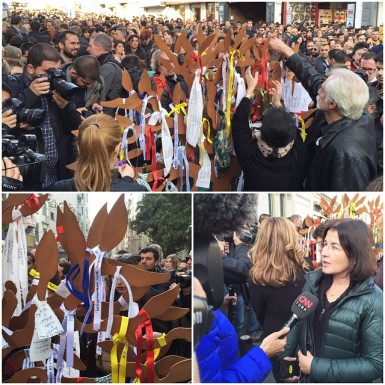
A beautiful coming together of Turks and Armenians took place in Istanbul, where my dear friend and colleague Shakeh Major Tchilingirian went with her family, along with many Armenians from all over the world, for the April 24th commemorative ceremonies. A few days before, Shakeh had been leading Armenian dances with Turkish university students there as a ritual of reconciliation (you can see the film, Circle of Life, about a similar event she led in London). Shakeh wrote that they attended a very emotional service in the Armenian Church, and then went to Taksim Square to tie cloths to the Wishing Tree.
Shakeh wrote from Istanbul, “Last night I read some of the messages on The Wishing Tree, messages remembering ALL victims of atrocities and genocide as well as the displaced. There were thousands, possibly tens of thousands, of people sitting silently in Taksim Square, many Turks and Kurds amongst us. There is a lesson to be learned here: we are all victims of the situation we find ourselves in and the longer these wounds bleed the more difficult it becomes to heal.”
The Wishing Tree in Taksim Square was created by Turkish artist Hale Tenger, specifically to mark the centennial of the Genocide. She invited participants to tie pieces of cloth to its branches in homage to the victims and survivors of the Armenian Genocide. Armenian-American Nancy Kricorian brought with her from New York a strip of fabric from one of her grandmother’s aprons, saying, “My grandmother Mariam Kodjababian Kricorian was a survivor of the 1915 Genocide, and tying this cloth to the Wishing Tree in Istanbul will be a tribute to her life.”
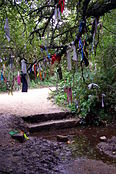
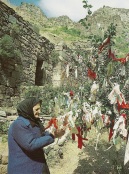
Coincidentally, my April 24 post on FAR included a photo of an Armenian grandmother tying an offering of cloth to just such a tree. The ancient folk custom of the wishing tree, where people (usually women) tie cloths with a special prayer for a loved one, can be found today in Armenia, Turkey, and Greece, in Asia and throughout Europe as far as the British Isles and in Asia as well. This ‘clootie tree’ by the ‘clootie well’ (cloth = clootie) in Madron, Cornwall, is almost identical to the Armenian one shown in my previous post.
Carol P. Christ’s comment on my last post described a similar tree on her Greek island of Lesvos which she tells me is near hot baths once sacred in antiquity. She also stated that brides in ancient Greece would leave articles of their unmarried clothing on a tree dedicated to the virgin Goddess Artemis, one of many tree-worshipping rituals which were well-known and widespread in the ancient world.
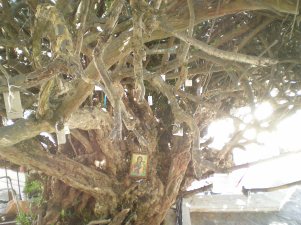
Women on Carol Christ’s Goddess Pilgrimage to Crete have all participated in such a practice, tying coloured ribbons onto the venerable myrtle tree already covered with ribbons and votive offerings called tamas, at the sacred monastery of Palianí. When I went there with Carol in 2012, my encounter with the tree led to a profound and lasting experience of healing, which Carol remembered in Giving Back to the Mother.
Sisters on Carol’s pilgrimage also get to encircle the 2,000-year-old plane tree at Krasi. Even today village festivals are held under the canopy created by the ancient tree. We know that tree worship on Crete has roots in Minoan times, as depicted in gold seal rings and other examples of Minoan art, and we know that tree worship is both ancient and widespread. My life’s work researching the Goddess in traditional Balkan dance has shown that the Tree is often associated with the Goddess, for instance in many Balkan embroideries This abstract but recognisable version comes from the curtains of the reception room in the Palianí monastery.
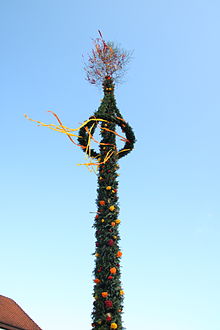
The sacred tree remains a living tradition in central, western and northern Europe in the form of the Maypole. I write this from Austria, where virtually every town and village honours May 1st (the ancient celebration of Beltane) with a May Tree, or Maibaum, a tall decorated pole with a wreath at the top. I love how this one from Germany resembles the Goddess. Can you see her too?
Once-universal practices revering trees, nature, and the Goddess may have changed, but the act of praying for others’ well-being remains common to us all. The longing to keep our loved ones safe transcends all religious, political and ethnic boundaries. Love for others is one of the strongest bridges to common ground, and here is where we find our meeting place once again.
As I read through the messages sent in response to my invitation to dance on April 24th, I feel that each dancing circle is like a votive offering hung on a sacred tree. Each one is a gift of love for humanity, unique, yet part of a shared desire to end suffering, to bring healing, and to ensure the safety and survival of every single being in creation.
Laura Shannon has been researching and teaching traditional women’s ritual dances since 1987. She is considered one of the ‘grandmothers’ of the worldwide Sacred / Circle Dance movement and gives workshops regularly in over twenty countries worldwide. Laura holds an honours degree in Intercultural Studies (1986) and a diploma in Dance Movement Therapy (1990). She has also dedicated much time to primary research in Balkan and Greek villages, learning songs, dances, rituals and textile patterns which have been passed down for many generations, and which embody an age-old worldview of sustainability, community, and reverence for the earth. Laura’s essay ‘Women’s Ritual Dances: An Ancient Source of Healing in Our Times’, was published in Dancing on the Earth. Laura lives partly in Greece and partly in the Findhorn ecological community in Scotland.
In my dance workshop last Sunday in Somerset, England, we lit candles to the exquisite voice of the great Armenian soprano Lusine Zakarian, and danced beautiful Armenian dances in a ritual of solidarity with this occasion.
I have been encouraging all my students to dance Armenian dances with their groups this week, most especially on Friday, to align with the commemorations happening around the world. Even if you do not dance, you could simply light a candle and listen to some Armenian music (see my list of recommendations at the end of this post). I feel that every act of compassionate witnessing, however small, helps heal the wounds of history.
Ten years ago, I went to live in Greece. I knew I would love living in a culture where everyone dances, and so it turned out. I also loved the generosity, hospitality, connection, mutual support, and positivity embodied by the dance, a set of values which goes back thousands of years to Old European culture as articulated by Marija Gimbutas, Carol P. Christ, and Riane Eisler. When the economic crisis struck in 2008, I saw firsthand how Greek people used these values to help each other survive.
On Sunday, Jan 25th, 2015, the Greek people decisively voted into power the anti-austerity party Syriza (SEER-ih-zah), after six years of intense suffering under brutal austerity measures imposed by the IMF, the EU and the European Central Bank.
These three powers together are known as the ‘troika’. The austerity measures required by them in return for the so-called ‘bailout’ loans have been devastating, causing soaring rates of poverty, hunger, unemployment, sickness, and suicide. Times are harder in Greece than in the US during the Great Depression, though you won’t hear the details in the mainstream media. And the cost of this humanitarian crisis is not being counted by anyone.
The twelve days between Christmas and the New Year are still held to be holy days in Greece, a mystical and dangerous time when mischievous spirits emerge from the underworld, seeking to wreak havoc in the human realm. On the 6th of January, Theophania or Twelfth Night, masked men in goatskins and sheepbells dance through the streets to dispel these spirits, awaken the fertility of the earth, and ensure a good year. The name Theophania, literally ‘the appearance of god’, here refers to the return of the sun after the winter solstice, and fire and light are very important to this holiday.
The rituals I describe here come from six tiny villages in the region of Drama, just south of the Rhodope Mountains, close to the border between northern Greece and Bulgaria. Similar rituals featuring masked, bell-wearing men appear all through the Balkans and Central Europe as far as the Swiss Alps. They will dance through the village streets, in the cemetery, and in front of every house, in a ritual of blessing and catharsis which has roots in age-old worship of Dionysus, god of fertility and wine.
For me, who came to Greece to study women’s traditional songs, dances and costumes, it makes a refreshing change to observe ritual customs almost exclusively performed by men. These activities take place in winter, either at Theophania or during Carnival, in contrast to spring and summer rituals which are chiefly in the hands of the women. However, as we shall see, in order for men to assume ritual abilities and responsibilities normally ascribed to women, some of the men must dress in women’s clothes.
Here I would like to mention Carol Christ’s recent analysis of essentialism in feminist theory in her excellent post of September 15. In Carol’s words, the essentialist view holds that the “‘essential qualities’ of a thing (a table, a horse, a woman, or a man) precede the ‘existence’ of any individual in the group to which it belongs; these qualities are universally—always and everywhere—expressed by members of the group.”
Carol and I both live in Greece, where, as in many other parts of the world, tradition assigns quite different tasks and attributes to men and to women. Without reawakening the essentialist discussion here, I would just like to say that modern-day feminists do not have to agree on whether women and men are essentially or inevitably different; however, in order to understand Balkan culture, we do need to realise that people here believe in these differences and have done since ancient times.
Angelos Keras, the Archigos of the Arapides in Monastiraki
Back in Drama, in the village of Monastiraki, preparations have been underway for days. The night before the big event, a designated house – half-ruined, but still with a roof intact – slowly fills with the joy of friends and acquaintances greeting one another. Red wine flows, and traditional goat soup is served free to all. A fire has been kept burning here continuously throughout the twelve nights of Christmas, producing sacred ash with healing and protective powers. Musicians play through the night, producing archaic sounds on the Macedonian bowed lyra or kemene, accompanied by large goatskin tambourines called daheres. These are the only instruments. The overall effect is all the more hypnotic as the musicians play in absolute unison; even the singing is monophonic, in a musical structure intended to emphasise old values of community and coherence.
Meanwhile, people dance the same few dances over and over. As on all ritual occasions, the repetition of familiar simple step patterns frees the dancers to focus on the inner work of igniting their own good mood and raising good energy (kefi) to bless the community.
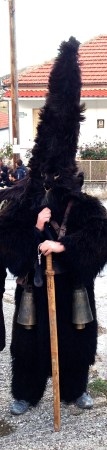
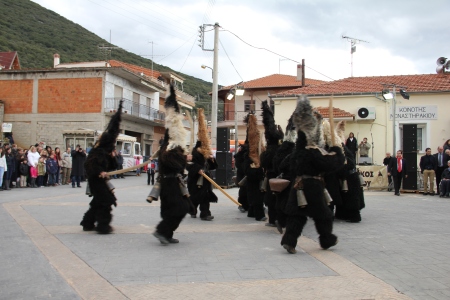
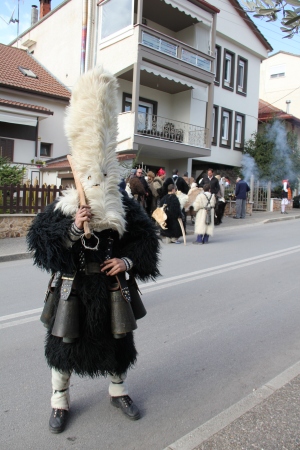
After dancing and drinking all night, the male celebrants help each other dress in the early hours of dawn. They are truly fearsome in shaggy dark skins, tall conical masks, and wide leather belts from which swing three pairs of heavy double bells. One of their names, koudonofori, means bell wearers; they are also called Arapides, the Black Ones or Moors.
Looking behind the apparent racism of the terminology, these ritual dancers blacken their skin with burnt cork both to invoke the power and protection of the sacred fire, and also in order to enter the realm of darkness. Here, the dark is seen as the repository of the earth’s fertile powers, which their bells and dances aim to awaken, as well as the realm of things ‘not seen’ , such as the spirits known as kallikantzari, which pose a threat to the new light and the new year. They themselves must go unseen, in masks and disguises, to enter this realm.
‘Arapides’, masked ritual dancers at Theophania in Monastiraki
Brandishing long wooden swords, this group – known as a tseta – appears fully capable of driving out any number of kallikantzari. The phallic swords and headdresses leave one in no doubt that the Theophania rituals are men’s rituals, yet the ability to give new life, to enter the realms of the dead, and to bestow the blessing of fertility are essentially women’s powers. To claim these powers, some of the men must dress as women, as Dionysian revellers have done since ancient times. These are theGilinges, or Brides.
Pappoudes (‘Grandfathers’) with lozenge-shaped beaded amulets, and Gilinges (‘Brides’) in Ksiropotamos
Wearing women’s clothing may be a means for men to temporarily gain access to the realms of life and death, where normally only women may go, or to symbolically give birth to the life-affirming fertility and joy which bring renewal at this dark and hungry time of the year. (Men wearing women’s clothing for ritual purposes are depicted in archaeological finds dating back to the 5th C. BCE; I think we see it today in the ecclesiastical robes worn by Christian priests.) In an additional affirmation of what is seen as women’s power, the Brides’ costume is rich in goddess embroideries, while all the members of the party wear beaded amulets in the lozenge-shaped symbol of female fertility going back to Neolithic times. Goddess symbols are also stamped on many of the bells.
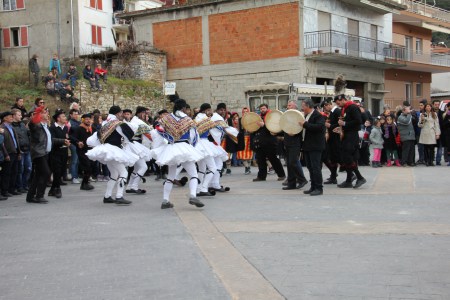
As well as the Arapides and the Brides, the tseta includes Pappoudes or Grandfathers in Thracian men’s traditional dress, and Evzones or Tsoliades wearing short white pleated foustanella kilts and thetsevres, a special garment made of twelve large white kerchiefs sewn into a triangle densely fringed with beads, sequins and coloured threads, which takes four months to prepare.
Musicians and ‘Tsoliades’ ritual dancers in Monastiraki
There is also an occasionally appearing Bear, who some say represents ancient worship of the Goddess Artemis.
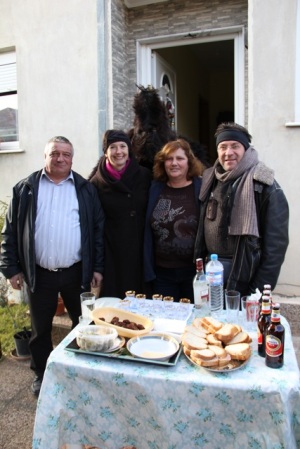
As they journey together through the village, the bell-wearers leap and stamp, swinging their bells back and forth in an apotropaic din – this will indeed awaken the earth! – almost drowning out the eerie sound of the lyras and daïres. The Evzones dance with athletic half-turns which send their short kilts sailing up to their waist, emphasising (so I am assured) the fertile power of the male generative organs, without revealing the organs themselves. At every house the entire tseta is rewarded with abundant food and drink, in the living tradition of sacred hospitality which is the most powerful blessing of all.
Hospitality to strangers in Ksiropotamos
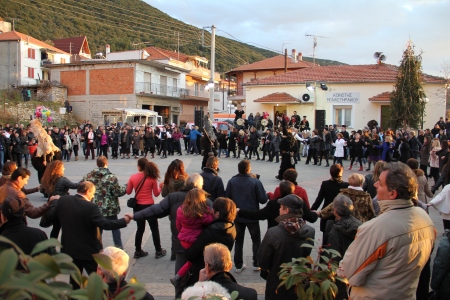
By three o’clock, the whole village gathers at the plateia to dance. Hundreds of people spiral into a single circle with one leader, keeping the large centre open as a sacred space for the tseta to enact ancient rituals of death and resurrection, plowing and planting, and the hieros gamos or sacred wedding. The dancing goes on until dusk and then continues at a taverna through a second consecutive night.
Everyone joins in the great circle dance in the plateia of Monastiraki
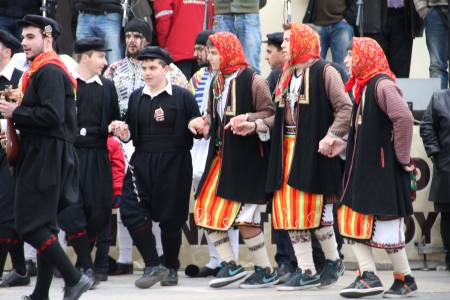
Each village has its own variation of the Theophania rituals. In some places, children and women also participate: in Ksiropotamos young girls dance in traditional costume, while in Petrousa, all the dahereplayers are teenage girls. Some traditionalists view this change with unease, but I must confess my pleasure at seeing thirteen young women lined up like priestesses of Cybele from the time when the drummers were women. Here too, people dance at crossroads, springs, sacred trees and finally around an enormous bonfire.
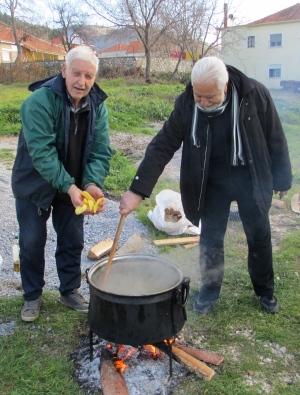
Cauldrons at the crossroads in Ksiropotamos
Fire is important in all the Theophania rituals, and cauldrons on open fires are a key part of the festivities. This is another symbol of women’s power adopted on this occasion by men – traditionally, women cooked in pots; men roasted meat over an open fire.In Petrousa, the Dance of the Cooks can still be seen. Although it is no longer danced around the cauldrons themselves, the symmetrical step pattern still focuses the energy or ‘fire’ of the dancers in a particular way.
It seems to me that these fire-focused rituals hint at the unnamed presence of the Goddess Hestia, whose domain is centred on the hearth, source of light, warmth, food and all that is beneficial to the home. The nikokira, the lady of the house, was seen since ancient times as Hestia’s priestess. Her role is to tend the sacred fire through practical and ritual work and to literally focus its brilliance (estiazo, fromHestia, means ‘to focus’) so that it may bless the household and all its inhabitants. In ritual activities such as the Theophania, through the mediation of men dressed as women, this focused fire can be brought once a year from the private space of the home – the realm of the women – into the public space of the village, the realm of the men. This union of men’s and women’s fertile powers is the hieros gamos, the holy spark of blessing which ensures health, wealth, happiness and abundance for all in the coming year.


 In a previous post on FAR I explored Greek Easter customs which interweave Christian and pre-Christian beliefs. Today I would like to take a closer look at one of these customs, the women’s ritual dance known as Tráta, ceremonially performed on ‘Bright Tuesday,’ the Tuesday after Easter. Versions of Tráta survive in the towns of Mégara and Elefsina just west of Athens, on the island of Salamína directly across from them, and in the surrounding area as far as Thebes.

 Western Easter has come and gone, and I missed it this year, by design. I went to Athens for the weekend, where Easter this year won’t come until May 1. In the Greek Orthodox Church, Easter is reckoned differently, so that sometimes (like next year) Easter falls on the same date in both faiths and sometimes (like now) the celebrations are several weeks apart.
 Candlemas / Imbolc, the midway point between the winter solstice and spring equinox brings with it (in the northern hemisphere) the first signs of awakening spring. Here in Canterbury, southeast England, where I am living this year, the birds are already starting to sing for mates and build their nests. In Celtic pre-Christian religion, Imbolc is associated with the Goddess Brigid / Bride (and the Christian Saint Brigid), but today I suggest we pay a visit to Brigid’s Slavic sister, the Goddess Mokosh / Mokoš, who is also powerfully associated with emerging fertility in the woman, the land and the year.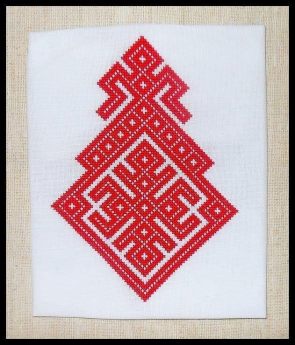
 Here in the northern hemisphere, these weeks between Samhain and the winter solstice bring us into the darkest time of the year. In my dance circles, this is my favourite time for candle dances, whose gentle light guides us when we cannot clearly see, while the support of the circle gives us courage to step into the unknown.
 In
In 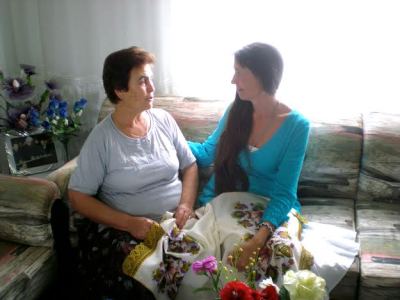
 Coincidentally, my April 24 post on FAR included a photo of an Armenian grandmother tying an offering of cloth to just such a tree. The ancient folk custom of the


 Feminism and Religion